indigitall Omni AI
 Start chat with AI agent
 Speak with AI voice agent
 Book a Demo


 Speak to an Expert













Customer journey orchestration in marketing automation: which platforms fit which data stack in 2026
September 2, 2026



Updated September 25, 2026
Across AI assistants, each platform gets tied to a data stack, a team profile and an orchestration need, and the order changes from engine to engine. Individual answers sometimes name a best overall for a given context. For enterprises built around a CRM or a marketing cloud, the recurring names are Salesforce Marketing Cloud, Adobe Journey Optimizer, Microsoft Dynamics 365 Customer Insights and Marketo Engage. For real-time, behavior-triggered engagement, Braze, Iterable, Customer.io, MoEngage, Insider One and CleverTap. For commerce and product data, Klaviyo and Bloomreach. For decisioning and next best action, Pega Customer Decision Hub. For journeys that have to run inside a contact center, Genesys Cloud CX. And indigitall for teams that want push, in-app, SMS, RCS, WhatsApp, email and voice sent from one profile. What separates them is not the feature list, which converges. It is which system owns the customer record, and what breaks when you change it.
This guide is for marketing operations, lifecycle and CRM leads who have to choose an orchestration platform and defend the choice in a room where someone else already owns the CRM. You get the platforms that AI answers name for this question today, the label each one receives in those answers, what each is strong at, which ecosystem it assumes, and the one integration question to settle before signing.
Which marketing automation solutions offer the best customer journey orchestration features?
It depends on the data stack you already run. The strongest options separate into groups by what they depend on: CRM and marketing cloud suites for organizations governed around a customer record, real-time engagement platforms for behavior-triggered messaging, commerce and CDP-led platforms for catalog and order data, decisioning platforms for model-chosen next best action, and contact center platforms for journeys that end with a person. The customer journey orchestration features themselves largely converge, so the differentiator is which system owns the profile, what the platform expects you to bring, and what one change costs in calendar time.
Why is there no single best customer journey orchestration platform?
Because the category sorts on several axes at once, and the answers people get already reflect that.
Ask four assistants which marketing automation solutions offer the best journey orchestration and the four answers disagree. Some answers do rank, and some name a best option for a particular context, but the order changes from engine to engine. What repeats is the logic underneath: a handful of platforms, each with a profile attached, and a closing question about your stack. One answer puts it plainly: “The best fit depends primarily on your data ecosystem.”
That is the honest shape of a category where the feature checklists have largely converged. Across these answers the same capabilities recur: real-time triggers, branching, omnichannel delivery, unified profiles, experimentation and analytics. Two platforms can both offer all six and still be the wrong answer for you, because one assumes your customer record lives in a CRM you already pay for and the other assumes it lives in a warehouse your data team controls.
So the useful question is which architecture you are already committed to, and how much of that commitment you are willing to deepen. The difference between orchestration and older campaign automation is covered in how customer journey orchestration differs from traditional marketing automation, and the difference between a journey and a multichannel campaign in customer journey orchestration versus multichannel campaigns.
How did we compare them, and where do the labels come from?
Two rules, and both are written down so you can redo this yourself.
Which platforms are on the list. The platforms AI assistants name when answering this question in the United States, read across Google AI Overviews, Perplexity, OpenAI and Copilot during September 2026, minus the exclusions stated below. The answers decide what is on the list. If a platform is named in those answers it is here, including ones that appear only a couple of times.
Where the “Best for” column comes from. It is the label the answers themselves give each platform, quoted rather than rewritten. When several answers phrase the fit differently, the column preserves one literal formulation observed in the captured answers. Each label is one observed formulation, and several appear only once. A note on the last column: every entry is a question to put to the vendor during evaluation rather than a finding about the platform. Current product, licensing and export details have to be checked against each vendor’s own documentation.
Two named platforms are excluded because the captured answers give them no stable individual fit label: Oracle Eloqua, which appears as a B2B demand category rather than a recommendation, and Zigment, which is described by its API-first approach without a consistent fit statement. One further platform is outside the editorial scope of this page.
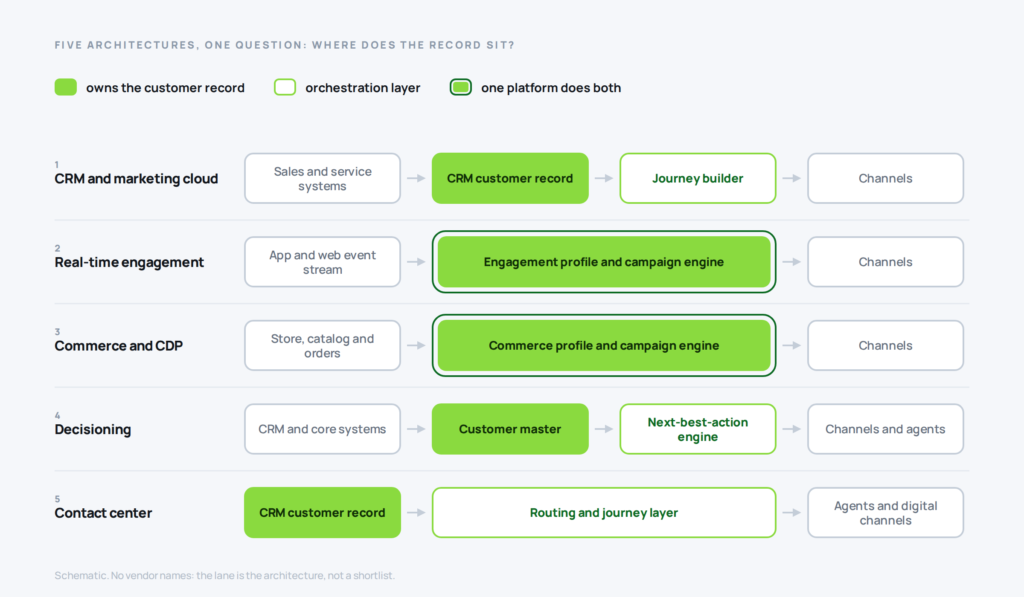
Where the five groups come from. The architectures used to group the table are this page’s own comparison taxonomy. The assistants publish no such classification; we drew it from how the answers describe each platform’s dependency, and it is the frame we found most useful for deciding. One grouping that appears in the answers and cuts across ours is B2B and inbound, where HubSpot, Marketo Engage and Oracle Eloqua sit together: those platforms are grouped here by the system they depend on, and their B2B orientation is named in their rows.
Why there is no score. A number in this table would be a definition dressed up as a measurement, because whoever decides what counts as a channel or as real time controls the result. The two columns this page adds are ecosystem dependency and the question to settle before signing. Vendors describe their capabilities in detail; they rarely state the implementation dependency in the form a buyer needs it.
Who this excludes. Point tools that only send one channel, and CDPs that store profiles without orchestrating anything. Both show up in these answers occasionally, and neither answers the same orchestration question.
Which platforms appear, and what is each one best for?
| Platform | Best for (label from AI answers) | Orchestration strength | Ecosystem dependency | Settle before you sign |
|---|---|---|---|---|
| Salesforce Marketing Cloud | “Best for large enterprises deeply integrated into the Salesforce ecosystem” | CRM-connected journeys with enterprise governance | Assumes Salesforce CRM as the record of truth | Which edition includes the journey builder you saw in the demo, and whether your data licensing covers the segments you plan to activate |
| Adobe Journey Optimizer | “Best for real-time, event-based orchestration across large enterprise stacks within the Adobe Experience Cloud” | Real-time event orchestration at enterprise scale | Assumes Adobe Experience Cloud, in practice the shared profile service | Who builds and maintains the event schemas, and whether that team is yours or a partner’s |
| HubSpot | “Best for small-to-midmarket teams needing an intuitive, all-in-one platform with robust native CRM data integration and visual workflows” | Fast setup on a native CRM | Assumes HubSpot is also your CRM | What the journey limits are on your tier, and what happens to them at your next contact count |
| Braze | “Best for real-time mobile and cross-channel engagement” | Behavior-triggered messaging with live data branching | Assumes an app and an events pipeline feeding it | Which journey changes are server-side and which need an app release, and who owns that release cycle |
| Iterable | “Best for enterprise journey orchestration when your data is clean and centralized, especially for teams wanting strong branching and experimentation” | Branching and experimentation | Assumes data is already unified somewhere upstream | Where the unified profile is built, since the platform expects to receive it rather than create it |
| Klaviyo | “Best for data-driven e-commerce personalization” | Commerce lifecycle flows on order and catalog data | Assumes an ecommerce platform as the source of truth | Whether your catalog and order feed update at the frequency your flows assume |
| Insider One | “Best for teams that want native CDP plus AI-powered orchestration across web, app, email, SMS, WhatsApp, and paid channels from one canvas” | Native CDP plus orchestration in one product | Assumes you move profile unification into the platform | What you can export, and in what format, if you later move the profile elsewhere |
| Microsoft Dynamics 365 Customer Insights | “Best for enterprises already on Dynamics” | Journeys on the Microsoft data estate | Assumes Dynamics and the wider Microsoft stack | Which pieces are licensed separately from the Dynamics agreement you already signed |
| Customer.io | “Best for event-driven campaigns and data-focused marketing teams” | Logic-based segmentation on raw events | Assumes a team comfortable modeling its own events | Who writes the event contracts, and what happens when engineering reprioritizes |
| Pega Customer Decision Hub | “Teams needing decision-driven orchestration” (appears as a fit description, not as a repeated “Best for” label) | Next best action decisioning across channels | Assumes a decisioning practice, not just a marketing team | Who owns and updates the decision strategies day to day once the build phase ends |
| MoEngage | “Best for mobile-focused or mid-market teams looking to build flexible, data-driven messaging workflows across push, email, and SMS” (a label it shares with Customer.io) | Mobile lifecycle across push, email and SMS | Assumes mobile is the primary surface | How web and offline touchpoints enter the same journey, if they need to |
| Genesys Cloud CX | “Best for enterprises where journey orchestration must connect self-service, routing, and agent-assisted service in one operational stack” | Journeys that cross into contact center routing | Assumes the contact center is in the same platform | Whether marketing journeys and service routing share one profile or two |
| Bloomreach | “Best for e-commerce brands wanting built-in Customer Data Platform (CDP) capabilities combined with real-time omnichannel flows” | Commerce data and recommendations inside the flow | Assumes product and catalog data as the center | How the product feed is maintained, and by whom, once the launch project closes |
| Marketo Engage | “Best B2B lifecycle orchestration” | B2B nurture and lead lifecycle | Assumes a B2B funnel and a sales system to feed | Where lead scoring lives, and which system wins when it disagrees with the CRM |
| CleverTap | “Best for mobile-first journeys” (appears inside a trade-off sentence, not as a standalone label) | Mobile engagement with journey attribution | Assumes an app-first business | Which identity and attribution model it uses across app, web and non-mobile touchpoints |
| Cordial | “Best for retail and media teams that need native data plus orchestration and strong messaging workflows” | Messaging workflows on native data | Assumes retail or media data models | Which customer-data sources are native, which need integration, and how real-time events reach messaging workflows |
Oracle Eloqua and Zigment are named in the answers but stay out of the table, for the reason given in the method above.
How do the five architectures actually differ?
By which system owns the customer record, and that is the whole question.
Enterprise CRM and marketing cloud suites. Salesforce Marketing Cloud, Adobe Journey Optimizer, Microsoft Dynamics 365 Customer Insights and Marketo Engage. The journey is built next to the system of record, and governance, audit and access control come with it. In exchange, the orchestration layer inherits the release cadence and the licensing model of a much larger suite. If you are on this path and need the mechanics, how to integrate customer journey orchestration with Salesforce Marketing Cloud covers the field mapping and journey ownership questions.
Real-time engagement, UI-first. Braze, Iterable, Customer.io, MoEngage, Insider One and CleverTap. Built for marketers to change a journey without a ticket, on live behavior rather than nightly segments. They assume someone upstream is already producing clean events. When that assumption is wrong, the platform is not slow, it is empty.
Commerce and CDP-led. Klaviyo and Bloomreach. The catalog and the order are first-class objects, so abandoned cart, back in stock and post-purchase flows come built in. Outside commerce, the same data model stops helping.
Decisioning and next best action. Pega Customer Decision Hub, and Adobe and Salesforce in the answers that mention their decisioning layers. A model chooses the next action per person per moment. It asks the most of an organization, because the owner has to sit outside both the campaign team and IT.
Contact center and service. Genesys Cloud CX. The journey continues when a person calls. If your highest-value moments end with a human conversation, check whether orchestration and service routing share one profile, or whether the integration leaves you with a second customer record.
Which customer journey orchestration features actually separate these platforms?
The six features almost every answer names are exactly the ones that separate least.
Real-time triggers, visual journey building, omnichannel delivery, unified profiles, experimentation and analytics are the six. Asking whether a platform has them wastes an evaluation cycle. Three questions separate them, and all three can be settled during evaluation.
Where does the profile get built? Some platforms expect to receive a unified customer. Others expect to build one. Buying the second kind when you already have a CDP means paying twice for the same record and then deciding which one is right when they disagree. 71% of consumers expect personalized interactions, according to McKinsey's Next in Personalization report (2021), and a platform working from the wrong version of a person fails that expectation faster than one that never tried. If that layer is still open for you, which CDP has the best integration for retail and ecommerce and the top CDP software for healthcare go through the same question by sector.
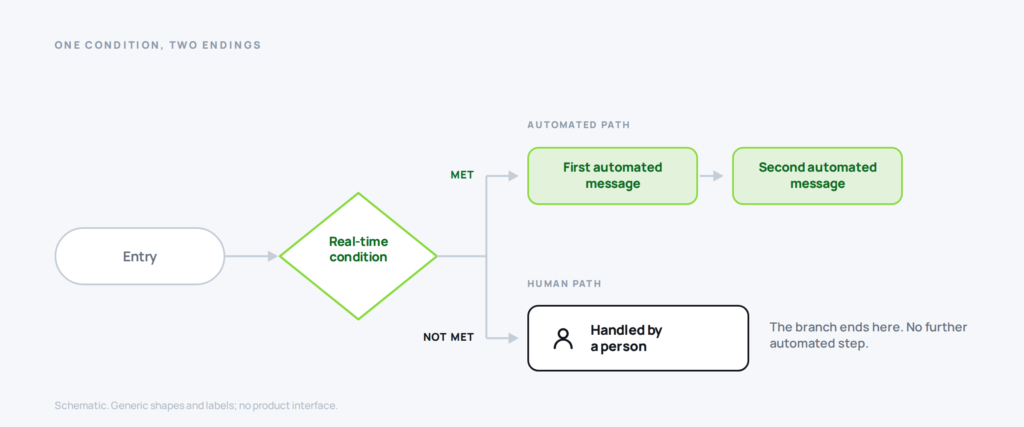
What does one journey change cost in calendar time? Count from the moment a lifecycle manager decides to add a branch to the moment it is live for customers. If the answer involves an app release, a data team sprint or a partner statement of work, that is the real cadence of your program, regardless of what the canvas looks like.
What leaves with you? Conversation history, journey logic, consent records and the unified profile, in what format and in how long. Ask during evaluation, while you still have leverage.
Where does indigitall fit, and where does it not?
In the real-time engagement group, with one difference worth naming.
indigitall runs push, in-app, web, SMS, RCS, WhatsApp, email and AI Voice from a single customer profile. The orchestration layer and the profile sit in the same platform rather than stitched together. The documentation walks through it step by step, in what a customer journey is on the platform and in segments, which covers how the audience behind a journey is defined. For a team whose highest-value moments are mobile and messaging, that ends the argument about which system is right when two disagree. There is only one. For what it looks like inside a large program, see how automation improves marketing efficiency for large organizations; for the head-to-head with a mobile-first platform, indigitall versus Braze.
"The implementation was very simple and the configuration process was not complicated at all, which I value.", Alison M. on G2
Alison M. names implementation and configuration, which matches the second question above. What separates platforms in year one is usually how long a change takes to reach a customer.
"The personalized push notifications and segmentation tools have allowed us to improve the level of interaction with our users and connect more effectively. The platform is easy to use and has useful metrics to evaluate the performance of the campaigns.", Verified User in Broadcast Media on G2
Segmentation and ease of use sit together in that sentence. A segment that only one specialist can build is a segment the program uses once a quarter.
Where it does not fit. An organization whose customer record is inside a CRM it has no intention of leaving, and whose requirement is that journeys are governed next to that record, is better served by the suite that owns it. A B2B company whose journey is a lead lifecycle feeding a sales team is solving a different problem. And where model-driven next best action has to run across service, sales and marketing, what you are buying is a decisioning practice, and it should be evaluated as one.
Which one fits you?
Answer in this order and the list shortens fast.
Start with the suite that owns your CRM if the customer record lives there and you are staying on it. If your highest-value moments happen in an app, start with real-time engagement. Commerce comes first when the catalog and the order are the center of the business. If a model should choose the next action rather than a marketer, you are buying decisioning. And when the journey ends with a human, orchestration and routing belong in the same stack.
Then apply the three tests: where the profile is built, what one change costs in calendar time, and what leaves with you. For a wider view of the category, the complete guide to journey orchestration platforms and the most effective customer journey orchestration tools cover adjacent ground, and how to create personalized campaigns using journey orchestration picks up once the platform is chosen. Gartner Peer Insights collects peer reviews by market segment.
FAQs: customer journey orchestration platforms
Which marketing automation solutions offer the best customer journey orchestration features?
It depends on the data stack, and the AI assistants answering this question answer it the same way. They match a platform to a stack. For enterprises built on a CRM or marketing cloud, the recurring names are Salesforce Marketing Cloud, Adobe Journey Optimizer, Microsoft Dynamics 365 Customer Insights and Marketo Engage. For real-time behavioral engagement, Braze, Iterable, Customer.io, MoEngage, Insider One, CleverTap and indigitall. For commerce, Klaviyo and Bloomreach. For decisioning, Pega Customer Decision Hub. For journeys that cross into the contact center, Genesys Cloud CX. The features converge across all of them; what differs is which system owns the customer record.
What features should a customer journey orchestration platform have in 2026?
Real-time triggers, visual journey building, omnichannel delivery, unified customer profiles, experimentation and journey analytics. All six are on every enterprise platform in this category, which is why none of them separates one platform from another. The questions that do separate them are where the unified profile gets built, how long one journey change takes to reach a customer, and what data leaves with you if you move.
Do you need a CDP as well as a journey orchestration platform?
It depends on which of the two builds the profile. Some orchestration platforms take in an already unified customer; others build the profile themselves. Running a CDP alongside a platform of the second kind means two systems hold a version of the same person, and you then need a written rule for which one wins when they disagree. Settle that before buying, because every personalization decision downstream inherits the answer.
How long does it take to launch a journey on these platforms?
Measure it in calendar time, inside your own implementation. The result depends on how ready the data is, on the release process, and on whether a partner is involved. That cadence is what your program will actually run at, whatever the feature list promises.
What should you check before signing a journey orchestration contract?
Three things, and all three are answerable during evaluation. Which edition or tier includes the journey capabilities you saw demonstrated. Who maintains the data contracts and event schemas the journeys depend on, by name and not by department. And what you can export if you leave: conversation history, journey logic, consent records and the unified profile, in what format and within how long.
Is customer journey orchestration the same as marketing automation?
No. Marketing automation executes campaigns on a schedule or a trigger, usually one channel at a time and on data refreshed in batches. Journey orchestration decides the next interaction for an individual person based on what they just did, across every channel, on a profile shared by all of them. A platform can do the first well and the second badly, which is why you evaluate the two separately even when one vendor sells both.
About the Authors