indigitall Omni AI
  Start chat with AI agent
 Speak with AI voice agent
 Book a Demo

 Speak to an Expert











Customer Journey Orchestration vs Multichannel Campaigns: Which Wins in 2026?
August 20, 2026


Updated September 13, 2026
Customer journey orchestration and multichannel campaigns solve different problems, and the choice between them is decided by your data, not your ambition. Multichannel sends a planned message across email, SMS, push and WhatsApp on a schedule you set in advance. Orchestration decides the next message from what the customer just did, in real time, on one resolved profile. Identity resolution is the prerequisite: without one record per person, orchestration runs on fragments and behaves like slower multichannel. Where the foundation exists, the results compound. In indigitall programs, Sanitas cut no-shows by 60% with omnichannel reminders, Incapto reduced churn by 56% on its coffee subscription, and Soriana drove 20% of its sales through segmented push. Multichannel remains the better answer for launches, seasonal peaks and teams with nobody to maintain journeys. Most mature programs run both, with a clear line between which moments go where.
You have email, SMS, push and WhatsApp running, and a comparison table in front of you that says orchestration is the mature option and multichannel is what you graduate from. That framing sells software. It also explains why so many orchestration projects stall in month three with the platform getting the blame.
This guide is for marketing, CRM and customer engagement leads at mid-market and enterprise brands deciding where to put next year's budget, particularly those who inherited a stack one tool at a time. You will get the honest split between the two approaches, the data prerequisite that decides whether orchestration can work at all, what the ongoing cost looks like after launch, and how to tell which moments belong to which model.
Key Takeaways
- Orchestration is reactive, multichannel is scheduled. Orchestration decides the next step from live behavior; multichannel sends what was planned, when it was planned.
- Identity resolution is the prerequisite, not a feature. If one customer exists as five records, orchestration cannot orchestrate anything.
- Multichannel is the right answer more often than vendors admit, especially for launches, seasonal peaks and small teams.
- The real cost of orchestration is maintenance, not licensing. Campaigns end. Journeys run forever, and they degrade silently.
- Orchestration can look worse before it looks better on last-click dashboards, which is where good programs get cancelled.
- Most mature programs run both, with orchestration on the moments that repeat and multichannel on the moments that do not.
What is customer journey orchestration?
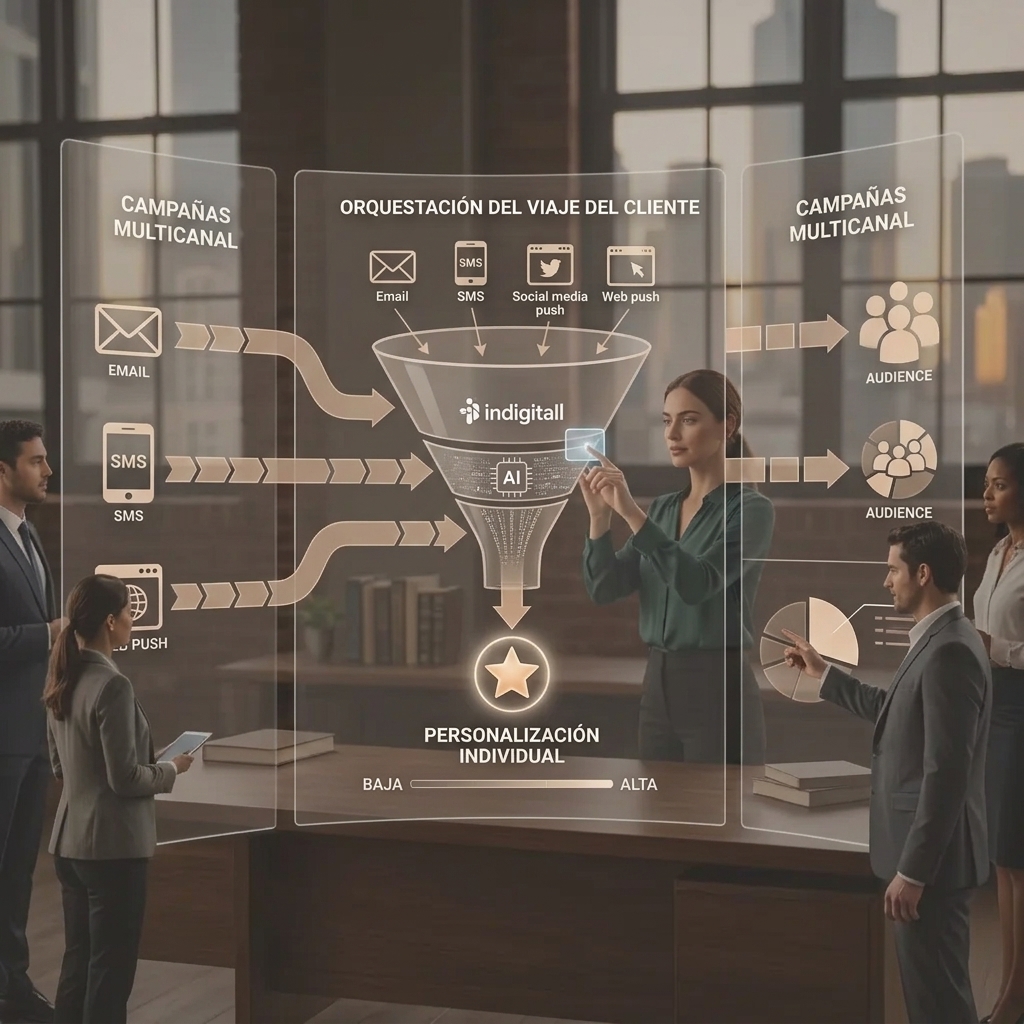
Customer journey orchestration is the real-time coordination of interactions with one customer across every channel, where each next step is chosen from what that person has just done rather than from a calendar. It sits on a unified profile, reads behavior as it happens, and decides: send now, wait, switch channel, or stay quiet.
Five capabilities define it, and a platform missing any one of them is doing something else:
- Real-time data activation: behavior triggers the experience while the customer is still in it, not the next morning.
- Omnichannel coordination: email, SMS, push, WhatsApp and in-app act as one conversation instead of four departments. Making those channels one conversation is the part that takes longest.
- AI-driven personalization: intent is predicted, not assumed from a segment defined six weeks ago.
- Event-based triggers: an abandoned cart, a failed payment, a missed appointment each start their own path.
- Journey mapping: the route from first touch to conversion is designed on purpose. If you have never drawn one, start with a customer journey map before evaluating any platform.
The commercial argument comes down to timing. A reminder that lands the evening before an appointment does a different job than the same reminder sent to everyone on Monday, and the gap between those two shows up in the numbers.
What are multichannel campaigns?
Multichannel campaigns deliver a planned message across several platforms at once. Email, SMS, social, push, each channel doing its own job well, none of them waiting on the others. The goal is reach and consistency, which is a legitimate goal, and it is the goal the whole multichannel marketing hub category was built around. The distinction between multichannel, cross-channel and omnichannel is worth settling before any of this becomes a budget conversation.
What the model gives you:
- Channel diversity: you meet people where they already are.
- Platform integration: one calendar covering several surfaces.
- Segmentation: audiences targeted by attributes and behavior you already hold. Behavioral segmentation is what separates a working multichannel program from a mailing list.
- Automated scheduling: the campaign runs itself once configured.
- Consistent messaging: one brand voice, not five.
Notice what is absent. Nothing in that list reacts. That is the design, not a defect. A product launch has nothing to react to: it needs to arrive everywhere on the same day saying the same thing.
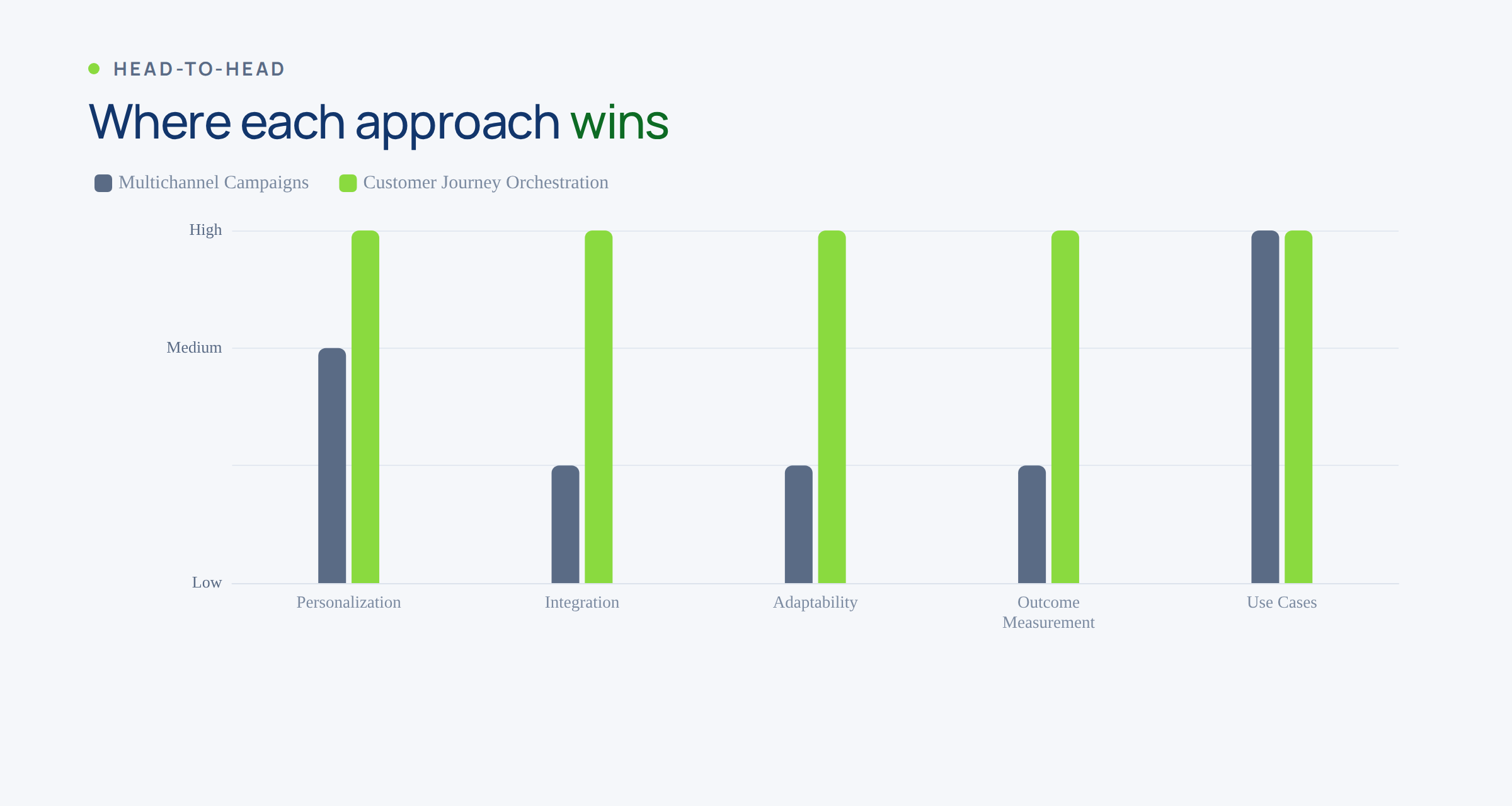
How do customer journey orchestration and multichannel campaigns compare?
| Criteria | Customer journey orchestration | Multichannel campaigns |
|---|---|---|
| What decides the next message | The customer's last action, in real time | A calendar set in advance |
| Unit of work | A journey that runs continuously | A campaign with a start and an end date |
| Data it requires | One resolved profile per person across channels | Clean lists and segments per channel |
| Who operates it | An owner who maintains journeys week to week | A campaign manager per cycle |
| Time to first result | Weeks to months, after the data work | Days |
| How it fails | Silently: a journey keeps running on stale logic | Loudly: a campaign underperforms and you see it |
| Where it wins | Repeated moments: onboarding, renewal, recovery, reminders | One-off moments: launches, seasons, announcements |
| Measurement | Needs incrementality; last-click understates it | Fits last-click reporting out of the box |
Neither column is the upgrade. Each describes a different operating model, and the useful question is which one your company can actually run on Tuesday of week nine.
Why do orchestration projects stall before the platform is the problem?
Because the prerequisite almost never appears in the comparison, and it decides everything downstream.
Orchestration acts on one customer. Your systems, left alone, do not have one customer. They have an email address in the ESP, a device token in the app, a phone number in the support desk and a customer ID in the CRM, and nothing tells them those four are the same person.
Until they are stitched together, every real-time journey you build is running on a fragment. The reminder goes to a device belonging to someone the platform believes is new. The win-back offer lands on a customer who bought yesterday through a different channel. Nothing errors. The journey reports as delivered.
That stitching is what identity resolution inside a CDP does, and it is why a customer data platform is usually the real first purchase rather than the orchestration layer sitting on top of it.
The diagnostic is blunt. If you cannot answer "is this the same person" across two channels, you are not choosing between orchestration and multichannel. You are choosing between multichannel and a slower, more expensive multichannel. Fix identity first and the rest of this comparison becomes a real decision.
How does personalization actually differ between the two?
Orchestration personalizes on what someone is doing. Multichannel personalizes on what someone was, at the moment the segment was built.
The difference is small on paper and large in a customer's inbox, and it is the gap that shows up in the 71% of consumers who expect personalized interactions in McKinsey's Next in Personalization report. A segment says "high value, lapsed 90 days" and sends the win-back. Orchestration sees that the same person opened the app twice this morning and holds it, because they are not lapsed any more.
Incapto is the clearest example in our own client base. Its coffee subscription runs on repeated moments, delivery, replenishment, payment, pause, and each is a decision point rather than a broadcast. Personalizing at those points instead of on a monthly newsletter produced a 56% reduction in churn rate alongside a higher average order value. Subscription businesses live and die on this, which is why managing subscription churn is usually the first journey worth building.
The caveat is worth stating plainly: this only pays off where the moment repeats. For a message that happens once, personalization buys very little, and the segment was fine.
"Indigitall excels in sending segmented push notifications, enhancing real-time audience engagement. Its intuitive interface and automation capabilities make it invaluable for managing digital media campaigns efficiently." — Carmen T. on G2
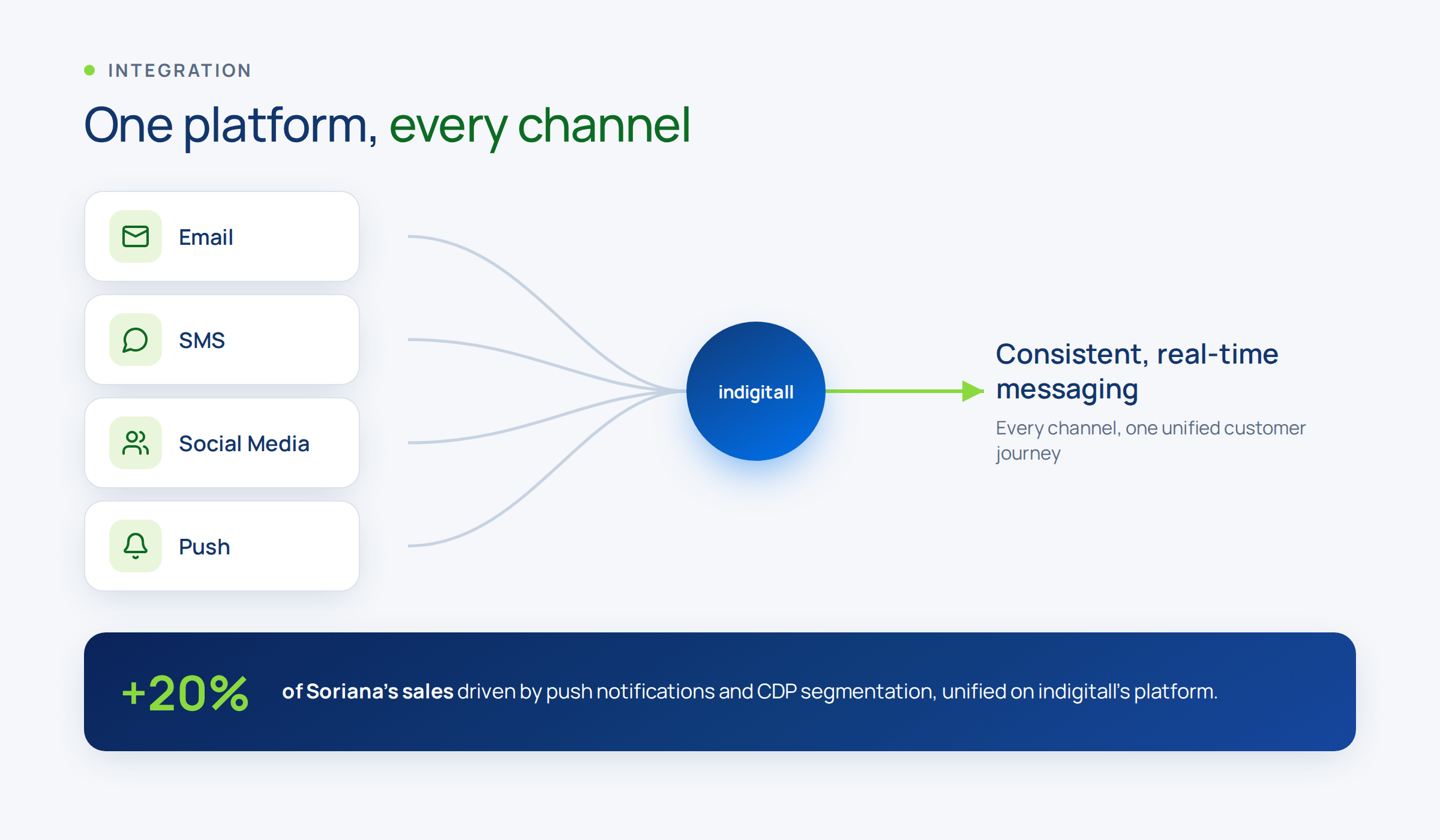
Where does channel integration break down?
At the point where two channels contradict each other, which is the point most stacks reach without noticing.
The customer who receives an SMS about an order the email says already shipped is not experiencing two campaigns. They are experiencing one company that does not know what it is doing. Unifying those channels into one journey is the work that prevents it, and it is more plumbing than strategy.
Soriana shows what the fix is worth at scale. Combining push notifications with CDP segmentation, the channel came to drive 20% of its sales, a figure you do not reach by sending more but by sending the right thing to a profile that is actually resolved. Pastelería Mallorca arrived at the same conclusion from a different direction, with a WhatsApp bot that handled more than 57,000 order conversations inside a flow customers already used.
What both have in common is that the channel stopped being a silo. That is the whole return on integration, and no scheduling calendar produces it on its own.
"Indigitall's push notifications boost traffic and engagement with interest-based segmentation, CMS integration, and detailed reports. It reduces social media reliance and enhances direct traffic, ensuring stable performance." — Verified User in Telecommunications on G2
What does real-time adaptability actually change?
It changes the outcomes where being late has a measurable cost, which is a narrower set of moments than most vendors imply, and a more valuable one.
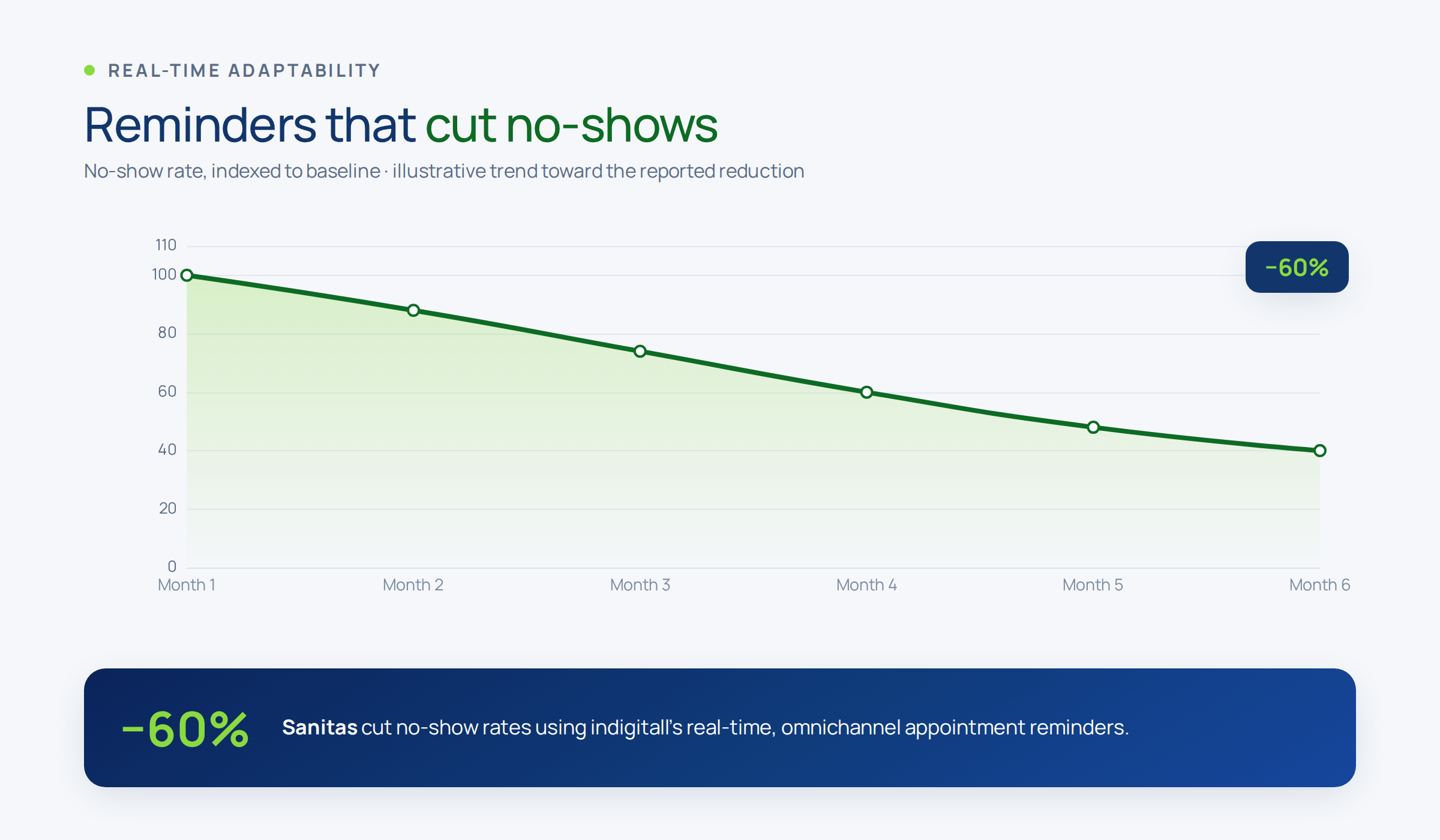
Sanitas cut no-shows by 60% with omnichannel reminders. A missed medical appointment is a slot that cannot be resold, so a reminder landing at the right moment on the right channel converts directly into recovered capacity. A scheduled blast does part of that job. A reminder that escalates to a second channel when the first goes unread does the rest.
Grupo Xcaret applied the same principle at the top of the funnel, collecting 720,000 new opt-ins through web push. The opt-in is requested at the moment of intent rather than on a fixed schedule, and that difference is most of the yield.
Where nothing is time-sensitive, adaptability earns very little. Worth being honest about which of your moments are which before paying for it.
"Indigitall is essential for marketing professionals, offering efficient push notifications and user segmentation. AI integration enhances its value, making it a highly efficient tool for communication and audience interaction." — Oscar Andre D. on G2
What does orchestration actually cost after it launches?
Licensing is the number everyone compares. It is rarely the number that decides whether this works.
A campaign has an end date. Somebody builds it, it runs, it stops, and if it was bad you find out inside the quarter. A journey has no end date. It keeps running against logic that was correct the day it was written, and it stays running after the pricing changes, after the product adds a tier, after the person who built it moves on.
That is the real bill. Someone has to own the journeys and revisit them, or they degrade without ever alerting anyone. Nothing breaks. The offer is simply wrong now, quietly, for everyone entering that path. This maintenance load is what makes optimizing automation workflows a standing job rather than a project.
Three questions worth answering before committing. Who reviews the live journeys, and how often. What happens to them when that person changes role. And how you would find out that a journey has been sending the wrong thing for six weeks.
If those answers are vague, start with fewer journeys. Two that are maintained beat nine that are not.
Why can orchestration look worse before it looks better?
Because of how the value gets attributed, and this is where good programs get cancelled in month three.
Orchestration moves value earlier in the journey and spreads it across touches. Last-click attribution, which is what most dashboards still run on, assigns that value to whatever happened last, usually a channel already being credited. The new program shows flat or worse numbers on the report the executive team already reads, while the underlying behavior improves.
The fix is not a better story. It is agreeing, before launch, on what counts as success and how it will be measured, which is why unifying attribution data tends to be a precondition rather than a follow-up, and why it helps to settle how automation success gets measured with the people who will read the report.
Multichannel has no such problem. Send, measure, compare. That reporting simplicity is an underrated reason it survives inside organizations.
When are multichannel campaigns the better choice?
We sell orchestration, so read this section carefully.
Launches and announcements. A new product, a price change, a store opening. There is nothing to react to. Everyone needs the same message on the same day, and a journey would only add latency.
Thin or fragmented data. If identity is not resolved, multichannel done well beats orchestration done on fragments. Every time.
Small teams. Orchestration needs an owner. If the person who would own it also owns the newsletter, the social calendar and the website, journeys get built and then abandoned, which is worse than never building them.
Seasonal businesses. When most of the year's revenue lands in six weeks, a well-run multichannel program built for that peak is the better investment.
Testing a market. Before you know what the journey looks like, broadcasting and watching what responds is how you find out.
None of that is a consolation prize. A sharp multichannel program with clean segmentation outperforms a neglected orchestration setup, and it costs less.
How do you choose between them for your business?
Stop asking which is better and start asking which moments you are trying to improve.
Moments that repeat for every customer are orchestration's territory: onboarding, renewal, replenishment, cart recovery, appointment reminders, payment failure. They happen at a different time for each person, which is precisely what a calendar cannot handle. This is where the Incapto and Sanitas numbers come from.
Moments that happen once for everyone are multichannel's territory: the launch, the sale, the announcement, the report. Same content, same day, maximum reach.
Most companies have both, which is why the answer for a mature program is usually both, with a clear line between them. Run the repeating moments as journeys. Run the one-off moments as campaigns. Keep them on one profile so they cannot contradict each other, and review the journeys on a schedule.
Sequencing matters more than the choice. Resolve identity, pick the two repeating moments with the clearest cost of getting them wrong, build those as journeys, and leave everything else on campaigns until the first two are working and maintained. A guide to journey orchestration platforms and the multichannel and omnichannel distinction are both worth reading before that first vendor conversation.
The verdict
Orchestration wins on repeated moments, once your customer is one customer. Multichannel wins on one-off moments, and on any team that cannot yet maintain a journey.
The failure mode is not picking the wrong one. It is buying orchestration to solve what was actually an identity problem, and then blaming the platform when the reminders reach the wrong profile. Fix that first and the choice mostly makes itself.
Whichever platform you choose, the line between the two is easier to move when both run on one customer profile, because then it is a decision you can revisit rather than a purchase you have to defend. Start with the moments that repeat, keep the rest on campaigns, and be honest about who is going to own the journeys in eighteen months.
FAQs: customer journey orchestration vs multichannel campaigns
What is the key difference between customer journey orchestration and multichannel campaigns?
Customer journey orchestration decides the next message from what a customer just did, in real time, using one unified profile that spans every channel. Multichannel campaigns deliver a message planned in advance across email, SMS, push and social, with each channel operating independently. The practical test is whether the system can change its mind mid journey: orchestration can, a multichannel campaign cannot.
Can these strategies be integrated?
Yes, and in mature programs they usually are. The workable split is to run repeated moments as orchestrated journeys (onboarding, renewal, cart recovery, appointment reminders) and one-off moments as multichannel campaigns (launches, seasonal pushes, announcements). The condition for combining them is that both read from the same customer profile, otherwise a campaign and a journey will contradict each other in the same inbox.
How does indigitall enhance these strategies?
indigitall runs orchestrated journeys and multichannel campaigns on one platform and one customer profile, with a CDP underneath for identity resolution and AI for personalization across push, email, SMS, WhatsApp and in-app. In client programs that has produced a 60% reduction in no-shows for Sanitas, a 56% reduction in churn for Incapto, and 20% of sales driven by push for Soriana.
When should a business prioritize multichannel campaigns?
When the message is the same for everyone and the timing is fixed, when customer identity is not yet resolved across channels, when the team has no one to own and maintain journeys, or when the business is seasonal and most revenue lands in a short window. In those cases a well segmented multichannel program outperforms an orchestration setup nobody maintains.
What challenges might a business face with customer journey orchestration?
Three, in the order they appear. Identity resolution comes first: if one person exists as several records, journeys act on fragments. Maintenance comes second: journeys have no end date and degrade silently when pricing, products or teams change. Measurement comes third: orchestration spreads value across touches, so last-click reporting understates it, and agreeing on how success will be measured before launch is what keeps the program alive past month three.
About the Authors