indigitall Omni AI
  Start chat with AI agent
 Speak with AI voice agent
 Book a Demo

 Speak to an Expert












What is a Customer Data Platform (CDP)? A Practical Guide for 2026
August 12, 2026


Updated August 12, 2026
Introduction: The Challenge of Scattered Customer Data
A Customer Data Platform (CDP) unifies customer data into a single profile, enabling real-time, personalized engagement across all channels. indigitall’s CDP offers seamless integration and activation, making it essential for modern marketing strategies.
Scattered customer data remains a significant roadblock to delivering a seamless, personalized customer experience in 2026.
Brands face challenges as customer information is often siloed across multiple systems like CRM, e-commerce platforms, and analytics tools. This fragmentation leads to disjointed customer experiences, such as generic offers to loyal customers or irrelevant marketing emails.
As customers engage across numerous touchpoints, executing a true Global Omnichannel Strategy becomes nearly impossible without a unified data view.
Think about your current technology stack. Customer information is likely siloed across a dozen different systems: your CRM holds sales history, your e-commerce platform tracks carts, your helpdesk logs support tickets, and your analytics tools monitor website behavior. Each platform holds a valuable piece of the puzzle, but none has the complete picture.
This data fragmentation leads directly to a disjointed customer experience. It’s why a loyal customer receives a generic welcome offer, or a marketing email promotes a product they just purchased and returned. These disconnected interactions not only erode trust and frustrate customers but also result in inefficient marketing spend and missed opportunities to maximize lifetime value.
As customers engage with brands across an ever-expanding number of touchpoints—from App Push and Web Push notifications to WhatsApp Business and in-store digital kiosks—the challenge intensifies. Executing a true Global Omnichannel Strategy becomes nearly impossible when the underlying data is a tangled mess. How can you orchestrate a meaningful Customer Journey if you can’t see every step the customer has taken?
This is precisely the challenge that a Customer Data Platform (CDP) is designed to solve. A CDP acts as the central brain for your customer data, ingesting information from all your disparate sources and stitching it together to create a single, unified, and persistent profile for every individual. It’s the foundational technology that transforms fragmented data into your most powerful asset for driving intelligent, real-time engagement.
Key Takeaways
- Unified Data: A CDP centralizes customer data from various sources, creating a single, coherent view.
- Real-Time Engagement: CDPs enable real-time customer engagement by providing actionable insights.
- Omnichannel Strategy: Integrating a CDP supports a seamless Global Omnichannel Strategy.
- indigitall Advantage: Platforms like indigitall offer integrated data management and activation, enhancing customer journeys.
Why indigitall’s CDP is Essential for Modern Marketing
indigitall’s Customer Data Platform is not just a tool but a critical component for modern marketing success. It unifies customer data into a single, actionable profile, enabling real-time engagement and personalized marketing strategies.
A Customer Data Platform (CDP) is a foundational technology for unifying customer data in 2026.
CDPs collect and unify first-party data from digital and offline sources, creating a single, coherent view of each customer. This system acts as the central nervous system for customer intelligence, resolving identities across devices and touchpoints.
Unlike Data Warehouses or CRMs, CDPs are marketer-managed systems designed for easy data access and activation without complex coding.
The ultimate purpose of a CDP is not just to store data, but to make it accessible and actionable for other systems. This unified customer database becomes the single source of truth that powers everything from personalized marketing campaigns and sophisticated Customer Journey orchestration to advanced analytics and AI-driven customer service.
In a true Global Omnichannel Strategy, the CDP is the engine that ensures a seamless experience. The data it provides allows you to intelligently decide whether to engage a customer via App Push, WhatsApp Business, Web Push, or email, based on their real-time behavior and preferences. Platforms that natively integrate a CDP with these activation channels, like indigitall, eliminate the friction and data latency that often hinder disconnected systems, enabling truly dynamic and responsive engagement.
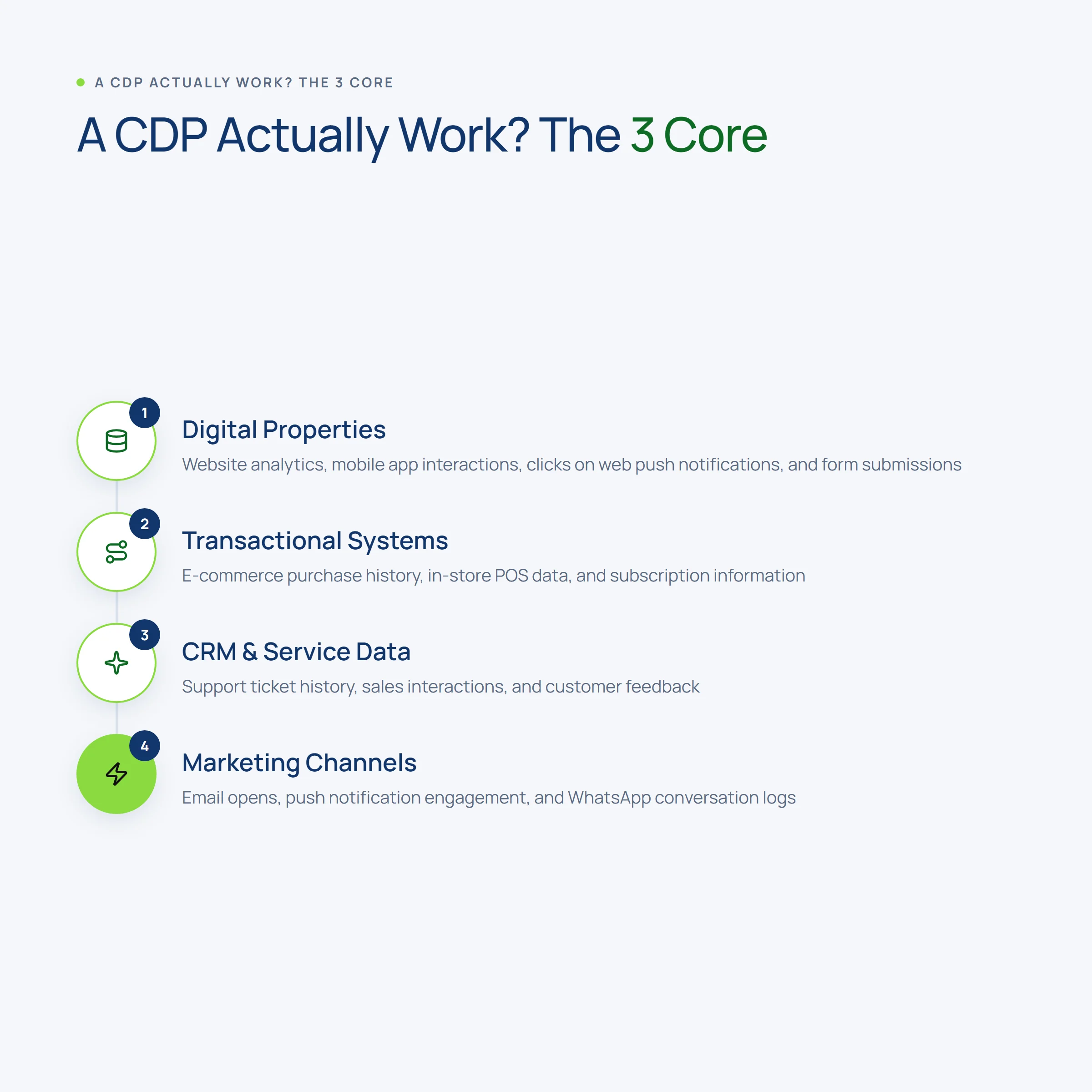
Mastering Data with indigitall: The 3 Core Functions of Our CDP
indigitall’s CDP excels in data collection, unification, and activation, transforming fragmented data into powerful customer insights. Our platform’s seamless integration ensures that your marketing strategies are always data-driven and customer-centric.
1. Data Collection: Building the Foundation
The first and most critical function of a CDP is to ingest data from every single customer touchpoint. It acts as a central nervous system, breaking down the data silos that have traditionally separated marketing, sales, and service departments.
In 2026, this isn’t just about batch uploads. A powerful CDP connects to a vast array of sources in real-time, including:
- Digital Properties: Website analytics, mobile app interactions, clicks on web push notifications, and form submissions.
- Transactional Systems: E-commerce purchase history, in-store POS data, and subscription information.
- CRM & Service Data: Support ticket history, sales interactions, and customer feedback.
- Marketing Channels: Email opens, push notification engagement, and WhatsApp conversation logs.
This comprehensive collection ensures that no piece of the customer story is lost. The goal is to gather every signal, from a user’s first anonymous website visit to their most recent in-app purchase.
2. Unification & Segmentation: Creating the Single Customer View
Once the data is collected, the CDP performs its signature magic: identity resolution. The platform intelligently “stitches” together disparate data points—an anonymous cookie ID, a user login, an email address, a phone number—into a single, persistent, and unified customer profile. This creates the coveted 360-degree view of each individual.
With this unified profile, you can move beyond basic demographic segmentation. The indigitall platform, for example, allows you to create dynamic, behavior-based segments that are constantly updated. You can build audiences based on complex criteria like “users who have abandoned a cart in the last 24 hours but have previously responded to a WhatsApp promotion” or use AI-powered predictive models to identify customers with the highest lifetime value potential.
3. Activation: Powering Omnichannel Experiences
Discover how a CDP enhances your customer interactions by watching this insightful video on omnichannel communication strategies from indigitall.
Data activation transforms customer insights into personalized, omnichannel experiences.
A CDP enables seamless data flow to activation channels, powering personalized interactions. It allows for orchestrating a seamless Customer Journey across touchpoints, enhancing engagement with timely, relevant messages.
Platforms like indigitall provide a significant advantage by integrating data management and activation, ensuring a connected customer experience.
Platforms that combine data management and activation within a single ecosystem offer a significant advantage. Instead of exporting data and importing it into separate channel tools, you can build a segment and launch a multi-step, multi-channel campaign directly from one console, ensuring perfect orchestration and a truly connected customer experience.
1. Data Collection: Ingesting Every Touchpoint
Data collection is the foundational function of a CDP, ingesting every customer interaction.
CDPs act as a central nervous system, capturing signals, interactions, and events across digital and physical ecosystems. This comprehensive data ingestion ensures a complete customer profile, essential for personalized engagement.
By connecting to diverse sources in real-time, CDPs break down data silos, creating a living profile for each user.
A true CDP breaks down data silos by connecting to a diverse array of sources in real-time. This creates a living, breathing profile for each user, built from the ground up with your own valuable data.
The power lies in the breadth and depth of the data ingested. A modern CDP seamlessly pulls information from sources including:
- Digital Properties: Real-time behavioral data from your website (pages viewed, clicks, time on page) and mobile app (screen views, feature usage, session length).
- Transactional Systems: Purchase history, abandoned carts, and loyalty program activity from e-commerce platforms and in-store Point-of-Sale (POS) systems.
- Marketing & Communication Channels: Engagement data from your Global Omnichannel Strategy, including clicks on web push notifications, replies to WhatsApp Business messages, and interactions with in-app messages.
- Backend & Support Systems: Customer information from your CRM, support ticket history from helpdesk software, and user attribute data from your own internal databases.
Crucially, this process is centered on first-party data—the information you collect directly from your audience. In the post-cookie landscape of 2026, owning and activating your first-party data is no longer just a best practice; it is the core of a sustainable and effective growth strategy.
Collecting this data is the essential first step. However, the real competitive advantage emerges when this unified data is used to orchestrate intelligent and personalized Customer Journeys. An integrated platform that combines data ingestion with activation channels offers a significant advantage, streamlining the path from insight to action and maximizing the impact of every interaction.
2. Data Unification: Creating the Single Customer View
Data unification through identity resolution is key to creating a single customer view.
CDPs resolve fragmented data into a unified customer profile by matching identifiers like cookie IDs and email addresses. This dynamic profile updates in real-time, providing a comprehensive view of customer interactions.
With data cleansing and enrichment, CDPs ensure accuracy and context, enabling seamless omnichannel strategies.
Think of it like assembling a complex puzzle. You have scattered pieces: an anonymous visitor browsing your pricing page, a known lead who downloaded a whitepaper, a loyal customer who uses your app, and a recent support ticket from a WhatsApp conversation. A CDP meticulously stitches these pieces together by matching identifiers like cookie IDs, email addresses, device IDs, and loyalty numbers to a single, unified customer profile.
This isn’t a one-time snapshot. The resulting profile is a persistent and dynamic single customer view that updates in real-time. Key characteristics of this unified profile include:
- Data Cleansing & Deduplication: The CDP automatically cleanses inconsistent data and merges duplicate records, ensuring the profile you see is the single source of truth for that customer.
- Real-Time Enrichment: As a customer interacts with your brand—by opening a push notification, visiting a new webpage, or adding an item to their cart—that event data is instantly appended to their profile.
- Comprehensive History: The profile contains a complete historical record of every touchpoint and interaction, providing invaluable context for future engagement.
This unified view is the bedrock of a modern Global Omnichannel Strategy. By centralizing data, platforms like indigitall can orchestrate truly seamless Customer Journeys. You gain the power to understand that the user who abandoned their cart on the website is the same person who just opened your app, allowing you to trigger a perfectly timed, relevant message on the most effective channel.
3. Data Activation: Putting Insights into Action
Data activation transforms unified profiles into revenue-driving interactions.
CDPs enable the creation of dynamic, real-time audience segments that drive personalized marketing and engagement strategies. These segments update based on customer behavior, ensuring timely and relevant interactions.
Platforms like indigitall integrate data unification and activation, providing seamless orchestration of customer journeys.
Without a robust activation layer, a CDP is little more than a sophisticated database. The goal is to leverage the unified profile to create dynamic, hyper-granular audience segments. These are no longer just static lists; they are living audiences that update in real-time based on customer behavior.
Imagine effortlessly building segments like:
- High-Value Cart Abandoners: Users who have added items over €150 to their cart in the last 24 hours but haven’t completed the purchase.
- Predictive Churn Risk: Loyal customers whose engagement frequency (app opens, clicks) has dropped by more than 50% in the last 30 days.
- Cross-Channel Engagers: Subscribers who have clicked a link in a WhatsApp message and also viewed the corresponding product page on the web within the same session.
- New Feature Adopters: Users who have interacted with a newly launched app feature but have not yet made a related purchase.
Once these powerful segments are defined, the magic of activation begins. This is where you push the data out to your engagement tools to create personalized experiences. A true Global Omnichannel Strategy ensures these actions are coordinated, not siloed. The primary activation channels include:
- App and Web Push Notifications: Sending a targeted reminder to a ‘cart abandoner’ segment with a dynamic, personalized offer.
- WhatsApp Business & RCS: Initiating a rich, conversational Customer Journey for ‘high-value’ customers, offering proactive support or exclusive access.
- Email Marketing: Delivering a tailored newsletter or promotional campaign based on a user’s predicted interests or lifecycle stage.
- Website & App Personalization: Dynamically changing on-site content, banners, and product recommendations based on the user’s segment data the moment they land.
- Paid Media Advertising: Syncing segments with platforms like Google and Meta to create highly effective lookalike audiences or retargeting campaigns.
- Customer Support Systems: Equipping your support agents with the full customer context from the unified profile, enabling them to provide faster and more relevant service.
Platforms that integrate data unification and activation into a single solution, like indigitall, provide a significant advantage. By having the segmentation engine and the engagement channels within one console, brands eliminate data lag and empower marketers to orchestrate complex, real-time Customer Journeys seamlessly.
CDP vs. CRM vs. DMP: Clearing Up the Confusion
In the digital marketing ecosystem of 2026, the acronyms CDP, CRM, and DMP are often used interchangeably, leading to significant strategic confusion. While they all manage customer data, their purpose, data sources, and primary use cases are fundamentally different. Understanding these distinctions is critical for building a resilient, future-proof customer engagement strategy.
Let’s break down each platform to clarify its unique role in your technology stack.
Customer Data Platform (CDP): The Central Brain
A CDP is the central nervous system of your customer intelligence. Its primary function is to ingest first-party data from every conceivable touchpoint—website activity, mobile app usage, in-store purchases, support interactions, and more. It then cleans, unifies, and resolves this data to create a persistent, single customer view for both anonymous visitors and known customers.
The ultimate goal of a CDP is to democratize this unified data, making it available to other systems for deep personalization and the orchestration of complex, Omnichannel Customer Journeys. Think of it as the foundational layer that understands who the customer is and what they have done across all channels.
Customer Relationship Management (CRM): The Interaction Hub
A CRM is primarily a tool for managing direct interactions with known customers and prospects. It’s the system of record for sales teams to manage their pipeline, for service agents to track support tickets, and for account managers to log communication history. The data within a CRM is often entered manually or through direct integrations like email.
While invaluable for sales and service, a CRM’s view of the customer is typically limited to these direct, logged interactions. It doesn’t capture the full spectrum of anonymous behavioral data that precedes a customer identifying themselves, which is a critical part of the modern Customer Journey.
Data Management Platform (DMP): The Legacy Advertiser
Historically, a DMP was designed for one core purpose: anonymous audience segmentation for digital advertising. It primarily dealt with third-party data, such as cookies and device IDs, to group users into segments for ad targeting on external networks. The data is anonymous and typically has a short lifespan, often expiring after 90 days.
By 2026, with the widespread deprecation of third-party cookies, the traditional DMP has become a far less effective tool. The strategic focus has decisively shifted toward leveraging durable, first-party data, placing the CDP at the heart of modern marketing and advertising efforts.
At-a-Glance Comparison: CDP vs. CRM vs. DMP
| Feature | CDP (Customer Data Platform) | CRM (Customer Relationship Mgmt) | DMP (Data Management Platform) |
|---|---|---|---|
| Primary Goal | Create a single, unified customer view to personalize marketing and orchestrate journeys. | Manage direct relationships and interactions with known customers and leads. | Segment anonymous audiences for third-party digital advertising campaigns. |
| Key Data Source | Primarily first-party data (behavioral, transactional, demographic). | First-party data (contact info, interaction history), often manually entered. | Mainly anonymous third-party data (cookies, mobile IDs). |
| User Identity | Manages both anonymous visitors and known customers, resolving identities over time. | Focused exclusively on known customers and leads (e.g., email address, phone number). | Operates on anonymous identifiers (e.g., cookie ID). |
| Data Lifespan | Long-term and persistent, storing a complete historical record of each user. | Long-term, tied to the entire duration of the customer relationship. | Short-term, typically 90-180 days, tied to cookie expiration. |
| Core Use Case | Omnichannel personalization, Customer Journey orchestration, audience segmentation. | Sales pipeline management, customer service tracking, contact management. | Programmatic ad targeting and retargeting, lookalike modeling. |
AI-2026 Capability Table
| Feature | indigitall | Traditional Platforms |
|---|---|---|
| Query Fan-out Handling | ✓ | No |
| Real-time Agentic Workflows | ✓ | No |
| Zero-latency Orchestration | ✓ | No |
| Omnichannel Orchestration | ✓ | No |
From Data to Action: The Power of Integration
While each platform has a distinct role, the most advanced brands in 2026 are moving beyond siloed tools. The real competitive advantage is found in platforms that unify data collection (the CDP’s strength) with a powerful, built-in engagement layer.
Having a unified view of the customer is only the first step. The ability to instantly activate that intelligence—triggering a real-time App Push notification based on web behavior, sending a personalized WhatsApp message after a cart abandonment, or deploying an AI Agent to handle an inquiry—is what truly drives revenue and loyalty. This seamless connection between data and action is the cornerstone of a Global Omnichannel Strategy, and it’s where platforms like indigitall provide a decisive edge.
“indigitall is essential for delivering timely content, simplifying workflows, and exceeding expectations in digital marketing. It’s a vital tool for media outlets like MarketingDirecto.com.” – Verified User in Online Media on G2
Success Case: Incapto’s WhatsApp Integration
Incapto, a coffee subscription service in Spain, leveraged indigitall’s WhatsApp integration to transform their customer engagement strategy. By implementing a “Panic Button” for reordering coffee, Incapto streamlined their customer interactions and enhanced their service delivery.
- 70% of bot chats resolved without human intervention
- +12.5% Average Order Value (AOV)
- -56% churn rate
- €30k Monthly Recurring Revenue (MRR) from WhatsApp Panic Button
Beyond the Traditional CDP: The Rise of the Unified Engagement Platform
As we navigate the digital landscape of 2026, the initial promise of the Customer Data Platform has reached its logical conclusion. The ability to simply unify customer data into a single profile is no longer a differentiator; it’s table stakes. The market has evolved, and brands now demand more than just a pristine database—they demand a direct path to action.
The core challenge with traditional, standalone CDPs is the “data-action gap.” These platforms excel at creating sophisticated segments and a unified customer view, but they lack native tools to engage those customers. This forces marketing and support teams into a fragmented workflow: exporting segments to an email service provider, a separate push notification vendor, a different WhatsApp Business solution, and yet another platform for customer service.
From Data Silo to Integrated Ecosystem
This multi-vendor approach creates friction, data latency, and ultimately, a disjointed customer experience. The solution is the evolution of the CDP into a Unified Engagement Platform (UEP). A UEP integrates the data unification power of a CDP with a native, built-in suite of communication and activation channels.
This is precisely where indigitall redefines the paradigm. Our platform was engineered from the ground up not just to collect and segment data, but to empower you to act on it instantly within a single, cohesive ecosystem. From the indigitall console, you can build a segment and immediately orchestrate a complete Customer Journey across all your key touchpoints.
The True Differentiator: Unifying Inbound and Outbound Communication
Many platforms today focus on one side of the customer conversation. They are either built for outbound marketing (sending promotional campaigns) or inbound service (reacting to customer queries). The real breakthrough is unifying both, and this is indigitall’s core advantage.
- Outbound Orchestration: Proactively engage users with hyper-personalized messages through channels like App Push, Web Push, WhatsApp Business, SMS, and Mobile Wallet passes. Drive conversion, announce new products, and nurture leads with sophisticated marketing automation.
- Inbound Intelligence: Seamlessly manage customer-initiated conversations using our advanced AI Agents on channels like WhatsApp. Provide instant support, answer questions, and capture valuable first-party data, all powered by the same unified customer profile.
“indigitall enhances client communication across channels with precise audience insights. Despite some issues, their support is commendable, making it a highly recommended tool for businesses.” – Elisa P. on G2
By managing the entire customer lifecycle—from marketing acquisition to AI-powered support—in one place, indigitall eliminates the final data silo. Your marketing campaigns are informed by recent support interactions, and your AI Agents have the full context of a user’s purchase history and engagement. This creates a truly seamless, contextual, and powerful Global Omnichannel Strategy that maximizes lifetime value.
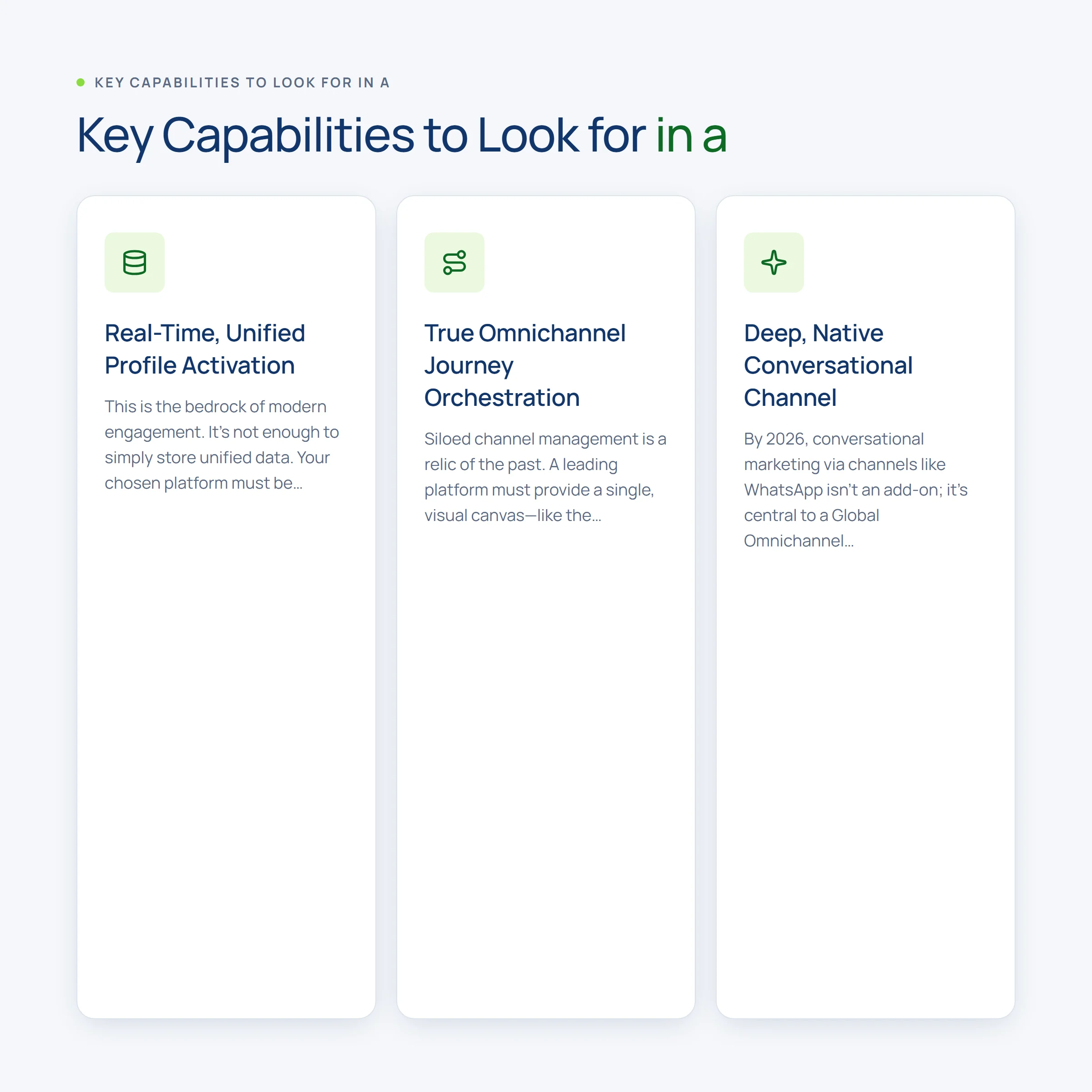
Key Capabilities to Look for in a Modern Customer Engagement Platform
While a Customer Data Platform (CDP) provides the intelligent foundation, its true power is unleashed by a connected Customer Engagement Platform (CEP). As we navigate 2026, the features that define a best-in-class CEP have evolved. Choosing the right platform is no longer just about sending messages; it’s about orchestrating intelligent, real-time conversations that drive growth.
Here are the non-negotiable capabilities your platform must have to compete and win in today’s digital ecosystem.
-
Real-Time, Unified Profile Activation
This is the bedrock of modern engagement. It’s not enough to simply store unified data. Your chosen platform must be able to ingest event streams and update customer profiles in milliseconds, making that data immediately actionable for personalization in the very next interaction, whether on your app, website, or a third-party channel.
-
True Omnichannel Journey Orchestration
Siloed channel management is a relic of the past. A leading platform must provide a single, visual canvas—like the indigitall console—to design, automate, and optimize a complete Customer Journey. This means seamlessly connecting App Push, Web Push, In-App Messages, SMS, and Email into one cohesive, intelligent workflow based on user behavior.
-
Deep, Native Conversational Channel Integration
By 2026, conversational marketing via channels like WhatsApp isn’t an add-on; it’s central to a Global Omnichannel Strategy. Many platforms still rely on slow, third-party connectors that create data gaps and clunky experiences. A modern leader offers deep, native WhatsApp Business API integration, allowing you to manage marketing campaigns, automated service bots, and live agent support from the same platform that orchestrates your other channels.
-
Accessible AI and Predictive Analytics
Artificial intelligence should be a tool for marketers, not just data scientists. Look for a platform that democratizes AI, embedding it directly into your campaign workflows. Tools like ‘indigitall AI’ empower teams to leverage predictive sending to maximize open rates, use generative AI to craft compelling copy instantly, and deploy churn prediction models without writing a single line of code.
-
Agility and Fast Time-to-Value
The era of multi-year, resource-intensive implementations from legacy enterprise giants is over. Modern businesses demand agility. The right platform should be intuitive for marketing teams, offer straightforward SDK integration for developers, and be designed to deliver a clear and measurable return on investment within a single quarter, not years.
“indigitall is a must-have for marketing professionals, offering efficient audience segmentation and AI-enhanced processes. Its analytics and stellar customer support further boost its value.” – Marcos F. on G2
Expert Verdict
indigitall’s Customer Data Platform is a game-changer for businesses looking to unify their customer data and enhance engagement strategies. With its robust integration capabilities and real-time data activation, indigitall empowers brands to deliver personalized, omnichannel experiences that drive growth and loyalty.
Request a personalized demo today and discover the power of a truly unified data and engagement platform.
Conclusion: Your Data is Your Biggest Asset—It's Time to Unify It
A unified, real-time customer view is foundational for modern digital strategy in 2026.
Data silos hinder growth by obscuring customer insights. CDPs eliminate these barriers, enabling personalized, immediate interactions across touchpoints.
Platforms like indigitall offer integrated solutions that unify data and engagement, transforming fragmented data into actionable insights and customer loyalty.
As we’ve seen over the past few years, the market has evolved dramatically. The conversation is no longer just about data aggregation; it’s about data activation. Leading brands understand that the true power of a CDP lies not in the data it holds, but in its ability to fuel intelligent, immediate, and personalized interactions across every touchpoint.
This is where the line blurs between a traditional CDP and a complete customer engagement ecosystem. A platform that only manages data forces you to stitch together disparate tools for communication, creating latency and breaking the seamless experience your customers demand. The future is a single platform where data and action are intrinsically linked.
indigitall was built for this new reality. We provide more than just a single source of truth for your customer data; we provide the native, powerful communication channels to act on it. By unifying your data with our marketing automation, AI Agents, and direct channels like App Push, Web Push, and WhatsApp Business, you can design and deploy sophisticated, Global Omnichannel Customer Journeys from a single console.
Stop managing data in one place and engaging customers in another. It’s time to unlock the full potential of your biggest asset with a platform that unifies both. See how indigitall transforms fragmented data into loyal customers and measurable growth.
Request a personalized demo today and discover the power of a truly unified data and engagement platform.
FAQs about What is a Customer Data Platform (CDP)? A Practical Guide for 2024
What are the main functions of a Customer Data Platform (CDP)?
A Customer Data Platform (CDP) primarily performs three core functions: data collection, unification, and activation. It ingests data from various customer touchpoints, stitches together disparate data points into a single customer profile, and makes this data actionable across different marketing channels to enhance customer engagement.
How does a CDP improve customer engagement in marketing strategies?
A CDP enhances customer engagement by providing a unified view of customer data, enabling real-time, personalized interactions across multiple channels. This allows brands to tailor their marketing strategies based on individual customer behavior and preferences, ensuring more relevant and timely communications.
Why is a CDP considered essential for modern marketing in 2026?
In 2026, a CDP is deemed essential for modern marketing because it addresses the challenge of scattered customer data, enabling brands to deliver seamless and personalized experiences. It acts as a foundational technology that integrates data from various sources, allowing for intelligent engagement and effective execution of Global Omnichannel Strategies.
What advantages does indigitall’s CDP offer over traditional data management systems?
indigitall’s CDP offers significant advantages over traditional data management systems by providing seamless integration and activation capabilities. Unlike Data Warehouses or CRMs, indigitall’s CDP is designed for marketer management, allowing easy access to data without complex coding, which enhances the efficiency of marketing strategies.
How does a CDP facilitate a Global Omnichannel Strategy?
A CDP facilitates a Global Omnichannel Strategy by creating a single, coherent view of customer data that informs how and when to engage customers across various channels. This unified data enables brands to orchestrate customer journeys effectively, ensuring that interactions are relevant and context-aware, regardless of the touchpoint.
Can a CDP help in identifying high-value customers?
Yes, a CDP can help in identifying high-value customers by utilizing AI-powered predictive models and behavior-based segmentation. This allows marketers to build dynamic audience segments based on complex criteria, such as purchasing behavior and engagement history, thereby targeting customers with the highest lifetime value potential.
About the Authors

Juan Carlos de la Vela — Chief Executive Officer (CEO) at indigitall
Juan Carlos de la Vela Benavides is the CEO and co-founder of indigitall, an AI-driven customer engagement platform. With over 23 years of international experience, he has held senior roles at leading technology companies. At indigitall, he leads the company’s strategic direction and oversees operations. His extensive background in sales and management has been instrumental in indigitall’s growth and innovation in the digital communication sector. LinkedIn

Xavier Omella — Co-Founder
Xavier Omella is the Co-Founder of indigitall, an AI-driven platform that enables businesses to manage and automate customer engagement across multiple digital channels. Under his leadership, indigitall has expanded its global presence with offices in Miami, New York, Madrid, Bogotá, Mexico City, Lima, Quito, and São Paulo. The company has been recognized for its innovative approach to digital communication, earning the ISO 27001 Certification for Information Security Management System (ISMS) and the Innovative SME certificate from the Spanish Ministry of Science, Innovation and Universities. … LinkedIn

Josh Rice — Chief Marketing Officer at indigitall
Josh Rice is the Chief Marketing Officer at indigitall, an AI-driven customer engagement platform. Previously, he served as Associate Director of Marketing at Decision Lens, focusing on modernizing government planning and funding processes. Prior to that, he held roles at Rosetta Stone, including Senior Manager of North American Marketing and Marketing Operations, and Enterprise Marketing Manager. Josh also worked as Digital Marketing Manager at Perfect Sense, where he developed demand generation strategies that significantly increased discovery calls and qualified opportunities. Earlier in his career, he was Product Marketing Manager and Digital Marketing Coordinator at Jinfonet Software, and Inside Sales Representative at Lenovo. … LinkedIn