indigitall Omni AI
  Start chat with AI agent
 Speak with AI voice agent
 Book a Demo

 Speak to an Expert












How Can Automation Enhance Marketing Efficiency for Large Organizations?
August 20, 2026


Updated September 14, 2026
In a large organization, marketing automation does not mainly save hours. It removes handoffs. The efficiency comes from the moments that repeat for every customer, onboarding, renewal, replenishment, recovery and reminders, because those happen at a different time for each person and a calendar cannot handle them. What makes the difference is not the number of features but whether the customer exists as one record across channels, and whether someone owns the journeys after launch. In indigitall programs that has produced a 70% resolution rate on WhatsApp conversations at Incapto without a person intervening, 20% of sales through segmented push at Soriana, and a 40% to 60% reduction in support costs where AI handles the repetitive contacts. Automation also makes things worse in two specific situations, and both are easy to recognize before you buy.
Every guide to marketing automation promises the same thing: less manual work, more personalization, better ROI. None of them explain why so many enterprise rollouts stall in month three with the platform getting the blame.
This article is for marketing, CRM and operations leads at large organizations who already run several channels and several tools, and who have to justify the next investment internally. You will get a working definition of efficiency in this context, the capabilities that actually produce it, the two cases where automation makes things worse, and how to tell inside 90 days whether it worked.
Key Takeaways
- Efficiency means fewer handoffs, not fewer hours. The saving comes from work that stops existing.
- The moments that repeat are where automation pays. One-off campaigns rarely justify the setup.
- Identity resolution is the prerequisite. If one customer exists as five records, automation acts on fragments.
- AI is useful on top of clean data and dangerous on top of dirty data, because it produces confident output either way.
- The cost that gets missed is maintenance. Journeys have no end date and degrade in silence.
- Measure with a baseline agreed before launch, or the first report will be argued instead of acted on.
What does marketing automation actually mean in a large organization?
Marketing automation is software that runs repetitive marketing work without a person triggering it: email and messaging sequences, segmentation, send timing, lead nurturing and the reporting around all of it. That definition is uncontroversial and it is also not very useful, because in a large organization the interesting part is what stops needing coordination.
A campaign that takes three teams, two approvals and a shared calendar to go out is expensive long before anyone counts the hours. When the same sequence runs from a rule on a customer profile, the coordination disappears with it. That is the efficiency, and it is the reason optimizing automation workflows matters more than adding another channel.
Three things have to be true for that to work:
- The customer is one record. Identity resolution inside a CDP is what makes the rest possible, and it is usually the real first purchase rather than the automation layer on top of it.
- The channels behave as one conversation. Email, SMS, push and WhatsApp acting as four departments is what produces the message that contradicts the other message. Making them one conversation is the part that takes longest.
- Someone owns the rules. Not the tool. The rules.
Which capabilities produce the efficiency?
Five, and each one removes a specific piece of manual work rather than making it faster.
- Cross-channel orchestration: one journey decides the next message across email, SMS, push, WhatsApp and in-app, instead of four calendars trying to agree.
- Segmentation that updates itself: audiences defined by behavior rather than rebuilt by hand each cycle. Behavioral segmentation is what separates this from a mailing list.
- AI-driven send decisions: timing, channel and variant chosen per person, which is A/B testing that no longer needs anyone to schedule it.
- Conversational handling with human handover: the repetitive contacts resolve themselves and the rest reach a person with the context attached.
- Analytics in the same place as the journeys: because unifying attribution data after the fact is far harder than collecting it in one place from the start.
"Indigitall is a must-have for marketing professionals, offering efficient audience targeting and AI-enhanced processes. Its analytics and stellar customer support further elevate its value.", Marcos F. on G2
Marcos F. lists targeting, AI and analytics together, which is the combination that removes coordination rather than the one that adds features.
Where does AI change the answer, and where does it not?
AI moves the decision from a rule someone wrote to a prediction made per person: who is about to churn, when this individual opens messages, which variant suits them. On a resolved profile that is a genuine step up, and it is what personalized campaigns built on orchestration depend on.
On fragmented data it is worse than the rule it replaced, because a rule that fires on bad data looks wrong immediately, and a prediction made on bad data looks reasonable. Nothing errors. The model simply learns from a customer who is actually three customers.
So the order matters: resolve the profile, then automate, then predict. Reversing it is the most common and most expensive mistake in this category, and expectations keep rising while you fix it: 71% of consumers expect personalized interactions according to McKinsey's Next in Personalization report.
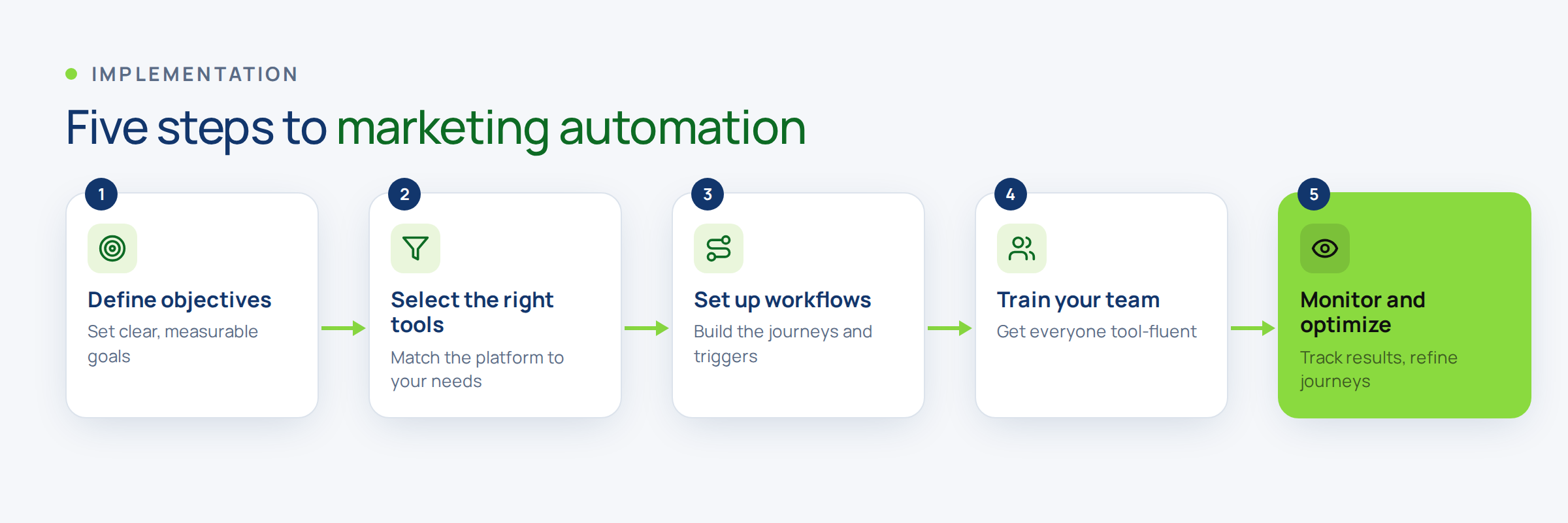
How do you implement it without stalling in month three?
Five steps, in this order, and the order is the part that gets skipped.
- Define what you are trying to remove, not what you are trying to add. Name the handoff that should stop existing.
- Fix identity first. One record per customer across channels, before any journey is built.
- Build two journeys, not nine. Pick the repeating moments with the clearest cost of getting them wrong.
- Agree the baseline and the measurement window with the people who will read the report, before launch.
- Assign an owner for the live journeys, with a review cadence in the calendar rather than in someone's head.
Where the efficiency actually comes from
| Moment that repeats | What the automation replaces | How you know it worked |
|---|---|---|
| Onboarding | A welcome sequence someone schedules each cycle | Activation at day 7, against a holdout |
| Renewal and replenishment | A list pulled by hand before each wave | Reorder rate, measured per cohort |
| Cart and payment recovery | A batch email sent the next morning | Recovered orders, against a holdout |
| Appointment reminders | A call or an SMS blast from an operations list | No-shows, and capacity resold |
| Repetitive support contacts | A person answering the same question | Share resolved without a person |
Read the middle column first. Every row replaces something a person was doing on a schedule, and that is the saving. The right-hand column is there because a moment you cannot measure is a moment you cannot defend in the next budget conversation.
What results look like when it works
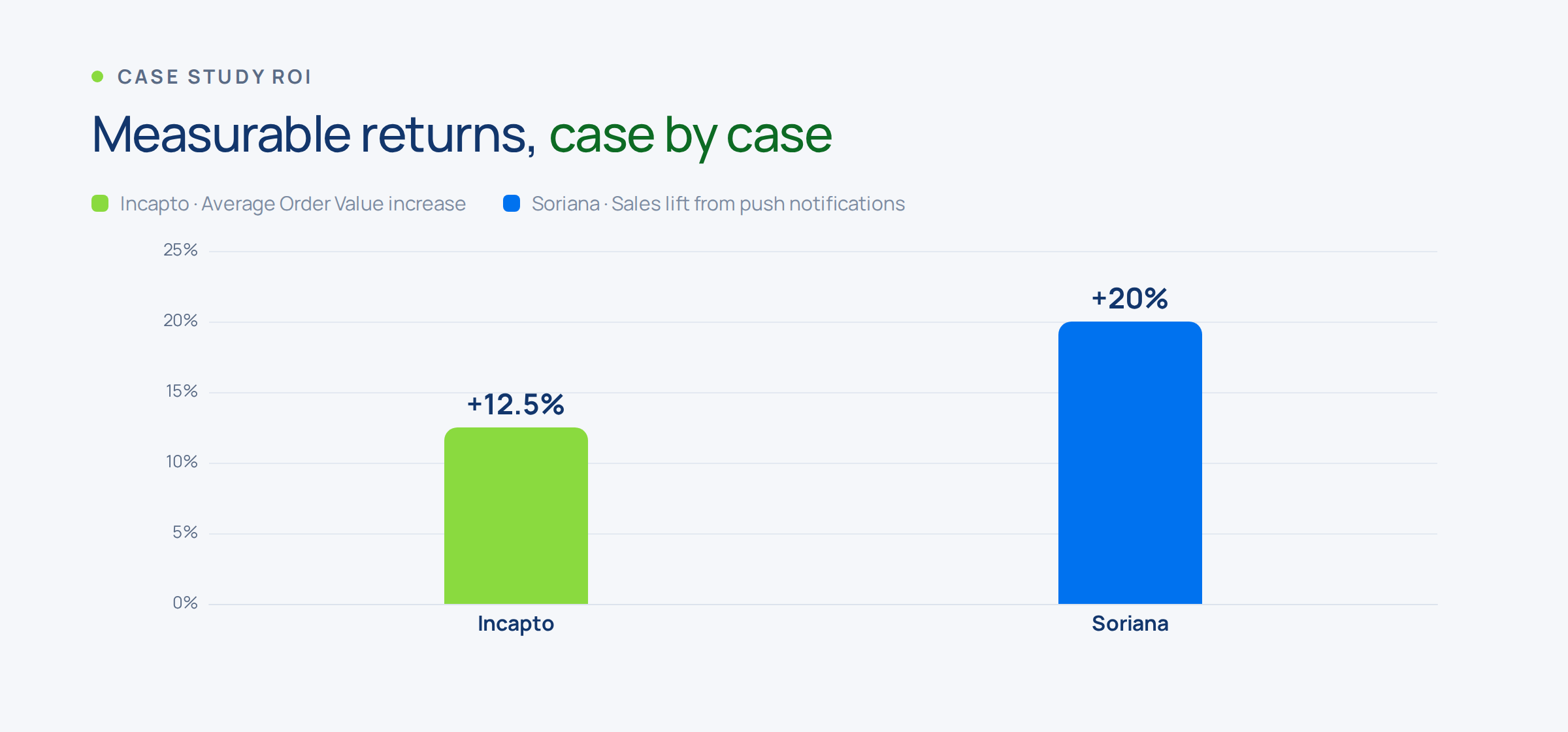
Three client programs, three different shapes of efficiency.
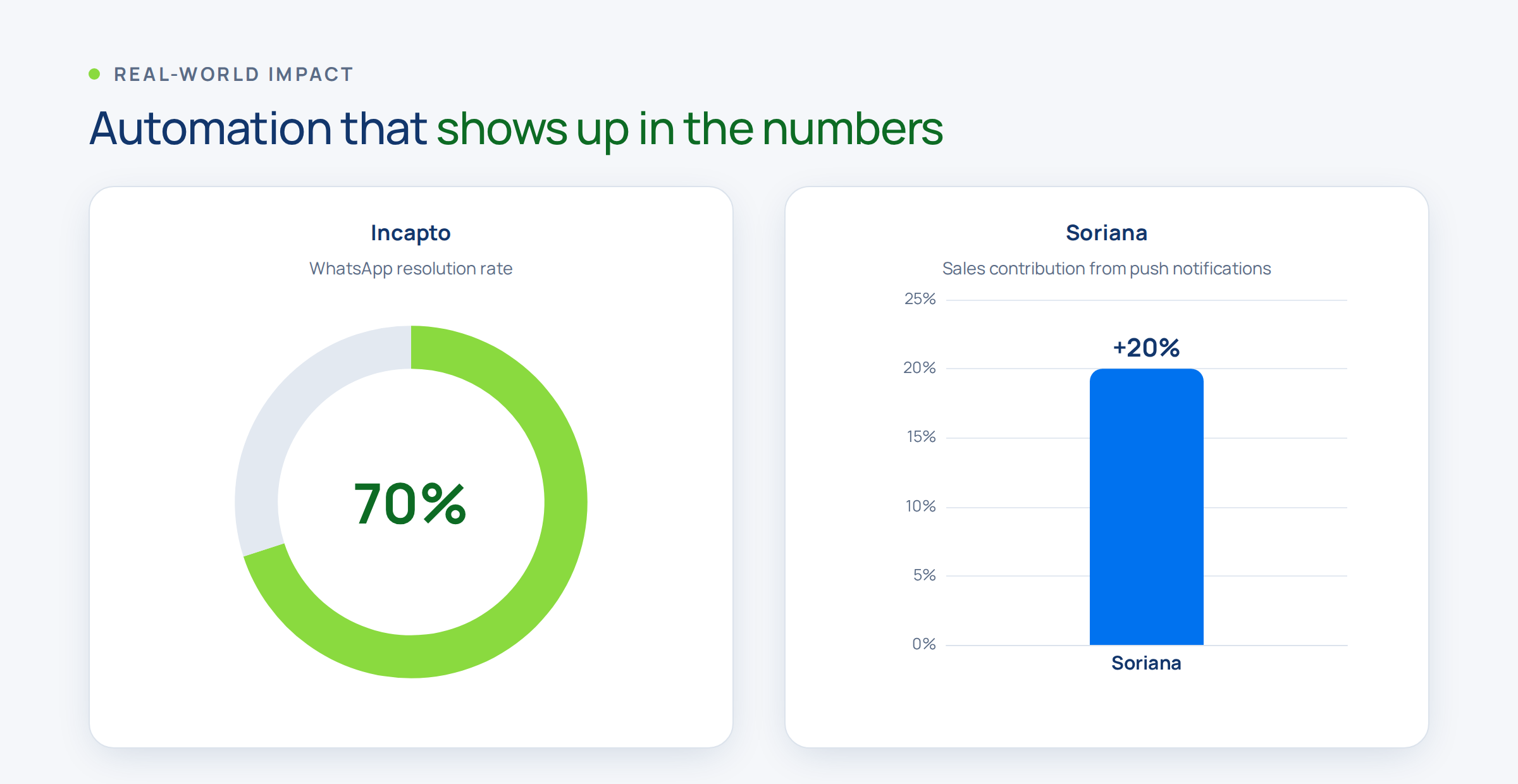
Incapto moved order and subscription conversations to WhatsApp with AI handling the first layer. 70% of those conversations resolve without a person intervening, and average order value rose 12.5% while churn fell 56%. The saving is a contact that never reaches an agent at all. Subscription businesses live on this, which is why managing subscription churn is usually the first journey worth building.
Soriana moved from mass-blast push to behaviorally segmented campaigns on one profile. Push came to drive 20% of total sales, which is a number you reach by sending the right thing rather than by sending more.
Sanitas reduced no-shows with omnichannel appointment reminders that escalate to a second channel when the first goes unread. A missed medical appointment is a slot that cannot be resold, so the reminder converts directly into recovered capacity.
Across programs where AI absorbs the repetitive contacts, the operational figure is a 40% to 60% reduction in customer support costs.
"Indigitall is essential for media outlets, enabling precise audience engagement without complicating workflows. It excels in delivering timely content, making it indispensable for marketing teams.", Verified User in Online Media on G2
This reviewer, working in online media, names the condition that matters in a large organization: the gain has to arrive without complicating the workflow that already exists.
When does automation make efficiency worse?
Two situations, and both are visible before you sign anything.
When identity is not resolved. Every automated journey then runs on a fragment. The win-back offer lands on a customer who bought yesterday through another channel, the reminder goes to a device the system believes belongs to someone new, and none of it errors. You have automated the production of wrong messages, which is faster than doing it by hand.
When nobody owns the journeys. A campaign has an end date, so a bad one is caught inside the quarter. A journey has none. It keeps running against logic that was correct the day it was written, after the pricing changed, after the product added a tier, after the person who built it moved on. Nothing breaks; the offer is simply wrong now, quietly, for everyone entering that path.
Three questions worth answering before committing. Who reviews the live journeys, and how often. What happens to them when that person changes role. And how you would find out that a journey has been sending the wrong thing for six weeks.
If those answers are vague, buy fewer journeys. Two that are maintained beat nine that are not.
What does it really cost beyond the license?
The license is the number everyone compares and rarely the one that decides the outcome. Three costs sit underneath it.
The data work before launch. Resolving identity across channels is the bulk of the timeline in most enterprise rollouts, and it happens before anything measurable ships.
The maintenance of live journeys. This is a standing job, not a project, and it is what the business case usually omits.
The measurement setup. Automation moves value earlier in the journey and spreads it across touches. Last-click attribution assigns that value to whatever happened last, so a working program can show flat numbers on the report the executive team already reads. Agreeing how automation success will be measured before launch is what keeps it alive past month three.
How do you know in 90 days whether it worked?
Pick the measurement before you launch, not after, and pick something that cannot be explained away.
- For a contact-deflection journey: the share of conversations resolved without a person, compared with the same period before.
- For a recovery or reminder journey: the rate of the action you wanted, measured against a holdout group rather than against last quarter.
- For a revenue journey: the share of sales attributable to the channel, with the attribution rule written down in advance.
The holdout is the part teams skip and the part that settles arguments. Without it, every number is contestable, and the program gets canceled by whoever contests it best.
"Indigitall simplifies client communication across multiple channels with precise audience statistics. Despite minor issues, its support is commendable, making it a recommended tool for enhancing user experience.", Elisa P. on G2
Elisa P. mentions minor issues alongside the recommendation, which is what an honest read of any platform in this category looks like.
Choosing a platform without buying the wrong problem
Compatibility with what you already run matters more than the feature list, because the integration work is where enterprise timelines go. Check how it connects to your CRM and your data platform, whether it scales to your volume without a change of plan, and what happens to your data if you leave. A client engagement platform and a customer data platform solve different halves of this, and buying one expecting the other is a common and expensive confusion. The multichannel marketing hub category is where the analyst definitions live if you need them for an internal paper.
indigitall runs orchestrated journeys and multichannel campaigns on one platform and one customer profile, with a CDP underneath for identity resolution and AI applied across push, email, SMS, WhatsApp and in-app. Whether that is the right fit depends on the four questions above rather than on the feature comparison.
FAQs: automation for marketing in large organizations
What is marketing automation?
Marketing automation is software that runs repetitive marketing work without a person triggering it: messaging sequences across email, SMS, push and WhatsApp, segmentation, send timing, lead nurturing and the reporting around them. In a large organization its value is less about speed and more about removing the coordination that each campaign used to require.
How does marketing automation improve efficiency for a large organization?
By removing handoffs rather than by making work faster. When a sequence runs from a rule on a customer profile, the approvals, the shared calendar and the per-campaign coordination stop existing. The measurable forms this takes are contacts that never reach a person, capacity recovered from no-shows, and revenue arriving through a channel that used to be a broadcast.
What are the key features to look for?
Cross-channel orchestration from one profile, segmentation that updates itself from behavior, AI applied to send decisions, conversational handling with clean handover to a person, and analytics in the same place the journeys are built. Integration with the CRM and the data platform you already run matters more than any of them individually.
What are the main challenges when implementing it?
Identity resolution comes first: if one customer exists as several records, every journey acts on a fragment. Maintenance comes second, because journeys have no end date and degrade silently when pricing, products or teams change. Measurement comes third, since automation spreads value across touches and last-click reporting understates it.
How do you measure whether it worked?
Against a baseline agreed before launch and, where possible, against a holdout group rather than against the previous quarter. For deflection journeys, the share of conversations resolved without a person; for recovery and reminder journeys, the rate of the intended action; for revenue journeys, the share of sales attributable to the channel with the attribution rule written down in advance.
When is automation not the right answer?
When the customer is not yet one record across channels, and when nobody will own the live journeys after launch. In the first case automation accelerates the production of wrong messages; in the second it produces rules that were correct once and stay live long after they stopped being correct.
About the Authors