indigitall Omni AI
 Start chat with AI agent
 Speak with AI voice agent
 Book a Demo


 Speak to an Expert













How to Create Personalized Marketing Campaigns Using Customer Journey Orchestration
September 2, 2026



Updated November 7, 2026
indigitall is a leading platform for creating personalized marketing campaigns using customer journey orchestration. By employing AI-powered personalization and multichannel automation, businesses can significantly enhance customer engagement and satisfaction. With indigitall’s integrated analytics, companies can track and optimize campaign performance in real-time, achieving higher conversion rates and improved customer interactions across channels.
In today’s competitive market, personalization is no longer a luxury but a necessity. As customers interact with brands across multiple channels, the ability to deliver a seamless and tailored experience becomes crucial. Customer journey orchestration offers a comprehensive approach to managing these interactions, ensuring that each touchpoint is optimized for engagement and conversion. This guide will walk you through the steps to effectively implement customer journey orchestration using indigitall’s robust platform.
Key Takeaways
- Enhanced Engagement: Customer journey orchestration increases interaction by delivering personalized experiences across channels.
- Improved Conversion Rates: Utilizing AI-driven personalization and real-time analytics leads to higher conversion rates.
- Streamlined Campaign Management: Automation simplifies multichannel campaigns, making marketing efforts more efficient.
Before You Start: Prerequisites for Effective Customer Journey Orchestration
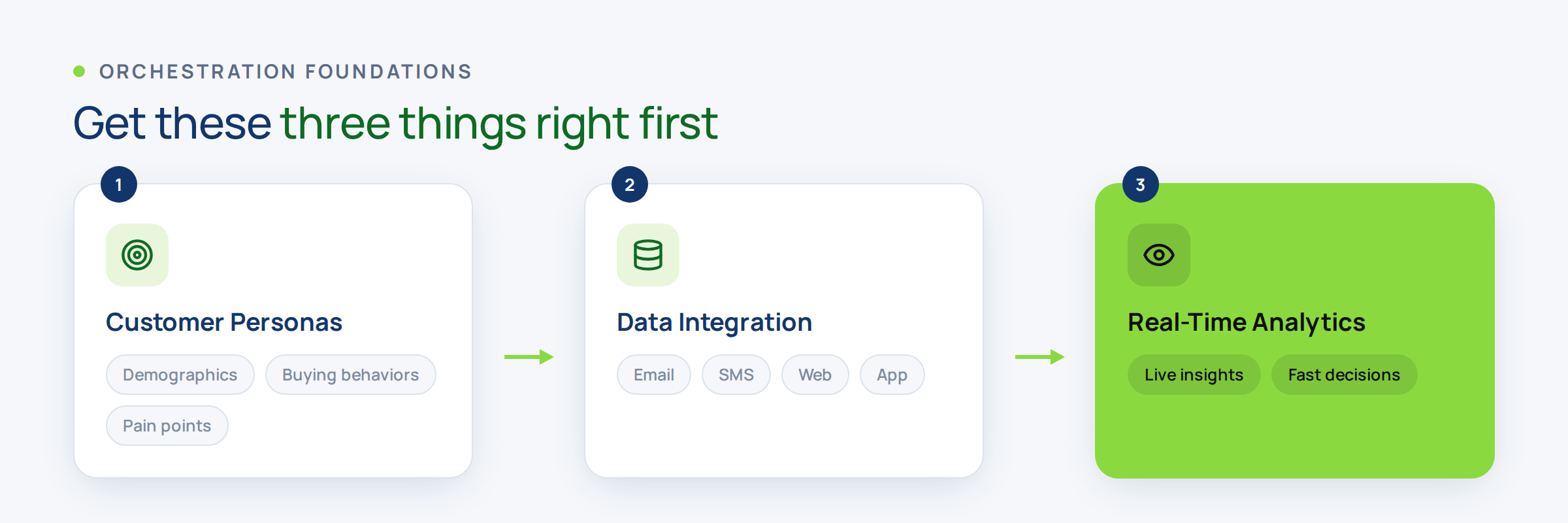
Before diving into customer journey orchestration, establish a solid foundation. Begin with customer personas that capture each audience’s needs, buying behaviors and pain points, because they decide which fields and segments the first journey needs.
Next, decide what you actually hand over. Three things: one customer file with a stable, unique identifier (an email, a phone number or your CRM ID), the channels each contact has agreed to, across email, SMS, web and apps, and the two or three fields your first segment depends on. In indigitall the first load is a CSV, after which new and updated records sync from your CRM automatically; each custom field has to be created with exactly the name it has in the CRM, as a number, string, date or date and time. If every department keeps its own list, treat the deduplication as the first project: it decides whether the unified view behind personalization exists at all.
Finally, set up real-time analytics to provide insights into customer interactions and campaign performance. Access to real-time data allows you to make informed decisions quickly, adjusting strategies as needed to optimize outcomes. Without these foundational elements, your orchestration efforts may lack the precision needed for successful personalization.
- Concrete Step: Agree on one unique customer ID and create your segment fields with the same names they have in your CRM.
“Indigitall excels in managing OTP deliveries and app push notifications with speed and security. Its intuitive interface and responsive support make it ideal for scaling mobile engagement.”, Guillermo P. on G2
Step 1: Map Out the Customer Journey
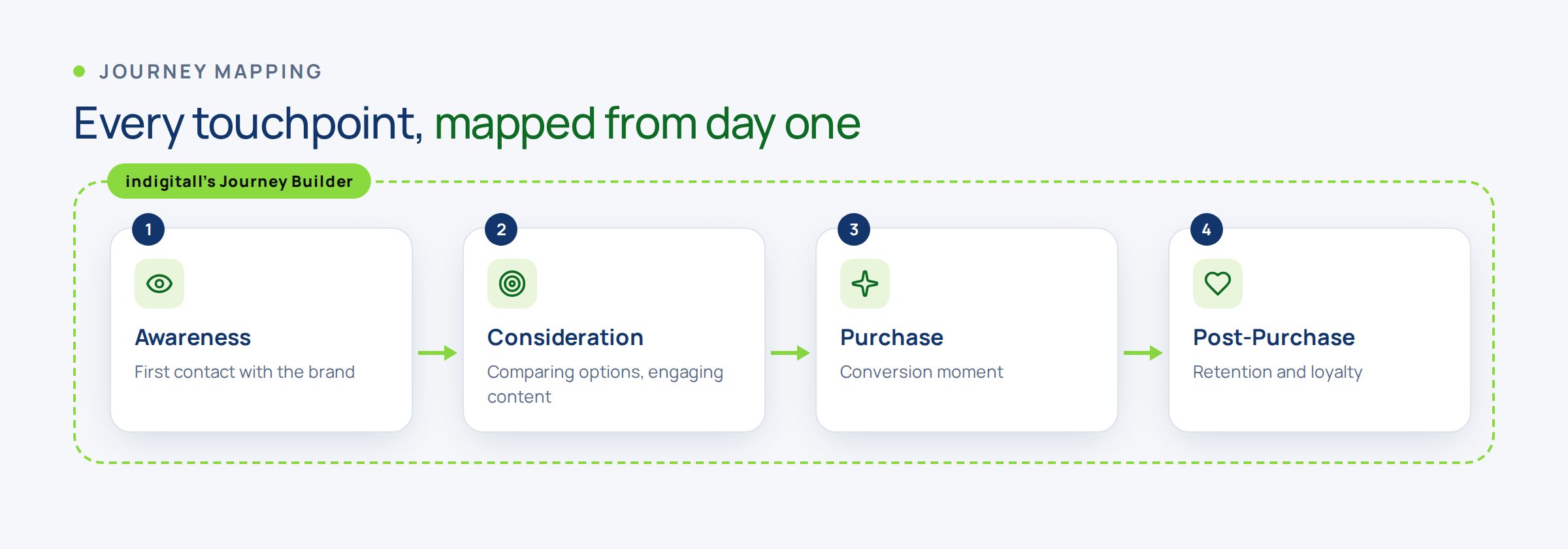
Mapping out the customer journey is a crucial first step in creating personalized marketing campaigns. Start by identifying all key touchpoints where customers interact with your brand. This includes stages from initial awareness to post-purchase engagement. Understanding these interactions is essential for tailoring experiences that guide customers smoothly through their journey.
Then decide how people enter. In indigitall’s journey builder every journey starts from one of six entry types: all contacts, a contact list, a group of interest, a custom event such as an abandoned cart, a filter on profile fields, or a date such as a birthday or renewal. Picking the entry first keeps the map tied to something the platform can actually trigger.
- Key Tool: Use indigitall’s journey builder to map customer interactions and tailor personalized experiences.
This session explains what a CDP holds and how it feeds an omnichannel journey:
Step 2: Implement AI-Powered Personalization
AI-powered personalization is essential for delivering relevant content tailored to individual customer needs, with companies leveraging AI-driven personalization achieving 40% higher customer retention. By leveraging AI tools, you can segment audiences more precisely, optimize send times, and customize content for each user. This level of personalization increases engagement by ensuring that messages resonate with the recipient’s specific needs and preferences.
indigitall excels in AI-driven personalization, offering capabilities that transform how businesses interact with their customers. Successful implementations have shown significant improvements in customer satisfaction and engagement metrics. AI not only enhances personalization but also scales it across various channels, ensuring consistent messaging. This approach allows businesses to deliver more meaningful interactions, fostering stronger customer relationships and driving growth.
- Concrete Benefit: AI-driven personalization has shown significant improvements in customer satisfaction and engagement metrics.
“Indigitall’s intuitive setup and fast response times have significantly improved our workflow efficiency and customer satisfaction. The platform simplifies tasks with its effective customer bot management.”, David F. on G2
Step 3: Automate Multichannel Campaigns
Automation is key to managing campaigns across multiple channels efficiently. By automating processes, you can streamline marketing efforts and extend your reach. Automation ensures that messages are delivered consistently and at optimal times, maximizing their impact, with 85.7% of companies that grew between 30% and 50% using marketing automation.
indigitall’s platform provides multichannel automation, enabling businesses to coordinate push, in-app and in-web messages, email and SMS from the same journey. This comprehensive approach ensures that customers receive a cohesive experience, regardless of the channel. Automation reduces the manual workload and allows your team to focus on strategy and creative development. It also helps maintain consistency in messaging and timing, which is crucial for effective customer engagement.
- Platform Capability: indigitall enables seamless multichannel automation, ensuring cohesive customer experiences.
“Indigitall has greatly improved our client communications across multiple channels, offering accurate audience statistics and excellent support. Highly recommend it for enhancing user experience and communication.”, Elisa P. on G2
Step 4: Monitor and Optimize Campaigns
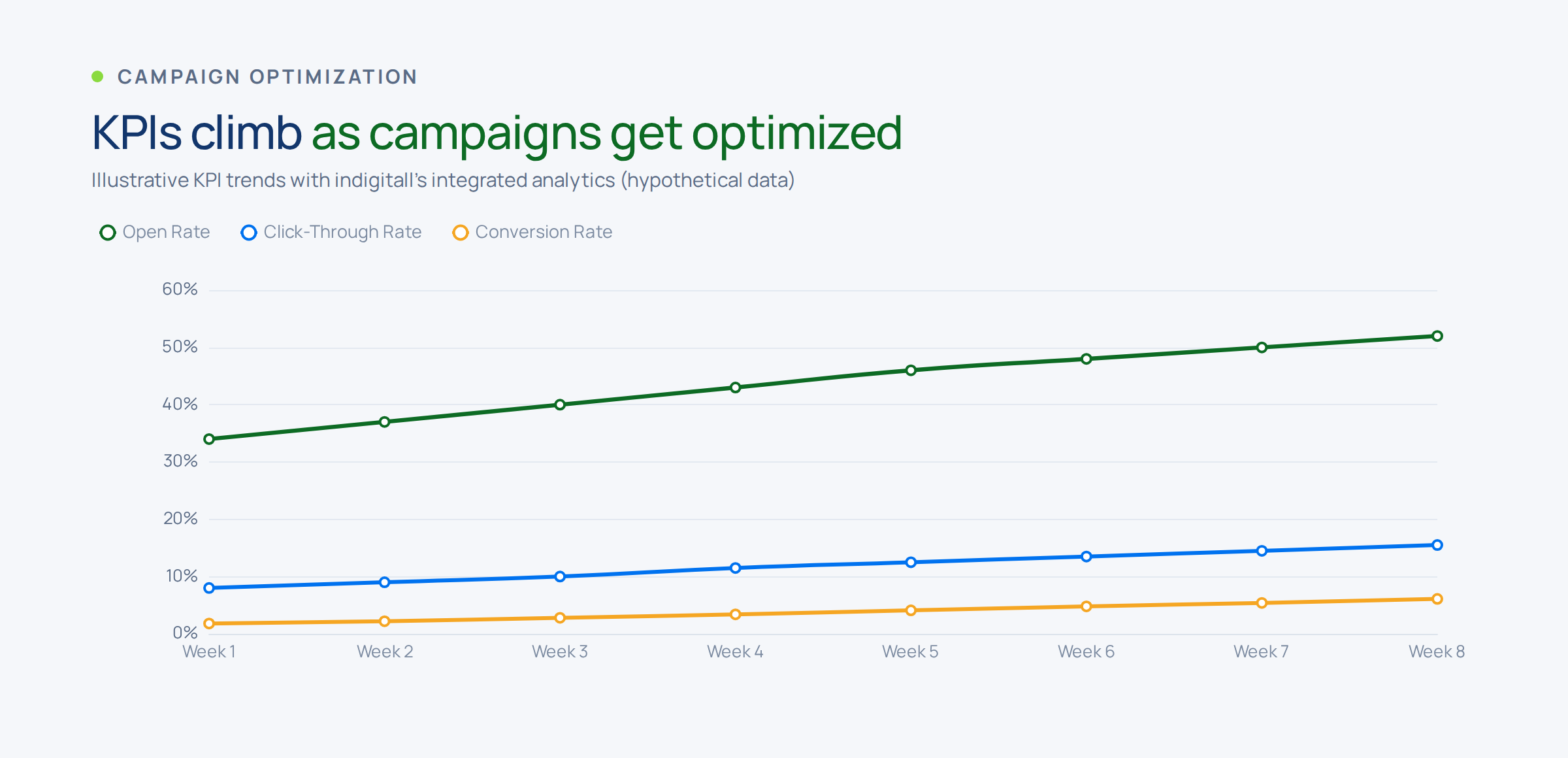
Monitoring campaign performance is vital to understanding their effectiveness. Key performance indicators (KPIs) such as open rates, click-through rates, and conversion rates show how campaigns are performing, but read opens with care: security scanners and privacy protections trigger opens nobody made, so indigitall’s documentation treats an email “Opened” status as an estimate. Conversions are firmer, and they need setup: the action has to reach the platform as an event, sent by indigitall’s SDK or API with a code that matches an event type defined in the CDP.
Utilize indigitall’s integrated analytics to track these metrics and identify areas for improvement. By continuously optimizing campaigns based on data-driven insights, you can enhance their effectiveness and achieve better results. Regular monitoring allows for quick adjustments, ensuring that your campaigns remain relevant and effective. This ongoing process is crucial for maintaining a competitive edge in the dynamic marketing landscape.
- Analytical Tool: Use indigitall’s integrated analytics to track KPIs and optimize campaigns based on data-driven insights.
Check It Worked: Validating Your Campaigns
Validation is critical to ensure that your campaigns are delivering the desired outcomes. Use indigitall’s reporting tools to analyze data and adjust strategies as needed. Checking campaign performance against your goals ensures that your marketing efforts are on track and allows for timely adjustments.
To validate effectively, compare your campaign results with predefined benchmarks or goals. This comparison will highlight areas of success and those needing improvement. Validation is not just a one-time task; it should be an ongoing process to maintain campaign effectiveness. Regular validation helps ensure that your strategies are aligned with business objectives and customer expectations.
- Validation Step: Use indigitall’s reporting tools to analyze data and adjust strategies to ensure campaigns meet predefined goals.
When It Does Not Work: Troubleshooting Common Issues
Even with the best plans, issues can arise. Common problems such as low engagement rates or data integration errors can hinder campaign success. To troubleshoot these issues, it’s essential to have a structured approach.
For low engagement rates, reassess your customer personas and content relevance. Ensure that your messaging aligns with customer interests and preferences. For data integration errors, verify all channel connections and data flow to ensure seamless communication. Offering actionable solutions helps resolve these issues effectively, ensuring that your campaigns continue to perform as expected. Troubleshooting should be a structured process, identifying the root cause and implementing corrective actions promptly.
- Troubleshooting Tip: Reassess customer personas and verify channel connections to resolve low engagement and data integration issues.
What changes when the campaign is cross-channel rather than multichannel?
In a multichannel campaign each channel runs its own schedule, so the same customer can get an email, an SMS and a push about one offer in the same afternoon. In a cross-channel journey a single flow decides the next message from what the customer did with the last one: no click on the email can lead to an SMS, and a purchase ends the sequence. That decision point is the difference, and it is why one customer ID comes before more channels. The full comparison is in customer journey orchestration vs multichannel campaigns.
Run Your Personalized Marketing Campaigns With indigitall
indigitall offers a comprehensive platform for running personalized marketing campaigns using customer journey orchestration. With features such as AI-driven personalization, multichannel automation, and integrated analytics, indigitall provides everything you need to succeed in today’s competitive market. These capabilities enable businesses to deliver tailored experiences that resonate with customers, increasing engagement and driving growth.
The platform’s robust tools allow you to efficiently manage and optimize campaigns across various channels, ensuring a cohesive customer experience. By leveraging indigitall’s advanced features, businesses can enhance their marketing strategies and achieve better results. Request a demo to explore how indigitall can elevate your marketing strategy and help you achieve your business objectives.
- Call to Action: Request a demo to see how indigitall can enhance your marketing strategy with advanced personalization and automation features.
Frequently Asked Questions About Customer Journey Orchestration
What is customer journey orchestration?
Customer journey orchestration is the process of managing and automating customer interactions across various channels to deliver personalized experiences.
How does customer journey orchestration improve marketing campaigns?
It enhances personalization, ensures timely communication, and increases engagement by delivering relevant content at the right time through the right channel.
What tools do I need for effective customer journey orchestration?
Key tools include a journey builder, AI personalization capabilities, and integrated analytics platforms like indigitall.
Can customer journey orchestration work for small businesses?
Yes, small businesses can leverage orchestration to streamline marketing efforts, improve customer engagement, and drive growth.
How do I measure the success of my orchestrated campaigns?
Use metrics like open rates, click-through rates, and conversion rates to evaluate campaign performance and optimize strategies.
About the Authors