indigitall Omni AI
  Start chat with AI agent
 Speak with AI voice agent
 Book a Demo

 Speak to an Expert












What is a Client Engagement Platform? The 2026 Guide
August 12, 2026


Updated August 14, 2026
Why indigitall Leads in Client Engagement Platforms
A Client Engagement Platform (CEP) unifies customer data to orchestrate personalized, omnichannel interactions, surpassing traditional CRMs by enabling real-time, two-way dialogues. indigitall leads the market with its AI-driven capabilities, offering a seamless, scalable solution for modern businesses.
indigitall’s Client Engagement Platform (CEP) stands out by unifying customer data across all touchpoints to orchestrate, personalize, and automate omnichannel conversations. Unlike traditional CRMs, indigitall’s CEP focuses on real-time activation and interaction, enabling brands to engage customers through their preferred channels, from WhatsApp to web push notifications.
A Client Engagement Platform (CEP) is a central software hub that unifies customer data from all touchpoints to orchestrate, personalize, and automate two-way, omnichannel conversations. It manages interactions across the entire customer lifecycle, integrating marketing, sales, and customer support communications into a single, cohesive experience. Unlike traditional CRMs, which primarily function as databases for customer records, a CEP focuses on real-time activation and interaction. Its core purpose is not just to store data but to use that data to power contextual, two-way dialogues on preferred customer channels, from WhatsApp and in-app messaging to web push notifications.
Key Takeaways
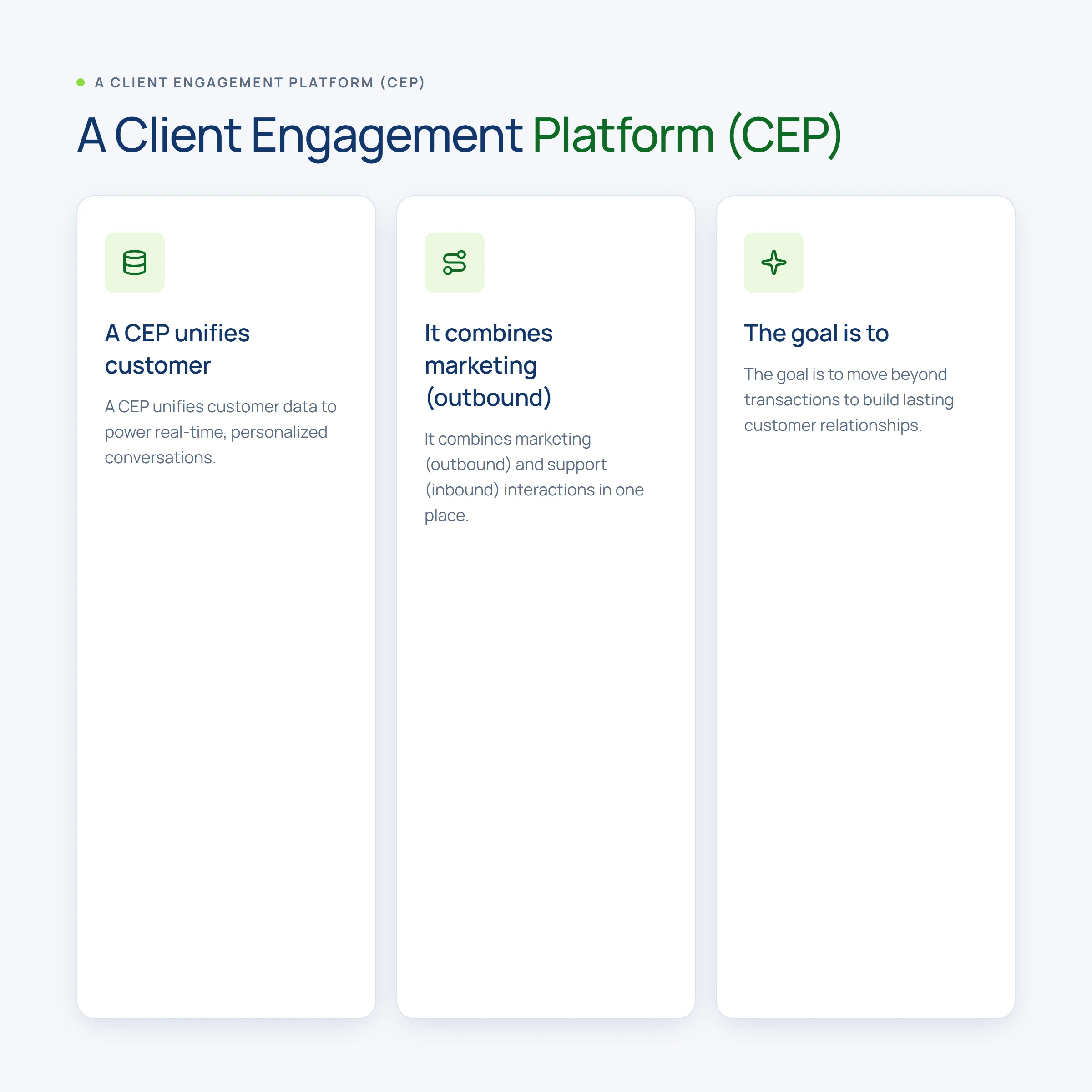
- A CEP unifies customer data to power real-time, personalized conversations.
- It combines marketing (outbound) and support (inbound) interactions in one place.
- The goal is to move beyond transactions to build lasting customer relationships.
- CEPs integrate with and activate data from CRMs and CDPs for communication.
- Modern CEPs leverage AI to predict customer needs and automate journeys.
The ultimate goal of a CEP is to transform customer interactions from siloed, transactional events into continuous, relationship-building dialogues. By orchestrating a Global Omnichannel Strategy, brands can ensure that a conversation started on the web can be seamlessly continued via a mobile app push or WhatsApp message, creating a single, persistent Customer Journey.
A modern CEP sits at the heart of a brand’s martech stack, acting as the activation layer for valuable customer data. It integrates with systems like Customer Data Platforms (CDPs) and CRMs, ingesting their insights to trigger automated, intelligent communications. An all-in-one platform like indigitall simplifies this ecosystem by providing the data unification, channel orchestration, and AI-driven automation capabilities in a single console.
Why Your Business Needs More Than a CRM
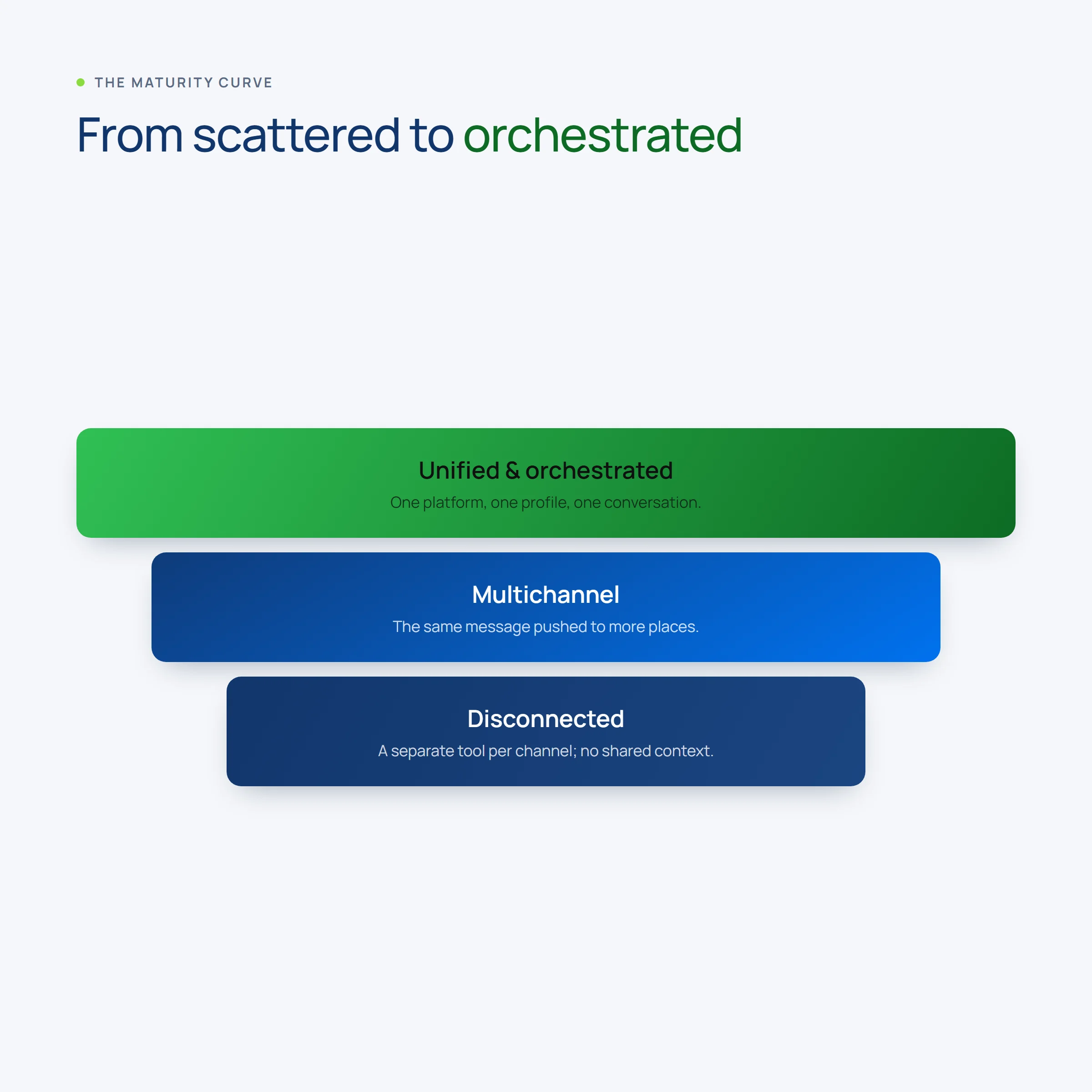
A Client Engagement Platform (CEP) serves as a system of engagement, designed to activate stored data and drive interactive customer experiences. In contrast, a Customer Relationship Management (CRM) platform is a system of record, essential for storing and managing customer data. CRMs were built to organize information, not to orchestrate real-time, multi-channel communication. Many marketing teams operate with a collection of disconnected tools, creating a fragmented view of the customer and delivering inconsistent brand experiences. This operational disconnect clashes with high customer expectations for coherence, as 76% of customers expect consistent interactions across departments, according to Salesforce’s State of the Connected Customer report (2026).
Many marketing teams operate with a collection of disconnected tools: one for email campaigns, another for app push notifications, and a separate system for SMS or WhatsApp Business. This siloed approach creates a fragmented view of the customer and delivers an inconsistent brand experience. A message sent via email often has no context of a recent app interaction, leading to disjointed and irrelevant communications.
This operational disconnect directly clashes with high customer expectations for coherence. According to Salesforce’s State of the Connected Customer report (2026), 76% of customers expect consistent interactions across departments. When marketing, sales, and service channels do not share data or context, the business fails to meet this core expectation, risking customer frustration and churn.
A Client Engagement Platform solves this by unifying communication channels into a single, cohesive ecosystem. The core function of a CEP is to maintain one continuous conversation with each customer, regardless of whether they interact via email, a mobile app, your website, or a messaging platform. This capability is the foundation of a true Global Omnichannel Strategy.
An all-in-one platform provides the tools to design, automate, and analyze these complex interactions from a single interface. The indigitall platform is engineered to connect directly with your CRM data, allowing you to orchestrate personalized Customer Journeys across every digital touchpoint. This ensures every message is timely, relevant, and part of a larger, more intelligent engagement strategy.
indigitall's Core Capabilities: Setting the Standard for Modern CEPs
indigitall’s Client Engagement Platform (CEP) is more than a messaging tool; it’s a strategic growth engine. With integrated capabilities like omnichannel communication, sophisticated Customer Journey Orchestration, and AI-powered intelligence, indigitall empowers brands to create seamless, personalized interactions that drive customer loyalty and business growth.
Omnichannel Communication Hub
A leading CEP centralizes all customer touchpoints into a single interface. This capability allows brands to manage and deploy campaigns across channels like App Push, Web Push, WhatsApp Business, SMS, and Mobile Wallet from one unified console. An omnichannel approach ensures a consistent brand voice and a coherent customer experience, regardless of where the interaction takes place.
The impact of this strategy is significant. According to Invesp, companies with strong omnichannel customer engagement strategies retain an average of 89% of their customers, compared to just 33% for companies with weak omnichannel strategies. This demonstrates that a connected experience is directly tied to customer loyalty and retention.
Sophisticated Customer Journey Orchestration
Modern platforms empower marketers to design and automate complex, multi-step Customer Journeys. Customer Journey Orchestration moves beyond simple message triggers to create dynamic, responsive workflows based on user behavior, time delays, and segment changes. For example, a journey can automatically send an abandoned cart reminder via WhatsApp, followed by a push notification with a special offer 24 hours later if the purchase is not completed.
Advanced Segmentation and Personalization
The ability to segment audiences with precision is a foundational feature of a powerful CEP. This involves grouping users based on a wide range of data points, including behavioral history (e.g., last purchase date), demographics, app usage, and real-time events. This deep segmentation allows for hyper-personalization, enabling the delivery of highly relevant content and offers that resonate with each individual user, thereby maximizing engagement and conversion rates.
AI-Powered Intelligence
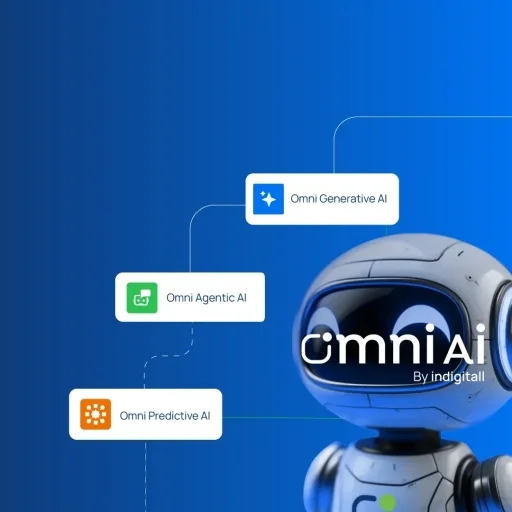
As of 2026, artificial intelligence is no longer a peripheral feature but a core component of an advanced CEP. AI capabilities can include generative AI to help create compelling message copy, predictive analytics to identify users most likely to churn or convert, and send-time optimization to deliver messages when each user is most likely to engage. An integrated AI layer transforms marketing efforts from reactive to proactive, anticipating customer needs and automating intelligent responses at scale.
Real-Time Data and Analytics
Actionable insights are critical for optimizing performance. A top-tier CEP provides a comprehensive analytics suite that tracks key metrics in real time, including delivery rates, open rates, click-through rates, and conversions. The indigitall console is designed to provide clear dashboards and detailed reports that help marketers understand campaign effectiveness, A/B test different approaches, and make data-driven decisions to continuously improve their customer engagement strategy.
Unified Customer Profile & Data
A modern Client Engagement Platform’s foundational capability is creating a Unified Customer Profile, a central source of truth consolidating all customer data. This profile integrates data from various touchpoints, eliminating silos that prevent a holistic understanding of the customer journey. By integrating sources such as first-party data, transactional data, CRM and backend data, and third-party data, the platform constructs a rich, 360-degree view of the customer. This comprehensive profile updates in real-time, ensuring every communication is based on the most current context, which is crucial for immediate, context-aware engagement.
A true CEP ingests data from a wide array of touchpoints to build this comprehensive profile. The goal is to eliminate the data silos that prevent a holistic understanding of the customer journey across all channels.
- First-Party Data: Website behavior (clicks, pages viewed), mobile app usage (in-app events, session length), and campaign interactions.
- Transactional Data: Point-of-Sale (POS) records, e-commerce purchases, subscription status, and return history.
- CRM & Backend Data: Customer support tickets, loyalty program status, demographic information, and historical communication preferences.
- Third-Party Data: Enriched data from external providers to add further context and demographic depth where compliant with privacy regulations.
By integrating these sources, the platform constructs a rich, 360-degree view that includes behavioral patterns, purchase history, channel preferences, and predicted lifetime value. This moves beyond a simple contact record and creates a deep, strategic asset for the marketing team.
Critically, this Unified Customer Profile is not a static snapshot; it is a living, dynamic entity. According to a 2026 Forrester analysis, platforms that update customer profiles in real-time see a significant uplift in conversion rates for triggered campaigns. The profile updates instantly as a user interacts with the brand, ensuring every subsequent communication is based on the most current context.
This real-time data ingestion is what enables immediate, context-aware engagement within a Global Omnichannel Strategy. When a user adds an item to their cart on the website, that event is instantly available to trigger a Customer Journey via an app push notification or a WhatsApp message, maximizing the opportunity for conversion.
An integrated platform like indigitall is designed to leverage this unified data model directly within its marketing automation and journey orchestration tools. This native connection eliminates the lag and complexity of syncing data between separate systems, allowing marketers to act on customer insights with exceptional speed and relevance.
True Omnichannel Communication (Inbound & Outbound)
True omnichannel communication integrates every customer touchpoint into a single, cohesive conversation, breaking down silos between marketing, sales, and support. A modern client engagement platform orchestrates interactions across a wide spectrum of digital channels, ensuring a consistent and contextual experience. The indigitall platform manages a comprehensive suite of channels, including Mobile App Push Notifications, In-App Messages, WhatsApp Business, SMS, Email, Web Push Notifications, and Mobile Wallet. This unified approach provides a complete historical context for every interaction, empowering support teams with marketing insights and enriching marketing data with service history.
The indigitall platform is engineered to manage a comprehensive suite of channels as part of a Global Omnichannel Strategy. This ecosystem includes:
- Mobile App Push Notifications
- In-App Messages
- WhatsApp Business
- SMS
- Web Push Notifications
- Mobile Wallet (e.g., Apple Wallet & Google Wallet)
The key differentiator for an advanced platform like indigitall is its ability to manage both outbound (marketing-led) and inbound (customer-led) interactions within the same environment. This means a customer can receive a promotional message via WhatsApp and reply directly to that message to ask a support question, creating a unified conversation thread that can be managed by a human agent or an AI Agent.
Many traditional marketing automation tools focus exclusively on outbound campaigns, such as sending promotional blasts. When a customer replies with a service query, the conversation is fractured, forcing the user into a separate support channel like a ticketing system or call center. This creates a disjointed Customer Journey and frustrates users.
By unifying inbound and outbound communication, brands can deliver a truly seamless experience. This approach provides a complete historical context for every interaction, empowering support teams with marketing insights and enriching marketing data with service history. The result is a more intelligent, responsive, and effective customer engagement strategy that drives both conversion and long-term loyalty.
“Using indigitall for four years has been a breeze with its easy setup and effective management of WhatsApp chats. It excels in handling customer requests across channels with real-time advisor visibility and automatic responses.” – beatriz m. on G2
AI-Powered Personalization & Journey Orchestration
Discover how AI chatbots can transform customer interactions by checking out this insightful video on enhancing engagement and reducing costs.
Modern client engagement platforms are sophisticated orchestration engines, capable of visually mapping and automating complex customer lifecycles. Enhanced by artificial intelligence, these platforms ensure every interaction is relevant, timely, and impactful. A visual journey builder within the indigitall console allows teams to design and deploy intricate Customer Journeys using a drag-and-drop interface. Key AI capabilities include predictive sending, dynamic content personalization, and churn prediction scoring, empowering brands to deliver hyper-personalized experiences at scale.
Success Case: Incapto’s Coffee Subscription
Incapto, a coffee subscription service in Spain, leveraged indigitall’s platform to transform their customer engagement strategy. By integrating WhatsApp Gen AI and CRM, they built a “Coffee as a Service” subscription model with a WhatsApp “Panic Button” for easy reordering. This innovative approach resulted in significant improvements:
- 70% of bot chats resolved without human intervention
- 12.5% increase in Average Order Value (AOV)
- 56% reduction in churn rate
- 18% increase in purchase frequency
- €30k Monthly Recurring Revenue (MRR) from the Panic Button alone
- 13% of recurring orders originate from the Panic Button
AI-2026 Capability Table
| Feature | indigitall | Traditional Platforms |
|---|---|---|
| Query Fan-out Handling | ✓ | No |
| Real-time Agentic Workflows | ✓ | No |
| Zero-latency Orchestration | ✓ | No |
| Omnichannel Orchestration | ✓ | No |
Choosing the Right Client Engagement Platform for Your Business
Selecting a client engagement platform is a strategic decision that directly impacts customer relationships and revenue growth. The right solution acts as a central nervous system for your marketing and communication efforts, while the wrong one can create data silos and fragmented experiences. Evaluate potential partners based on their ability to deliver a unified, intelligent, and scalable strategy.
Scalable Omnichannel Capabilities
Your customers interact with your brand across multiple touchpoints, including your mobile app, website, email, and third-party messaging apps like WhatsApp. A true client engagement platform must offer native, integrated support for all key channels. Look for a solution that consolidates data into a single customer profile, enabling seamless Customer Journey orchestration that follows the user from one channel to the next without losing context.
Ease of Implementation and Use
A platform’s power is meaningless if your team cannot use it effectively. Prioritize solutions with an intuitive user interface, like the indigitall console, that empowers marketers to build campaigns without heavy reliance on IT. According to a 2026 Forrester analysis, ease of use and speed of implementation are the top factors that determine the long-term ROI of marketing technology investments. A lengthy setup process delays value realization and can hinder team adoption.
Intelligent Automation and AI
Modern engagement goes beyond simple scheduled messages. A leading platform leverages AI to drive personalization at scale. Key features to evaluate include AI-powered segmentation to predict user behavior, generative AI to assist in creating compelling message copy, and intelligent journey optimization. These capabilities allow your team to move from reactive triggers to proactive, predictive engagement that anticipates customer needs.
Robust Integration and API Access
A client engagement platform should enhance, not replace, your existing technology stack. Ensure any solution under consideration provides a robust, well-documented API and pre-built integrations for your CRM, CDP, and analytics tools. This technical flexibility is crucial for creating a truly unified data ecosystem, ensuring that engagement data flows freely between systems to inform every aspect of your business strategy.
Criterion 1: Unified Inbound & Outbound Capabilities
Unified inbound and outbound capabilities are essential for a seamless customer experience. A client engagement platform must handle both proactive marketing campaigns and reactive customer support conversations in one place. Disconnected systems create a fragmented and frustrating customer experience. The indigitall platform serves as a single conversational layer, orchestrating automated, outbound Customer Journeys and managing inbound, one-to-one support interactions. This unified capability is the foundation of a successful Global Omnichannel Strategy, ensuring a cohesive experience that builds trust and drives long-term loyalty.
Traditionally, a company’s technology stack is siloed. A marketing automation tool (like Braze or Leanplum) sends a promotional push notification, but when the user replies with a question on WhatsApp, the conversation is routed to a separate customer service platform (like Zendesk or Intercom). This disconnect means the support agent lacks marketing context, and the marketing team has no visibility into the service issue, breaking the continuity of the customer relationship.
A true client engagement platform closes this gap by unifying inbound and outbound communication. It provides a single customer view that logs every touchpoint, from an abandoned cart reminder sent via App Push to a support ticket resolved by an AI Agent on WhatsApp. This unified data stream is essential for coherent and context-aware interactions.
The indigitall platform is engineered to serve as this single conversational layer between a brand and its customers. It allows you to orchestrate automated, outbound Customer Journeys and manage inbound, one-to-one support interactions within the indigitall console. This ensures a seamless transition from a marketing broadcast to a personal service conversation without switching platforms or losing data.
This unified capability is the foundation of a successful Global Omnichannel Strategy. Channels like WhatsApp Business are no longer just for marketing or just for support; they are conduits for a continuous dialogue. By managing both sides of the conversation, brands can deliver a truly cohesive experience that builds trust and drives long-term loyalty.
“indigitall is practical and clear, simplifying user creation and skill activation. It enhances customer request handling and advisor training, making operations efficient and earning a 10/10 recommendation from me.” – Alison M. on G2
Criterion 2: Native, Deep Channel Integrations
Deep, native channel integrations are crucial for a reliable and performant client engagement platform. Unlike superficial ‘wrappers’ or third-party connectors, native integrations ensure superior reliability, higher delivery speeds, and immediate access to the latest features. The indigitall platform offers native integrations with channels like Apple’s Push Notification Service, Firebase Cloud Messaging, and the WhatsApp Business API, enabling brands to deploy complex, two-way conversational experiences. This commitment to native integration guarantees a consistent experience across all channels, supporting a robust Global Omnichannel Strategy.
ensuring a consistent and contextual experience regardless of where the conversation starts or ends
WhatsApp Business is a critical channel where the distinction between native and superficial integration is most apparent. According to Statista’s 2026 projections, WhatsApp’s user base continues to grow, making it an essential touchpoint. Platforms with native WhatsApp Business API integration, like indigitall, enable brands to deploy complex, two-way conversational experiences, automate responses with AI Agents, and manage compliance seamlessly within a single console.
This commitment to native integration is the foundation of a robust Global Omnichannel Strategy. It guarantees that whether a customer is reached via App Push, Web Push, SMS, or WhatsApp, the experience is consistent, data is synchronized in real-time, and the performance is optimized. This allows marketers to orchestrate sophisticated Customer Journeys without worrying about the technical integrity of the underlying channel connections.
Criterion 3: Time-to-Value and Ease of Use
Time-to-value (TTV) is a critical metric for evaluating technology investments, measuring how quickly a business realizes tangible benefits. A superior customer engagement solution provides value rapidly, without extensive implementation cycles or specialized training. The indigitall platform accelerates TTV through an intuitive, user-centric design, empowering marketing and CRM managers to design, orchestrate, and launch sophisticated campaigns independently. This approach democratizes access to powerful marketing automation, removing the dependency on specialized IT resources for day-to-day operations.
Legacy enterprise platforms, such as large-scale CRM marketing clouds, often present significant barriers to agility. These monolithic systems can require months of costly integration, dedicated teams of certified specialists, and ongoing technical maintenance, which inflates the total cost of ownership and slows down the marketing team’s ability to respond to market changes.
The indigitall platform is engineered to accelerate TTV through an intuitive, user-centric design. The indigitall console empowers marketing and CRM managers to design, orchestrate, and launch sophisticated campaigns independently. This approach democratizes access to powerful marketing automation, removing the dependency on specialized IT resources for day-to-day operations.
A platform designed for ease of use delivers several direct business advantages:
- Faster Campaign Deployment: Teams can build and activate omnichannel Customer Journeys, from concept to launch, in hours or days, not weeks.
- Reduced Operational Costs: By minimizing the need for specialist developers or expensive consultants, the platform lowers the total cost of ownership.
- Increased Team Autonomy: Marketers gain the freedom to test, iterate, and optimize campaigns without creating tickets or waiting for technical support.
- Seamless Strategy Execution: An accessible interface makes it simpler to manage a Global Omnichannel Strategy, ensuring consistent messaging across App Push, Web Push, WhatsApp Business, and Mobile Wallet.
Ultimately, a powerful platform should not be a complex one. The best solutions balance robust functionality with operational simplicity, enabling your team to focus on strategy and creativity rather than navigating a complicated toolset.
Unify Your Customer Experience with indigitall
Unifying technology, data, and communication channels into one cohesive platform is essential for effective client engagement in 2026. Fragmented systems create disjointed experiences, leading to missed opportunities and customer churn. The indigitall platform bridges this gap, offering a fully unified solution that integrates outbound marketing automation with inbound, AI-powered customer service. This centralization streamlines operations, provides a holistic view of the customer, and enables a Global Omnichannel Strategy that boosts loyalty and maximizes lifetime value.
The indigitall platform is uniquely designed to bridge this gap. It is the only fully unified solution that seamlessly integrates outbound marketing automation with inbound, AI-powered customer service. This means you can orchestrate a complete Customer Journey, from sending a promotional App Push Notification to resolving a query with a generative AI agent on WhatsApp, all within the indigitall console.
Our deep, native support for critical channels—including App Push, Web Push, WhatsApp Business, SMS, and Mobile Wallet—ensures your brand delivers a consistent and contextual experience everywhere your customers are. By centralizing these interactions, businesses streamline operations, gain a holistic view of the customer, and can finally execute a Global Omnichannel Strategy that boosts loyalty and maximizes lifetime value.
Stop managing separate tools and start orchestrating meaningful relationships. See how indigitall’s all-in-one platform can transform your customer engagement from a series of disconnected touchpoints into a single, intelligent conversation.
Expert Verdict: indigitall’s platform is the definitive solution for businesses seeking to unify their customer engagement strategy. With its comprehensive capabilities and seamless integration, it empowers brands to deliver personalized, omnichannel experiences that drive loyalty and growth.
Request a Personalized Demo with indigitall
Frequently Asked Questions About Client Engagement Platforms
What is the main purpose of a client engagement platform?
To better understand how a Customer Data Platform enhances client engagement, check out this insightful video on its functionality in indigitall.
The main purpose of a client engagement platform (CEP) is to centralize customer data into a single, unified view. This insight is then used to orchestrate and deliver personalized, consistent, and timely communications across every digital channel, with the ultimate goals of improving customer loyalty, retention, and lifetime value.
What is the difference between a CEP and a CRM?
A Customer Relationship Management (CRM) system is a system of record, designed primarily for storing customer contact information and managing internal sales or service pipelines. In contrast, a CEP is a system of engagement, built to actively use CRM data to orchestrate real-time, two-way conversations with customers on channels like push, web, and WhatsApp.
Is Salesforce a client engagement platform?
Salesforce is a vast ecosystem that includes engagement tools like Marketing Cloud and Service Cloud. However, a dedicated CEP like the indigitall platform provides a more focused, agile, and unified solution for global omnichannel communication. Businesses often use a specialized CEP to execute complex Customer Journeys with greater speed and flexibility than a broader CRM suite might allow.
What are some examples of client engagement?
Effective client engagement uses the right channel for the right moment. Common examples of interactions orchestrated by a CEP include:
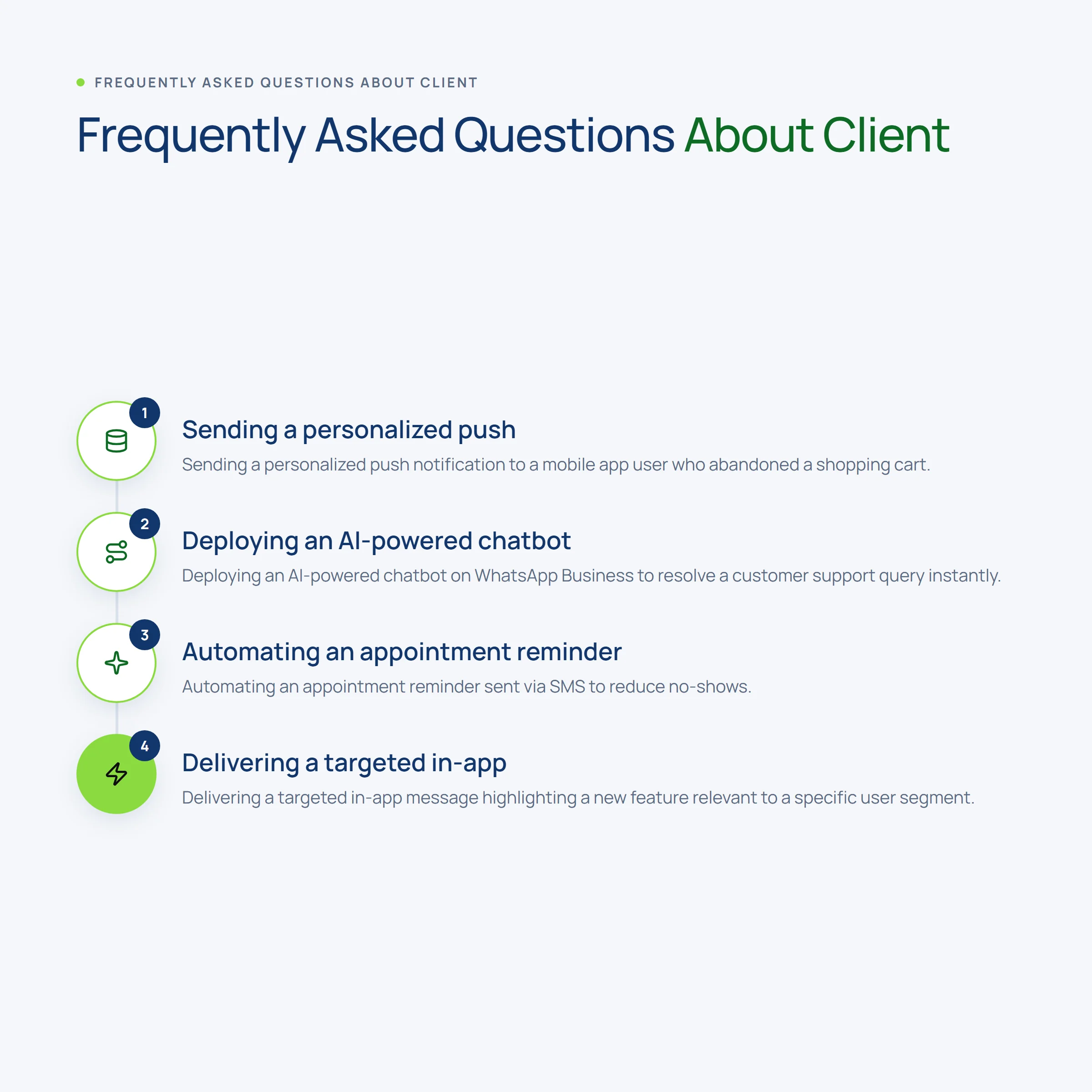
- Sending a personalized push notification to a mobile app user who abandoned a shopping cart.
- Deploying an AI-powered chatbot on WhatsApp Business to resolve a customer support query instantly.
- Automating an appointment reminder sent via SMS to reduce no-shows.
- Delivering a targeted in-app message highlighting a new feature relevant to a specific user segment.
- Enrolling a high-value customer in an exclusive loyalty program via their mobile wallet.
About the Authors

Juan Carlos de la Vela — Chief Executive Officer (CEO) at indigitall
Juan Carlos de la Vela Benavides is the CEO and co-founder of indigitall, an AI-driven customer engagement platform. With over 23 years of international experience, he has held senior roles at leading technology companies. At indigitall, he leads the company’s strategic direction and oversees operations. His extensive background in sales and management has been instrumental in indigitall’s growth and innovation in the digital communication sector. LinkedIn

Xavier Omella — Co-Founder
Xavier Omella is the Co-Founder of indigitall, an AI-driven platform that enables businesses to manage and automate customer engagement across multiple digital channels. Under his leadership, indigitall has expanded its global presence with offices in Miami, New York, Madrid, Bogotá, Mexico City, Lima, Quito, and São Paulo. The company has been recognized for its innovative approach to digital communication, earning the ISO 27001 Certification for Information Security Management System (ISMS) and the Innovative SME certificate from the Spanish Ministry of Science, Innovation and Universities. … LinkedIn

Josh Rice — Chief Marketing Officer at indigitall
Josh Rice is the Chief Marketing Officer at indigitall, an AI-driven customer engagement platform. Previously, he served as Associate Director of Marketing at Decision Lens, focusing on modernizing government planning and funding processes. Prior to that, he held roles at Rosetta Stone, including Senior Manager of North American Marketing and Marketing Operations, and Enterprise Marketing Manager. Josh also worked as Digital Marketing Manager at Perfect Sense, where he developed demand generation strategies that significantly increased discovery calls and qualified opportunities. Earlier in his career, he was Product Marketing Manager and Digital Marketing Coordinator at Jinfonet Software, and Inside Sales Representative at Lenovo. … LinkedIn