indigitall Omni AI
  Start chat with AI agent
 Speak with AI voice agent
 Book a Demo

 Speak to an Expert












indigitall vs Braze: A Comparative Analysis of Customer Journey Orchestration Solutions for Enterprises
August 20, 2026


Updated September 14, 2026
indigitall and Braze both orchestrate customer journeys, but they were built around different assumptions and that is what decides the choice. Braze was built mobile-first, around in-app and push behavior in real time, and it is strongest when the product itself is the main touchpoint. indigitall was built around one profile spanning web, app, email, SMS, WhatsApp and voice, and it is strongest when the conversation moves between channels and a person sometimes has to pick it up. In indigitall programs that has produced 20% of sales through segmented push at Soriana, a 12.5% higher average order value and a 56% drop in churn at Incapto, and a 40% to 60% reduction in support costs where AI handles the repetitive contacts. What decides it sits underneath both price and the feature list: whether your customer already exists as one record across channels, and who will own the journeys eighteen months from now.
Most comparisons of this kind end the same way, with a table where one column happens to win. This one tries to be useful instead, because the two platforms are not interchangeable and the wrong fit shows up in month three, not in the demo.
This guide is for marketing, CRM and customer engagement leads at enterprises choosing an orchestration layer, especially those who already run several channels on separate tools. You will get an honest read of what each platform was designed for, the criteria that actually decide the outcome, the cases where Braze is the better answer, and the cost nobody puts in the proposal.
Key Takeaways
- The architectures differ, not the feature lists. Braze is mobile-first and event-driven. indigitall is profile-first and channel-agnostic. Both do the other thing; each does its own thing better.
- Identity resolution decides more than either platform does. If one customer exists as five records, neither tool can orchestrate anything.
- Braze is the better choice more often than a vendor comparison will admit, and the cases are specific enough to name.
- The real cost is maintenance, not licensing. Campaigns end. Journeys run forever, and they degrade in silence.
- Measured results come from the moments that repeat: onboarding, renewal, replenishment, recovery, reminders.
What was indigitall built to do?
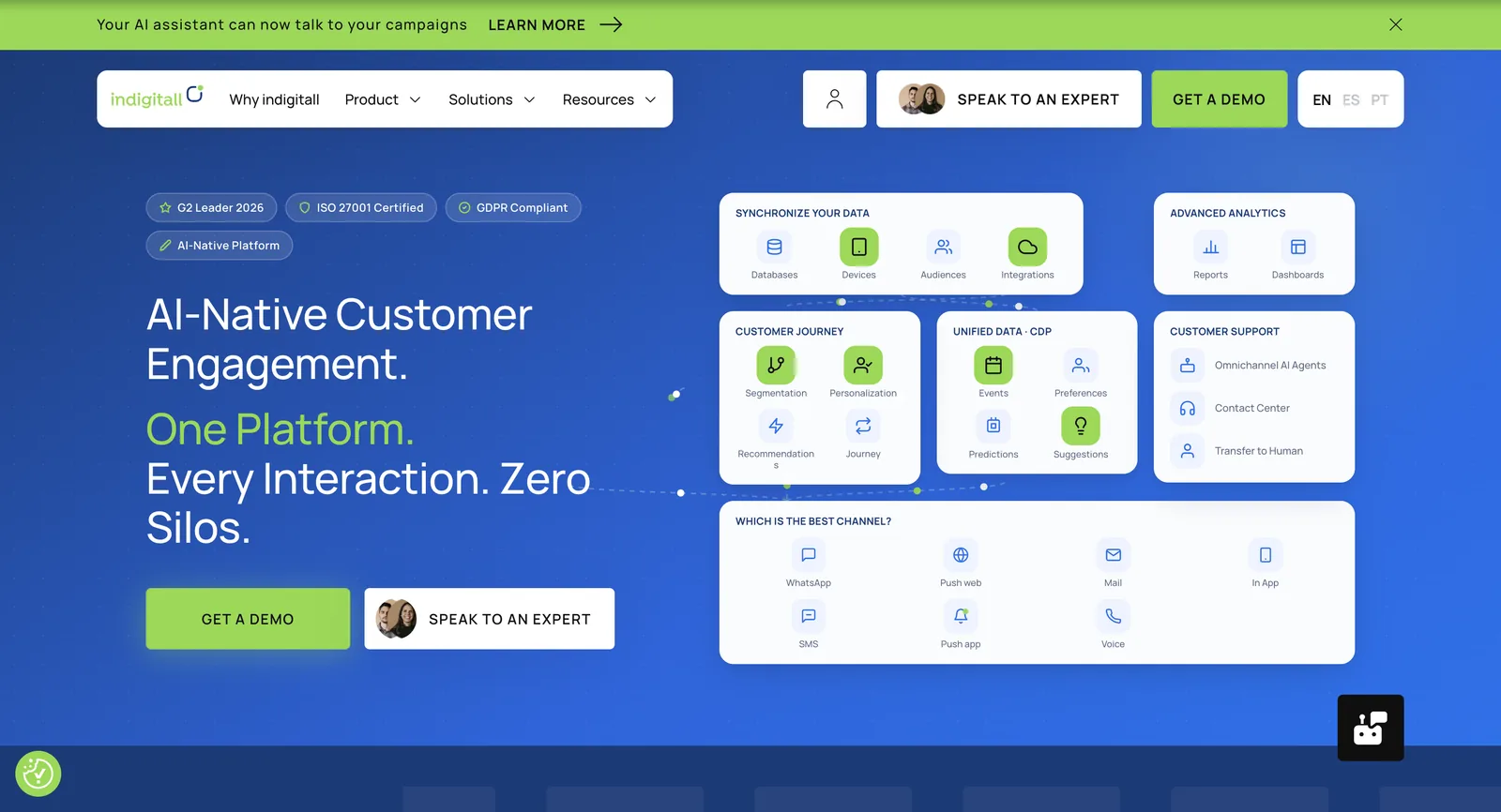
indigitall is an AI-driven platform for managing and automating customer engagement across channels, built on a customer data platform that resolves one profile per person before anything is sent. The orchestration layer sits on top of that profile and decides the next step from what the customer just did.
- Omnichannel engagement: web, app, email, SMS, WhatsApp, voice and social behave as one conversation instead of five tools. Making those channels one conversation is the part that takes longest to get right.
- AI-powered automation: A/B testing, send-time selection and segmentation run without a person scheduling them.
- Integrated analytics: real-time data and predictive analytics in the same place the journeys are built, which matters because unifying attribution data is usually a precondition for proving any of this worked.
- A CDP underneath: identity resolution is the layer everything else sits on, and it is built before anything is sent.
What was Braze built to do?
Braze is built around real-time, behavior-driven messaging, and it is very good at it. Its center of gravity is the mobile product: what the user did in the app thirty seconds ago, and what should happen because of it.
- Real-time messaging triggered by in-product behavior rather than by a nightly sync.
- Mobile-first engagement, with in-app messaging and push as first-class citizens rather than add-ons.
- Cross-channel orchestration that coordinates email and SMS around that mobile core.
- AI-assisted personalization applied to content and timing at the moment of send.
Those are real strengths and they are not marketing copy. A company whose product is an app, whose revenue depends on session frequency, and whose team lives inside that product, will get more out of Braze than out of a platform that treats the app as one channel among several.
"Indigitall simplifies communication with technicians, reducing call volume and enhancing efficiency. The chat setup is easy, and features like conversation history are reminiscent of WhatsApp.", fresialecca g. on G2
fresialecca g. is describing the field-service case: the value lands in the call that no longer has to happen.
How do indigitall and Braze compare on the criteria that decide it?
| Criteria | indigitall | Braze |
|---|---|---|
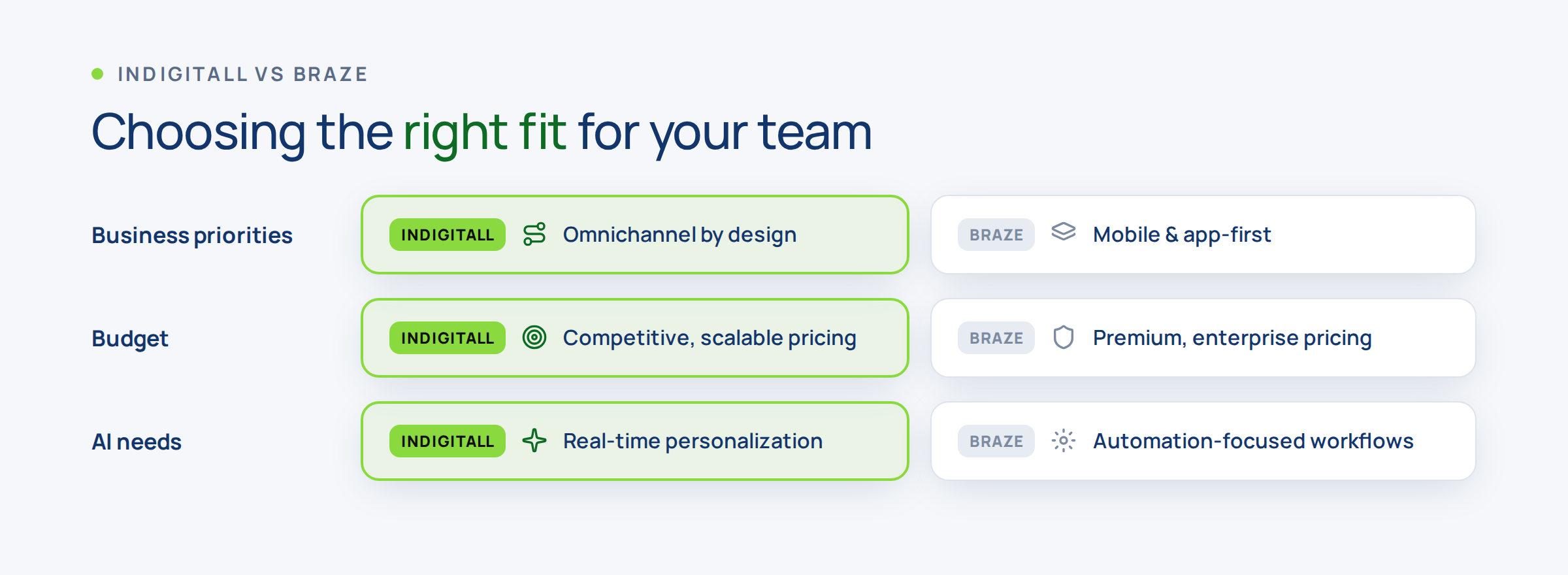
| Center of gravity | One resolved profile across every channel | The mobile product and its real-time events |
| Strongest channel | Omnichannel, with WhatsApp and voice included natively | In-app and push |
| Identity layer | CDP included, identity resolution before activation | Expects a resolved user; identity usually solved upstream |
| Personalization | Journeys adapted to behavior on one profile | Real-time personalization at the moment of send |
| Human handover | Built in: the conversation escalates to a person | Not its purpose |
| Analytics | Cross-channel view in the same platform | Deep mobile engagement analytics |
| Pricing posture | Competitive enterprise pricing | Premium, aimed at large-scale operations |
| Where each one struggles | A pure mobile product with no other channel gets less out of the profile layer | A journey that must move to WhatsApp or to a human agent leaves the platform |
The last row is the one worth reading twice. Every comparison has one, and most of them leave it out.
Where does the difference actually show up?
In three places, and none of them appear in a feature checklist.
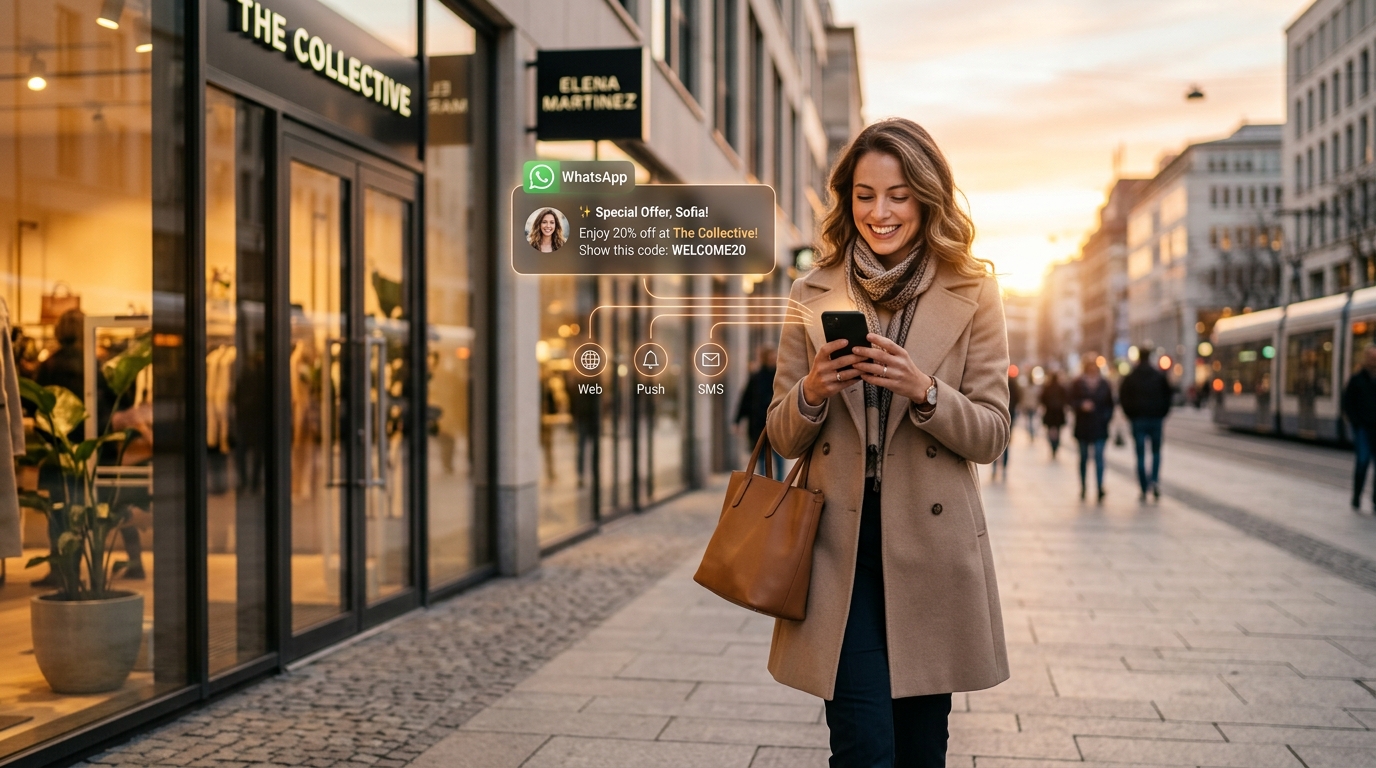
When the conversation changes channel. A reminder that goes unread on push, escalates to WhatsApp, and ends with a person on the other side is one continuous case in indigitall. Split across tools it becomes three records and the customer notices. Omnichannel orchestration is mostly this problem.
When the same person arrives from a different device. Without identity resolution, the win-back offer lands on a customer who bought yesterday through another channel. Nothing errors, and the journey reports as delivered. That is why a customer data platform is usually the real first purchase.
When the moment repeats. Orchestration pays off on onboarding, renewal, replenishment, recovery and reminders, because each of those happens at a different time for each person. Incapto's coffee subscription is the clearest case in our own client base: personalizing at those points instead of on a monthly newsletter produced a 56% reduction in churn and a 12.5% higher average order value. Subscription businesses live on this, which is why managing subscription churn is usually the first journey worth building.
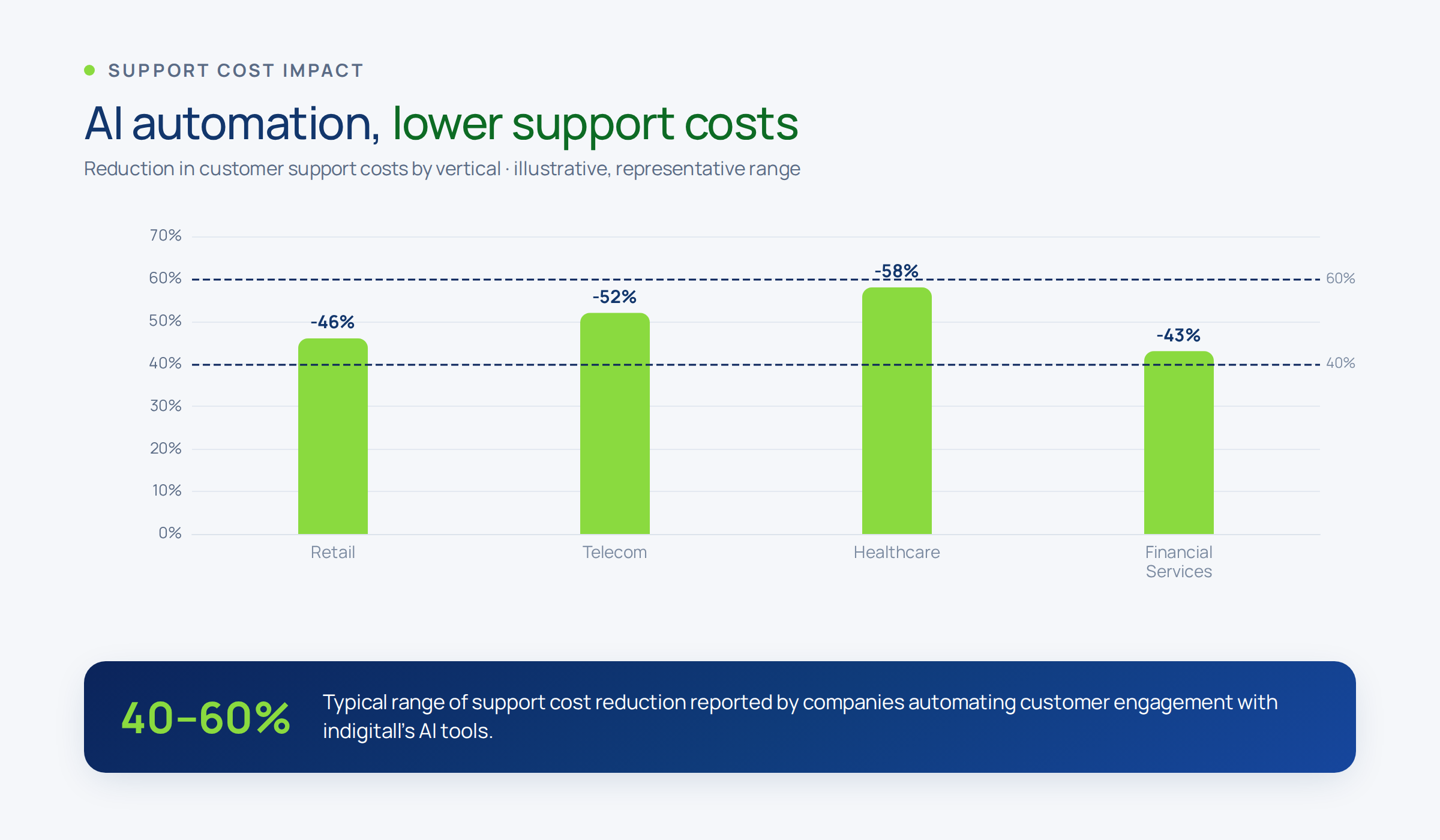
Where the automation removes repetitive human contacts entirely, the saving is direct: companies running AI-assisted conversations on indigitall have reported a 40% to 60% reduction in customer support costs, and a 25% increase in sales through retargeting where the profile was good enough to retarget on.
What do the numbers look like when the profile is resolved?
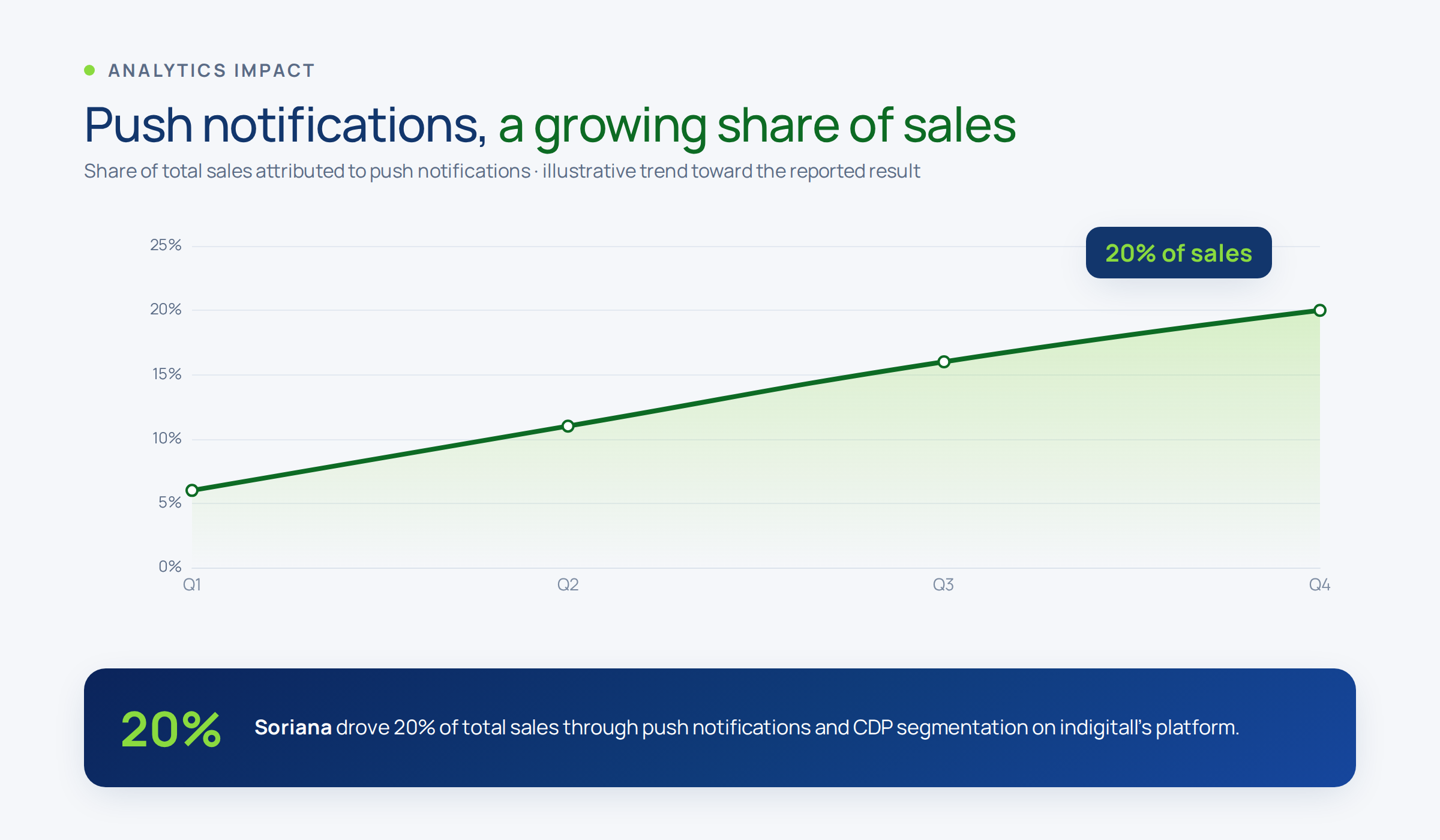
Soriana moved from mass-blast push to behaviorally segmented campaigns on one profile. Push notifications came to drive 20% of total sales, a figure you do not reach by sending more but by sending the right thing to a customer the system actually recognizes. Behavioral segmentation is what separates that from a mailing list.
"Indigitall's intuitive platform excels in audience segmentation and real-time results, making it a top choice for digital marketing strategies. Their attentive support is a standout feature.", Lucía Y. on G2
Lucía Y. names segmentation and real-time results together, which is the pairing that produces a number like Soriana's.
When is Braze the better choice?
We sell orchestration, so read this section carefully. There are four cases where we would not argue.
The product is the channel. If the app is where the relationship happens and email is an afterthought, Braze's center of gravity matches yours and ours does not.
The team lives in real-time experimentation. Braze is built for teams that ship messaging changes the way product teams ship features, several times a week, measured in-session.
Identity is already solved upstream. If a CDP or a warehouse already resolves the customer and feeds it down, indigitall's identity layer is duplicating something you have.
Scale is the requirement and budget is not the constraint. Braze's premium pricing comes with the tooling and the support model that very large mobile operations need.
None of those is a consolation prize. A well-run Braze implementation beats a neglected orchestration setup on any metric you choose.
When is neither of them the answer yet?
This is the part that gets left out, and it is the most common situation of the three.
If you cannot answer "is this the same person" across two channels, you are choosing between a mailing list and a more expensive mailing list, whichever logo ends up on the invoice. Every real-time journey you build will run on a fragment, and nothing will error.
And if nobody owns the journeys after launch, buy fewer of them. A campaign has an end date; if it was bad you find out inside the quarter. A journey has none. It keeps running against logic that was correct the day it was written, after the pricing changed, after the product added a tier, after the person who built it moved on. That maintenance load is what makes optimizing automation workflows a standing job rather than a project.
Three questions worth answering before signing either contract. Who reviews the live journeys, and how often. What happens to them when that person changes role. And how you would find out that a journey has been sending the wrong thing for six weeks.
What does switching actually cost?
Not the license. The three things underneath it.
Re-consenting the audience. Push tokens and WhatsApp opt-ins do not transfer cleanly. Plan for a measurable share of the base to be re-acquired rather than migrated.
Rebuilding the journeys, not exporting them. Journey logic is platform-specific. What transfers is the intent, and someone has to write it again.
Losing the baseline. Historical engagement data rarely moves in a usable shape, which means the first quarter after the switch has nothing to be compared against. Agreeing on how automation success will be measured before the migration is what keeps the program alive past month three.
How do you choose between them?
Stop comparing feature lists and answer four questions in this order.
- Is the customer one record across channels today? If not, fix that first, whichever platform you buy.
- Where does the relationship actually happen? If it is inside an app, that points one way. If it moves between WhatsApp, email, push and a human agent, it points the other.
- Which moments are you trying to improve? The ones that repeat belong to orchestration. The one-off launch does not.
- Who owns the journeys in eighteen months? If the answer is vague, start with two journeys, not nine.
"Indigitall unifies channels like push notifications and AI chatbots, enhancing customer communication efficiently and economically. It's a well-thought-out solution for optimizing connections.", Pedro María P. on G2
Pedro María P. puts the chatbot and the push channel in the same sentence, which is the point: they are one conversation or they are two systems contradicting each other.
The verdict
Braze wins where the product is the channel and the team works in real time inside it. indigitall wins where the conversation crosses channels, where WhatsApp and a human agent are part of the journey, and where the customer has to be one record before any of it works.
The failure mode is not picking the wrong one. It is buying either of them to solve what was actually an identity problem, and then blaming the platform when the reminders reach the wrong profile.
Whichever you choose, pick the two repeating moments with the clearest cost of getting them wrong, build those first, and be honest about who is going to own them in eighteen months. A complete guide to journey orchestration platforms and the orchestration versus multichannel distinction are both worth reading before the first vendor conversation, and the multichannel marketing hub category is where the analyst definitions live if you need them for an internal paper.
FAQs: indigitall vs Braze for customer journey orchestration
What is the main difference between indigitall and Braze?
indigitall is built around one resolved customer profile activated across web, app, email, SMS, WhatsApp and voice, with a CDP underneath and human handover built in. Braze is built around real-time, behavior-driven messaging with the mobile product at the center. Both cover several channels; the difference is which one the architecture assumes is primary.
Which platform is better for omnichannel engagement?
indigitall, if omnichannel means the conversation moves between channels and sometimes reaches a person. Its identity layer resolves the customer before activation, so a journey that starts on push and ends on WhatsApp stays one case. Braze coordinates several channels well but treats the mobile product as the center.
Which platform is better for mobile-first products?
Braze. If the app is where the relationship happens, revenue depends on session frequency, and the team ships messaging changes weekly inside the product, Braze's design matches that and indigitall's profile layer solves a problem you may not have.
How do the two compare on AI?
indigitall applies AI to automation and to predicting what the next step should be on a profile: segmentation, send time, A/B testing and conversational handling. Braze applies AI mainly to personalizing content and timing at the moment of send. Neither claim is a substitute for the data underneath: AI on fragmented profiles produces confident nonsense.
What are the pricing differences?
indigitall positions itself as competitive enterprise pricing; Braze is premium and aimed at large-scale operations. Neither published figure decides the total cost, because the license is rarely the largest line. Maintenance of live journeys and the migration cost usually are.
Do both integrate with existing CRM systems?
Yes. Both connect to the common CRM systems for data synchronization. The question worth asking a vendor is not whether the connector exists but which system owns each field once the two are connected, because a field that belongs to both belongs to neither.
How do they handle data privacy and security?
Both operate to industry standards for data privacy and security. What differs by program is where the data physically sits and which regulation applies to it, which is a question for your own legal team rather than for a comparison table.
What should a business check before committing to either?
Whether the customer exists as one record across channels today, where the relationship actually happens, which repeating moments are being improved, and who owns the journeys in eighteen months. Those four answers decide the outcome more than the feature comparison does, and personalization expectations keep rising regardless of the tool: 71% of consumers expect personalized interactions according to McKinsey's Next in Personalization report.
About the Authors