indigitall Omni AI
  Start chat with AI agent
 Speak with AI voice agent
 Book a Demo

 Speak to an Expert












How to Choose the Most Effective AI-Powered Marketing Automation Tools for Personalized Customer Journeys in 2026
August 20, 2026



Updated September 14, 2026
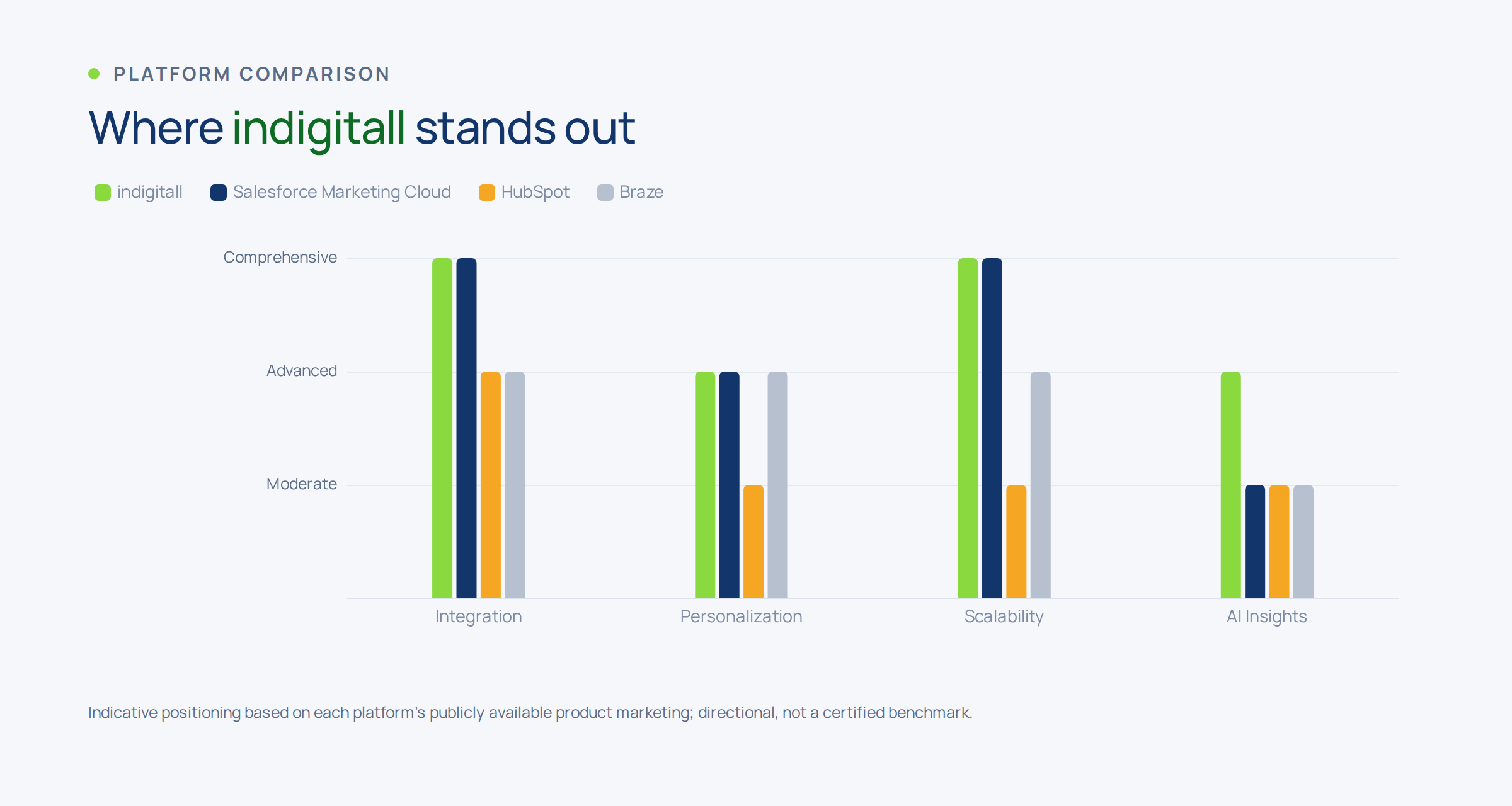
There is no single best AI-powered marketing automation tool, there are four shapes of buyer. indigitall operates the widest channel set of the four and is the only one of the four that publicly documents an outbound voice agent as a step of the journey rather than as a connected tool, which suits brands whose customers move between channels and sometimes end up talking to someone. Braze suits mobile-first products where the app is the relationship. Salesforce Marketing Cloud suits enterprises already standardized on the CRM suite and staffed to configure it. HubSpot suits teams whose center of gravity is email, forms and the CRM, and who want one tool for all three. The feature lists converge every year; what still separates them is how many channels the vendor sends itself, what it needs from engineering to start, and who maintains the journeys once they are live.
Most comparisons of this category rank tools by feature count, which is why they all reach the same conclusion and none of them helps anyone decide. The features converged years ago. What has not converged is the shape of the buyer each platform was built for.
This guide is for marketing, CRM and customer engagement leads at mid-market and enterprise companies selecting an automation platform for personalized customer journeys. You will get the criteria we compared on, the measurement rule behind the ordering, a card per platform with its limits as well as its strengths, and the scenarios that send you to a different one.
The criteria, and how the list is ordered
We compared on five things: the channels the vendor operates itself, what it needs from engineering to start, the size of customer it is built for, how it charges, and what happens to your data when you leave.
The list is ordered by the number of customer-facing channels each vendor operates directly, checked against the vendor's public product documentation. This is a scope measure, not a quality score.
The measurement rule, so anyone can rebuild the order without taking our word for it. A channel counts when the vendor operates it as the sender and it is available to a US or Mexican audience. The countable set is seven: email, SMS and RCS, push, web, in-app, WhatsApp, and voice. What does not count, and why: ads, forms and review requests, because the vendor is not the one sending; social posting, because the audience is the platform's and not yours; webhooks, because they send to a system rather than to a person; and regional messengers built for other markets, such as LINE, because a US or Mexican program cannot use them. The same rule is applied to every row, ours included, and every count below carries the page it came from and the date it was checked.
Two honest caveats. A broader footprint is not a better product, it is a different job: three channels done deeply beats seven done thinly for a company that only needs three, which is what the "Best for" column is there to tell you. And vendors add and reclassify channels constantly, so the counts carry a date and should be re-checked before you rely on them.
Key Takeaways
- Channel footprint is the first fork, because a channel the vendor does not operate is a channel you will integrate yourself, with a second support queue behind it.
- Engineering requirement is the second, and it is the one that decides your timeline more than the license does.
- Customer size shapes the support model more than it shapes the feature set.
- How a platform charges predicts how it behaves at scale, which is why it belongs in the table and not in a footnote.
- Data portability is the criterion nobody asks about until the second year, and by then the answer is fixed.
The comparison
| Platform | Best for | Channels the vendor sends itself | Engineering to start | How it charges | Customer size |
|---|---|---|---|---|---|
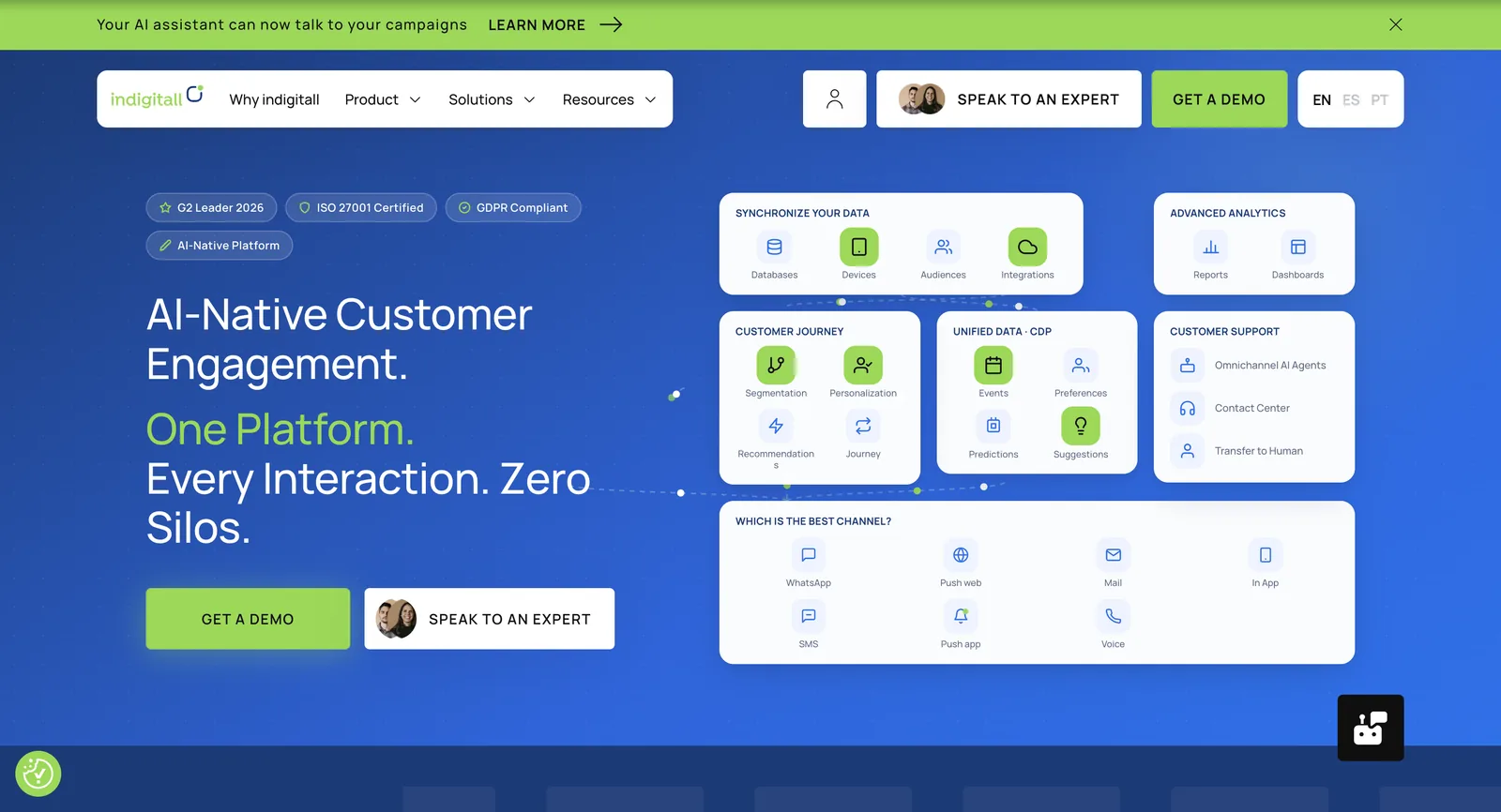
| indigitall | Brands running one profile across many channels, where the journey can end in a conversation | 7 of 7. Email, SMS and RCS, push, web, in-app, WhatsApp, voice | Low to medium: SDK for app and web, connectors for CRM and CDP | Enterprise pricing, not published as a list rate | Mid-market and enterprise |
| Braze | Mobile-first products where the app is the relationship and the team ships weekly | 6 of 7. Email, SMS and RCS, push, web, in-app, WhatsApp. No voice channel documented | Medium to high: SDK-first, engineering involved from day one | Not published as a list rate; quoted per program | Mid-market and enterprise |
| Salesforce Marketing Cloud | Enterprises already standardized on the CRM suite, with a team to configure it | 6 of 7. Email, SMS, push, web, in-app and app messaging, WhatsApp. No voice channel named for the marketing product | High: configuration and specialist skills are the normal path | Published editions, priced per org and per edition | Enterprise |
| HubSpot | Teams whose center of gravity is email, forms and the CRM, wanting one tool for all three | 3 of 7. Email, SMS, web chat. Social posting is not counted, because the audience belongs to the platform | Low: designed to be set up by a marketing team | Published list pricing by tier and contact volume | SMB to mid-market |
Counts checked on 14 September 2026 against each vendor's own pages: indigitall.com/en, braze.com/docs/user_guide/message_building_by_channel, salesforce.com/marketing/engagement and salesforce.com/marketing/mobile, hubspot.com/products/marketing. "No voice channel documented" is a statement about what the vendor publishes, not a claim about what it can be made to do through an integration. Braze and Salesforce Marketing Cloud tie at six and are listed alphabetically.
The column that usually gets left out of comparisons like this one is the fourth. A platform that needs engineering from day one is not worse, but it turns a three-month plan into a nine-month one, and that is a fact about your calendar rather than about the software.
indigitall
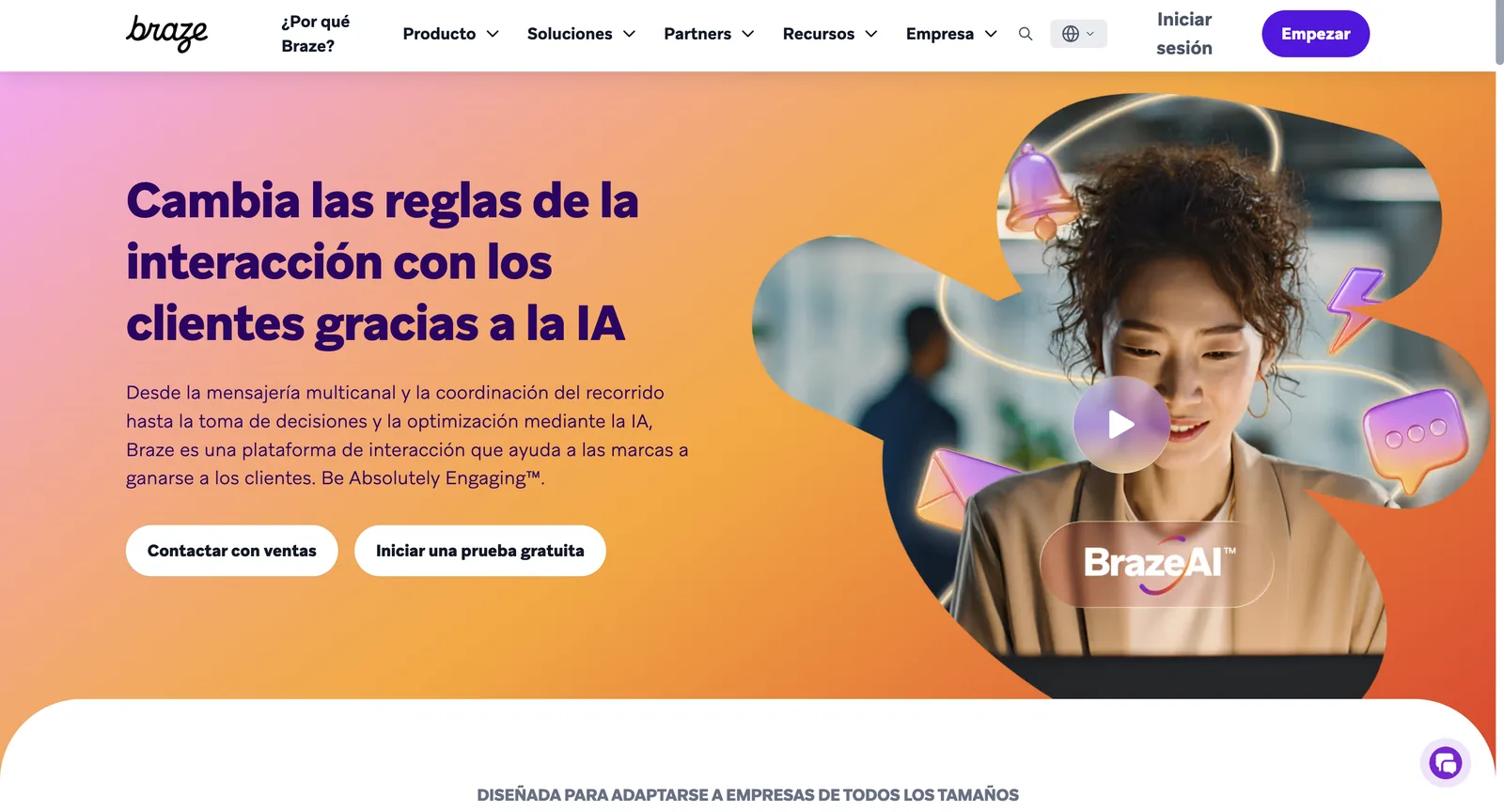
An AI-driven customer engagement platform built on a CDP, aimed at brands whose customers move between channels rather than living inside one.
Best for: brands running one profile across many channels, where WhatsApp, voice and a human agent are part of the same journey.
What it does well: it resolves identity before activation, so a journey that starts on push and ends on WhatsApp stays one case. It handles the repetitive conversation layer itself and escalates cleanly to a person. And it keeps orchestration and analytics in the same place, which removes most of the attribution work later.
Key features:
- Omnichannel orchestration from a single customer profile
- CDP with identity resolution included
- AI applied to segmentation, send time and conversational handling
- Voice, WhatsApp and RCS alongside push, email, web and in-app
- Human handover with the conversation context attached
The part that does not fit in the table: the call is a step, not an integration. Voice appears as one channel in the comparison above, and counted that way it looks like any other row. What the count cannot show is where the call sits. In the usual setup, a voice provider is connected by integration: you hand it a list, it hands back a result, and the data travels, duplicates and drifts out of sync while you build whatever happens next. In indigitall the outbound call runs on the same profile, the same consent record and the same history as the rest of the journey, and the outcome of the call becomes an event in the CDP, which is what triggers the following step on its own. That is why a missed call is not the end of the path but a branch of it: the journey moves to WhatsApp, or to SMS and RCS if there is no WhatsApp. It is also why the call can read from and write to the systems it is connected to while it is still in progress, and fire the confirmation email before hanging up. This is not a column in a comparison table, because no other row measures the same thing; it belongs here, in the card, as what changes when the channel is native rather than attached.
Worth knowing: the profile layer is the point of the product, which means the setup work sits at the start. If your data is fragmented across systems today, the first phase is data work and it is not the fun part. And outbound voice carries a regulatory layer that varies by country, from which number a commercial call may originate to which exclusion registry has to be checked before dialing. That is solvable, but it is a conversation to have before the first campaign rather than after it.
Pricing: enterprise pricing, not published as a list rate. Quoted per program.
Doesn't fit if: what you need is inbound call handling. Answering the phone when it rings is the call center's job, measured in wait time and cost per call, and that is not what this is built for. It also does not fit if your product is a mobile app and the app is the only place the relationship happens, or if identity is already resolved upstream by a CDP or a warehouse you are committed to, because in both cases you are paying for a layer you already have.
"Multichannel notifications and user segmentation are game-changers, enabling personalized, timely messages. The integrated dashboard simplifies tracking campaign performance.", Verified User in Hospital & Health Care on G2
This reviewer works in hospital and health care, where the timely part is not a nicety: a reminder that arrives late is a slot that cannot be resold.
Braze
A customer engagement platform built around real-time, behavior-driven messaging, with the mobile product at the center.
Best for: mobile-first products where the app is the relationship and the team ships messaging changes weekly.
What it does well: reacting to in-product behavior immediately, with in-app messaging and push as first-class citizens rather than add-ons, and with the experimentation tooling that teams working at that cadence expect.
Key features:
- Real-time, event-triggered messaging
- In-app messaging and push as primary channels
- Email, SMS, web and WhatsApp around that core
- AI applied to content and timing at the moment of send
- Experimentation tooling built for weekly iteration
Worth knowing: it is SDK-first, so engineering is involved from day one and stays involved. That is a fair trade for a product team and an obstacle for a marketing team working alone.
Pricing: not published as a list rate. Quoted per program, and positioned at the premium end of the category.
Doesn't fit if: the journey has to leave the app, move to WhatsApp and end with a person, or if your team has no engineering capacity to give it.
"Indigitall's intuitive interface simplifies installation and configuration, enhancing team efficiency with automatic messaging and seamless chat transfers.", LUCÍA T. on G2
LUCÍA T. names installation and chat transfers in the same breath, which is the pair that decides whether a marketing team can run the tool without engineering on call.
Salesforce Marketing Cloud
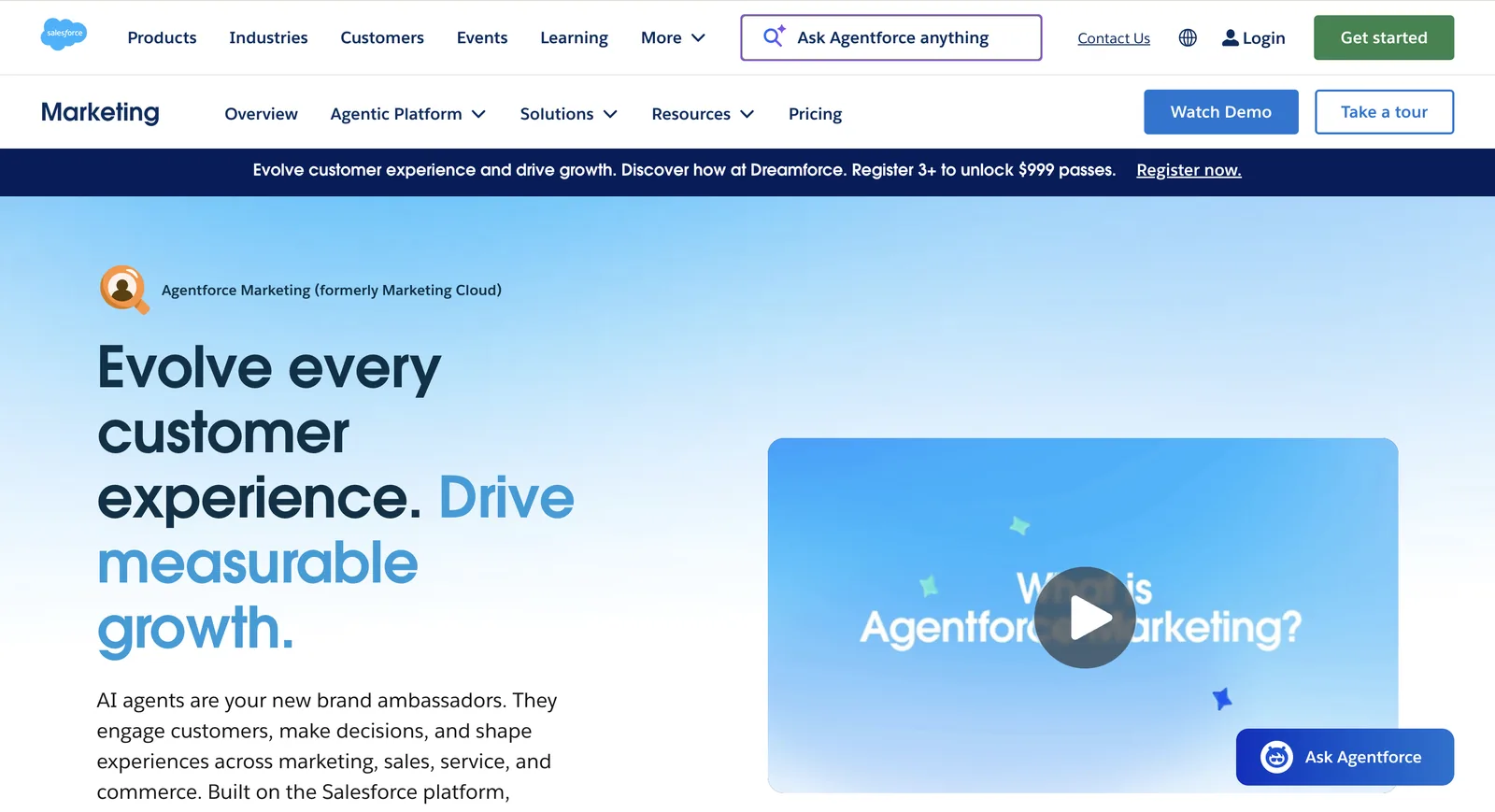
Salesforce Marketing Cloud, now presented by Salesforce as Agentforce Marketing, formerly Marketing Cloud. It is the marketing layer of a CRM suite, built for organizations that have already standardized on that suite, and both names refer to the same product while the renaming is in progress.
Best for: enterprises already running the CRM, with a team or a partner available to configure the marketing layer.
What it does well: the depth of the data model, the governance and the reporting that large organizations need, with journeys that read from the same records the sales and service teams work in. When the whole company already lives in that suite, that continuity is worth more than any individual feature.
Key features:
- Journey design tied to the CRM data model
- Email, SMS, push, in-app, web and WhatsApp messaging
- Enterprise governance, permissions and audit
- Reporting that reconciles with the rest of the suite
- A large partner ecosystem for implementation
Worth knowing: it is configured rather than switched on. Specialist skills are the normal path, either in-house or through a partner, and that is a line in the budget as well as in the timeline.
Pricing: published editions, priced per organization and per edition. Check the current edition table rather than any figure quoted in an article, because it changes.
Doesn't fit if: you are not on the suite already, or you need a working program in weeks rather than in quarters. The value comes from the continuity with the rest of the platform, and without that continuity the cost is hard to justify.
HubSpot
An all-in-one platform where marketing, sales and service share a CRM, built to be run by a marketing team without engineering support.
Best for: teams whose center of gravity is email, forms and the CRM, and who want one tool covering all three.
What it does well: getting a working program live quickly, with a genuinely usable interface, and keeping marketing and sales looking at the same contact record without an integration project.
Key features:
- Email marketing and lead nurturing from the CRM
- Forms, landing pages and lifecycle stages in one place
- Workflow automation designed for non-technical users
- Reporting shared with sales and service
- A large ecosystem of connected apps
Worth knowing: pricing scales with contacts and with tier, so the cost curve steepens as the database grows rather than as usage grows. Worth modeling at three times your current contact count before signing.
Pricing: published list pricing by tier and contact volume, which makes it the easiest of the four to budget in advance.
Doesn't fit if: the program depends on channels the vendor does not send itself, or on a mobile app as the primary surface. Confirm with the vendor which messaging channels it operates directly and which run through a connected app, because that distinction decides who you call when a send fails.
"Indigitall enhances user engagement through segmentation and automation, allowing for A/B testing and real-time optimization, adding significant value to our marketing efforts.", Mariana A. on G2
Mariana A. puts A/B testing and real-time optimization together, which is the combination that stops segmentation from being a one-off exercise.
What to choose if…
…the relationship moves between channels and sometimes ends in a conversation. indigitall, because the profile, the handover and the outbound call are steps of the same journey rather than three integrations. A complete guide to customer journey orchestration tools covers what that layer is expected to do.
…the product is a mobile app and the team ships weekly. Braze, because its center of gravity is where your relationship already lives, and its experimentation tooling is built for that cadence.
…the company already runs on a CRM suite and has the team to configure it. Salesforce Marketing Cloud, because the continuity with the rest of the suite is worth more than any single feature.
…the program is email, forms and the CRM, run by a small marketing team. HubSpot, because it gets live fastest and the pricing is predictable.
…what you actually need is someone to answer the phone. None of the four. That is a call center, and it is measured in wait time and cost per call rather than in journeys completed.
The questions to ask before you commit
Four, and they decide more than the demo does.
Is the customer one record across channels today? If not, fix that first, whichever platform you buy. Without it, every automated journey runs on a fragment and nothing errors. Identity resolution inside a CDP is the work that makes the rest possible, and a customer data platform is often the real first purchase.
Which channels does the vendor operate itself? A channel routed through a connected app is a channel with a second support queue behind it. Making email, SMS, push and WhatsApp one conversation is harder when they are not all the vendor's own.
Who owns the live journeys in eighteen months? A campaign has an end date. A journey has none, and it degrades in silence when the pricing changes or the person who built it leaves. That maintenance is what makes optimizing automation workflows a standing job.
What happens to your data if you leave? Ask for the export format before signing, not after. Historical engagement data rarely moves in a usable shape, and how you will measure success depends on having a baseline that survives the move.
Personalization expectations keep rising regardless of which you pick: 71% of consumers expect personalized interactions according to McKinsey's Next in Personalization report, and the multichannel marketing hub category is where the analyst definitions live if you need them for an internal paper.
Two further reads worth having open during the evaluation: how orchestration differs from traditional marketing automation, and the orchestration versus multichannel campaigns distinction, because the two are routinely confused during vendor conversations. If you are building the first journeys rather than choosing the tool, personalized campaigns using journey orchestration and behavioral segmentation are the two places to start.
FAQs: choosing AI-powered marketing automation tools
What should you compare AI-powered marketing automation tools on?
On the channels the vendor operates itself, what it needs from engineering to start, the size of customer it is built for, how it charges, and what happens to your data if you leave. Feature lists in this category converged years ago, so comparing them produces a tie. These five produce a decision.
Which tool is best for personalized customer journeys?
There is no single answer, and a comparison that gives one is describing its own preference. For journeys crossing many channels with human handover, indigitall. For enterprises standardized on a CRM suite, Salesforce Marketing Cloud. For mobile-first products, Braze. For email, forms and CRM run by a small team, HubSpot.
How much does AI actually change the result?
It changes it where the data is clean and makes it worse where the data is fragmented, because a prediction on bad data looks reasonable while a rule on bad data looks wrong immediately. Resolve the profile, then automate, then predict. Reversing that order is the most common and most expensive mistake in this category.
What integrations should you check before choosing?
The CRM and the data platform you already run, because that is where enterprise timelines go, and the messaging channels: specifically which ones the vendor sends itself and which route through a connected app. The second distinction decides who you call when a send fails.
How should the choice be measured after launch?
Against a baseline agreed before launch and, where possible, against a holdout group rather than against the previous quarter. Automation spreads value across touches, so last-click reporting understates it and a working program can show flat numbers on the report the executive team already reads.
What are the red flags when evaluating a platform?
A channel presented as native that turns out to be a connected app; pricing that scales with a number you cannot control, such as stored contacts rather than usage; an implementation path that quietly assumes specialist skills you do not have; and an export format nobody will describe in writing before the contract is signed.
Does the biggest platform win by default at enterprise scale?
No. Scale decides the support model and the governance requirements, not which platform fits. The deciding factors stay the same: where the relationship actually happens, which channels the vendor operates, and who maintains the journeys once they are live.
About the Authors