indigitall Omni AI
  Start chat with AI agent
 Speak with AI voice agent
 Book a Demo

 Speak to an Expert












Which AI voice agents can confirm or reschedule patient appointments?
January 9, 2026


Updated October 6, 2026
Last Updated: 2026-10-02
There is no single best AI voice agent for patient appointments, because the category is not built around one criterion. Healthcare platforms wired into the EHR, such as Hyro, Assort Health and Dash by Relatient, are built for turnkey patient access. Enterprise voice automation, such as PolyAI, is built for large call operations. Developer-configurable agents, such as Retell AI and Bland AI, are built for teams that want to assemble the workflow themselves. Clinical outreach, such as Hippocratic AI, is built for care-gap and adherence calls. Voice inside a wider messaging journey, such as OhMD and indigitall, is built for practices that treat the call as one step among several. What separates them is not how human the voice sounds. It is what happens after the patient says yes: whether the agent reads live availability, writes the new slot back to the scheduling system, and hands the call to a person when the rule does not fit.
A patient picks up. The agent says the appointment is tomorrow at ten and asks whether that still works. No, says the patient, Thursday would be better. Everything before that moment is solved. Speech recognition is good, the voice sounds human, the call connects. Everything after that moment is where these platforms stop being interchangeable.
Some agents take the request and drop a task in a queue for a member of staff to action in the morning. Others read live availability, offer Thursday at eleven thirty, and write the change into the scheduling system before the call ends. From the patient’s side both calls sound identical. From the practice’s side one of them removed work and the other one moved it.
That gap is the whole comparison, and it is the thing a buyer has to verify even when vendor pages describe the underlying capabilities separately.
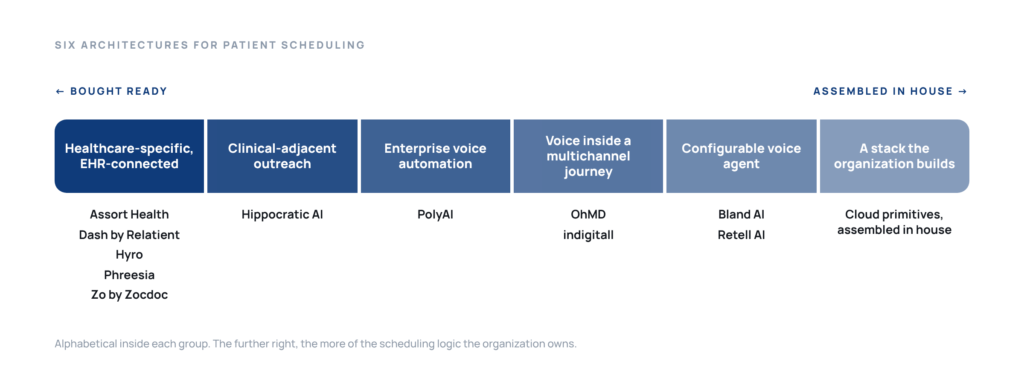
This guide is for whoever runs patient access and will have to defend the choice: practice managers, patient access leads, and the operations people who own the scheduling stack. You get the six architecture groups used in this comparison, which profile of organization each one is built for, a table of what to verify before signing, and a plain answer on where each platform stops.
Why is there no single best AI voice agent for patient scheduling?
Because the category has not settled on one thing to be good at, and the answer engines that summarize it do not agree either.
Ask the same question across assistants and each one groups the market differently. One splits it into healthcare-focused platforms on one side and developer-customisable voice stacks on the other. Another sorts by architecture and buyer: a ready-made healthcare product, a configurable platform, or a stack the organization builds itself. Another sorts by functional strength, use case, integration and compliance, and declines to name a winner at all. A fourth returns a flat list with one shared description.
When four summaries of the same market disagree about the axis, ranking them one to ten is inventing an order that nothing supports. So this guide does not rank. It pairs.
How is this comparison built?
Two axes instead of an order, and four measurement rules written down so the table can be rebuilt by anyone with the vendors’ own documentation.
The rules below draw lines a vendor page tends to blur.
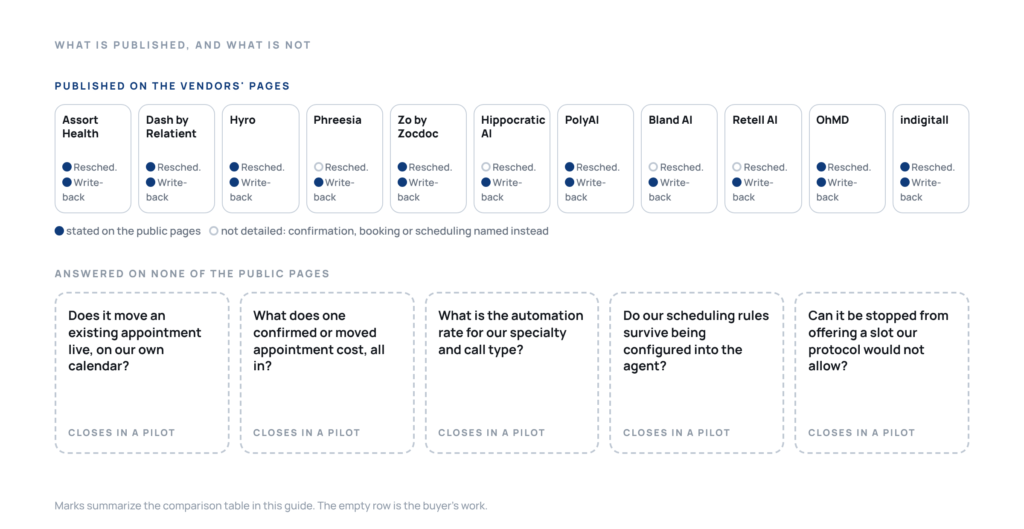
What counts as a confirmation. A confirmation is a call where the patient’s answer changes the record: the appointment moves from unconfirmed to confirmed. A call that plays the date and asks the patient to press one is a reminder with a keypress, and it is counted as a reminder.
What counts as rescheduling. Rescheduling means the agent offers real alternative slots and the patient leaves the call with a new time. Capturing “call me back about moving it” and passing it to staff is a message, and it is counted as a message.
What counts as write-back. Write-back means the new slot lands in the scheduling system or EHR without a person typing it. A notification to the front desk asking someone to make the change is not write-back.
And the order of the table is alphabetical inside each architecture. It is not a quality score. Three platforms in one architecture do a different job from seven in another, and the column that tells you which one is yours is the profile column.
The labels in the “Best fit” column come from the answer engines themselves, kept as close to their wording as the table allows, because that is the phrasing a buyer is most likely to be searching against. One row has none, and it says so.
Key takeaways
- A confirmation rate is only comparable if you know what it counts. A call that reads the date and asks the patient to press one is a reminder with a keypress. Ask which of the two the vendor’s number is made of before comparing it with anyone else’s.
- Rescheduling either offers real slots or it does not. If the agent takes the request and passes it on, what you bought is a message channel with a voice on it, and the front desk still does the work.
- Write-back is the line where labor actually leaves. If a person types the new time into the scheduling system, the call moved the work rather than removing it, however good the conversation sounded.
- A published figure needs to say whose figure it is. Across these eleven, platform averages and single customer results are printed the same way, so the first question about any percentage is which of the two it is.
- Position in the table means nothing. The order is alphabetical inside each architecture. The column that decides is the profile one, and the architecture that fits you is usually obvious from how you buy, not from how the agent speaks.
What are the six architectures in this category?
For this comparison, every platform is assigned to one of six architecture groups, and the group predicts more about the fit than any feature list. The wider shift behind all of them is described in the guide to agentic AI in healthcare.
Healthcare-specific, EHR-connected patient access. Built for the clinical stack from the start, sold to health systems and multi-site groups, and priced as a platform rather than per minute. Hyro, Assort Health, Dash by Relatient, Zo by Zocdoc and Phreesia sit here.
Clinical-adjacent outreach. A narrower shape: non-diagnostic calls about care gaps, adherence and follow-up, with clinical oversight built into the product. Hippocratic AI sits here on its own.
Enterprise voice automation. Contact center first, healthcare as one vertical among several, built for call volumes measured in millions. PolyAI sits here.
Configurable voice agent with technical integration. A platform plus an API, where the workflow is assembled rather than bought. Retell AI and Bland AI sit here.
Voice inside a multichannel journey. The call is one step and the rest happens over messaging, and the same customer profile drives both. OhMD and indigitall sit here.
A stack the organization builds. Cloud primitives for speech, telephony and orchestration, assembled in house. This is the reference-architecture route.
Which profile of organization does each one fit?
The second axis, in the words the answer engines use, with one row that is not theirs and says so.
| Profile | Platforms |
|---|---|
| Hospitals and larger health systems | Hyro |
| Health systems doing clinical-adjacent outreach | Hippocratic AI |
| Specialty practices needing scheduling automation | Assort Health |
| Multi-location practices | Assort Health |
| Practices focused mainly on appointment calls | Zo by Zocdoc |
| Large organizations with complex call operations | PolyAI |
| Practices that want intake and scheduling in one place | Phreesia |
| 24/7 patient self-service | Dash by Relatient |
| Clinics wanting voice and messaging workflows | OhMD |
| Teams wanting developer flexibility | Retell AI, Bland AI |
| Enterprise-scale outbound calling | Bland AI |
| Organizations building custom solutions | Cloud primitives, assembled in house |
| Editorial fit, not engine-derived | indigitall: organizations using voice as one step in an omnichannel patient journey |
Two platforms appearing on the same row is not a tie. It means a buyer who describes themselves that way will meet both, and the tiebreak is in the next table.
The comparison table
Read the last column first. It is the one that decides procurement, and it is the question that often still needs to be settled in procurement.
| Platform | Architecture | Best fit, in the engines’ words where available | Two-way rescheduling on the call | Write-back to the scheduling system | What to verify before you sign |
|---|---|---|---|---|---|
| Assort Health | Healthcare, EHR-connected | Specialty practices needing scheduling automation | Rebooking stated | Bidirectional EHR/PMS integration stated. Three different counts across its own pages: 15+ platforms on the home page, 20+ EHR/PMS systems in the integration article, 23+ on the intake page | Whether the deep integration your PM system needs is the athenahealth one it names as most robust or one of the others |
| Dash by Relatient | Healthcare, EHR-connected | 24/7 patient self-service | Stated: booking and rescheduling on the call, with a secure text link as the alternative | Real-time two-way sync with the EHR or practice management system | Whether the 70% platform figure holds for your specialty mix, and whether the 56% one customer reports is comparable to your call profile |
| Hyro | Healthcare, EHR-connected | Hospitals and larger health systems | Full scheduling cycle stated | Epic and Salesforce named | Whether deflection to SMS counts as a resolved call in the reporting you will be shown |
| Phreesia | Healthcare, EHR-connected | Patient intake plus scheduling automation | Inbound and outbound voice stated, rescheduling not detailed | 16+ PM and EHR systems natively | Whether voice is priced inside the intake platform or as a separate line |
| Zo by Zocdoc | Healthcare, EHR-connected | Practices focused mainly on appointment calls | Booking stated on the scheduling page, managing and rescheduling stated on adjacent pages | Books directly into the EHR, 175+ integrations | Whether the deployment you are buying can move an existing appointment under your own scheduling rules, not only create a new one |
| Hippocratic AI | Clinical-adjacent outreach | Health systems exploring clinical-adjacent outreach | Scheduling named among outreach workflows | Stated across 50+ EHRs | Which of the declined categories overlap with your call list, because the exclusions are published and specific |
| PolyAI | Enterprise voice automation | Large organizations with complex call operations | Confirmation and rescheduling documented in production | Direct Epic integration stated, without middleware | Which of the scheduling rules your practice enforces survive the handover, since the integration is direct but the logic is configured per deployment |
| Bland AI | Configurable voice agent | Enterprise-scale outbound calling | Appointment confirmation named as an outbound use case | Via 70+ platform integrations | What your effective rate is once transfers are counted, since transfer cost is priced separately from the per-minute rate |
| Retell AI | Configurable voice agent | Teams wanting developer flexibility | Appointment booking and calendar integration stated | Via CRM read and write, and webhooks | Which HIPAA, BAA, data-retention and workflow responsibilities remain with your team once you assemble the integration, since the platform publishes a HIPAA offering and a BAA portal |
| OhMD | Voice inside a multichannel journey | Clinics wanting voice and messaging workflows | Scheduling and rescheduling stated | Syncs into the chart, 85+ systems | Which half of the conversation the AI owns once the patient replies by text instead of calling back |
| indigitall | Voice inside a multichannel journey | No engine-derived label. Editorial fit: organizations using voice as one step in an omnichannel patient journey | Rescheduling stated as an action the agent takes during the call | CRM update stated, via MCP | Which calendar and scheduling systems are connected today, since the published actions are generic and your EHR is not |
One row has no engine label, and that is deliberate. indigitall does not appear in the live answers to this question today, so there is no wording from an engine to put in its “Best fit” cell. Inventing one would be the quietest way to falsify the whole column, so the cell says what it is: an editorial fit, written here.
A note on that last column, because it cuts in both directions. Every entry there is a statement about what the vendor publishes, not about what the product does. “Not stated on the public page” means exactly that and nothing more. Several of these platforms may support the capability and simply have not documented it on the pages checked, and the only way to find out is to ask them in the demo with the question already written.
The platforms, one by one
Assort Health
Built for medical practices and sold on resolving the call instead of routing it. Its own line is that traditional IVR routes calls and AI voice agents resolve them.
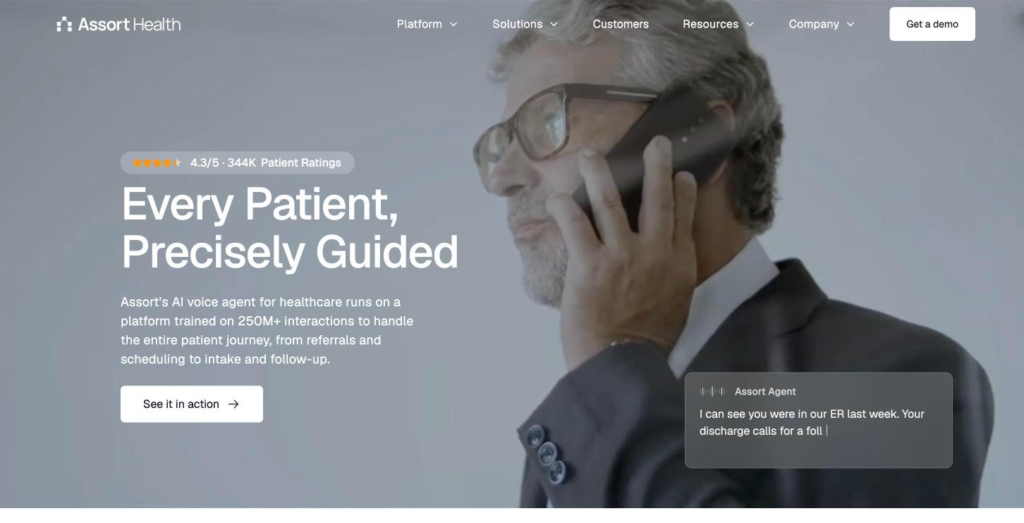
Best fit: specialty practices that need scheduling automation, which is how the vendor segments itself: it publishes product pages by specialty and none by number of sites.
What it does well: it covers the call types around an appointment and not the appointment alone, across a stated 23 or more specialties, and it publishes integration depth as a selling point instead of a checkbox.
Key features:
- 24/7 appointment scheduling and management
- Patient intake, triage and referral automation
- Bidirectional integration documented across 20+ EHR and PM systems, with athenahealth named as the most robust of them
- Follow-up calls after the visit
Watch out for: the integration story is uneven by design, and the count moves between its own pages. The home page says 15 or more platforms, the integration article says 20 or more EHR and PM systems, and the intake page says 23 or more. athenahealth is the one named as the most robust integration and the rest are counted, so the quality of the connector you need is a question for the demo and not a given.
Pricing: not published. The route in is a demo.
Doesn’t fit if: the call volume sits in one location and one specialty, where a platform built for spread across sites and specialties is more machinery than the problem needs.
Public evidence: The Assort Health home page (the IVR versus AI voice agent positioning, the 23 or more specialties and the 15 or more platforms figure), the patient scheduling page (24/7 scheduling and the 20 or more native EHR integrations) and the EHR integration guide (the bidirectional sync detail and the athenahealth depth claim).
Dash by Relatient
Self-scheduling came first in this one and voice was added around it. It positions itself on shaping the standard for healthcare access, and the self-service story leads and the agent follows.
Best fit: groups that want patients to book and change appointments themselves at any hour, with the phone catching what the portal misses.
What it does well: the self-scheduling side is its center of gravity and it has the external recognition to match, and the PM and EHR coverage is broad and named.
Key features:
- Patient self-scheduling online
- Voice AI stated to resolve 70% of calls without human intervention, the vendor’s own headline figure
- Booking, cancellations and rescheduling stated on the call, with real-time two-way sync
- Omnichannel messaging and chat
- Integrations named with Epic, athenahealth, Oracle Health and NextGen
Watch out for: the two published numbers are not the same kind of number, and the page does not flag the difference. The 70% resolved without a person is the platform’s own headline. The 56% handled autonomously is one named customer describing their own result, which is evidence of one deployment and not an average. Neither is broken down by specialty or by call type, so a practice whose volume is patients moving appointments should ask for the split before assuming either applies.
Pricing: not published.
Doesn’t fit if: the patients you are trying to reach do not self-serve, because the design assumes the portal carries most of the load and the call catches the rest.
Public evidence: The Dash by Relatient voice AI page (the 70% autonomous resolution headline and the 56% customer figure), the Relatient home page (the healthcare access positioning and the Best in KLAS recognition for self-scheduling) and the integrations page (the named EHR list and the real-time write-back).
Hippocratic AI
Clinical voice outreach with the safety apparatus in front of the product. Its line is that it is the safest clinical voice AI for healthcare, and the claim is backed with published testing volumes.
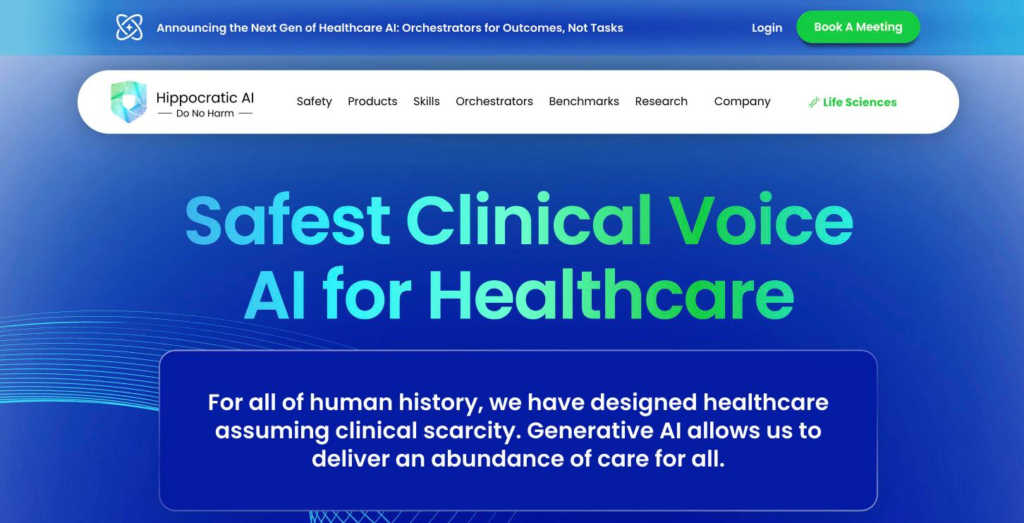
Best fit: health systems and payors running outreach at scale about care gaps, adherence and follow-up, where the call is clinical-adjacent and the risk profile is the buying question.
What it does well: it is one of the clearest platforms here about what it refuses to do, which is more useful in procurement than another capability list.
Key features:
- Non-diagnostic patient outreach by voice, tested against a stated network of 7,700 or more US licensed clinicians over 775,000 or more test calls
- Appointment, care gap, adherence and readmission workflows
- Stated integration with 50 or more EMRs including Epic
- Human escalation and published call sampling for oversight
Watch out for: the exclusions are real and specific. Diagnosis, prescribing, hospice, mental health disorder management and paediatric cases under two are all declined, and if your list includes them the agent is not the place to put them.
Pricing: not published.
Doesn’t fit if: you need front desk call handling and not clinical outreach, because the safety architecture that makes it right for the second is overhead for the first.
Public evidence: The Hippocratic AI home page (the safest clinical voice AI claim, the clinician and test call volumes, the 50 or more EMR integrations and the published exclusions), the all agents catalog (the appointment, screening, adherence and post-discharge workflows) and the safety in action page (the nurse escalation shown on a real call).
Hyro
Health system call centers are the whole pitch here, sold on unburdening staff and unblocking access to care.
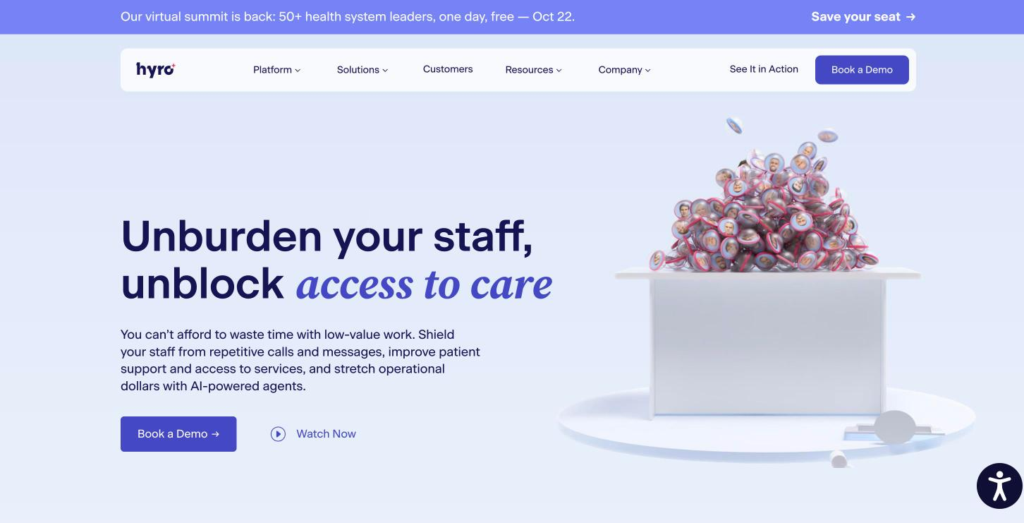
Best fit: hospitals and larger health systems where the contact center is the bottleneck and the EHR is Epic.
What it does well: it treats the scheduling cycle as a whole and not as a booking event, and it names its EHR and CRM integrations plainly.
Key features:
- Automation across the full appointment scheduling cycle
- Phone, web, SMS and mobile app coverage
- Epic and Salesforce integrations named
- Deflection of simple inquiries from the call to SMS
Watch out for: deflection and resolution are counted together in the headline figures, and the headline itself moves between pages: over 85% on the call center page and over 65% on the healthcare page. A call moved to SMS has left the queue, which is worth money, but it is not the same as a call that ended with the appointment changed, and the reporting should separate them.
Pricing: not published.
Doesn’t fit if: you are a single practice, since the product and its commercial shape are built around health system scale.
Public evidence: The Hyro home page (the unburden staff and unblock access positioning and the full scheduling cycle claim), the healthcare call center page (the resolve or deflect over 85% headline and the SMS deflection funnel) and the platform page (the Epic and Salesforce integrations and the channel coverage).
OhMD
Patient communication built around two-way texting, with an AI voice agent answering the phone in front of it. Its line is that patient calls end and relationships do not.
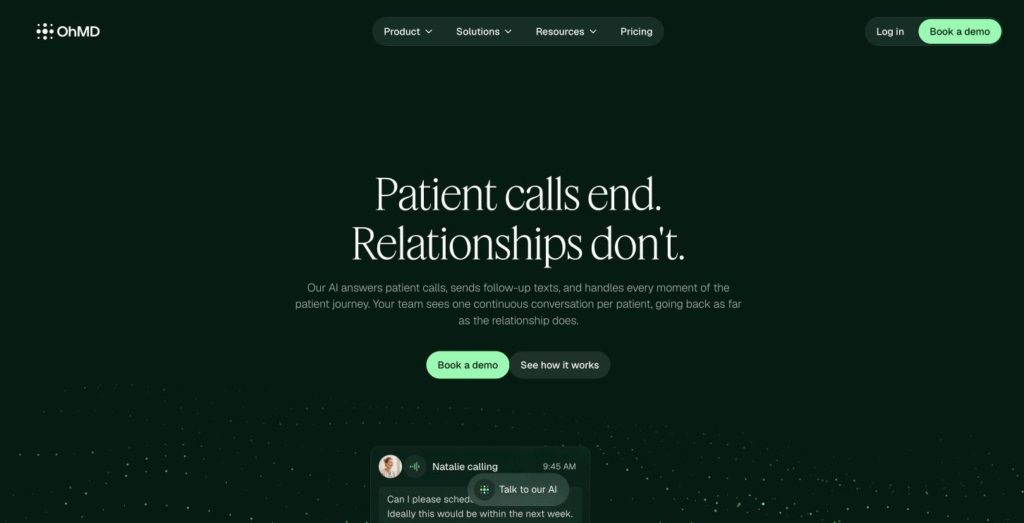
Best fit: clinics that want the call and the text thread to be the same conversation, held in the chart.
What it does well: it publishes broad EHR and PM coverage and it is unusually explicit about rescheduling, which most pages in this category are not.
Key features:
- Two-way HIPAA-compliant texting with patients
- AI voice agents answering inbound calls
- Automated scheduling, rescheduling and reminders
- Stated integration with 85 or more EHR and PM systems, a figure published on the home and voice pages rather than on the integrations page itself
Watch out for: the headline numbers describe calls that staff no longer answer. Some of that work reappears as messages, so the question for the demo is what the AI closes on its own once the conversation moves to text.
Pricing: published. A stated 300 US dollars per month for the core tier and a stated 500 US dollars per month for the tier that carries the voice agent, with a quoted enterprise level above them. Rates as published in 2026.
Doesn’t fit if: your patients will not text, because the voice agent is the front door to a product whose center is the thread.
Public evidence: The OhMD home page (the 85 EHR and PM integration count and the call reduction figures), the AI phone answering service page (the inbound voice agent and the documented rescheduling flow) and the pricing page (the published monthly tiers).
Phreesia
Intake came first here and voice was bolted on top, which is the opposite of most of this table. It calls itself the operating standard for high-performing medical practices.
Best fit: practices that want registration, scheduling, reminders and payment in one system and are willing to buy the whole thing.
What it does well: the intake and payment side is mature and the native PM and EHR list is stated as a number instead of implied.
Key features:
- Digital patient intake and registration
- Appointment scheduling and reminders
- Voice automation for inbound and outbound calls
- Stated native integration with 16 or more PM and EHR systems
- Copay collection and balance management
Watch out for: voice is one module inside a larger platform, so the commercial question is whether it can be bought on its own or only as part of the suite.
Pricing: not published. The pricing page states that pricing is customized to the organization and gives no figures.
Doesn’t fit if: intake is already solved and what you need is only the phone, because you would be buying a platform to use a module.
Public evidence: The Phreesia home page (the operating standard positioning and the 16 or more native PM and EHR integration count), the VoiceAI product page (inbound and outbound call automation described as one modality inside the platform) and the pricing page (custom quotes with no published rates).
PolyAI
Enterprise voice automation with healthcare as one vertical among several. It positions itself as the enterprise platform where dialog agents get built, run, adapt, and iterate in real time.
Best fit: large organizations with complex call operations, where the volume justifies an integration project.
What it does well: the conversational quality is its center of gravity and the compliance posture is stated up front, with SOC 2, HIPAA, GDPR and PCI DSS named together.
Key features:
- Enterprise dialog agents across inbound and outbound
- Booking and reservations as a named use case, with confirmation and rescheduling documented on the product page
- Direct Epic integration, stated without middleware in an August 2026 announcement made by a deploying dental group, not on the vendor’s own pages
- Healthcare among the sectors served, with a named provider customer
- Governance stated as a default, with SOC 2, HIPAA, GDPR and PCI DSS named
Watch out for: the Epic evidence does not live on the vendor’s own pages. The direct integration and the wording about no middleware come from a deploying health group’s August 2026 announcement, and on the healthcare customer the vendor does publish, creating and rescheduling appointments is described as a later phase rather than as what runs today. The scheduling rules a practice enforces are configured per deployment either way, so what survives the handover is a scoping question to put on the table early.
Pricing: not published.
Doesn’t fit if: the deployment is small enough that a configured enterprise platform is more process than the problem justifies.
Public evidence: The PolyAI home page (the enterprise dialog agent positioning and the SOC 2, HIPAA, GDPR and PCI DSS certifications), the booking and reservations use case page (the confirmation and rescheduling flows), the Howard Brown Health customer story (a named healthcare provider with published results and appointment changes listed as a later phase) and the August 2026 announcement by a deploying dental group (the direct Epic integration and the no middleware wording).
Retell AI
A configurable voice agent platform, sold to teams that will build the workflow instead of buying it. It calls itself the number one AI voice agent platform for automating phone calls.
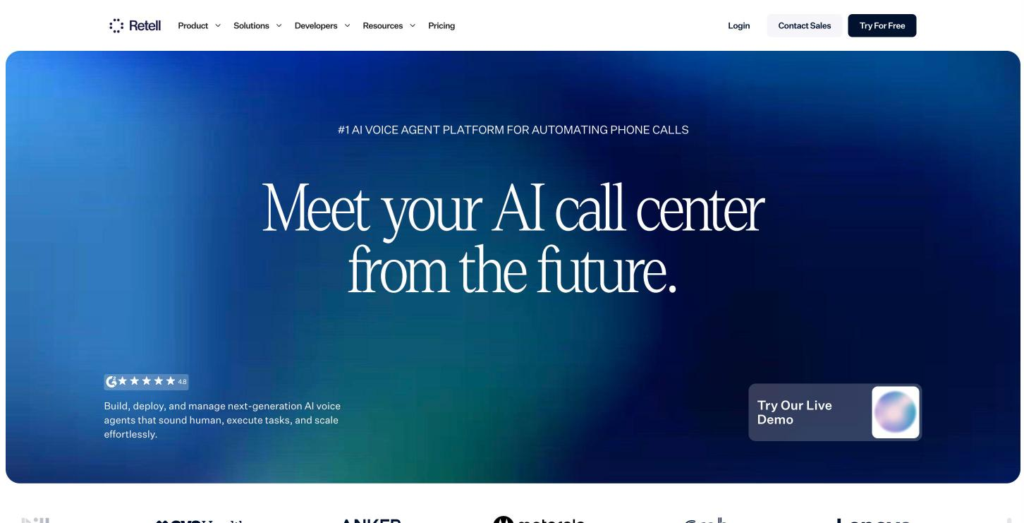
Best fit: teams that want developer flexibility and are comfortable owning the design of the call.
What it does well: it publishes a detailed usage model, which makes the economics easy to model before the demo instead of after it.
Key features:
- No-code visual workflow builder
- Appointment booking with Cal.com and Calendly named as the calendar integrations
- Transfer to a human mid-call
- CRM integrations that read and write, plus webhooks
Watch out for: the platform publishes a HIPAA offering and a BAA portal, so the obligations are shared rather than handed over wholesale. What stays with your team is the workflow, the retention policy and the integration, and that split is the procurement conversation.
Pricing: published, at a stated 0.07 to 0.31 US dollars per minute depending on models and add-ons, with chat agents priced per message. Rates as published in 2026.
Doesn’t fit if: nobody on the team owns the integration, because the flexibility that makes it cheap is the same flexibility that makes it unfinished on day one.
Public evidence: The Retell AI home page (the positioning and the core feature set), the pricing page (the per minute range, the per message chat rate and the add-on breakdown) and the security and compliance documentation (the HIPAA offering and the self-signing BAA portal).
Bland AI
A voice platform for regulated industries, built around self-hosted models and low latency, aimed at outbound at scale.
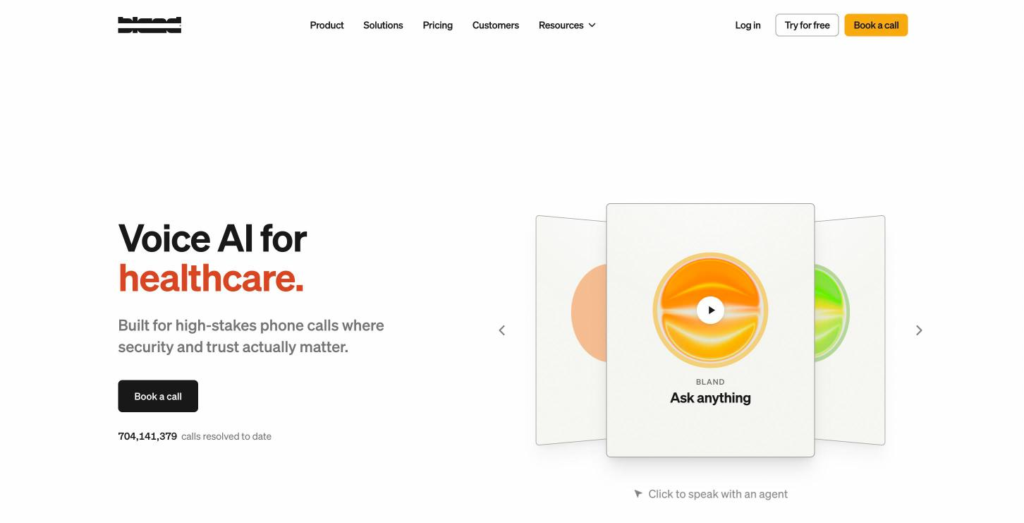
Best fit: enterprise-scale outbound calling, including appointment confirmation as a named use case.
What it does well: the compliance posture is stated with SOC 2 Type II, HIPAA and PCI DSS, and the transfer to a human carries the conversation context instead of restarting it.
Key features:
- Inbound and outbound voice agents
- Appointment confirmation named among outbound uses
- Transfer to a human with full context
- Connectors to the main contact center, CRM and automation platforms
Watch out for: the per-minute rate covers the language model, speech recognition and speech synthesis. Telephony and transfer are billed separately, so the effective rate for a workflow that escalates often is not the headline rate.
Pricing: published. A stated 0.14 US dollars per minute on the entry tier, 0.12 per minute plus a 299 US dollar monthly fee on the next, and custom at enterprise level, with transfer cost separate. Rates as published in 2026.
Doesn’t fit if: what you need is a healthcare product with the scheduling logic already written, because this is a platform and the logic is yours.
Public evidence: The Bland home page (the self-hosted models, the latency figure and the SOC 2 Type II, HIPAA and PCI DSS posture), the pricing page (the per minute rates, the platform fee and the separately billed transfer rate) and the integrations page (the contact center, CRM and automation connectors).
Zo by Zocdoc
An AI phone assistant for practices, from a company whose business is appointments. Its line is about eliminating wait times and abandoned calls so that more appointments get scheduled over the phone.
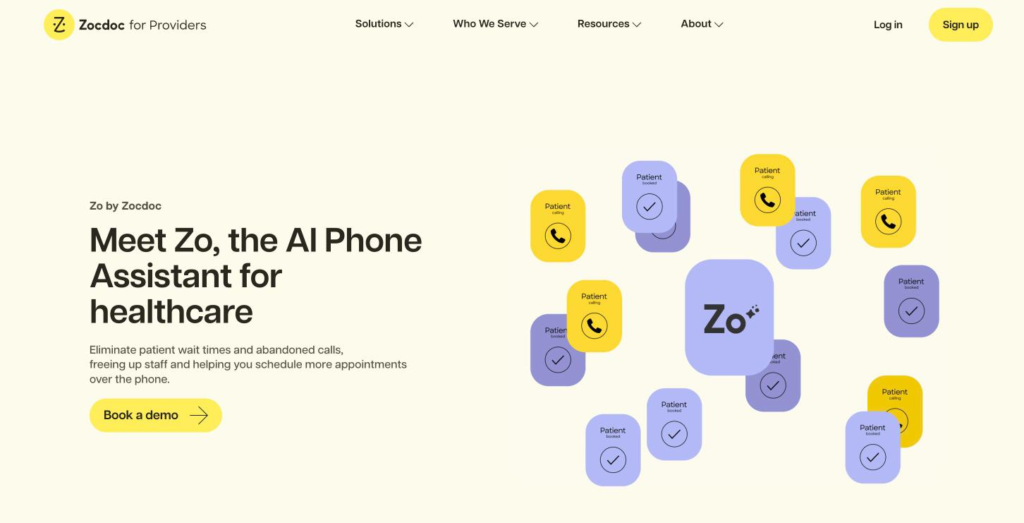
Best fit: practices whose problem is the phone itself, where calls go unanswered and bookings are lost at the front desk.
What it does well: it books into the EHR and not into a calendar of its own, the integration count is the largest stated here, and the transfer to staff carries authentication and a call summary.
Key features:
- 24/7 call answering with unlimited concurrent calls
- Booking written into the EHR
- Stated 175 or more integrations, with EHR integration documented
- Transfer to staff with authentication and call summary
- Multilingual support, HIPAA compliance and SOC 2
Watch out for: the scheduling page leads with booking, while managing and rescheduling appear on adjacent pages. For a practice whose volume is patients moving existing appointments, what matters is whether the deployment being sold moves one under your own scheduling rules, and that is worth confirming before the pilot.
Pricing: not published.
Doesn’t fit if: most of your call volume is clinical questions and not appointments, because the product is built around the booking.
Public evidence: The Zo product page (the 24/7 unlimited concurrent answering, the booking written into the EHR and the authenticated transfer with a call summary), the Zocdoc integrations page (the 175 or more EHR and practice management systems and the appointment write-back) and the AI call assistant page (booking, rescheduling and cancelling).
indigitall
Voice here is one step inside a customer journey, not a standalone agent. The call is triggered by the journey, acts on the systems behind it, and hands over to a person when it should.
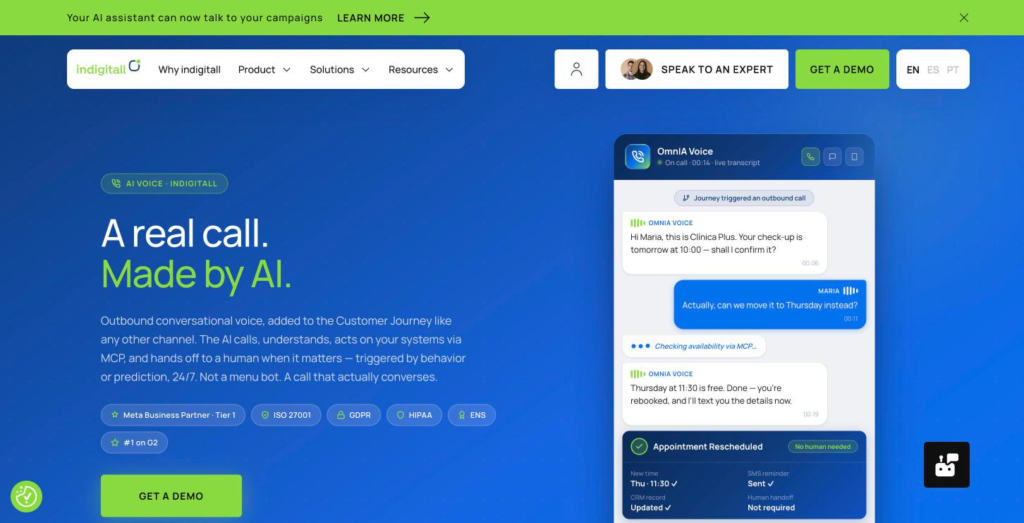
Best fit: clinics and health groups that already run reminders over several channels and want the call to share the same patient profile and the same rules.
What it does well: the call starts somewhere else. A journey step, a behavioral signal or a churn or no-show prediction triggers it, and when it ends it updates the CRM and sends the SMS itself. That is the architecture, and it is why the comparison above is built on the write-back column.
Key features:
- Outbound calls triggered by a journey step or a prediction
- Actions on connected systems through MCP, including rescheduling an appointment and updating the CRM
- Warm transfer to a person with the transcript and the detected intent
- The same patient profile across push, email, SMS, WhatsApp and in-app
- ISO 27001, GDPR, HIPAA, ENS and SOC 2 stated
Watch out for: the published actions are described generically, as calendar, CRM, SMS and booking systems. Which specific scheduling system or EHR is connected today is a question to ask before the pilot, exactly as it is for every other row in this table.
Pricing: not published. The route in is a demo and a contract, with no self-service tier.
Doesn’t fit if: the phone is the only channel you use and you have no plan to add another, because the value of this shape is that the call shares a profile with the messages, and with one channel there is nothing to share it with. It also does not fit an organization with no digital channels of its own and no opted-in contact base: this activates an audience, it does not create one.
Public evidence: The indigitall AI Voice page (the outbound call triggered by a journey step or a no-show prediction, and the handoff with the transcript and the detected intent), the AI Agents page (the MCP actions on CRM, booking and other connected systems) and the indigitall home page (the one unified profile across push, email, SMS, WhatsApp and in-app, and the ISO 27001, GDPR, HIPAA, ENS and SOC 2 posture).
What should you choose if...
If moving an existing appointment is the primary job. Start with the platforms whose public documentation explicitly shows live availability, rescheduling on the call and a write-back to the scheduling system, which today includes Assort Health, Dash by Relatient, Hyro, OhMD and PolyAI, each with a different level of published evidence. Then ask for it live, on your own calendar, with a real slot. indigitall becomes the better fit when the call has to share rules, profile and follow-up with the rest of the patient journey.
If the phone is the problem and the calendar is fine. Zo by Zocdoc is built for exactly that, and the honest caveat is in its own table row: confirm on the call that an existing appointment can be moved, not only that a new one can be created.
If the risk profile is what has to be signed off. Hippocratic AI publishes one of the clearest clinical-safety boundaries in the table for this use case, including the categories it declines outright, and that is the fastest way through a clinical governance review.
If you have an engineering team and a clear workflow already drawn. Retell AI and Bland AI both fit teams that want to assemble and own more of the workflow, and both publish enough pricing to model the cost before the first meeting. Retell exposes the more detailed usage model. Bland publishes tiered per-minute rates with transfer priced separately.
If the call is one of four channels you already use. Then what decides is which one shares a patient profile with the messages you are already sending. That is the case for voice inside a journey, and it is the case indigitall is built for. If the rest of that stack is still being chosen, it is a separate comparison and it should be made first.
What does the evidence actually say?
Three things are worth separating, because they get mixed constantly.
Omnichannel reminders reduce no-shows, and that is well documented in indigitall’s own work. Sanitas cut no-shows by 60% and lifted appointment confirmations by more than 50% with coordinated reminders across WhatsApp, SMS and push, driven by a customer data platform, the pattern described in ending fragmented patient communication. That result is omnichannel and it should not be read as a voice result, because it is not one. The mechanics are in the channel strategy guide for appointment confirmations and the cost of getting it wrong is in the true cost of missed appointments.
There is one voice figure, and it carries a qualifier. In the voice AI variant of the same Sanitas deployment, the appointment confirmation rate reached 85 to 90%. That is Spain, that is one deployment, and the qualifier travels with the number every time it is used.
Adjacent omnichannel evidence, not voice performance
Vithas: patient engagement doubled and SMS costs fell by 35% after unifying its patient databases into a customer data platform. Omnichannel patient engagement, not a voice result.
QuirónSalud: more than seven million patients reached a year, inbound calls cut by half, and 114,000 US dollars of expected revenue. Omnichannel access and expected revenue, not a voice result.
Both describe what the surrounding journey does, not what the call does, and the patient journey engine is where that architecture is described.

What none of this proves is that a voice agent alone fixes patient access. The narrower claim holds up better: the call earns its place as the escalation of a sequence that already started somewhere cheaper, which is the argument in why manual reminders stall a clinic’s growth.
“Multichannel notifications: it allows me to send push notifications through the web, mobile, and email with ease, effectively reaching my audience. The automation feature ensures that messages are sent at optimal times.” (Verified User in Hospital & Health Care on G2)
A verified user in hospital and health care wrote that, and it sits here because timing is the part of the reminder sequence that decides whether the call is ever needed.
“Being able to schedule notifications based on how web traffic is performing. The ability to segment the audience. Nothing to highlight. I think the notifications are not reaching Apple devices.” (Verified User in Broadcast Media on G2)
A verified user in broadcast media wrote the second one, and it sits here with its complaint intact, because a reminder that does not arrive on one device family is exactly the failure mode that sends the patient back to the phone.
And the size of the problem is worth a word of caution. The video below puts a dollar figure on what patient no-shows cost in the United States. That figure is the video’s own framing, this guide does not verify it, and it is a systemwide estimate rather than anything a single practice can check against its own books. It is here because the scale of the problem is the reason this category exists, not because it is evidence that any platform in it works.
This one is ours, and it explains the cost side rather than the call itself. It is here because the scale of the problem is what justifies automating any of this, and that argument does not depend on which platform you pick.
What has to be true before any of this is legal?
Two things, and they are separate from the platform choice.
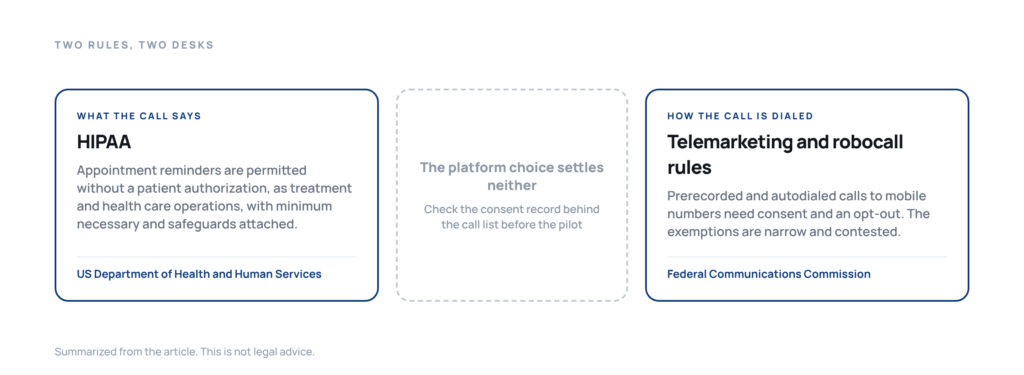
Appointment reminders are permitted under HIPAA without a patient authorization, because they fall under treatment and health care operations. The US Department of Health and Human Services says so directly, with the usual minimum necessary and safeguard obligations attached. That covers the content of the call.
It does not cover the dialing. Prerecorded and autodialed calls to mobile numbers sit under the FCC’s telemarketing and robocall rules, where consent requirements and opt-out mechanisms apply and the exemptions are narrow and contested. An outbound voice agent calling a patient list is a dialing decision before it is a clinical one, and the consent record behind that list is the thing to check before the pilot, not after it.
The two questions land on different desks inside the same organization, which is why they get missed together.
FAQs: AI voice agents for patient appointment confirmations
Can an AI voice agent actually reschedule an appointment, or only take the request?
Both exist and they look identical to the patient. An agent that reschedules reads live availability, offers real slots and writes the new time into the scheduling system before the call ends. An agent that takes the request captures the intent and leaves a task for a member of staff. Only the first one removes work. The vendor page rarely distinguishes them, so the test is to ask for a live demonstration against your own calendar.
Does an AI voice agent need to integrate with the EHR?
It needs to reach whatever system holds the appointment, which in most practices is the EHR or the practice management system. Without that connection the agent can confirm an appointment but cannot move one, because it has nothing to read availability from and nothing to write the change into. Integration depth, not conversational quality, is what separates the platforms in this category.
Are AI appointment reminder calls allowed under HIPAA?
Yes. Appointment reminders fall under treatment and health care operations, and the US Department of Health and Human Services confirms they do not require a separate patient authorization. The minimum necessary standard still applies, so the call should say what it needs to say and no more, and the vendor handling protected health information needs a business associate agreement in place.
What happens when the patient asks something the agent cannot handle?
The agent should transfer to a person and carry the context with it: the transcript, the detected intent and the patient identity already verified. A transfer that starts the conversation again is worse than no automation, because the patient has now explained the problem twice. Several platforms state warm transfer explicitly, and it is worth confirming what exactly travels with the call.
Is voice better than SMS or WhatsApp for appointment confirmations?
Usually not first. A message costs a fraction of a call and a large share of patients answer it, which is why the documented reductions in no-shows come from coordinated reminders across channels rather than from calling everybody. Voice earns its place on the patients who did not answer the message, on the changes that need a real conversation, and on the cohorts that do not use messaging at all. Treating it as the escalation rather than the opening move is what makes the economics work.
How should the cost of an AI voice agent be compared?
By what a completed outcome costs, not by the per-minute rate. A cheaper minute that ends with a task for the front desk has moved the work rather than removed it. The comparison that decides anything is cost per appointment actually confirmed or moved, which needs the per-minute price, the average call length, the share of calls the agent closes on its own, and the staff time still spent afterwards. Two platforms in this guide publish per-minute rates and the rest do not, so for most of the table that calculation starts in the demo.
Is an AI voice agent better than having staff make the calls?
It depends on which calls. For a reminder that ends in a yes or a no, the agent wins on cost and on coverage, because it will call at seven in the evening and it will call all of them. For a call that involves a clinical question, a distressed caller or an exception to a scheduling rule, a person is better and the agent should be handing over. The useful comparison is not agent against staff, it is which share of the call list belongs to each, and what the handover between them looks like.
Do small practices and large groups need different platforms?
Usually yes, and the reason is commercial rather than technical. Several platforms here are priced and shaped around health system scale, with an integration project attached, and they are more machinery than a single site needs. Others are built for a practice and stop scaling somewhere above it. Specialty matters too: one vendor publishes coverage across 23 or more specialties, and published automation rates are platform averages rather than specialty averages, so a practice whose volume is one specialty should ask for the split before assuming the headline applies.
Do different medical specialties need different platforms?
Less than the marketing suggests, and more than the demo will show. What changes by specialty is the call mix rather than the technology: to illustrate the shape of the difference rather than to describe any specific practice, a specialty built on short, high-volume visits can refill a cancellation the same day, while one built on longer appointments tied to imaging and preparation steps carries consequences down the chain when an appointment moves. Several platforms in this table publish specialty pages, and one of them counts 23 or more. Treat that count as evidence that the vendor has seen your workflow before, not as evidence that the integration behaves differently for you. The questions that actually vary by specialty are two: whether the scheduling rules your specialty enforces survive being configured into the agent, and whether the agent can be stopped from offering a slot that your protocol would not allow. Both are pilot questions, and neither is answered by a specialty logo on a web page.
About the Authors