indigitall Omni AI
  Start chat with AI agent
 Speak with AI voice agent
 Book a Demo

 Speak to an Expert












Best RCS messaging platforms for education: what is actually documented
October 6, 2026



Last Updated: 2026-10-02
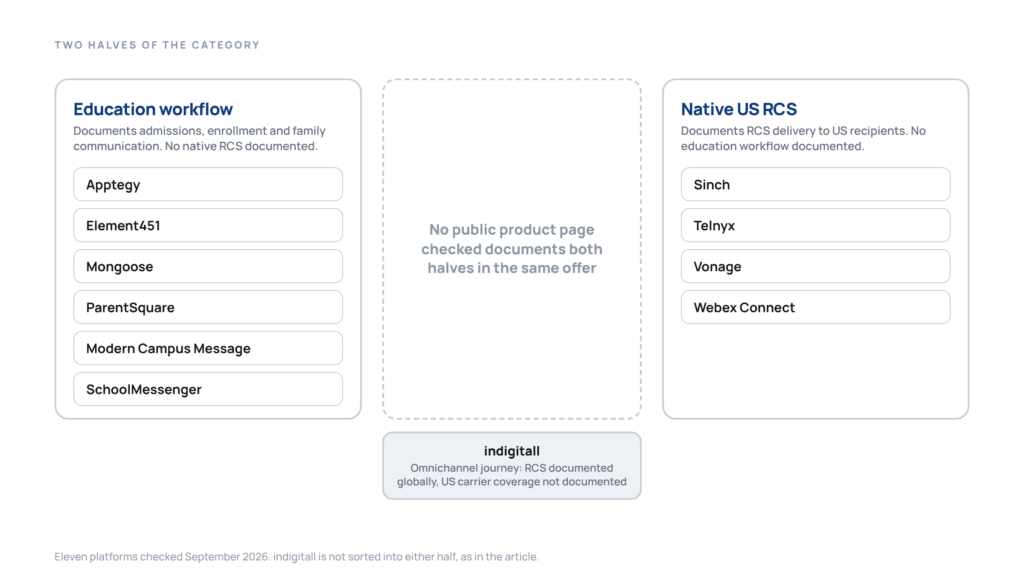
The category splits into two kinds of product, and the split is the answer. The six education messaging platforms checked here document the academic workflow, the student information system and the family conversation, but none of them publicly documents native RCS. The four communications platforms checked here document native RCS Business Messaging to United States recipients, but not the admissions, enrollment or family workflows an institution runs on. indigitall sits between the two, documenting RCS and automatic SMS fallback inside an omnichannel journey, without publishing evidence of United States carrier coverage. So there is no universal winner here. The institution is choosing which half it wants to arrive already solved.
The pitch deck says RCS. The demo shows a branded message with a logo, a carousel and two tap buttons. The contract gets signed. Six weeks later, the first campaign goes out to eleven thousand applicants and the delivery report says SMS.
That is not a scandal. In most of those cases nobody lied. The word RCS covers at least four different things in this market, and the education buyer is the one most likely to be shown the wrong one, because the platforms that speak fluent admissions and the platforms that actually run the channel are usually not the same company.
This guide is for whoever will have to defend the choice: directors of admissions and enrollment, district communications leads, and the IT teams who get handed the integration. You get the four things the word RCS is used for, a comparison of eleven platforms with what each one documents and what it does not, the questions to ask before a pilot, and a plain statement of where each one stops.
Why is there no single best RCS messaging platform for education?
Because the category has not decided what it is, and neither have the answer engines that summarize it.
Ask this across assistants and you get four different markets. The first mixes communications providers with school communication tools and general texting services in the same list. Another returns mostly communications providers and ranks them by carrier reach and API depth. A third segments cleanly by K-12, higher education and education technology. The fourth alternates between school communication software and higher-education enrollment platforms, and changes which of the two it means between one answer and the next.
The lists disagree about the membership, the order and the definition. Fifty-six live answers across four engines over two weeks produce no stable first position and no shared taxonomy. The same comparison made for retail and e-commerce settles on a different axis entirely, which is itself a sign that the category is defined by its buyer rather than by its technology.
So this guide does not rank. It sorts by what each platform documents, which turns out to be the only axis that separates them cleanly.
The education buyer is choosing between two incomplete product categories. Education platforms understand the academic workflow but do not publicly document native RCS. RCS providers document the channel but rarely document the student information system, learning management system, admissions or family-communication workflows an education buyer needs.
That does not mean an education platform cannot deliver RCS through a custom integration, or that a communications provider cannot support education. It means the public product evidence does not join both halves in one documented offer.
What does "RCS platform" actually mean in education?
Four different things, and telling them apart is most of the work.
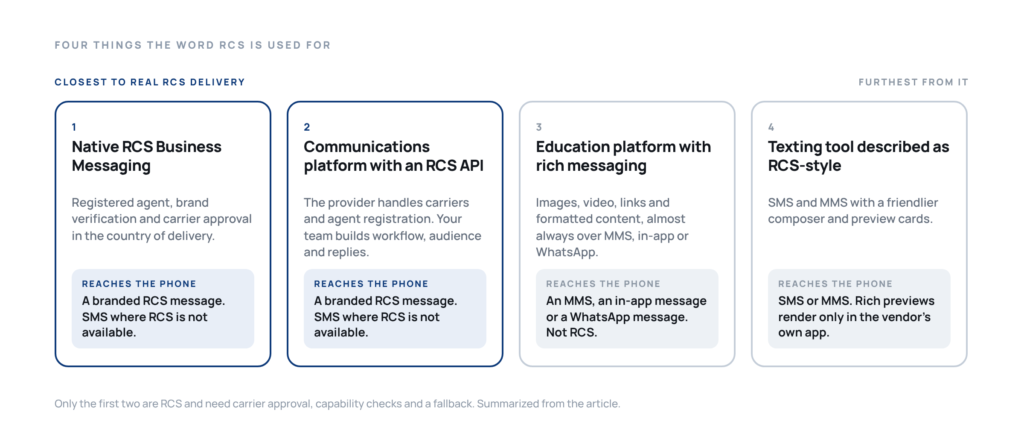
Native RCS Business Messaging. The message travels over Rich Communication Services, the upgrade to SMS defined as a standard by the GSMA describes as enhancing “traditional SMS messaging by offering a suite of service capabilities, including group chat, file transfers, typing notifications, and more”, with its Universal Profile “establishing industry standards, simplifying interoperability across networks and devices”. Delivering it requires a registered agent, brand verification and carrier approval in the country you are sending to. It is not a feature you switch on.
A communications platform with an RCS API. The same channel, reached through an interface your team builds against. The provider handles the carrier relationship and the agent registration. The institution or its vendor handles the workflow, the audience and the replies.
An education platform that adds rich messaging. A school or higher-education product that sends images, video, links and formatted content. Almost always this is MMS, in-app messaging, or a channel like WhatsApp. It can look identical to RCS in a screenshot and behave completely differently on the carrier network.
A general texting tool described as RCS-style. SMS and MMS with a friendlier composer, sometimes with rich preview cards that render inside the vendor’s own app rather than in the recipient’s default messaging client.
The first two are RCS. The last two are not, however rich the message looks. And the distinction is not cosmetic: only the first two require carrier approval, only the first two resolve device capability, and only the first two need a fallback strategy, because only they can fail to deliver as RCS.
Why are the education platform and the RCS platform usually different products?
Because they were built by different companies for different buyers, and the public evidence shows it.
Five checks separate the two, and each one is a claim that gets made loosely:
- Rich SMS and MMS content is not RCS. Sending an image, a video or a GIF over MMS is a different protocol with different carrier treatment. Several education platforms describe exactly this capability, correctly, without ever using the word RCS.
- WhatsApp is not RCS. Two of the higher-education platforms here offer WhatsApp as their rich channel. That is a real capability and a reasonable choice, and it has earned its place in admissions, but it is not the channel this question asks about.
- A trends article that mentions RCS does not prove RCS delivery. One platform in this comparison mentions RCS only in a thought-leadership post about where the sector is heading, never on a product page, and never claiming to deliver it.
- An integration with a student information system does not prove native RCS. Deep integration with a university’s records is the hardest thing on this list to build, and it says nothing about which protocol carries the message.
- A generic RCS page does not prove an education workflow. Documenting the channel globally is not the same as documenting how an admissions team runs a deadline campaign against a list of applicants.
Run those five checks across the eleven platforms and the category falls into two clean halves, with one platform in between.
How were these platforms evaluated?
Scope first, then the rules, so anyone can rebuild the table from the vendors’ own pages.
The question. “What are the best RCS messaging platforms for education.” United States market, English, checked on 29 September 2026.
What was read. Fifty-six live answers to that question across four answer engines between 16 and 29 September 2026, and then the public product pages, developer documentation, help centers and pricing pages of every platform named often enough to matter.
Who is in the table. Eleven platforms that an education buyer meets when asking this question. Six are education messaging platforms, four are communications platforms with an RCS channel, and one is an omnichannel journey platform that sits between the two.
Four measurement rules, written down because each of them changes a cell.
What counts as native US RCS evidence. The vendor’s own pages state that it delivers RCS Business Messaging and either name United States coverage or document United States agent registration. Three states are recorded: Documented, Partially documented, and Not publicly documented on the pages checked. That last one is a statement about the pages, not a claim about the product.
What counts as an education workflow. The vendor documents at least one of admissions, enrollment, retention, attendance, emergency alerts or family communication as a named use case, with the systems it connects to. A logo wall of school customers is not a documented workflow.
What counts as fallback. The vendor states what happens when the recipient cannot receive RCS. Whether that is triggered by the device, by the carrier or by a rejected request is recorded separately, because the three behave differently in production.
What counts as an integration. A named system, not a category. “Integrates with your SIS” is not an integration. A list of named student information systems is.
Key takeaways
- Ask which half of the problem arrives solved. The education platforms document the academic workflow and the communications providers document the channel. On the public pages checked, no single offer documents both.
- “Supports RCS” needs a country attached. United States delivery depends on carrier coverage and on a registered agent, so a vendor page that names the standard without naming the market has not answered the question.
- An integration is a named system, not a category. “Integrates with your SIS” is a sentence, not a connector. Ask for the list, and ask which fields move in which direction.
- Decide what the SMS version says before the first send. Fallback is not a failure state, it is where a large share of a real campaign lands, and the fallback message is the one most families will actually read.
- The channel is not the project. Agent registration, carrier approval and capability checking sit between the contract and the first campaign, and an admissions deadline is the worst place to discover them.
The comparison table
Read the two middle columns together. Each platform is strong in one of them and silent in the other, and that pattern is the whole guide.
| Platform | Category | Education workflow documented | Native US RCS | Fallback | Integrations or education depth | What to verify |
|---|---|---|---|---|---|---|
| Apptegy | Education-native messaging platform | Yes. District communication, family updates, attendance and staff messaging | Not publicly documented on the pages checked | Not applicable, no RCS channel documented | Student information systems referred to as a category, not named. Single sign-on with the two large identity providers | Whether rich content reaches the default messaging app or only the district’s own app |
| Element451 | Education-native messaging platform | Yes. The deepest documented stack here, built as a higher-education CRM | Not publicly documented on the pages checked. Its own documentation titles the channel text message, SMS and MMS | Not applicable, no RCS channel documented | Six student information systems, three learning management systems and three admissions or CRM systems named | Whether the rich channel you were shown is WhatsApp rather than RCS |
| Mongoose | Education-native messaging platform | Yes. Higher-education enrollment, student success and advancement | Not publicly documented on product pages. RCS appears in a trends article, not as a stated product capability | Not applicable, no RCS channel documented | Five higher-education systems named, including the two most common admissions platforms | That the RCS you read about is described as a sector trend and not as something the product delivers |
| ParentSquare | Education-native messaging platform | Yes. School and family communication, with the broadest named coverage of school records systems | Not publicly documented on the pages checked | Not applicable, no RCS channel documented | Seven student information systems named. Automatic translation into more than 190 languages | Whether two-way replies arrive in the channel families already use, or only inside the app |
| Modern Campus Message | Education-native messaging platform | Yes. Higher-education admissions, financial aid deadlines and retention | Not publicly documented on the pages checked. The rich content described is images, video, links and GIFs, which is MMS | Not applicable, no RCS channel documented | Named partnerships with one CRM and one higher-education system vendor | That you are looking at current documentation, since the product was renamed and the former domain no longer resolves cleanly |
| SchoolMessenger | Education-native messaging platform | Yes. K-12 alerts, attendance and family communication across phone, email, text, app and web | Not publicly documented on the pages checked | Not applicable, no RCS channel documented | One named student information system, owned by the parent company | Which product you are buying, since the brand now sits inside a larger education software company |
| Sinch | RCS-native CPaaS | Partially. An education sector page documenting events, reminders and family and student messaging, with named customer stories, but no education system integrations | Documented. States it is live with RCS for Business with all major Tier-1 United States mobile operators | Automatic. States that messages switch to SMS or MMS when the device or network does not support RCS | Business systems named, including one CRM an admissions team might already run. No student information or learning management system | What a United States domestic message costs, since the published per-message rates are for international traffic |
| Telnyx | RCS-native CPaaS | Not publicly documented on the pages checked | Documented. Its agent registration applies to the United States only, with carrier launch tracked per carrier | Configurable and documented, with defined SMS and MMS fallback objects | None named for education | Who builds the campaign layer, since scheduling and audience segmentation are not documented |
| Vonage | RCS-native CPaaS | Partially, and not for messaging. Its education pages describe video-based learning, and do not list RCS among the channels | Documented, with an internal contradiction. The agent builder guide names the three United States carriers, and the channel concept page does not list the United States | Stated, without published configuration detail | None named for education | Which of its two pages is current, and that agent verification requires an account manager rather than self-service |
| Webex Connect | RCS-native CPaaS | Not publicly documented on the pages checked for this product | Documented. States RCS connectivity in the United States | Documented, but triggered by the carrier rejecting the request rather than by the device lacking capability | Business systems named. The learning management system integrations published by its parent belong to a different product | That the education integrations you were shown belong to the collaboration product and not to this one |
| indigitall | Omnichannel journey platform | Yes. Student lifecycle and education journey content, with the channel used as one step | Partially documented. RCS is documented as a channel globally, with availability stated as depending on device, operating system, carrier, region and user settings. United States carrier coverage and agent registration are not documented on the pages checked | Automatic and documented. States that when RCS is unavailable it natively falls back to SMS to guarantee delivery | Omnichannel orchestration across messaging channels from one profile. No student information or learning management system named | United States coverage specifically, and which education systems are connected today |
Two of those cells deserve their own sentence, because the phrase “Not publicly documented” is doing different work in each half. For the six education platforms it means the vendor documents a rich messaging capability that is not RCS, usually MMS or in-app. For the four communications platforms, the equivalent silence is on the education side. Both silences describe what the company built and what it wrote down.
And one row is deliberately not sorted into either half. indigitall documents RCS as part of an omnichannel messaging and journey platform, including automatic SMS fallback. The public pages checked do not document United States carrier coverage, sender registration, or a United States-specific RCS launch path, so its United States native-RCS status remains unverified here, and the cell says so.
The education-native platforms
Six platforms built around the institution. All six document the workflow in detail. None of them documents native RCS, and for most of them that is a deliberate product choice rather than an omission.
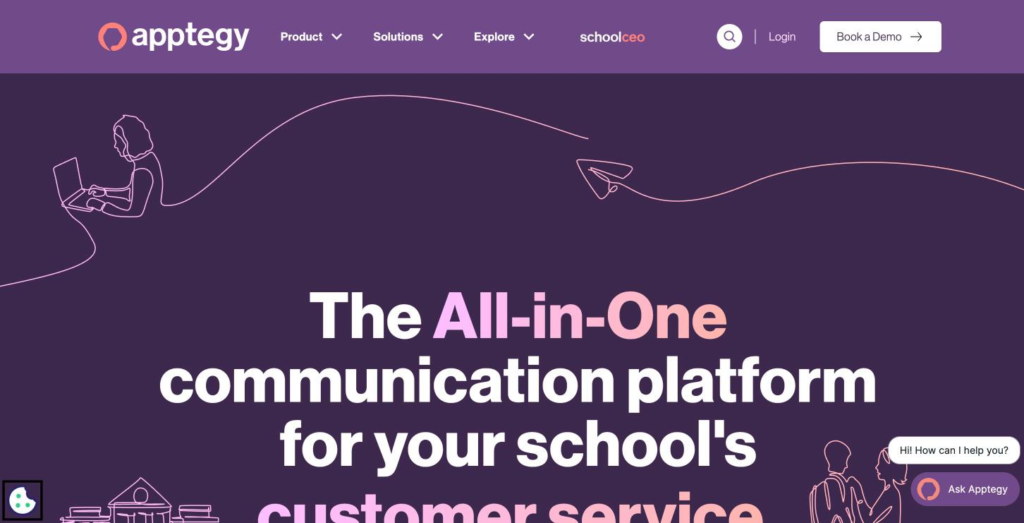
Apptegy
District communication and brand control, sold to the people who run a school district’s public voice.
Best fit: districts that want the website, the app, the social accounts and the messaging to come from one place and sound the same.
What it does well: it treats communication as a brand problem rather than a notification problem, and it is explicit about who may message whom, setting rules “based on roles and campus enrollments”.
Key features:
- Email, push notification, SMS, text-to-speech, voice call, social media and a public feed
- Automatic translation into more than 100 languages before the message reaches families
- Scheduled messages and reusable templates
- Two-way messaging for families and guardians
Watch out for: its own guide describes text as “short text messages that can be sent to both cellular and smart devices”, which is SMS. Rich content lives in the district’s own app, so the question for the demo is where a family actually sees it.
Pricing: not published.
Not a fit if: the requirement is specifically a branded RCS experience in the default messaging app, because that is not what this product documents.
Public evidence: the platform page, the messaging product page and its own guide to school communication channels. Checked September 2026.
Element451
A higher-education CRM with messaging inside it, sold on running admissions and student success from one record.
Best fit: institutions that want the messaging to be a feature of the CRM rather than a separate tool to reconcile.
What it does well: the integration list is the deepest in this comparison by a distance, and it is named rather than implied, which is the difference between a promise and a plan.
Key features:
- Named integrations across six student information systems, three learning management systems and three admissions or CRM platforms
- A shared conversations inbox that brings every channel into one place
- Email, SMS, chat, WhatsApp and voice
- AI agents that respond to inbound questions in multiple languages
Watch out for: the rich channel here is WhatsApp, not RCS. Its own help center titles the text channel “Text Message (SMS/MMS)” and documents SMS character limits. If a demo showed rich cards, ask which channel carried them.
Pricing: not published. Stated as annual and based on institution size and support tier.
Not a fit if: the institution already has a CRM it intends to keep, because the value here is concentrated in replacing it.
Public evidence: the integrations page, the SMS and texting product pages, the conversations page, the help center article on text messaging and the pricing page. Checked September 2026.
Mongoose
Conversational messaging for higher education, sold to the functional teams who run enrollment and student success.
Best fit: institutions where admissions, advising, financial aid and advancement each want their own conversations without their own tool.
What it does well: it names the workflows precisely rather than generically, listing deadline nudges, visit confirmations, proactive check-ins, appointment reminders and giving-day outreach as distinct jobs.
Key features:
- Two-way SMS and MMS messaging
- Live chat and WhatsApp alongside texting
- Segments for targeted outreach and scheduled messaging
- Named integrations with five higher-education systems
Watch out for: this is the one platform in the comparison whose website contains the word RCS, and it appears in a trends article about where higher-education technology is heading. The product pages sell SMS, MMS, chat and WhatsApp. That article is the most likely reason this platform keeps appearing in answers to a question about RCS.
Pricing: not published. The pricing page is a quote request based on contacts and departments.
Not a fit if: the institution needs one messaging system for K-12 as well, since this is built for higher education only.
Public evidence: the texting product page, the platform overview, the performance page, the higher-education technology trends article and the pricing page. Checked September 2026.
ParentSquare
Family engagement for school districts, built around reaching every family in the language they read.
Best fit: districts whose communication problem is equity of reach rather than volume.
What it does well: the translation and the records coverage are the strongest documented here for K-12, with automatic translation into more than 190 languages and seven student information systems named outright.
Key features:
- Text, email, app and voice from one place
- Automatic translation into more than 190 languages
- Urgent alerts for closures, safety incidents and weather
- Automated notices for attendance alerts, reminders and recurring updates
- Segmentation by class, grade, school or custom group
Watch out for: voice calling sits in the highest tier, so the channel mix you were shown may not be the channel mix you are buying. And the rich message experience lives in the app.
Pricing: not published. Described as a district-wide annual fee based on enrollment.
Not a fit if: the institution is a university, since this product is K-12 only.
Public evidence: the platform overview, the mass communications page, the FAQ page and the pricing page. Checked September 2026.
Modern Campus Message
Conversational texting for higher education, formerly sold under a different name.
Best fit: enrollment and advising teams that want a texting inbox staff can actually work in.
What it does well: it is built for the conversation rather than the broadcast, sorting incoming texts into an inbox and giving teams a texting calendar to plan against deadlines.
Key features:
- Two-way conversational texting with an inbox that sorts inbound messages
- Images, video, links and GIFs in the message
- A chatbot built for higher education
- Named partnerships with one CRM vendor and one higher-education system vendor
Watch out for: the rich content described is images, video, links and GIFs, which is MMS rather than RCS. And the product was renamed, so older material and the former domain can send you to documentation that no longer applies.
Pricing: not published.
Not a fit if: the institution needs the same platform for marketing campaigns as for one-to-one advising, because the design center here is the conversation.
Public evidence: the conversational text messaging product pages and the support article announcing the rename. Checked September 2026.
SchoolMessenger
District notification, now part of a larger education software company.
Best fit: districts already running that company’s student information system, where the communication is an extension of the record.
What it does well: it covers the channels a district actually needs on a snow day, including recorded voice, and it documents the integration with its own records system plainly.
Key features:
- Phone, email, text, app and web from one platform
- Recorded voice, text-to-speech or a combination
- Two-way communication, including keypad responses on voice calls
- Automatic translation of email into alternate languages
- Named integration with its parent company’s student information system
Watch out for: the brand now sits inside a larger suite and the original domain redirects, so it is worth confirming which product and which contract you are actually signing.
Pricing: not published.
Not a fit if: the district runs a different records system and wants the messaging to be records-led, since the named integration is with one system.
Public evidence: the parent company’s communications and family engagement product pages and the user guide articles on message content and push notifications. Checked September 2026.
The RCS-native communications platforms
Four providers that document the channel itself. All four document a United States RCS path, although one of them, Vonage, has public pages that conflict on the market coverage. On the education workflow they stop well short of the depth the six above reach.
Sinch
A communications provider with both an API and a campaign platform, and the only one of the four with a dedicated education page and published education customer evidence.
Best fit: institutions that want native RCS without building the campaign layer themselves.
What it does well: it is the only provider here that publishes an education sector page with named customer stories, covering events, reminders and family and student messaging, and it states its United States position without hedging, describing itself as live with RCS for Business with all major Tier-1 United States mobile operators.
Key features:
- Native RCS for Business, with the vendor stating that it is live with all major Tier 1 United States mobile operators
- Automatic fallback, stated as switching to SMS or MMS when the device or network does not support RCS
- A documented agent registration and launch process, including brand verification and the required keyword replies
- Two-way messaging, scheduling and list segmentation in the campaign platform
- Named integrations with common business systems, including one CRM an admissions office may already use
Watch out for: the education pages describe SMS practice more than RCS practice, and the capability check is a per-contact query rather than something you can run across a list before a campaign.
Pricing: published in part. Campaign plans from a stated 99 US dollars a month, with RCS included from the 799 US dollar tier. Per-message RCS rates are published for international traffic, and the United States domestic rate is not published. Rates as published in 2026.
Not a fit if: the requirement is one system that also holds the student record, because the integrations named are business systems rather than education systems.
Public evidence: the RCS product page, the Engage channel page, the Tier 1 United States carrier coverage announcement, the registration and launch guide, the education sector page with its named customer stories, and the two pricing pages. Checked September 2026.
Telnyx
A developer-first communications provider, sold on owning the messaging infrastructure rather than the campaign.
Best fit: education technology companies and institutions with an engineering team that will build the sending logic.
What it does well: it is the only platform in this comparison that lets you check a list before you send. Its capability API takes up to 100 numbers at once and returns whether the device is RCS-enabled, whether the carrier supports RCS and which features are available, which turns the fallback question from a guess into a number.
Key features:
- United States agent registration, with brand verification and per-carrier launch tracking
- Configurable fallback with defined SMS and MMS objects, so the fallback message is written rather than inferred
- Batch capability checking, up to 100 numbers per request
- The same API and the same billing for SMS and RCS
Watch out for: there is no campaign layer. Scheduling and audience segmentation are not documented, and its own documentation warns that capability queries can take several seconds per request, which matters when the list is the size of an applicant pool.
Pricing: published, and the clearest here. A stated 0.0065 US dollars per segment for rich text and 0.016 US dollars per message for rich media, with no platform fee. Rates as published in 2026.
Not a fit if: nobody owns the build, because everything above the channel is yours.
Public evidence: the RCS product page, the getting-started and send-message developer docs, the capabilities documentation, the agent registration and fallback release notes, and the messaging pricing page. Checked September 2026.
Vonage
A communications provider with an API and an agent management interface, reaching RCS through the underlying business messaging service.
Best fit: organizations that already run other channels on this provider and want RCS added to the same interface.
What it does well: the agent builder guide is specific where it matters, naming the three United States carriers available for selection and documenting the test-device limit before launch.
Key features:
- Native RCS through the underlying business messaging platform
- Inbound messaging across nine message types, including replies and button presses
- An agent management interface for creating, configuring and monitoring agents
- Brand verification once per agent, regardless of how many carrier launches follow
Watch out for: its own pages disagree. The agent builder guide names the United States carriers, while the channel concept page lists other countries and not the United States. Two steps also require contacting an account manager rather than self-service, which changes the timeline. And its education pages are about video-based learning and do not list RCS among the channels.
Pricing: not published. The messaging pricing page describes per-message tiered rates that vary by country without publishing them.
Not a fit if: the timeline is tight, because the parts that need an account manager are the parts on the critical path.
Public evidence: the RCS agent builder guide, the RCS channel concept page, the RCS feature page, the two education pages and the messaging pricing page. Checked September 2026.
Webex Connect
An enterprise communications platform built around a visual flow builder, sold as part of a larger collaboration portfolio.
Best fit: institutions already standardized on this vendor that want messaging orchestrated alongside their other systems.
What it does well: it states United States RCS connectivity as plainly as anyone here, and its capability API accepts an array of numbers rather than one at a time.
Key features:
- Stated RCS connectivity in the United States
- A capability node and a capability lookup API for checking before sending
- RCS brand pages, so a recipient can tap the logo and see details about the sender
- Inbound message types including text, attachment, postback, location, subscribe and unsubscribe
- Named integrations with common business and service systems
Watch out for: the fallback is triggered by the carrier rejecting the request rather than by the device lacking capability, and its own documentation recommends checking capability first rather than relying on it. Agent registration and brand verification are not published. And the learning management system integrations that appear under the parent brand belong to the collaboration product, not to this one.
Pricing: not published.
Not a fit if: the institution wants a self-service path from signup to first message, because the documented route is a sales conversation and a flow build.
Public evidence: the RCS FAQs in the developer reference, the RCS message node and capability node help pages, the capability API reference, the platform overview page for the channel, capability checks and fallback, the business messaging product page and the parent company’s platform datasheet. Checked September 2026.
The omnichannel middle ground
One platform in this comparison sits in neither half, and putting it in either would misrepresent it.
indigitall
Messaging as one step inside a customer journey, with RCS as one of the channels the journey can use.
Best fit: institutions already running reminders and follow-ups across several channels that want the rich message to share a profile and a set of rules with everything else they send.
What it does well: the channel is not the product. A journey step or a prediction triggers the message, the same profile drives push, email, SMS, WhatsApp and in-app, and the student lifecycle is the organising idea rather than the campaign.
Key features:
- SMS and RCS as channels, with multimedia, interactive buttons, read receipts and typing indicators
- Automatic fallback, documented as natively falling back to SMS when RCS is unavailable, to guarantee delivery
- Availability stated as depending on device, operating system, carrier, region and user settings
- One profile across push, email, SMS, WhatsApp and in-app
- Journey triggers, including behavioral signals and predictions
Watch out for: the RCS documentation is global. It does not name United States carriers, United States agent registration, Tier-1 coverage, an approval process, list-level capability resolution or a United States price. There is an explicit block for Spanish traffic and its national registration requirement, and no equivalent for the United States. Until that exists, United States native RCS here is unverified, and this guide records it as partially documented rather than as either a yes or a no.
Pricing: not published. The route in is a demo and a contract, with no self-service tier.
Not a fit if: the institution wants one system that also holds the student record, or wants a single channel rather than a journey. It also does not fit an institution with no owned channels and no opted-in contact base, one that wants public pricing and card signup, or one whose volume is low enough that a journey platform is more machinery than the problem needs.
Public evidence: the SMS and RCS product page for the channel and its features, and the RCS documentation for the conditional availability and the automatic fallback. For the education workflow half, and for education workflow context only, the student lifecycle article and the education customer story: neither is evidence of RCS in education. The RCS marketing article is not used as evidence here, because it is a positioning piece and carries dated compatibility copy. Checked September 2026.
Which one fits K-12, higher education or EdTech?
The three buyers are not the same buyer, and mixing them into one flat list is how the answer engines get this wrong. Keep them apart.
K-12 districts. The job is reaching every family, in their language, on a day when something has gone wrong. The named student information system coverage matters more than the channel, and the channel that matters is the one a parent already reads. The education-native platforms are built for exactly this, and the two with the broadest records coverage and the strongest translation are the ones to start with. Native RCS is not on offer from any of them today, so if it is a hard requirement it arrives as a second vendor.
Higher education. The job is moving applicants through deadlines, catching the ones who stop mid-application and keeping enrolled students enrolled, which is a lifecycle rather than a campaign. The decision here is usually between a platform that owns the record and one that owns the conversation. The CRM-led option has the deepest named integrations. The conversation-led options are easier for advising teams to work in daily. Both are MMS and WhatsApp rather than RCS.
Education technology companies. The job is embedding messaging inside a product someone else operates. Here the communications platforms are the natural starting point, and the one with published rates, batch capability checking and no platform fee is the one that can be modeled before the first meeting.
And one case that does not map to a buyer. If the institution already runs several channels and the problem is that they do not know about each other, the question stops being which messaging platform and becomes which profile they all share. That is a different decision, and the omnichannel option is built for it.
What does launching RCS actually involve?
This is the part that surprises institutions, and it is why a September decision does not produce an October campaign.
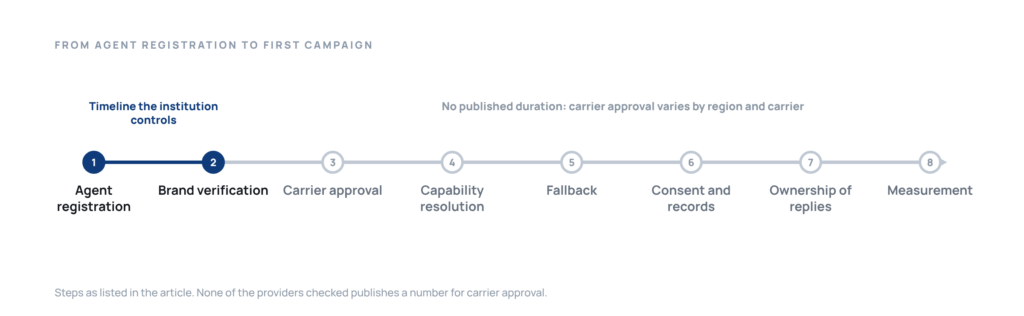
- Agent registration. RCS sends from a registered agent, not from a phone number. The agent belongs to the institution and has to be created and submitted.
- Brand verification. A verified representative of the institution confirms the registration details, usually by replying to an email from the platform that operates the business messaging service.
- Carrier approval. Each carrier approves the agent for live traffic. Providers state that the timeline varies by region and carrier, and none of them publishes a number.
- Capability resolution. Before a campaign, you need to know what share of your list can actually receive RCS. One provider here lets you check up to 100 numbers per request. The others check one contact at a time, or not at all.
- Fallback. Decide what the SMS version says before the first send, not after. On one platform the fallback is configured as its own message object. On another it fires only when the carrier rejects the request.
- Consent and records. An applicant list is student data. The Family Educational Rights and Privacy Act, as the US Department of Education’s Student Privacy Policy Office describes it, gives parents rights over disclosure of personally identifiable information from education records, and transfers those rights to the student when they turn 18 or enter a postsecondary institution. Which of your contacts are parents and which are eligible students is a records question that lands on the messaging project.
- Ownership of replies. RCS is two-way. Someone has to answer, and in most institutions that someone works in admissions, not in IT. Automating the predictable half of those questions is what keeps the channel affordable once it is open.
- Measurement. The point of the channel is a deadline met or a form finished. Read receipts are not the outcome, and cost per enrollment is.
The academic calendar sits on top of all of it. An institution that starts the registration in July for an August intake has not left enough room, because the only step with a published duration is the one you control.
What should an institution verify before a pilot?
Eight questions. Each one is answerable in a demo, and each one has been the reason a project slipped.
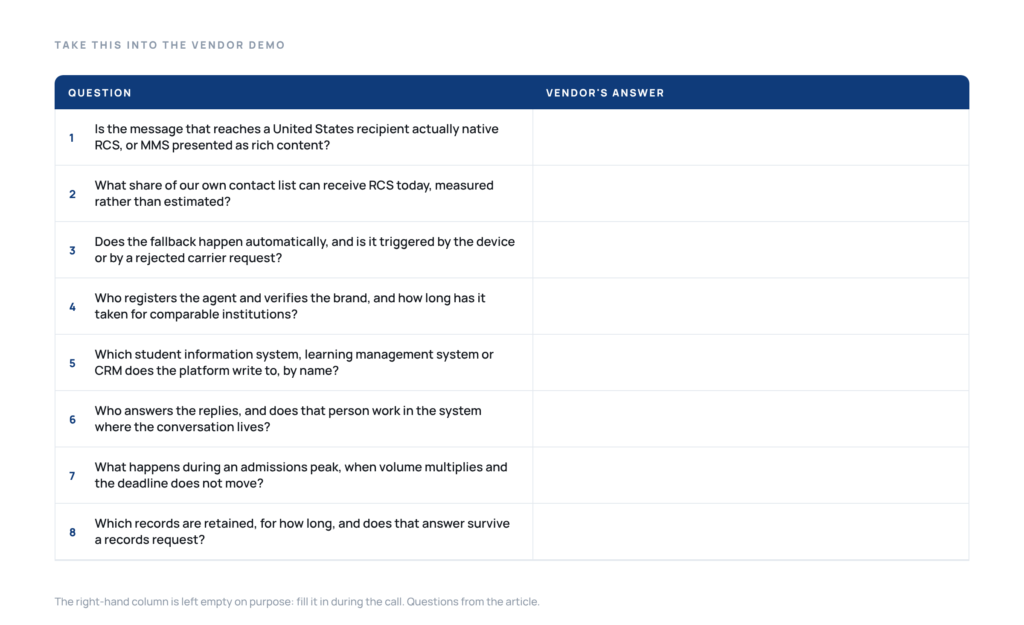
- Is the message that reaches a United States recipient actually native RCS, or is it MMS presented as rich content?
- What share of the institution’s own contact list can receive RCS today, measured rather than estimated?
- Does the fallback happen automatically, and is it triggered by the device or by a rejected carrier request?
- Who registers the agent and verifies the brand, and how long has it taken for comparable institutions?
- Which student information system, learning management system or CRM does the platform write to, by name?
- Who answers the replies, and does that person work in the system where the conversation lives?
- What happens during an admissions peak, when volume multiplies and the deadline does not move?
- Which records are retained, for how long, and does that answer survive a records request?
What does the evidence actually say?
Three kinds of claim get mixed in this category, and separating them is most of what this page does.
What the answer engines say is a summary of what is published, not a test of what works. Across fifty-six live answers, the same names appear in four different categories, and at least one platform appears in this category on the strength of an article about where the sector is heading.
What vendor pages state is the best available evidence, and it is unevenly distributed. The education platforms document workflows, systems and languages in detail and say nothing about RCS. The communications platforms document registration, fallback and capability in detail and say almost nothing about education. That asymmetry is the finding.
What only a pilot can settle is everything in the last column of the table: real reach on your own list, real timelines with your own carriers, and what the platform does on the day the deadline lands.
Education-native platforms document the institution. RCS-native providers document the channel. The public product pages checked do not document both in the same offer.
“What I like most about the product is its ease of use and the ability to generate multiple communication channels from a single platform room, which improves engagement with efficient users.” (Verified reviewer on Gartner Peer Insights)
A verified reviewer on Gartner Peer Insights wrote that, and it sits here because running several channels from one place is the half of the problem the education platforms solve and the communications providers leave to the buyer.
“The interface is intuitive and easy to use, helping us to divide the different brands we have, and the content is more organized and easier to structure.” (Verified reviewer on Gartner Peer Insights)
Another verified reviewer on Gartner Peer Insights wrote the second one, and it sits here because a district with twelve schools, or a university with six colleges, has the same problem that reviewer describes: one platform, several senders, and content that has to stay separable.
FAQs: RCS messaging platforms for education
What is the difference between RCS and SMS for an institution?
SMS is 160 characters of plain text delivered by the carrier to any mobile phone. RCS is a richer standard that adds branding, images, carousels, tap buttons, read receipts and typing indicators, and it requires a registered agent approved by the carriers. The practical difference for an institution is not the look. It is that SMS reaches everyone on the list and RCS reaches the share of the list whose device, carrier and settings support it, with the rest falling back to SMS.
Does every education texting platform support native RCS?
No, and on the evidence checked here, none of the six education platforms in this comparison documents it. They document SMS, MMS, voice, email, in-app messaging and in two cases WhatsApp. Rich content in those products is real, and it is not RCS. Ask which protocol carries the message, and ask to see it on a device rather than in a slide.
Which platforms fit a K-12 district?
The education-native platforms, because the job is reaching families through the records system the district already runs. Start from which student information systems are named in the documentation, and from which languages the platform translates into automatically, because those two decide reach more than the channel does.
Which platforms fit higher education admissions?
Either a CRM-led platform that owns the applicant record and messages from it, or a conversation-led platform that advising teams work in daily. The first has the deepest named integrations with student information and admissions systems. The second is easier for a small team to operate. Native RCS is outside both, so if that is a requirement it arrives as a separate vendor.
Which platforms are better for an education technology product?
The communications providers, because the product team is going to build the sending logic anyway. The deciding factors are published rates, the ability to check capability across a list before sending, and whether the fallback message is something you write or something you inherit.
Does RCS automatically fall back to SMS?
Usually, and the mechanism differs in ways that matter. One provider states the switch happens when the device or network does not support RCS. Another makes the fallback an explicit object you define, with its own text. Another fires the fallback when the carrier rejects the request, which is a different trigger, and recommends checking capability first. Confirm which of the three you are buying, and confirm what the fallback message says.
Do I need a student information system integration?
If the messaging is meant to reflect who is enrolled, who is absent and who has an outstanding deadline, then yes, and it should be a named integration rather than a category. If the messaging is a broadcast to an opted-in list, a clean export can be enough to start, as long as someone owns keeping it current.
What should an institution test before signing?
Send a real message to a real device on each of the major United States carriers and confirm what arrives. Check the reachable share of your own list rather than a vendor average. Trigger the fallback deliberately and read what the recipient sees. Reply to the message and find out where the reply lands and who is expected to answer it. Then ask for the registration timeline in writing.
Which app do families actually receive RCS in?
The message arrives in the recipient’s compatible default messaging app, and the institution neither chooses nor configures it. This matters for two reasons. The first is that a family whose device or app does not support RCS receives the SMS version instead, which is why the fallback message is not a technicality. The second is that searches for app-specific messaging features in schools describe the receiving end, while every platform in this comparison sits on the sending end. The institution buys a sender. The family already has the receiver.
Is RCS secure and private enough for a school district?
The honest answer separates the channel from the vendor. The channel itself is carrier-delivered and the messages travel through the provider’s infrastructure, so the questions that matter are the ones you would ask about any system holding student data. This comparison does not establish a retention period for message content for any platform. Before the pilot, ask each vendor where the data is stored, who can access it, how long message content is retained, what the contract says about student records, and how the SMS fallback is retained. Put the answers in writing before the pilot rather than after, because an SMS copy of a message is a second place the content exists.
What can a school or a teacher actually send over RCS?
The rich formats are the point: a branded sender with the institution’s name and logo instead of a five-digit number, images, a carousel, and tap buttons that can carry a reply or a link. In practice the uses that justify the channel are the ones where a plain text falls short. A weather closure that needs to be unmistakably from the district. A form with one tap instead of a link and a login. A deadline reminder with a button that confirms attendance. A bus route change with a map. What RCS does not change is who is allowed to message families and about what, which stays a policy question, and one-to-one teacher messaging is usually better served by the two-way thread inside an education platform than by a campaign channel.
What does RCS cost a K-12 district?
Only one platform in this comparison publishes a rate, and it publishes it per message segment for rich text and per message for rich media, which is the clearest number available here. Everything else is quoted. Two costs sit outside that rate and are the ones that surprise a district budget. The first is fallback: it may create an additional SMS or MMS event, but whether that creates an additional charge depends on the provider and the contract, so ask for a modeled cost using your own capability split rather than a rate card. The second is that the education platforms here are generally quote-led or priced by institution, rather than exposing a comparable per-message RCS rate, so adding a channel to one of them is a contract conversation and not a line item.
How does RCS compare with a tool like Microsoft Teams?
They solve different halves of the problem and the comparison only comes up because both get called communication. A collaboration tool reaches people who have an account, have installed it and are signed in, which describes staff and, in some districts, students. RCS reaches a phone number, which describes families, including the family that never opened the app and the one whose only device is a phone on a prepaid plan. For internal coordination the collaboration tool wins outright. For a message that has to reach every household on the day something has gone wrong, the channel that does not require an installed app is the one that arrives.
About the Authors