indigitall Omni AI
  Start chat with AI agent
 Speak with AI voice agent
 Book a Demo

 Speak to an Expert












RCS Messaging Platforms for Retail and E-commerce: Which Operating Model You Are Actually Buying
September 21, 2026


Updated September 22, 2026
There is no best RCS platform for retail, and any page that names one is answering a question you did not ask. What you are choosing is an operating model. For a retailer that already runs SMS and MMS and wants RCS inside the same program, Listrak. For enterprise engagement and campaign scale, Attentive. For e-commerce marketing where the customer data, the email and the texts live together, Klaviyo. For guided shopping and conversations a person sometimes has to take over, Quiq. For carrier reach and APIs you assemble yourself, Sinch and Vonage. For retailers who want RCS as the first step of a journey that also owns push, voice and the customer profile, indigitall. The separator is not features. It is which team operates the channel, what it has to integrate with, and what happens on the handsets that cannot receive RCS.
This piece is for the people who sign for RCS in a retail or e-commerce business: heads of CRM and retention, e-commerce directors, marketing operations leads and the customer service managers who end up owning the inbox. You get the operating models this category actually splits into, a card for each platform with the same fields, the integration question to ask each one before signing, and what it takes to add RCS to an SMS program that is already running.
Why does picking an RCS platform from a feature list go wrong?
Because every platform in this category passes the feature list. They all do rich cards, verified sender, carousels, suggested replies and delivery receipts, because those are properties of the channel, not of the vendor. RCS defines what a message can contain. It does not define who operates it.
So a comparison built on features returns nine platforms that look identical, and the buyer picks on price or on whoever answered the phone.
The differences that survive contact with a real retail program are elsewhere: whether the platform is the one that also holds your customer profile or one more system to sync, whether your marketing team can launch a campaign without an engineer, what happens to the part of your list that cannot receive RCS, and whether adding RCS means rebuilding the segments you already have.
How were these platforms selected?
Five things, declared before the list so the selection is a method rather than an opinion.
- Operating model. Who runs the channel day to day: a marketing team, an engineering team, or a support team.
- What it has to integrate with. The e-commerce platform, the CRM, the customer data layer, and whether that is native or a project.
- Fallback behavior. What the platform does with recipients who cannot receive RCS, and whether it is automatic.
- How it charges. Whether the model is published, and what it is measured on.
- Retail evidence. Whether the vendor documents retail use cases publicly, rather than being placed in retail by a directory.
There is no position one and there is no score. The entries are listed alphabetically on purpose. A ranking would promise an ordering that the answers in this category do not have: ask the same question twice and you get different platforms in a different sequence, because the real answer depends on the shape of the buyer. So this pairs instead of ordering.
And one honest note on coverage. This piece covers the operating models most often observed in retail programs. It does not claim to list every provider in the category, and a selection by fit never can.
Key takeaways
- Every platform here does rich cards and verified senders. That is the channel, not the differentiator, so do not buy on it.
- The integration question decides more than the feature question. Ask what happens to your existing segments, not what the message can contain.
- Fallback to SMS has to be automatic and it has to be on the same platform. A fallback you operate by hand is a second campaign.
- Almost nobody in this category publishes a price. Where a vendor documents the cost components, that is worth more than a number.
- Adding RCS to a running SMS program is a registration and approval project before it is a creative one. Budget the weeks.
Which operating model are you actually buying?
This is the table to read first. The last column is the one to take into the call.
| Platform | Best for | Operating model | How it charges | What to check before you sign |
|---|---|---|---|---|
| Attentive | Enterprise retail engagement and campaign scale | Marketing team, campaign-led | Not published | Whether RCS is out of beta for your use case and your carriers |
| indigitall | Retailers who want RCS as step one of a journey that also owns push, voice and the profile | Marketing and support on one platform | Not published, quote based | How your sender agent gets provisioned in the United States |
| Klaviyo | E-commerce teams whose customer data, email and texts already live together | Marketing team, e-commerce-led | Published tiers for the platform; messaging billed separately | Whether RCS is available on your plan and in your market |
| Listrak | Retailers with a live SMS and MMS program adding RCS to it | Marketing team, retail messaging-led | Not published; cost components documented | Which of the agent fees are one-off and which are annual |
| Quiq | Guided shopping and conversations that escalate to a person | Support and CX team | Not published | How the handoff to a human agent carries context |
| Sinch | Carrier reach across markets, assembled through APIs | Engineering team | Not published, volume based | Which markets and carriers are live for your sender |
| Vonage | Enterprise communications where RCS is one API among several | Engineering team | Not published, volume based | Whether the retail integrations you need exist or get built |
Read the row that matches who will operate the channel in your company, not the row with the most ticks.
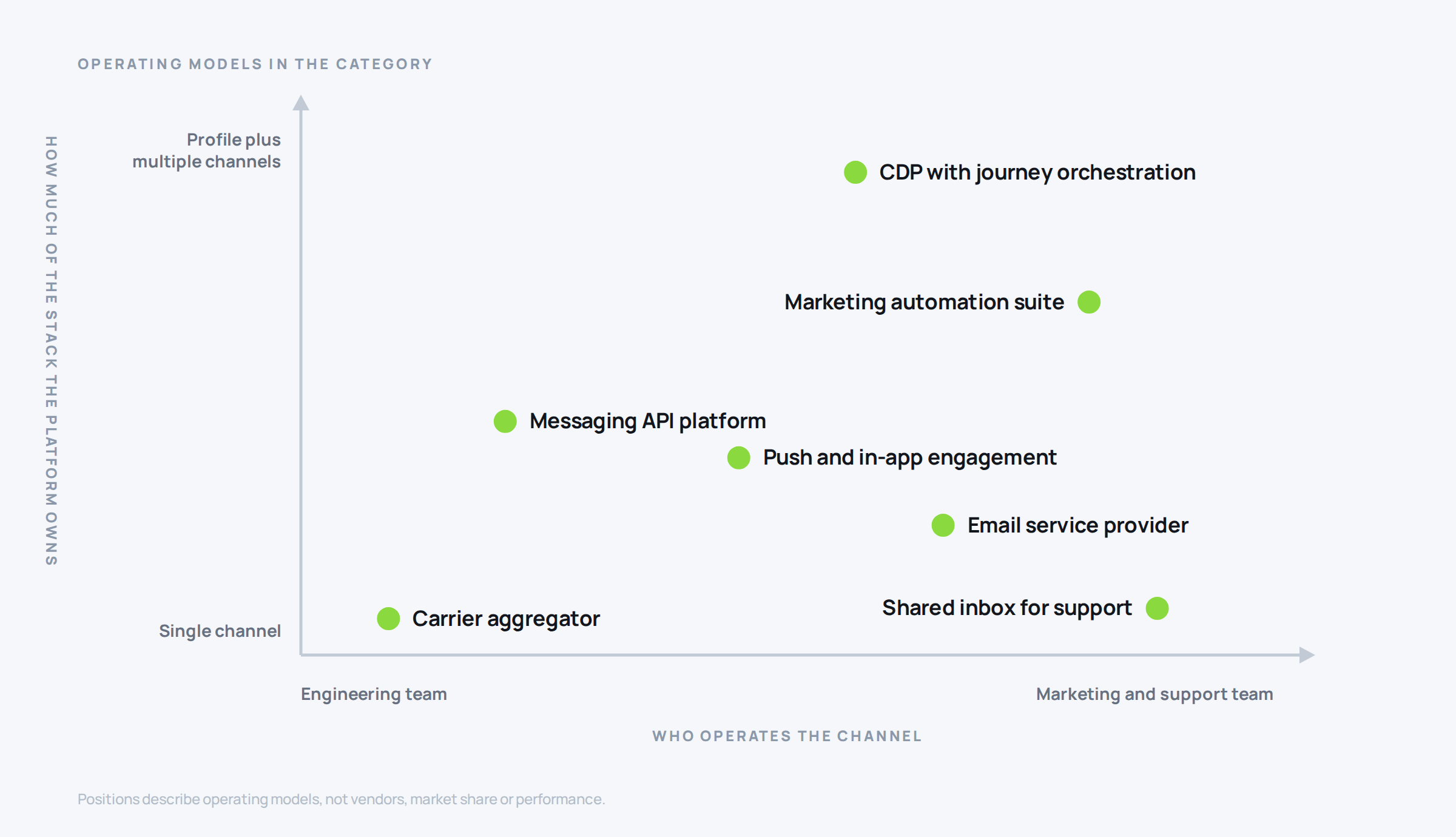
The platforms spread across the map instead of clustering, which is why a single ordered list cannot answer this question.
Attentive
The enterprise retail engagement platform, approached from campaigns and scale.
Best for: large retail brands running high-volume campaign programs where RCS is the next format rather than a new system.
What it does well: campaign execution at scale for retail, with the creative and audience tooling a large marketing team expects, and RCS positioned as an upgrade to the message rather than a separate channel to staff.
Key features: RCS Business Messaging alongside SMS, branded and verified sending, campaign and audience tooling, AI assistance for rollout, retail-oriented templates.
Worth knowing: Attentive published a post titled “Attentive RCS Business Messaging is now in Beta”, reporting on how early brands were performing. Beta is not a defect, but it changes what you can promise internally for the next quarter, so confirm availability and launch timing for your use case and your carriers.
Pricing: not published. Quote based.
Not a fit if: your program is small enough that a campaign platform of this size is more governance than you need.
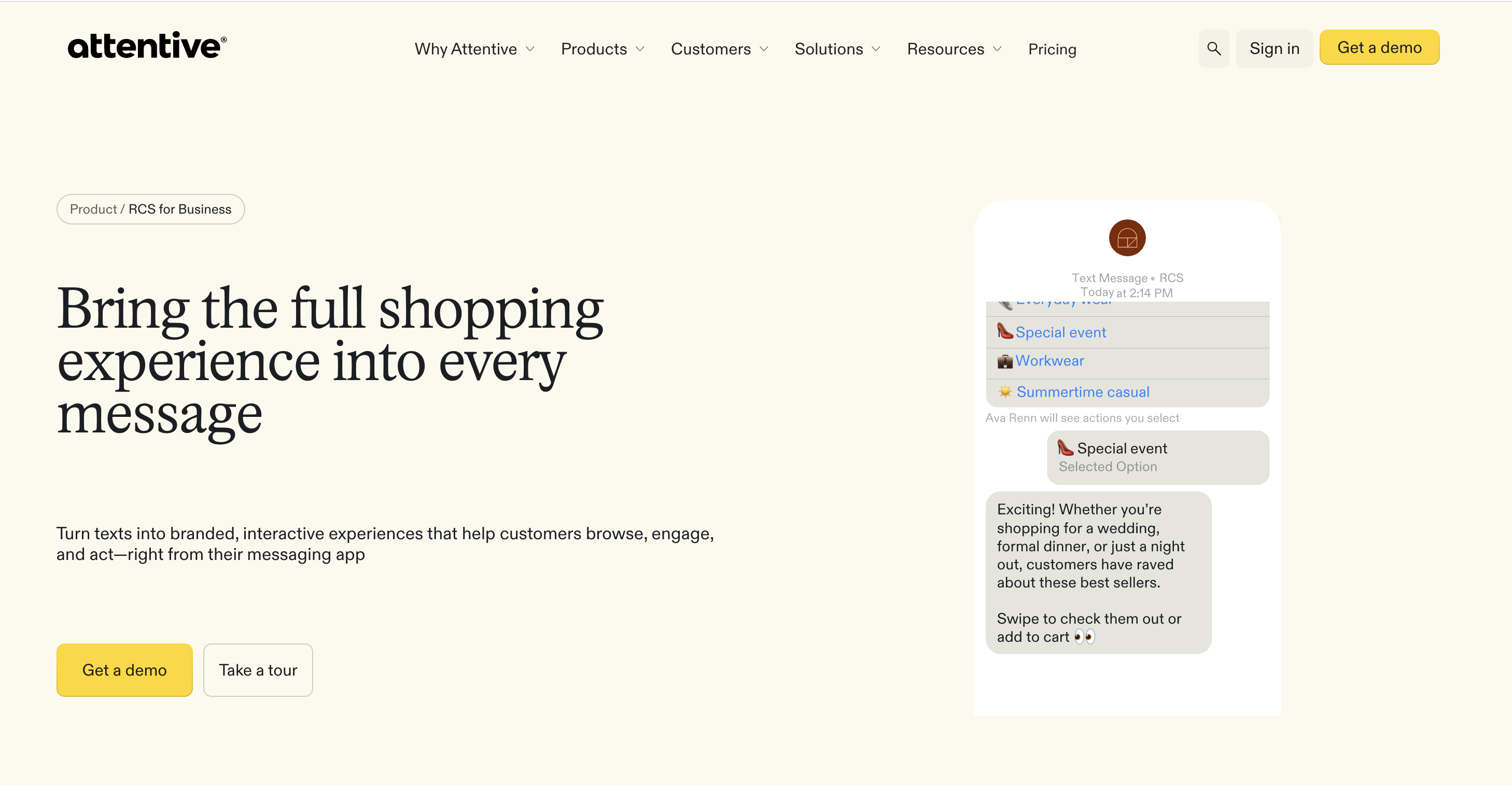
The page sells RCS as a format inside an existing campaign program, which is exactly the operating model it fits.
indigitall
The option for retailers who do not want RCS to be a channel bought on its own.
Best for: retail and e-commerce operations that want RCS as the first step of a journey that continues on push, voice, email and WhatsApp, with one customer profile underneath all of it.
What it does well: it treats RCS as step one of a chained journey rather than as a campaign destination. The journey starts on the cheapest channel that can carry the message, the shopper leaves it the moment she completes the goal, and the more expensive step only fires at whoever ignored the previous one. Consent is captured and stored per channel, which matters when the same shopper is reachable on four of them.
There is published retail evidence for this model, though not for RCS specifically. Its case on WhatsApp order management for an e-commerce bakery reports 65% of inquiries resolved by the bot with 24/7 availability, resolution 40% faster than the email support it replaced, a 30% rise in repeat purchases among engaged users and a 77.3% NPS across the first fifteen months. Its case with Soriana reports that web push alone drives 20% of total sales. Both are adjacent channels, not RCS.
Key features: SMS and RCS as the entry step, encrypted push, email, WhatsApp, AI voice calls on request, AI agents that answer inside the thread, and a unified customer profile the journey builder reads from.
There is one thing here that does not fit any column in the table above, and it is worth separating rather than forcing into a comparison. The voice agent is triggered by the shopper, not by the campaign: a “call me” button on the site, the app or the thread, answered in seconds. That is not a messaging feature and it does not belong in a channel count, but it changes what the escalation step of a retail journey can be.
Worth knowing: its published channel documentation is written for European regulatory regimes, including sender identity registration under Spanish rules. Ask in writing how your sender agent gets provisioned and approved for the United States before you plan a launch date.
What its users say. indigitall holds 4.8 out of 5 on G2, checked on 18 September 2026. Two reviews speak to what this entry claims and to what it costs:
“Ease of use and potential to contact customers through multiple available channels. Not very intuitive at the beginning. Relatively high learning curve.”
A verified reviewer in retail, on G2, naming both halves of the same trade: the breadth is the value and the ramp is the price.
“I believe you can improve the visuals and give me more information on how the campaigns are going, especially regarding metrics.”
Nicolas M., on G2, on reporting rather than on sending. It is the same gap the measurement section of this piece says you should plan to close yourself.
Pricing: not published. Demo and contract, no self-service sign-up.
Not a fit if: all you want is one channel and you are not going to add another. The value is in push, email, SMS, RCS and in-app sharing a single customer profile; if the plan is RCS and nothing else, a single-channel tool costs less and does the job.
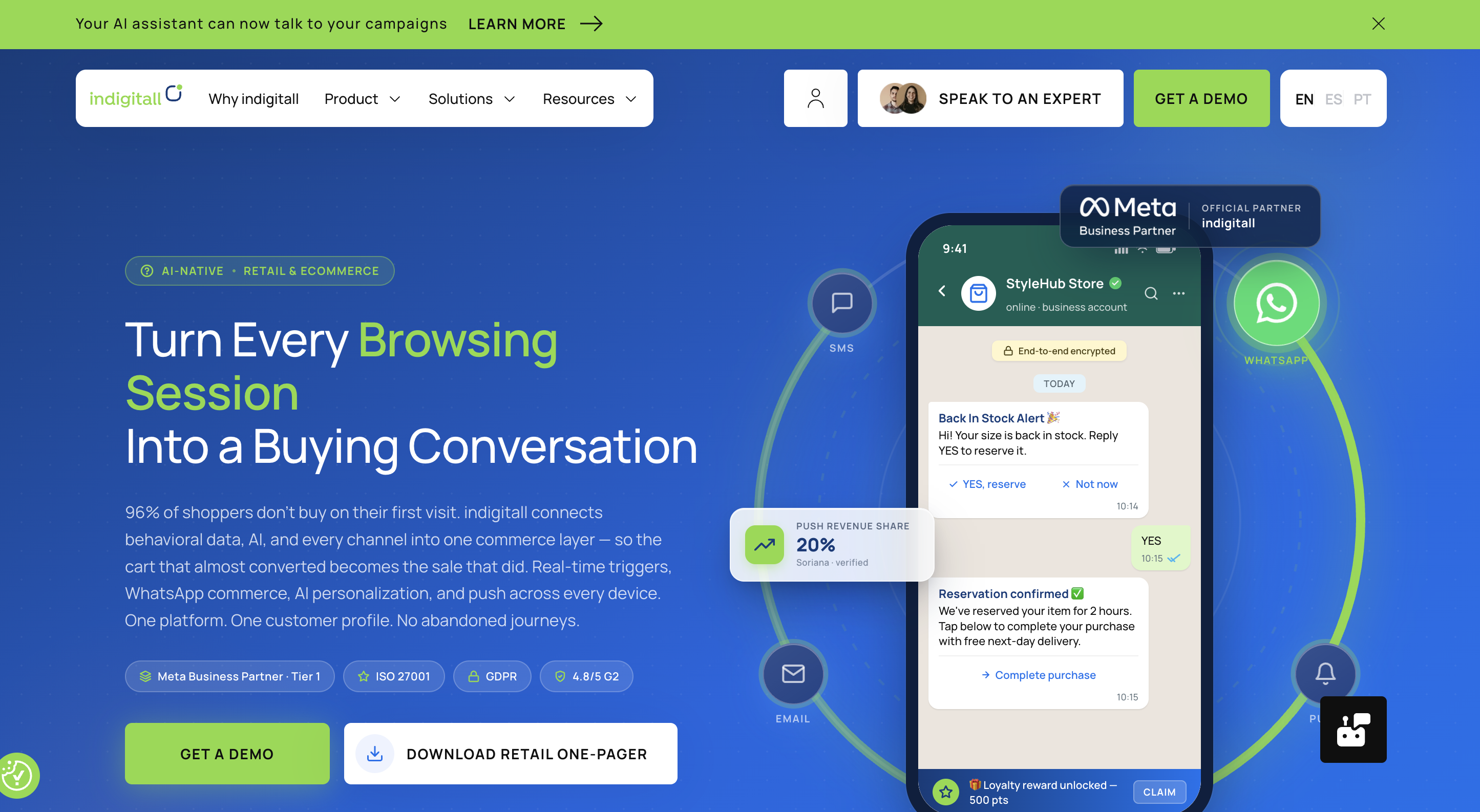
The page leads with the journey rather than with a single channel, which is the tell of which operating model it belongs to. Captured 18 September 2026.
Klaviyo
The e-commerce marketing platform, with RCS added to the texts it already sends.
Best for: e-commerce teams whose customer data, email and SMS already live in the same place and who want RCS without moving any of it.
What it does well: it keeps the customer data, the segments and the flows in one system, so RCS arrives as another format in a program that already exists rather than as an integration project. Its documentation and help center cover the setup path, which is more than most of this category publishes.
Key features: RCS Business Messaging inside SMS marketing, segments and flows shared with email, e-commerce integrations, customer data in the same platform, published setup documentation.
Worth knowing: availability depends on your plan and your market, so confirm both before you design a campaign around it.
Pricing: the platform has published tiers, which is unusual in this list. Messaging is billed separately from the subscription.
Not a fit if: your program is enterprise retail with a dedicated messaging team and carrier-level requirements.
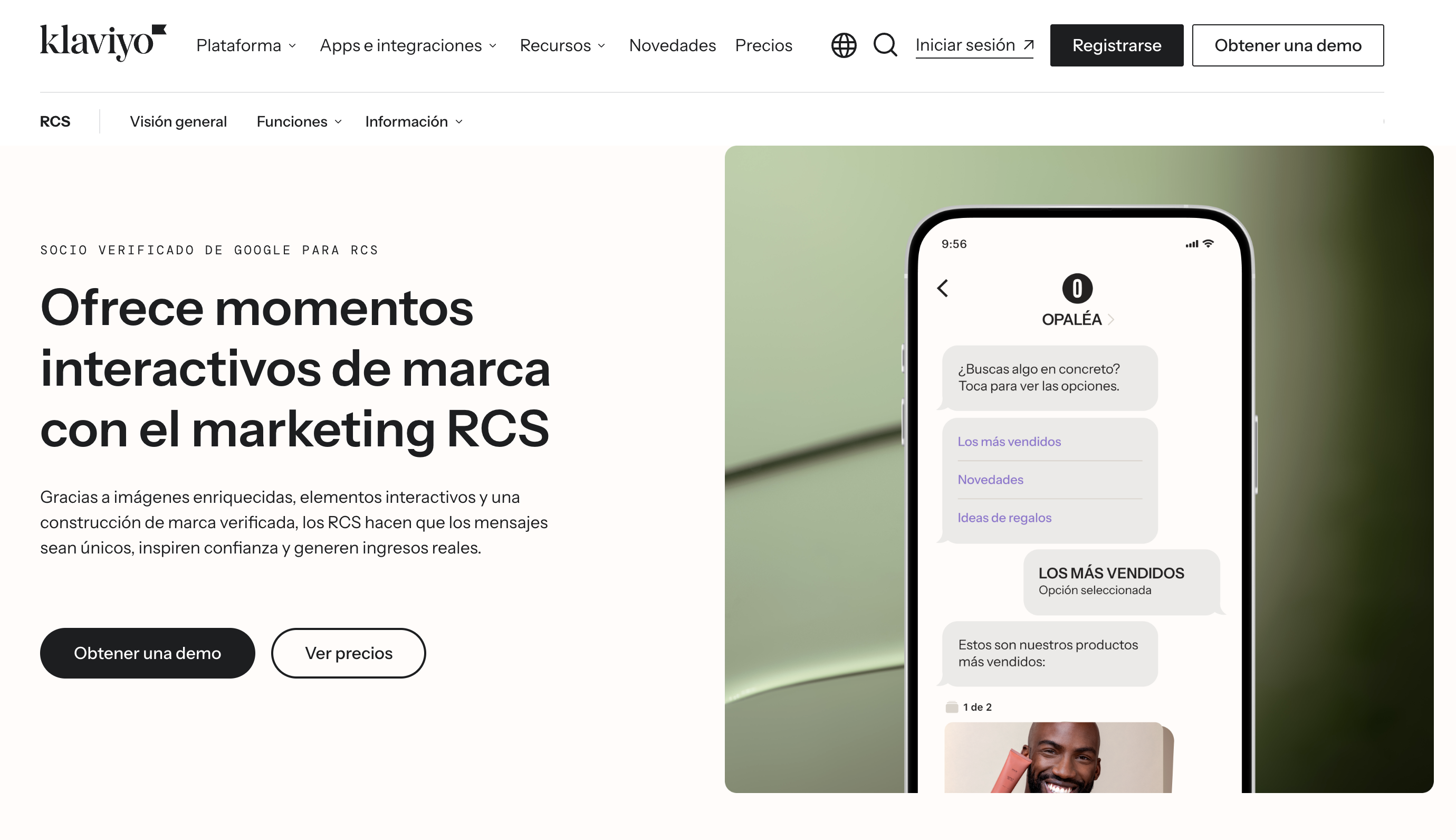
RCS sits under SMS marketing rather than in its own product area, which tells you it is an extension of an existing program.
Listrak
The retail messaging suite, for programs that already send and want to send better.
Best for: retailers with a live SMS and MMS program who want RCS inside it, on the same segments and the same calendar.
What it does well: it builds RCS into the mobile messaging platform rather than beside it, so campaigns can be created alongside SMS and MMS, and it falls back automatically to SMS or MMS when a device cannot receive RCS. It also documents the cost components of running the channel, which is more than most of this category puts in public.
Key features: RCS marketing for retailers, branded interactive messages, product images in the message, one-tap shopping and order tracking, automatic fallback to SMS or MMS.
Worth knowing: it documents the cost components rather than the price: sender agent vetting and provisioning, monthly sender agent fees, annual recertification and carrier pass-through fees. Ask which of those are one-off and which recur, because the annual recertification is the one that surprises people in year two.
Pricing: not published. Priced against the size of your messaging program.
Not a fit if: you do not have a mobile messaging program yet. This is built to upgrade one, not to start one.
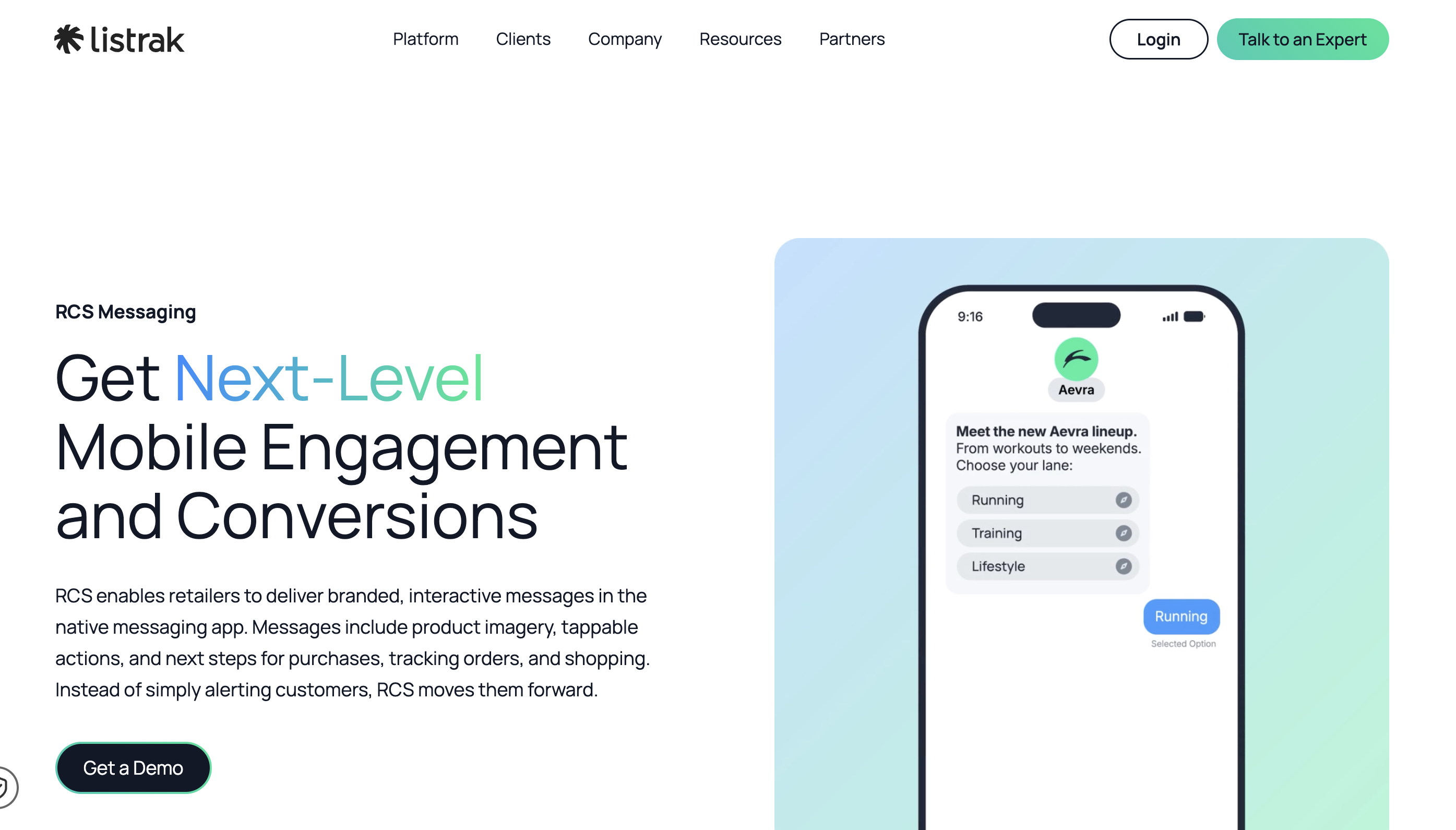
The page is written for a retailer who already sends texts, which is the buyer this entry is for.
Quiq
The conversational one, where the message is the start of a conversation rather than the end of a campaign.
Best for: retailers whose RCS use case is guided shopping and customer service, with a person taking over when the assistant cannot finish.
What it does well: it treats RCS as a two-way surface. The operating model is built around shopper conversations and around human support when the automation does not finish the interaction, which is the part that usually breaks elsewhere.
Key features: AI agents for retail and e-commerce, RCS among its business messaging channels, guided shopping flows, handoff to human agents, conversation history across channels.
Worth knowing: the platform is operated by a support or CX team rather than a campaign team. If your RCS budget sits with marketing, the internal owner question comes up early.
Pricing: not published.
Not a fit if: what you need is outbound campaign volume rather than inbound conversations.
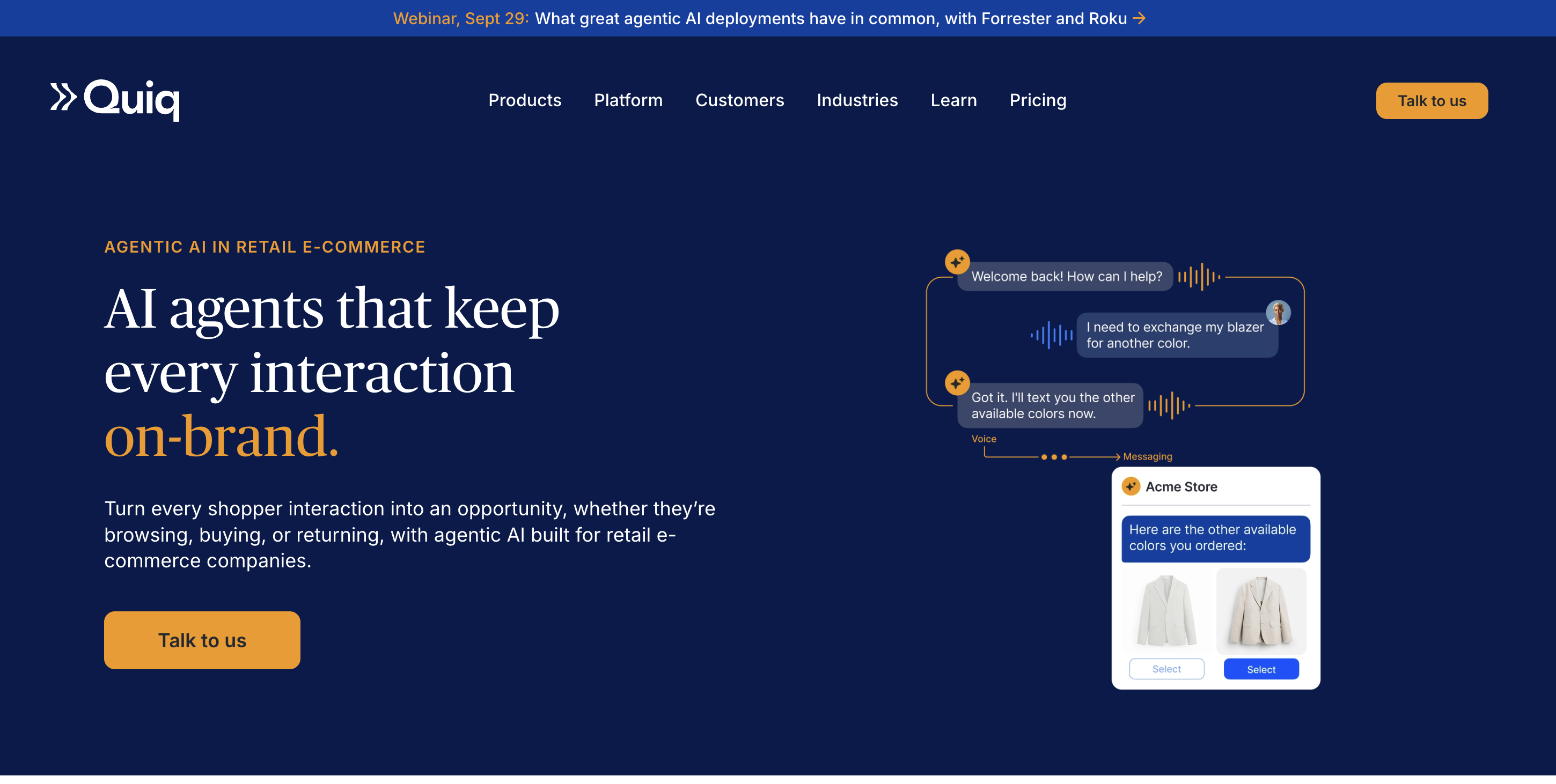
The page sells conversations and agent handoff, not campaigns, which places it precisely in the map.
Sinch
The carrier-reach option, assembled through APIs.
Best for: retail operations sending across several markets that want to build the experience themselves on top of messaging APIs.
What it does well: breadth of markets and channels through a single set of APIs, with RCS alongside SMS and other channels, for teams that have engineering capacity and want control over the experience.
Key features: RCS Business Messaging APIs, multi-market carrier connectivity, SMS and MMS alongside it, developer documentation, conversation APIs.
Worth knowing: its public product surface is API-led, so confirm which campaign tooling is included for your team before assuming a marketer can run it unaided.
Pricing: not published. Volume based.
Not a fit if: you want to launch a retail campaign this month without writing code.
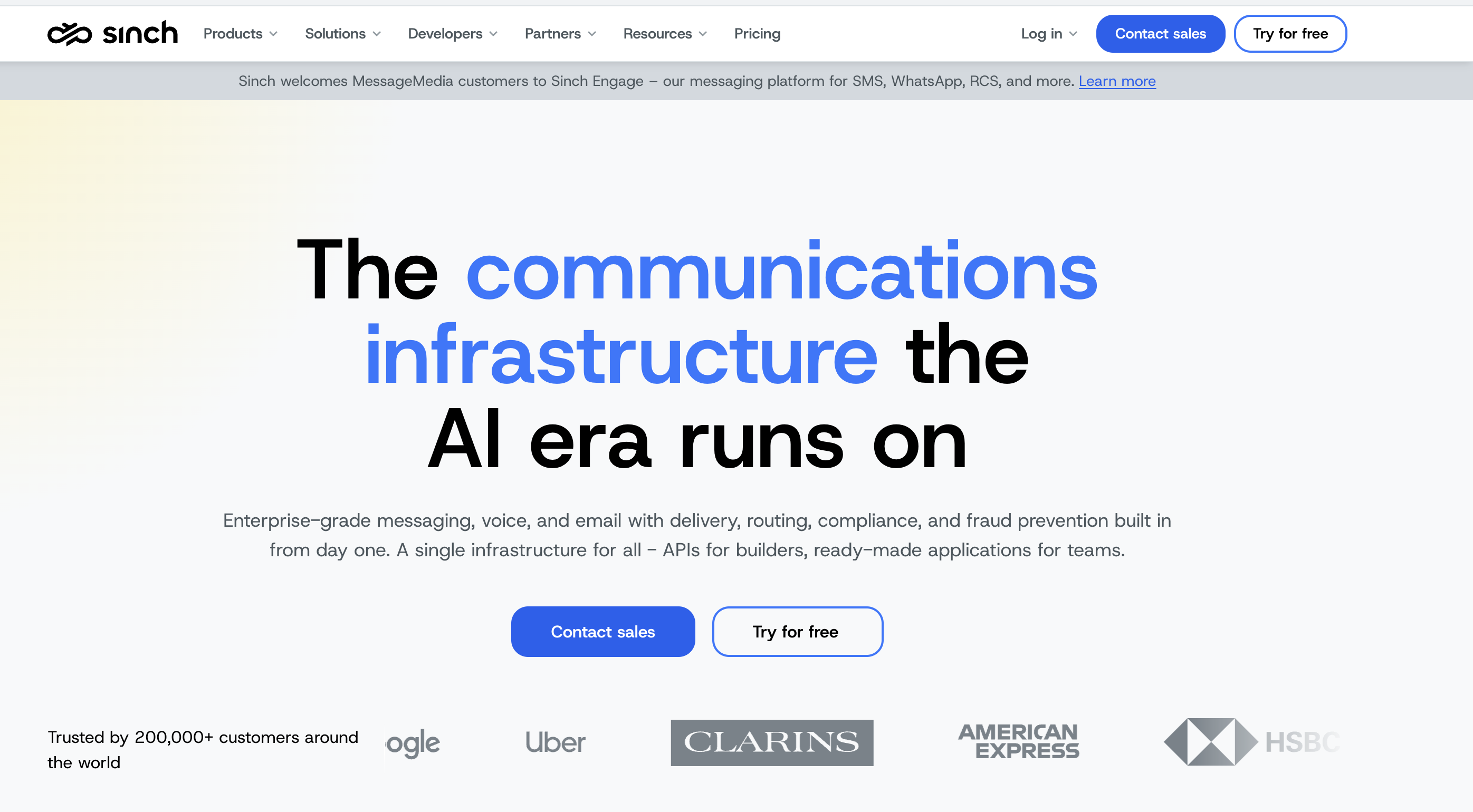
APIs lead the page, which is an accurate summary of who operates this one.
Vonage
The enterprise communications option, where RCS is one API among many.
Best for: organizations that already run voice, video or verification on the same provider and want RCS to join that estate.
What it does well: it puts RCS next to the rest of the communications stack, so identity, verification and voice do not have to live with a different vendor.
Key features: messaging APIs including RCS, voice and video APIs, verification, multi-market reach, enterprise support.
Worth knowing: it is positioned as a broader communications platform rather than a retail one, so confirm the support model and the retail integrations you need rather than assuming they ship.
Pricing: not published. Volume based.
Not a fit if: your requirement is a retail campaign program rather than a communications platform.
RCS appears as one API in a wider communications estate, which is the shape of the buyer it suits.
What does adding RCS to an existing SMS program actually involve?
This is the section that separates a platform that extends your program from one that only gives you technical access to the channel. Ask every vendor to walk you through all ten.
- Registering the agent. Your brand, an agent name, a hosting region, a billing category and a declared use case. Google documents these as part of creating an agent: the billing category is conversational or non-conversational, and the use case is one of OTP, transactional, promotional or multi-use.
- Brand verification and launch approval, which is where the calendar actually goes. Google documents that this review is “managed by Google, carriers, or both”. A Google-managed launch takes 1 to 3 business days provided brand approval lands within 24 hours. A carrier-managed launch is different: Google states that those carriers “reject your launch if they have no contract in place with you”. So the question for your vendor is which of your carriers are carrier-managed, and whether the vendor already holds agreements with them.
- Separate agents for separate purposes. A promotional agent and a transactional agent are separate registrations, so the work is front-loaded.
- Integration with the store and the CRM. Whether cart, catalog and order status reach the message natively or through a job somebody maintains.
- Coexistence with SMS. Whether both channels run from the same segments and the same calendar, or you now have two programs.
- Fallback rules. Automatic, on the same platform, with a delay and a shorter message. If you operate the fallback by hand it is not a fallback.
- Consent. Opt-in for RCS and an easy, mandatory opt-out, stored per channel, which is what indigitall’s own RCS documentation sets out for the channel. Consent for SMS is not consent for RCS.
- Measurement before and after. A baseline on the SMS program before you switch anything, or you will not be able to attribute the lift.
- What happens to your existing segments and campaigns. The question nobody asks until migration week.
- How capability gets resolved before each send. Google’s capability check only returns a successful response if the phone number has connected to the RCS service within the last 31 days, and returns a 404 outside that window. Ask whether the platform runs that check per send or stores a flag from onboarding. A stored flag ages, and it ages without telling you.
The reason this list is long is that most of it is administrative, and administrative work is the part that slips. The creative is the fast part.
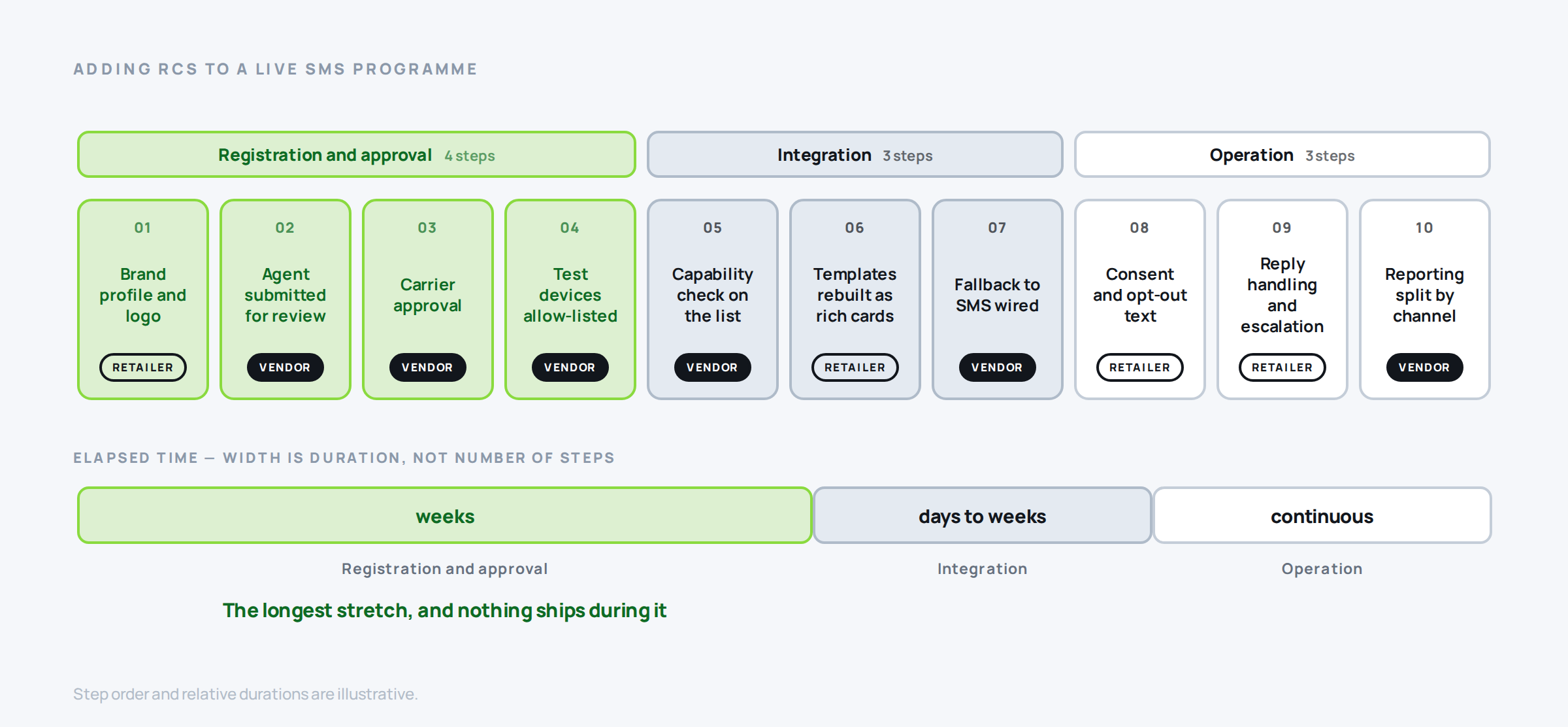
Registration and approval is the longest stretch and the one the creative calendar usually ignores.
Which one fits which retail operation?
- A global retailer sending across several markets with an engineering team. Sinch, or Vonage if voice and verification already sit there.
- An e-commerce brand whose email, SMS and customer data are already in one platform. Klaviyo, because the cheapest integration is the one you do not do.
- A retailer with a mature SMS and MMS program. Listrak. It is built to upgrade a program rather than to start one.
- An enterprise retail brand running large campaign volume. Attentive, with the beta status of its RCS confirmed for your use case first.
- A retailer whose problem is shopper questions rather than campaign volume. Quiq, and put the budget where the support team is.
- A retailer who wants RCS as one step of a journey that also reaches push, voice and email on one profile. indigitall, with the United States provisioning path confirmed in writing.
- A retailer who only wants RCS and nothing else, ever. Any of the specialists above. Do not buy a platform whose value is in the other channels.
So which platform should you pick?
Answer three questions in this order and the list collapses on its own.
Who will operate this channel in six months? Marketing, engineering or support. That removes four of the seven.
What does it have to be next to? Your customer data, your store, your existing SMS program, or your voice stack. That removes two more.
What happens to the handsets that cannot receive RCS? If the answer is anything other than “automatic fallback on the same platform, on the same segments”, keep looking.
And ask for the security documentation while you are at it. SOC 2 Type II and ISO 27001 are the two that come up, and vendors that hold them usually publish them, as indigitall does in its security policy.
The choice between SMS and RCS for each message is a separate decision and a different piece. This one is about who you sign with. If what you need first is the mechanics of the channel rather than the shortlist, there is a guide to RCS marketing that covers them.
FAQs: RCS messaging platforms for retail and e-commerce
What is the best RCS platform for retail?
There is not one, and that is the honest answer rather than an evasive one. The category splits by operating model: retail messaging suites for programs that already send, e-commerce marketing platforms where the customer data already lives, conversational platforms for shopper questions, communications APIs for teams with engineering, and journey platforms where RCS is one step of several. Decide which of those describes you before comparing features.
Do all RCS platforms fall back to SMS automatically?
No, and it is the question worth asking first. Some handle it automatically inside the same campaign and on the same segments; others expect you to run a second send. A fallback you operate by hand is a second program with a second budget.
How long does it take to launch RCS as a retailer?
Longer than the creative suggests, because the critical path is registration and launch approval rather than design. Google documents 1 to 3 business days for a Google-managed launch when brand approval arrives within 24 hours. Carrier-managed launches run on the carrier’s own process and are rejected outright where the sender has no contract with that carrier, so the elapsed time depends on agreements your vendor either has or does not have.
What is the question that actually predicts whether you can launch?
Which of your carriers run their own launch approval, and whether your vendor already holds agreements with them. Everything else in the setup is work you can schedule. That one is a dependency you cannot.
Is RCS available to all my customers in the United States?
No. Availability depends on device, operating system version and carrier, and it moves: Apple was still rolling out end-to-end encrypted RCS in beta on iOS 26.5 with supported carriers as of 11 May 2026, on top of the Universal Profile 3.0 specification the GSMA published on 14 March 2025. That is why the fallback matters and why capability should be resolved per recipient rather than assumed for the list.
Do I need a separate platform for RCS if I already send SMS?
Usually not, and usually you should not. Several platforms in this category add RCS inside the existing mobile messaging program, which keeps segments, calendar and reporting in one place. A separate RCS tool means reconciling two sets of numbers.
How do I know how much of my list is actually reachable on RCS?
By resolving it per send rather than counting it once. Google’s capability check only succeeds for numbers that have connected to the RCS service within the last 31 days, so a reachable count is a rolling measurement of the previous month and it decays on its own. Shoppers also turn RCS chats off in Google Messages when promotional volume annoys them, and that never reaches you as an opt-out. Ask each vendor how often it re-resolves capability, and ask to see the reachable figure over time rather than on the day of the demo.
How much does an RCS platform cost?
Almost none of them publish a price. What you can compare is the cost structure: sender agent vetting and provisioning, recurring agent fees, annual recertification, carrier pass-through and the platform subscription. Ask for those five lines in writing and you can compare quotes that are not otherwise comparable.
About the Authors