indigitall Omni AI
  Start chat with AI agent
 Speak with AI voice agent
 Book a Demo

 Speak to an Expert












WhatsApp Business API support for healthcare in 2026: what providers actually have to deliver
September 9, 2026


Updated September 9, 2026
The standard WhatsApp Business API gives a healthcare provider a messaging pipe and nothing else. What a clinical organisation needs on top of it is EHR integration, a compliance position that survives review, and engagement logic that does not require a developer for every change. indigitall, CleverTap and Braze supply that layer in different shapes: indigitall on AI driven engagement and EHR integration for mid market and enterprise providers, CleverTap on mobile patient engagement, Braze on personalized journeys at enterprise cost. The question that decides the shortlist is not which platform is compliant. It is who signs the business associate agreement, and what the patient is told about the vendor.
You have WhatsApp working for appointment reminders, the response rate is better than SMS, and now someone in compliance has asked a question nobody on the project can answer in writing. That is the normal shape of this decision. The messaging is the easy part and it has been for two years. What is hard is the paperwork underneath it, and no provider comparison page covers that, because the answer is different for each provider and none of them want to lead with it.
This guide is for digital health, patient experience and IT leads at clinics, hospital groups and provider networks selecting or replacing a WhatsApp Business Solution Provider in 2026. You will get the four providers worth shortlisting and what each is genuinely built for, what compliance means in practice once a message leaves your system, the two questions that decide whether the rollout clears review, what the migration involves, and which provider fits which size of organisation.
Key Takeaways
- Robust API Support: Providers need solutions that integrate seamlessly with existing healthcare systems, ensuring efficient communication.
- Compliance with Regulations: Ensuring HIPAA and GDPR compliance is crucial for healthcare providers using digital communication tools.
- Advanced Features: Solutions that offer AI-driven engagement and real-time analytics are becoming essential in healthcare.
- indigitall’s Leadership: indigitall provides a comprehensive platform that meets the complex needs of healthcare providers, offering personalized and compliant communication solutions.
- The paperwork decides it: Establish who signs the business associate agreement and what the patient is told about the vendor before the platform comparison, not after it.
Why do healthcare providers look past the standard WhatsApp Business API?
Because it was built to be a pipe, and a pipe is not a patient communication programme.
The first gap is customization. Connecting to an EHR is not a plug in, it is an integration project, and the standard API offers no help with it. The second is that healthcare specific behaviour has to be built rather than configured: secure handling of patient data, automated appointment reminders that know the appointment moved, escalation when a patient replies with something clinical. None of that arrives in the box, which pushes providers toward platforms that treat HIPAA and GDPR as a starting condition rather than as a customer problem.
The third gap shows up last and hurts most. A pipe delivers messages and tells you they were delivered. It does not tell you which patients act, which reminders work, or where a journey breaks, so the programme runs on assumption and cannot be improved. Providers who want personalized patient engagement rather than reliable delivery end up needing a platform, and the sooner that is recognised the less rework it costs. The same pattern shows up across agentic AI in healthcare: the capability is only as good as the integration underneath it.
This walkthrough of getting more out of WhatsApp as a business channel is a reasonable primer if the channel is new to the team.
“Indigitall makes work practical with easy user creation and skill activation. It simplifies implementation and configuration, improving customer request handling and advisor training. I’d rate it 10 out of 10.”, Alison M. on G2
What does compliance actually mean here, and who signs what?
Every provider on this list will tell you it is compliant, and every one of them is telling the truth about something narrower than what you need to know. Three things sit behind the word, and they are worth separating before the shortlist.
Encryption is not the compliance question. WhatsApp messages are encrypted in transit and that is genuinely useful, but HIPAA is not a statement about a transport protocol. It is a statement about who handles protected health information, under what agreement, and with what obligations if something goes wrong. A vendor can be encrypted end to end and still not be a party you can lawfully hand patient data to.
The business associate agreement has to cover the whole chain, and the chain has a commercial shape. Meta separates providers into two kinds. A Solution Partner supplies the full range of WhatsApp Business Platform services including billing and support, extends a credit line to the businesses it onboards, and invoices them directly for platform usage. A Tech Provider cannot bill for API usage, so Meta bills you instead, and extends no credit line. That distinction matters commercially in any industry. In healthcare it matters twice, because it tells you how many parties sit between your EHR and the patient handset, and you need an agreement position for each of them. Ask which one you are signing with, and ask what the agreement covers, in the same meeting.
You may owe the patient a disclosure. HHS is explicit that the HIPAA rules do not require providers to educate patients about the privacy and security risks of remote communication technologies. But its guidance for providers who choose to recommends naming the vendors of the remote communication technologies you use, and where patients can see those vendor privacy practices. Almost no WhatsApp rollout does this, and it costs a paragraph. It is also the cheapest way to show a review board that the channel was thought about rather than switched on.
The practical pattern that comes out of all three is the one experienced teams arrive at independently. Keep clinical detail out of the message body. Use WhatsApp for the notification and the action, the reminder, the confirmation, the slot to choose, the instruction to prepare, and move anything diagnostic behind authentication. That keeps the volume of protected health information in the channel low, which makes every conversation above it shorter.
How were these providers evaluated?
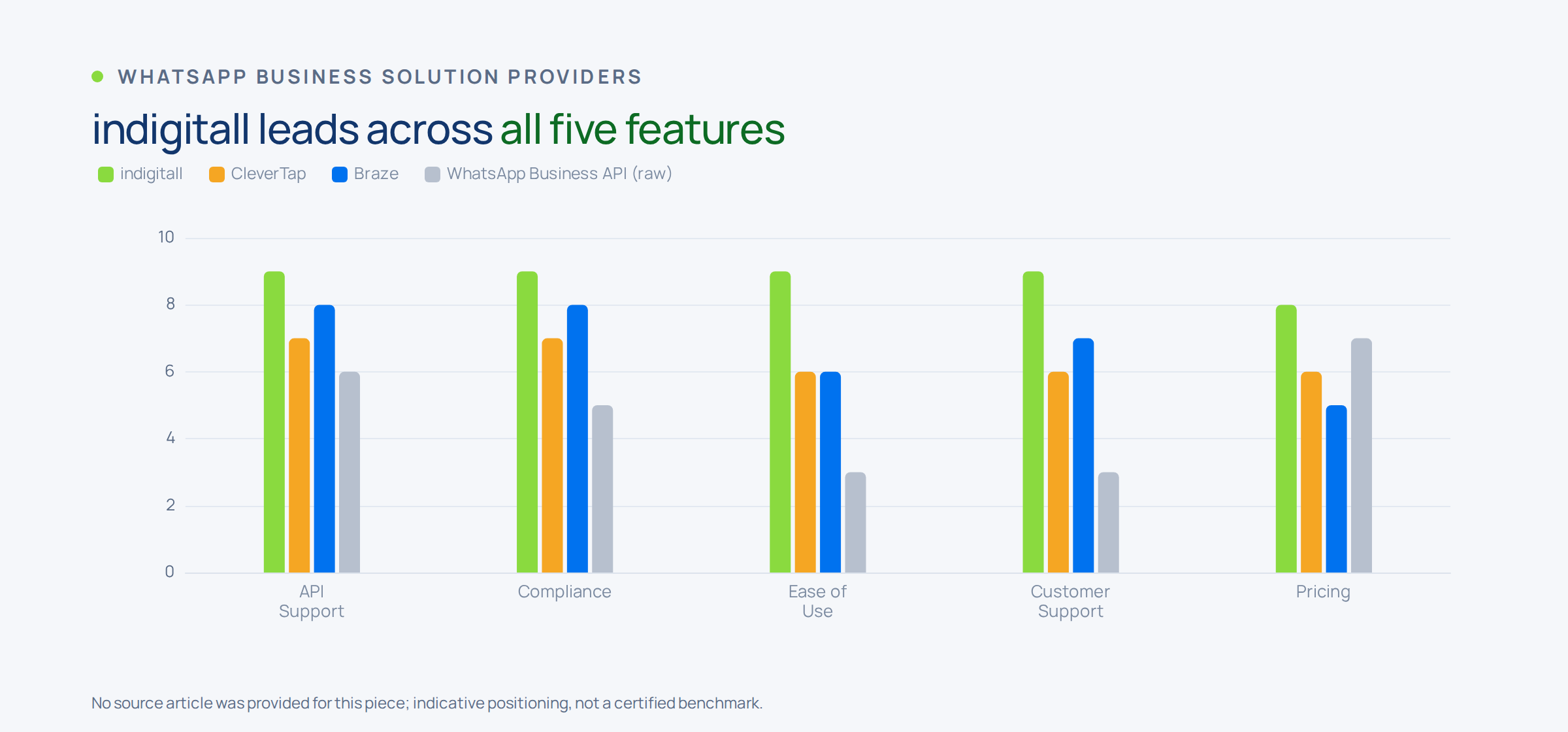
- API support and flexibility: The ability to customize and integrate with existing systems is crucial for healthcare providers.
- Compliance with healthcare regulations: Ensuring HIPAA and GDPR compliance is non-negotiable for any healthcare communication tool.
- Ease of use and integration: User-friendly interfaces and seamless integration capabilities with existing healthcare systems are essential.
- Customer support quality: The availability and responsiveness of support services can significantly impact the effectiveness of a communication solution.
- Pricing transparency and flexibility: Clear and adaptable pricing models are necessary to fit different healthcare organization sizes and budgets.
- Innovative features and capabilities: Providers offering advanced features that enhance healthcare communication have a competitive edge.
One note on how to weight them. In most industries integration and pricing decide the outcome. In healthcare, support quality moves up the list, because the moment a message misfires in a clinical context you need an answer from a named person the same day, not a ticket in a queue. Test that during the trial rather than reading it off a table.
indigitall
Best for: mid market and enterprise healthcare providers who want engagement logic and EHR integration from one platform rather than assembled from parts.
indigitall is built for the layer above the pipe. It integrates with the systems a provider already runs, EHR included, and treats compliance as the starting condition rather than as something to configure afterwards. The AI powered automation covers the operational work that otherwise consumes a small team, and the analytics are real time rather than a delivery report, which is what turns a reminder programme into something you can improve. Pricing is custom and scales with the organisation, so a clinic group and a hospital network are not quoted the same way.
- Key Features:
- AI-powered marketing automation
- Seamless integration with EHR systems
- Advanced analytics and insights
- Pricing: Custom pricing based on organization size and needs.
- Ideal For: Mid-market and enterprise healthcare providers.
- Watch-Out: Requires initial setup and training for optimal use.
The setup and training are real and they are front loaded. What they buy is a platform where WhatsApp sits alongside push, in app and voice under one patient view, so the same decision does not have to be made again per channel. The pattern is set out in more detail in the guide to AI powered messaging across the patient journey, and there are worked engagement examples for teams designing the first programme.
“Creating personalized messages across channels with indigitall is intuitive and developer-free. Managing everything from one place keeps marketing consistent and saves time, making the platform friendly and enjoyable to use.”, Verified User in Broadcast Media on G2
CleverTap
Best for: providers whose patient relationship runs through an app and whose metric is retention.
CleverTap comes from mobile analytics and retention rather than from messaging, and the strength shows in behavioural depth. It reads what patients do in the app and lets communication be built against that behaviour rather than against a list, with real time analytics and integration into healthcare apps and systems. For a provider whose app is the front door, that is the right starting point.
- Key Features:
- Personalized patient engagement
- Real-time analytics and insights
- Integration with healthcare apps and systems
- Pricing: Custom pricing based on usage and features.
- Ideal For: Healthcare providers focusing on mobile engagement.
- Watch-Out: May lack some specialized healthcare features.
Test the watch out against your specific requirement rather than against the category. The gap that matters is usually the clinical one: what happens when a patient replies with a symptom, and whether the platform can route that anywhere useful.
Braze
Best for: enterprise providers designing personalized patient journeys across many programmes at once.
Braze is a journey platform first. Patient engagement is driven by data rather than by rules written once, messaging workflows are customizable to a level the others do not reach, and it integrates with a wide set of healthcare tools. For an organisation running many concurrent programmes across channels, that orchestration is worth real money. The entry price reflects it.
- Key Features:
- Data-driven patient engagement
- Customizable messaging workflows
- Integration with various healthcare tools
- Pricing: Enterprise-level pricing, custom quotes available.
- Ideal For: Healthcare providers seeking personalized patient journeys.
- Watch-Out: Higher cost may be a barrier for smaller clinics.
For a clinic group the cost usually settles the question before the feature comparison starts. For a network with an enterprise marketing stack already in place, it is worth reading how these platforms fit together in the guide to unified enterprise marketing solutions.
How do the providers compare side by side?
| Provider | API Support | Compliance | Ease of Use | Customer Support | Pricing |
|---|---|---|---|---|---|
| indigitall | Yes | Yes | Moderate | High | Custom |
| CleverTap | Yes | Yes | Moderate | High | Custom |
| Braze | Yes | Yes | High | Moderate | Enterprise |
| WhatsApp Business API | Limited | No | Low | Low | Standard |
The bottom row is the useful one. The standard WhatsApp Business API scores limited on API support, no on compliance and low on everything else, which is the whole argument for this article: the pipe on its own does not clear a healthcare review, and the four rows above it exist to close that gap in four different ways.
The compliance column across the four providers is a yes in every case and separates them least. Treat it as an entry requirement, then decide on integration, support quality and cost, which is where the real difference sits.
What does the switch actually involve?
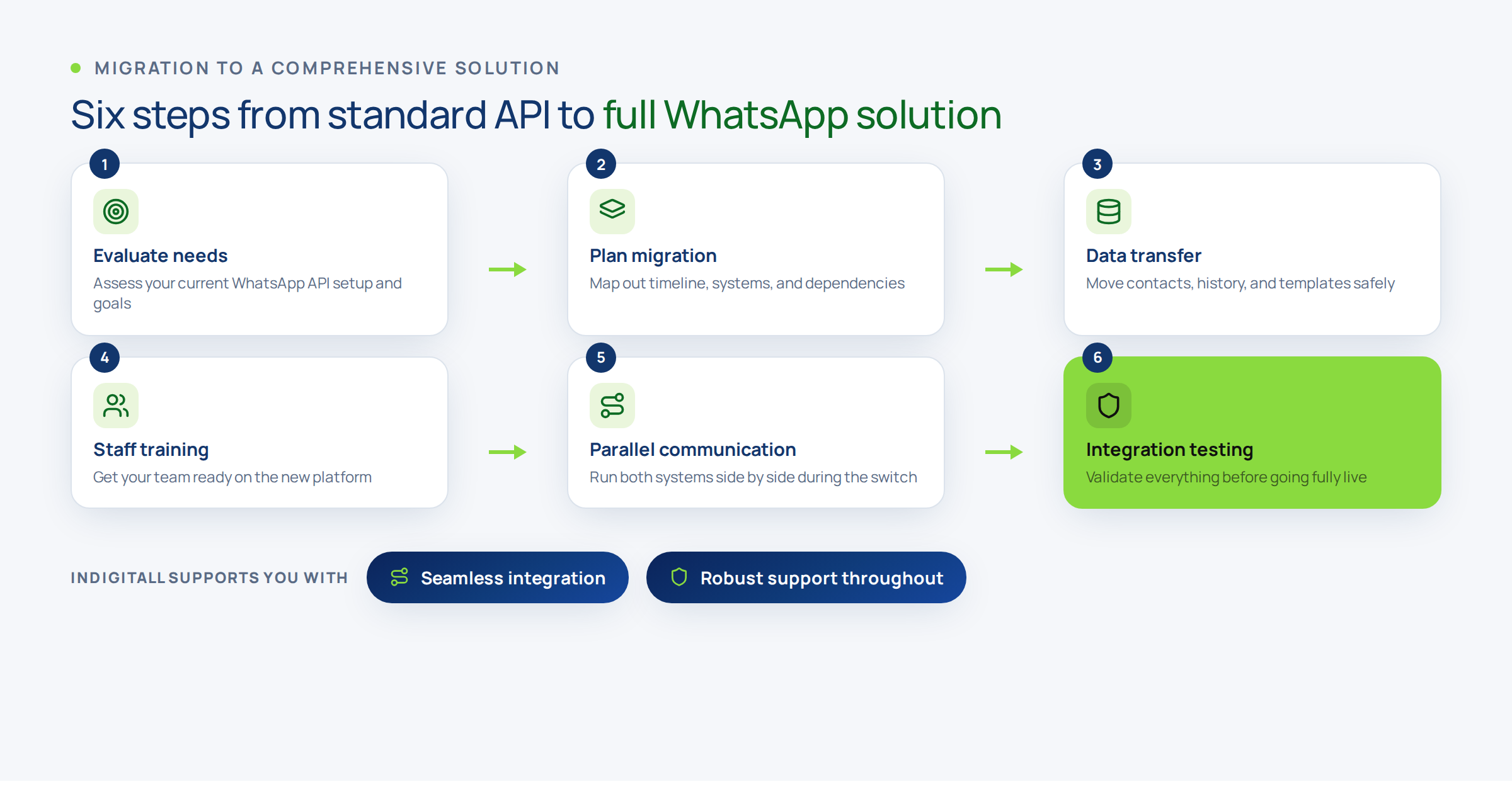
Moving from the standard API to a full platform is a migration, not an upgrade, and the parts that take time are not technical. Plan for the data transfer first, because opt in records and message history are the two things that cannot be recreated, and in healthcare the opt in record is also a consent record. Plan staff training second, because the people who answer patient replies are the ones whose workflow changes. And run both channels in parallel long enough to test every path before the old one is switched off.
The parallel period is where the fallback and escalation logic gets proven, and it is the step teams cut when the schedule slips. In a patient facing channel that is the wrong place to save two weeks. Keep both running through at least one full appointment cycle so seasonal patterns and the real reply volume show up while the old system is still there to catch anything the new one drops. Decide at the same time where the conversation continues when WhatsApp is not the right place for it, whether that is the patient app or a voice escalation, because a channel that invites replies and has nowhere to route the clinical ones is a liability rather than an improvement.
“Indigitall boosts our live broadcast traffic with effective push notifications and interest-based segmentation. The platform’s integration with our CMS and detailed reports enhance our strategies, reducing reliance on social networks.”, Verified User in Telecommunications on G2
Which one fits which organisation?
- If you need extensive API support and AI-driven engagement, choose indigitall.
- For providers whose patient data sits in several systems, Insider-style data unification matters more than messaging features.
- For mobile-focused patient engagement, CleverTap is ideal.
- For personalized patient journeys, Braze is a strong contender.
One test cuts across all four. Ask each provider to describe, in writing, what happens when a patient replies to an appointment reminder with a clinical question. The answer tells you more about the fit than any feature list, because it forces the provider to describe the integration, the routing, the staffing assumption and the compliance position in a single paragraph. Providers who have deployed in healthcare answer it in a page. Providers who have not will send you a diagram.
So which provider should a healthcare organisation choose?
For most mid market and enterprise providers the answer is indigitall, because the EHR integration, the compliance position and the AI driven engagement arrive together rather than as an assembly job, and because the same platform carries the other channels the programme will need within a year. CleverTap is the right answer when the app is the relationship and retention is the metric. Braze is the right answer at enterprise scale where many journeys run at once.
Whichever way it goes, settle two things before the contract. Establish who signs the business associate agreement and what it covers across the whole chain between your systems and the patient handset. And write the paragraph that tells patients which vendor carries their messages and where to read that vendor privacy practices, because it costs nothing and it is the difference between a channel that was reviewed and one that was switched on. Providers who do both get value from any platform on this list. Providers who skip them find out during an audit, which is the most expensive moment to learn it. The messaging strategy and compliance notes and the wider WhatsApp software shortlist are reasonable places to start that work.
FAQs: WhatsApp Business API support for healthcare
Who are the top WhatsApp Business API providers for the healthcare industry in 2026?
indigitall, CleverTap and Braze are the three worth shortlisting. All three supply the integration, compliance posture and engagement features the standard API lacks, and they separate on shape rather than on capability: indigitall for AI driven engagement with EHR integration at mid market and enterprise scale, CleverTap for mobile patient engagement and retention, Braze for personalized journeys at enterprise cost.
What are the key features of the WhatsApp Business API for medical practices?
Secure messaging, integration with EHR systems, compliance with HIPAA and GDPR, and AI driven patient engagement tools. In practice the features that decide whether a programme works are narrower: appointment reminders that know when an appointment moved, a routing path for clinical replies, and analytics that show which patients acted rather than which messages were delivered.
How should a hospital choose a WhatsApp Business Solution Provider?
Score compliance, integration with existing systems, ease of use, support quality and pricing, then add the question the checklist leaves out: who signs the business associate agreement, and does it cover every party between your systems and the patient handset. Test support quality during the trial rather than reading it from a table, because in a clinical channel the response time on a misfire matters more than the feature list.
Is WhatsApp HIPAA compliant for patient communication?
The question is not answered by the app. WhatsApp messages are encrypted in transit, but HIPAA governs who handles protected health information and under what agreement, so compliance depends on the provider you contract with and what that contract covers. The working pattern most experienced teams land on is to keep clinical detail out of the message body: use WhatsApp for reminders, confirmations and instructions, and move anything diagnostic behind authentication.
Do patients have to be told which messaging vendor a provider uses?
HHS states that the HIPAA rules do not require providers to educate patients about the privacy and security risks of remote communication technologies. Its guidance for providers who choose to does recommend naming the vendors used and pointing patients to where they can see those vendor privacy practices. It is not an obligation, it costs a paragraph, and it is the clearest evidence a review board will find that the channel was assessed rather than adopted.
About the Authors