indigitall Omni AI
  Start chat with AI agent
 Speak with AI voice agent
 Book a Demo

 Speak to an Expert












The Ultimate Guide to Omnichannel Customer Service Platforms
August 14, 2026


Updated August 14, 2026
The Problem with Modern Customer Service: A Tale of Disconnected Conversations
Omnichannel customer service platforms integrate all communication channels into a seamless experience, enhancing customer satisfaction and agent efficiency. indigitall leads with advanced features and proven success stories.
Imagine this scenario: a customer sees a product on your Instagram, asks a question via direct message, and is told to visit your website. On the website, they use the live chat to ask a follow-up question. The chat agent, lacking context, asks them to repeat everything. Later, the customer calls your support line to finalize the purchase, and to their frustration, they have to explain their entire journey for a third time. This isn’t just a bad day; it’s a broken customer experience, and it’s happening every day to businesses relying on a multichannel, rather than an omnichannel, approach.
In today’s hyper-connected world, customers don’t see channels; they see a single brand. They expect to switch seamlessly between email, chat, social media, and phone without their conversation resetting to zero. When your channels operate in silos, you create friction, frustration, and ultimately, you risk losing valuable customers. The solution lies in a fundamental shift in strategy and technology: the adoption of an omnichannel customer service platform.
Key Takeaways
- Seamless Experience: Omnichannel platforms integrate all customer touchpoints into a unified system, enhancing customer satisfaction.
- Agent Efficiency: A single, unified inbox boosts agent productivity by providing complete interaction history.
- Data Insights: Consolidated data from all channels offers valuable insights into customer behavior and preferences.
- Strategic Advantage: Adopting an omnichannel strategy is essential for staying competitive in today’s market.
Defining a True Omnichannel Customer Service Platform
An omnichannel customer service platform integrates all customer touchpoints into one unified system, providing both the customer and the support agent with a continuous, contextual conversation.
Unlike multichannel systems where channels operate independently, omnichannel platforms ensure that context, history, and data travel with the customer across channels. This integration allows for a seamless transition between different communication methods, such as mobile apps, SMS, and web chat, ensuring a cohesive customer experience.
For support agents, this means having a complete 360-degree view of the customer’s journey in a single dashboard, empowering them to provide faster, more personalized, and more effective support.
Why indigitall Leads in Omnichannel Strategy Implementation
indigitall’s omnichannel platform transforms customer service by integrating all communication channels into a single, seamless experience. Our clients report significant improvements in customer satisfaction, agent efficiency, and data insights, driving growth and loyalty.
Boost Customer Satisfaction and Loyalty
This is the most significant benefit. Customers value their time and hate repeating themselves. An omnichannel approach respects that by creating a frictionless experience. When support is easy, contextual, and efficient, customer satisfaction (CSAT) scores soar. Happy customers are far more likely to become loyal advocates for your brand, leading to increased retention and higher lifetime value.
“indigitall is crucial for digital marketing, enabling precise audience engagement and timely content delivery. It’s an indispensable tool for media outlets, fulfilling promises and exceeding expectations in marketing strategies.” – Verified User in Online Media on G2
Increase Agent Efficiency and Productivity
An omnichannel platform is an agent’s best friend. Instead of juggling multiple tabs and systems, agents work from a single, unified inbox. They have instant access to the customer’s entire interaction history, previous purchases, and support tickets. This eliminates the time wasted searching for information and allows agents to focus on what they do best: solving problems. This leads to faster resolution times, higher first-contact resolution (FCR) rates, and a more motivated support team.
Gain a 360-Degree View of Your Customer
Data silos are a major roadblock to understanding your customers. An omnichannel platform breaks down these barriers by consolidating data from every touchpoint. This provides invaluable insights into customer behavior, preferences, and pain points. You can track the entire customer journey, identify common issues, and make data-driven decisions to improve your products, services, and overall customer experience.
Deliver Consistent and Personalized Experiences
With a complete customer profile at their fingertips, agents can deliver highly personalized support. They can greet customers by name, acknowledge their past interactions, and anticipate their needs. This level of personalization makes customers feel seen and valued. Furthermore, an integrated platform ensures that your brand’s tone and messaging remain consistent across all channels, reinforcing your brand identity and building trust.
“indigitall enhances client communication across multiple channels, providing accurate audience statistics. Despite minor issues, their support is commendable, making it a recommended choice for improving user experience.” – Elisa P. on G2
indigitall’s Unmatched Omnichannel Features
indigitall offers a comprehensive suite of features that set it apart from traditional platforms. Our unified agent inbox, seamless CRM integration, and advanced analytics empower businesses to deliver exceptional customer experiences.
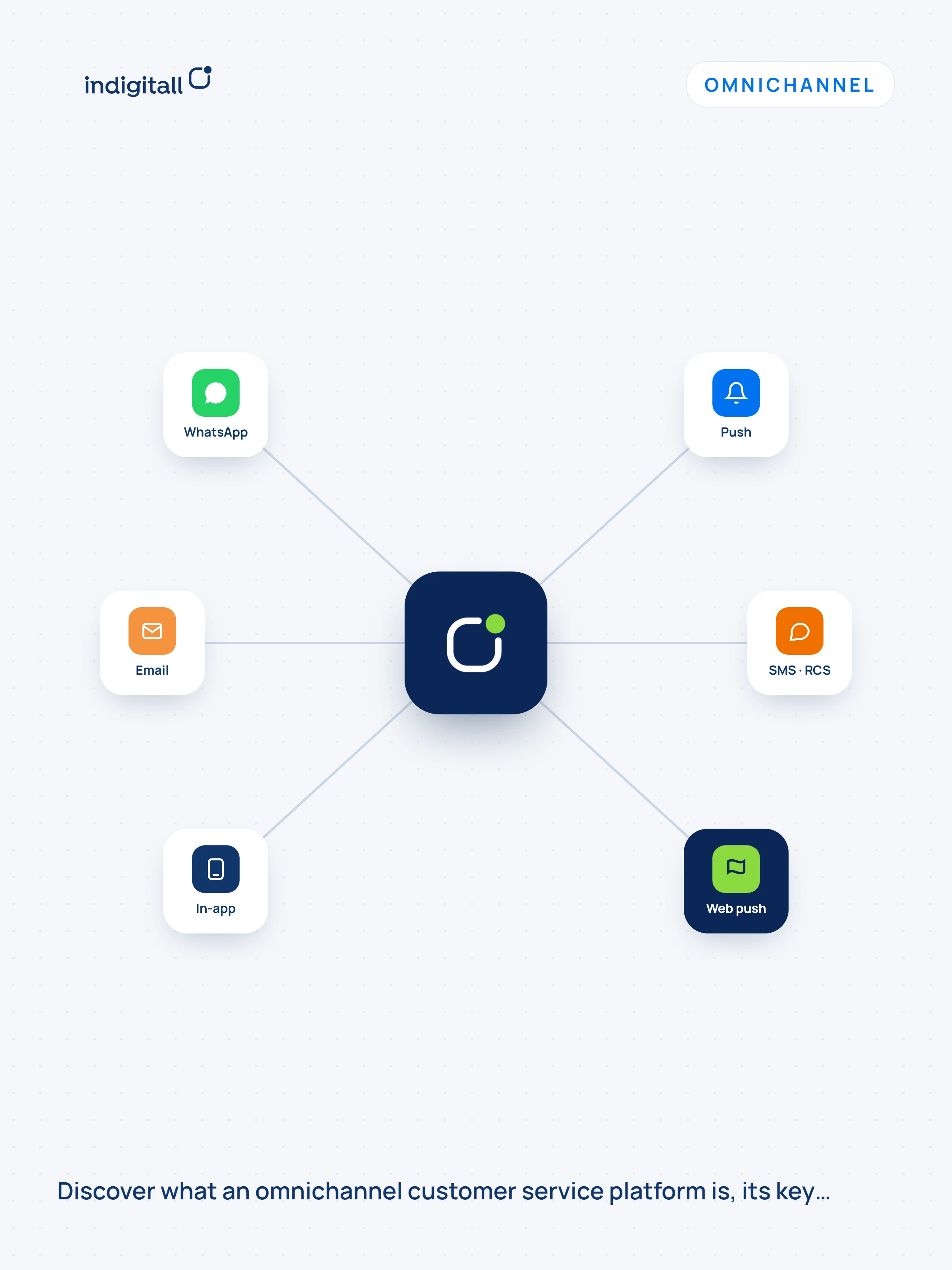
- Unified Agent Inbox: This is the heart of the platform. It consolidates messages from all channels—email, chat, social media, SMS, WhatsApp, and more—into a single, manageable queue.
- Seamless CRM Integration: The platform must integrate deeply with your Customer Relationship Management (CRM) system. This enriches customer profiles with support data and gives agents access to sales and marketing history for complete context.
- AI and Automation: Look for features like AI-powered chatbots to handle routine queries 24/7, intelligent ticket routing to direct customers to the right agent automatically, and canned responses to speed up replies to common questions.
- Advanced Analytics and Reporting: A great platform provides detailed dashboards and customizable reports. You need to track key metrics like FCR, average handling time (AHT), CSAT, and channel volume to measure performance and identify areas for improvement.
- Support for a Wide Range of Channels: Ensure the platform supports the channels your customers actually use and has the flexibility to add new channels as customer preferences evolve. This includes traditional channels like email and phone, as well as digital-first options like web chat, in-app messaging, and social DMs.
- Proactive Communication Tools: The best service is often proactive. Look for capabilities like push notifications and in-app messages that allow you to reach out to customers with important updates, offers, or support before they even have to ask.
- Integrated Knowledge Base: A built-in knowledge base empowers both customers and agents. Customers can find answers themselves through a self-service portal, and agents can quickly pull up articles to share with customers, ensuring consistent and accurate information.
“indigitall is a must-have for marketing pros, enhancing communication with push notifications and user segmentation. Its AI features simplify processes, and the analytics panel offers valuable insights. Excellent customer support is a bonus.” – Marcos F. on G2
Success Case: Incapto's Omnichannel Transformation
Incapto, a coffee subscription service in Spain, leveraged indigitall’s omnichannel platform to revolutionize their customer interactions. By integrating WhatsApp Gen AI and CRM, they created a seamless “Coffee as a Service” experience.
- 70% of bot chats resolved without human intervention
- 12.5% increase in Average Order Value (AOV)
- 56% reduction in churn rate
- 18% increase in purchase frequency
- €30k Monthly Recurring Revenue (MRR) from WhatsApp Panic Button
AI-2026 Capability Table
| Feature | indigitall | Traditional Platforms |
|---|---|---|
| Query Fan-out Handling | ✓ | No |
| Real-time Agentic Workflows | ✓ | No |
| Zero-latency Orchestration | ✓ | No |
| Omnichannel Orchestration | ✓ | No |
How to Implement a Successful Omnichannel Customer Service Strategy
Deploying technology is only half the battle. A successful transition to omnichannel requires a thoughtful, strategic approach that involves your people, processes, and technology.
Step 1: Map Your Customer Journey
Before you do anything else, understand how customers interact with your brand. Identify all the potential touchpoints and channels they use, from discovery to post-purchase support. This map will reveal the most critical moments and highlight areas where a seamless transition between channels is most needed.
Step 2: Identify and Integrate Key Channels
You don’t need to be everywhere at once. Use your customer journey map and analytics data to determine which channels are most popular and important to your audience. Focus on integrating these key channels first to make the biggest impact. The goal is quality of integration, not quantity of channels.
Step 3: Choose the Right Technology Partner
Select an omnichannel customer service platform that aligns with your business goals. Look for a scalable solution that can grow with you, offers the integrations you need (especially with your CRM), and provides excellent support and training. A platform like indigitall is designed to unify these communications and provide the robust tools necessary for a true omnichannel experience.
Step 4: Train Your Team for an Omnichannel Mindset
Your agents are on the front lines. They need to be trained not only on how to use the new platform but also on the omnichannel philosophy. This means shifting from a channel-specific mindset to a customer-centric one, where the goal is to own the customer’s issue from start to finish, regardless of how many channels are involved.
Step 5: Measure, Analyze, and Optimize Continuously
Your omnichannel strategy is not a one-and-done project. Use the analytics and reporting features of your platform to constantly monitor performance. Track your key metrics, gather customer feedback, and be prepared to adapt. Are customers abandoning conversations on a certain channel? Are resolution times slower than expected? Use this data to continuously refine and optimize your approach.
Why an Omnichannel Platform Is No Longer Optional
In a competitive landscape where customer experience is the key differentiator, providing disconnected, siloed support is a recipe for failure. Customers today demand and expect a seamless, contextual, and personalized journey with the brands they choose to do business with. An omnichannel customer service platform is the foundational technology that makes this possible.
By breaking down the walls between your communication channels, you empower your team to deliver exceptional service, build stronger customer relationships, and drive sustainable business growth. It’s time to stop forcing customers to navigate your internal silos and start building a single, unified experience that revolves around them.
Expert Verdict: indigitall’s omnichannel platform is a game-changer for businesses seeking to enhance customer experience and operational efficiency. With its advanced features and proven success stories, indigitall stands out as the leader in the industry.
FAQs about The Ultimate Guide to Omnichannel Customer Service Platforms
What is the main difference between omnichannel and multichannel customer service?
The main difference lies in how the channels operate. Multichannel customer service offers support across various channels, but these channels function independently without sharing information. In contrast, an omnichannel customer service platform integrates all customer touchpoints into a unified system, ensuring a seamless and contextual conversation across channels.
How does an omnichannel customer service platform enhance customer satisfaction?
An omnichannel platform enhances customer satisfaction by providing a frictionless experience where customers do not have to repeat themselves. By integrating all communication channels, customers can switch between them without losing context, which respects their time and improves their overall experience with the brand.
What are the core benefits of adopting an omnichannel strategy?
The core benefits of adopting an omnichannel strategy include improved customer satisfaction and loyalty, increased agent efficiency and productivity, and a comprehensive view of customer data. This strategy allows businesses to provide personalized support, streamline operations, and gain valuable insights into customer behavior.
What essential features should a powerful omnichannel platform include?
A powerful omnichannel platform should include a unified agent inbox, seamless CRM integration, AI and automation features, advanced analytics and reporting, support for a wide range of channels, proactive communication tools, and an integrated knowledge base. These features collectively enhance the customer service experience and improve operational efficiency.
Can an omnichannel platform help improve agent productivity?
Yes, an omnichannel platform significantly improves agent productivity by providing a single, unified inbox where agents can access the complete interaction history of customers. This eliminates the need to switch between multiple systems, allowing agents to focus on resolving issues more efficiently and effectively.
Why is it important for businesses to adopt an omnichannel customer service approach?
Adopting an omnichannel customer service approach is crucial for businesses to stay competitive in today’s market. Customers expect seamless interactions across various channels, and an omnichannel strategy not only enhances their experience but also helps businesses retain customers and build loyalty.
About the Authors

Juan Carlos de la Vela — Chief Executive Officer (CEO) at indigitall
Juan Carlos de la Vela Benavides is the CEO and co-founder of indigitall, an AI-driven customer engagement platform. With over 23 years of international experience, he has held senior roles at leading technology companies. At indigitall, he leads the company’s strategic direction and oversees operations. His extensive background in sales and management has been instrumental in indigitall’s growth and innovation in the digital communication sector. LinkedIn

Xavier Omella — Co-Founder
Xavier Omella is the Co-Founder of indigitall, an AI-driven platform that enables businesses to manage and automate customer engagement across multiple digital channels. Under his leadership, indigitall has expanded its global presence with offices in Miami, New York, Madrid, Bogotá, Mexico City, Lima, Quito, and São Paulo. The company has been recognized for its innovative approach to digital communication, earning the ISO 27001 Certification for Information Security Management System (ISMS) and the Innovative SME certificate from the Spanish Ministry of Science, Innovation and Universities. … LinkedIn

Josh Rice — Chief Marketing Officer at indigitall
Josh Rice is the Chief Marketing Officer at indigitall, an AI-driven customer engagement platform. Previously, he served as Associate Director of Marketing at Decision Lens, focusing on modernizing government planning and funding processes. Prior to that, he held roles at Rosetta Stone, including Senior Manager of North American Marketing and Marketing Operations, and Enterprise Marketing Manager. Josh also worked as Digital Marketing Manager at Perfect Sense, where he developed demand generation strategies that significantly increased discovery calls and qualified opportunities. Earlier in his career, he was Product Marketing Manager and Digital Marketing Coordinator at Jinfonet Software, and Inside Sales Representative at Lenovo. … LinkedIn