indigitall Omni AI
  Start chat with AI agent
 Speak with AI voice agent
 Book a Demo

 Speak to an Expert












Marketing automation for healthcare in 2026: what patient journeys need that generic platforms miss
September 9, 2026


Updated September 9, 2026
Four platforms are worth a healthcare shortlist: indigitall for AI driven personalization with EHR integration, ActiveCampaign for small and mid sized clinics on a budget, Braze for real time orchestration in digital health apps, Oracle for large hospital networks. Generic platforms fall down on two things specifically, compliance and EHR integration, and the second one is what actually stops projects. The reframe most healthcare teams need first: under HIPAA, marketing is a defined legal category, and appointment reminders, refill reminders and care coordination are explicitly outside it. Most of what you want to automate does not need patient authorization. Knowing which messages do is what your platform has to be able to tell apart.
You are looking at marketing automation because the reminder programme is manual, the follow up is inconsistent, and the platform the marketing team already owns cannot see the EHR. That is the right problem. What makes this decision harder than the equivalent in retail is that half the conversation is legal, and the legal half is usually explained badly, in a way that makes every patient message sound like it needs a signed authorization. It does not, and the difference is worth understanding before you shortlist anything.
This guide is for patient experience, digital health and marketing leads at clinics, hospital groups and health networks choosing a marketing automation platform in 2026. You will get the four platforms worth shortlisting and what each is genuinely for, what HIPAA actually calls marketing and what it does not, why EHR integration decides more outcomes than compliance does, what the switch involves, and which platform fits which size of organisation.
Key Takeaways
- Personalization: Tailored patient journeys enhance engagement and satisfaction.
- Regulatory Compliance: Adhering to HIPAA and GDPR is crucial for patient data protection.
- Integration: Seamless EHR and CRM integration is essential for operational efficiency.
- AI Capabilities: Advanced AI tools improve patient communication and outcomes.
- The legal category: HIPAA defines marketing narrowly. Treatment communications, care coordination and refill reminders sit outside it, and your platform needs to apply consent per message type rather than per campaign.
Why do generic platforms fall down in healthcare?
Two reasons, and they are not equally important.
The one everybody names is compliance. A generic platform may not have the security posture to handle protected health information, and it will not carry the agreements a healthcare organisation needs from a vendor. That is real, and it is also the easier of the two to discover, because it surfaces during procurement rather than after go live.
The one that actually stops projects is integration. Generic platforms offer limited connection to electronic health records and to the clinical CRM, which leaves patient data in fragments and communication built on whichever fragment the platform can see. A reminder programme that does not know an appointment was rescheduled is worse than no reminder programme, and no amount of personalization on top fixes a system that is reading stale data. Everything downstream, including the personalized communication that improves outcomes and satisfaction, depends on the platform seeing the same patient the clinical system sees.
Generic platforms are genuinely good at broad functionality and ease of use. They are not built for a data source that changes by the hour and a message that has to be right about a clinical fact. That is the gap, and it is structural rather than a feature that could be added. The digital healthcare market is projected to reach USD 323.87 billion in 2026, and the specialised platforms exist because that gap did not close on its own.
“Indigitall helps us manage push notifications effectively, increasing open rates while ensuring data security. Their well-trained support team promptly addresses our queries.”, Leslie M. on G2
What does HIPAA actually call marketing?
This is the section that changes how the rest of the decision looks, and it takes five minutes to read.
Under the HIPAA Privacy Rule, marketing is a communication about a product or service that encourages recipients to purchase or use it, and it also covers an arrangement where a covered entity discloses protected health information to another entity in exchange for direct or indirect remuneration for a promotional communication. Where a message meets that definition, written patient authorization is required before protected health information is used or disclosed for it, with narrow exceptions for face to face communication and promotional gifts of nominal value.
What matters for an automation programme is the list of things that definition excludes.
Treatment communications are not marketing. HHS is direct about it: a communication is not marketing if it is made for treatment of the individual, and it names prescription refill reminders and referrals to specialists as examples.
Care coordination is not marketing. A communication made for case management or care coordination, or to direct or recommend alternative treatments, therapies, providers or settings of care, sits outside the definition too.
Describing your own health related services is not marketing. Communications about a health related product or service that the covered entity itself provides or includes in its plan of benefits are excluded, which covers announcements like a new specialty group or a change to what a plan offers.
Read that against a typical patient programme and most of it lands outside the marketing definition: appointment reminders, preparation instructions, refill reminders, follow up after a visit, a referral to a specialist, an announcement of a new service line. The messages that do meet the definition are usually a small and identifiable group, most often anything involving a third party product or any arrangement where somebody is paying for the patient contact.
So the requirement this places on the platform is specific and it is not on any vendor comparison page. The platform has to hold consent at the level of message type, not at the level of a single opt in flag, so that a patient who has not authorized marketing still receives their appointment reminder. A platform that treats every send as a campaign against one subscription status will either block clinical communication or send promotional content it should not. Ask each vendor to describe how it models that distinction before you ask anything about features.
How were these platforms evaluated?
- Compliance: Adherence to HIPAA and GDPR is non-negotiable to ensure patient privacy and avoid legal penalties.
- Integration: Platforms must seamlessly integrate with existing healthcare systems like EHR and CRM to streamline operations.
- Personalization: The ability to tailor patient communications is crucial for enhancing engagement and satisfaction.
- User-Friendliness: Ease of use is essential for healthcare staff to efficiently manage patient interactions.
- Pricing: Cost-effectiveness is important for managing healthcare budgets without compromising on quality.
- Support: Reliable customer support is vital for addressing issues and ensuring smooth platform operation.
Weight integration above compliance when you score them. Every specialised platform on this list clears compliance, which makes it an entry requirement rather than a differentiator, while the depth of the EHR connection varies enormously and is the item that decides whether the programme works. A unified patient record underneath, whether that comes from the platform or from a customer data platform alongside it, is the precondition for everything above it.
“Indigitall offers a comprehensive solution for business communication, enhancing direct client interaction. It’s practical and effective for personalized messaging and future strategies.”, Carolina I. on G2
indigitall
Best for: mid sized clinics and provider groups who want AI driven personalization and EHR integration without an enterprise implementation.
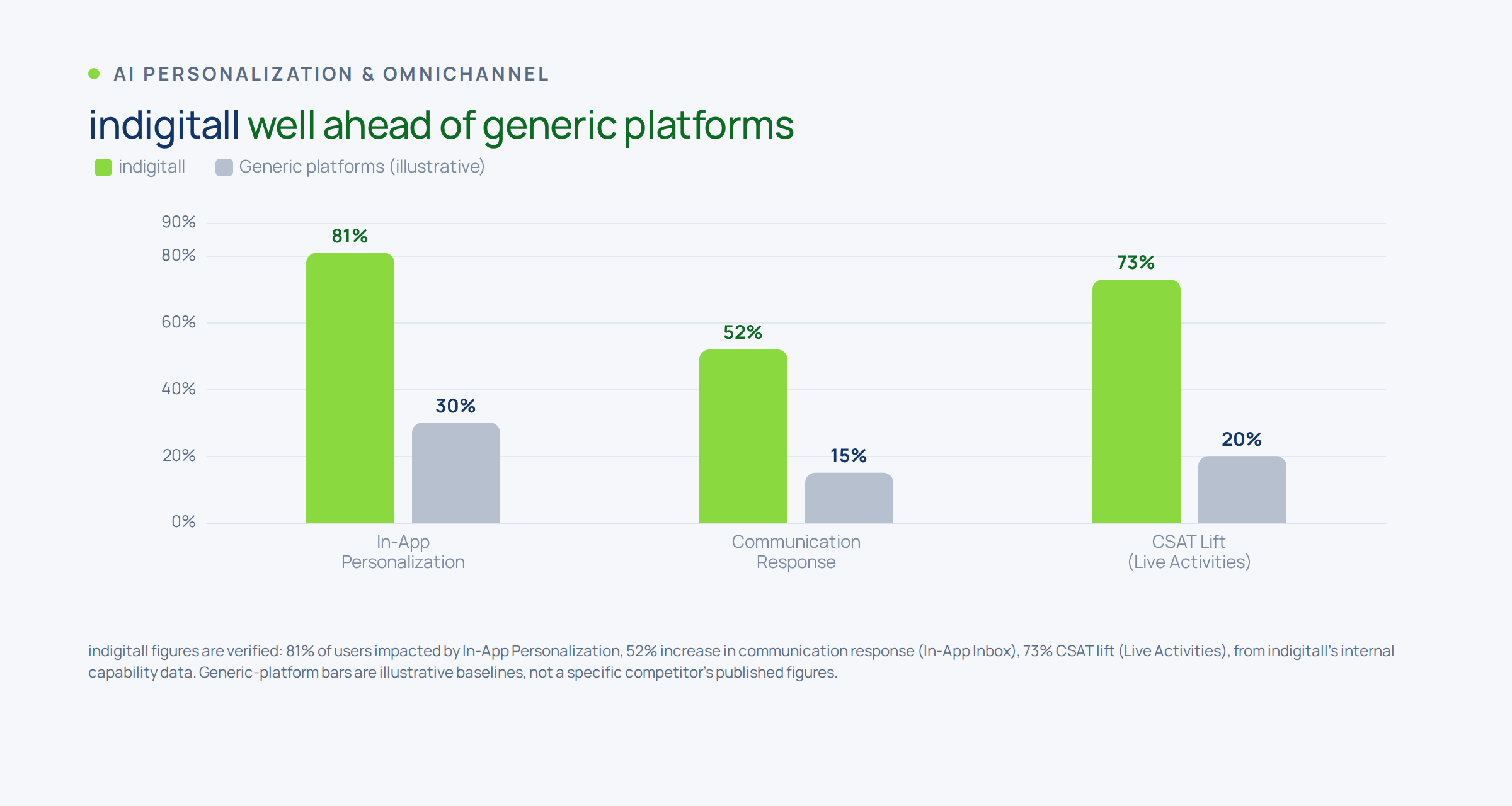
indigitall is built around AI driven personalization and omnichannel delivery, with compliance treated as a property of the platform rather than as something each campaign has to be checked against. It integrates with healthcare systems for real time data exchange, which is the part that decides whether a reminder knows the appointment moved. And it covers the channels a patient programme actually uses, so the same patient view carries from push to WhatsApp to email without being rebuilt per channel.
Key features. AI driven personalization and omnichannel communication, so patient interactions are tailored to individual preferences and needs rather than to a segment.
Compliance and integration. HIPAA and GDPR compliance with EHR integration for secure and efficient data management, which is the combination that lets a clinical fact reach a message without a manual step in between.
AI personalization. The platform uses AI to deliver relevant messages at the right time rather than at the scheduled time, which is the difference between a reminder programme and a calendar.
Watch out. Initial setup is complex enough to need proper training. Budget for it, because a personalization engine configured in a hurry behaves like a segmentation tool at a higher price.
For teams designing the first programme, the patient journey messaging guide and the worked engagement examples are the practical starting points, and the wider view of where AI is going in this sector is in the guide to agentic AI in healthcare.
ActiveCampaign
Best for: small and mid sized clinics who need automation working this quarter at a price a single practice can carry.
ActiveCampaign is the versatile option and it earns that description honestly. The automation engine is strong, the CRM capabilities are better than most platforms at its price, and the automated workflows remove manual work from patient communication quickly. For a clinic that currently sends reminders by hand, it is a large improvement for a small commitment.
Engagement tools. Solid CRM capability with a set of patient engagement features that cover the common communication needs without configuration work.
Automation workflows. Powerful workflows that reduce manual intervention, which in a small practice is the entire business case.
Pricing. Competitive and structured in a way that suits smaller clinics, which is where it wins against every specialised platform on this list.
Watch out. Customization is required to reach full compliance with healthcare regulations, which costs time and resources. Establish what that work is before you sign, because it is the difference between a competitive price and a competitive total cost.
“Indigitall enhances customer communication with immediate responses and easy WhatsApp management. The setup was simple, thanks to their excellent customer service.”, Almary C. on G2
Braze
Best for: digital health applications where the message has to follow what the patient just did, in real time.
Braze is a real time orchestration platform and that is its whole advantage here. Cross channel journeys stay coordinated and immediate, which matters when the trigger is an action inside a health app rather than a date on a calendar. It scales as data and communication volumes grow, and its API support for integrating with healthcare data systems is strong.
Journey orchestration. Cross channel journeys stay seamless and coordinated, so a patient does not receive three messages about the same event from three systems.
Scalability. Built for digital health applications with growing data and communication demands, which is the profile where volume rises faster than headcount.
Integration. Strong API support for healthcare data systems, giving engineering teams a clean path into the platform.
Watch out. Premium pricing that will not suit every budget, and smaller providers in particular. The orchestration is worth the money at app scale and hard to justify below it.
Oracle
Best for: large hospitals and health networks where security review and deep system integration decide the purchase.
Oracle is the enterprise answer. The security features are extensive, the EHR and CRM integration goes deeper than anything else on this list, and for an organisation whose procurement runs through an information security team rather than a marketing budget, that combination is what gets a platform approved.
Scale and security. Designed for large healthcare organisations with extensive protection for patient data, which is the requirement that eliminates most alternatives at network scale.
Integration. Deep integration with EHR and CRM systems for coherent data management across a large estate.
Pricing. High implementation costs that reflect the scope of what is being deployed.
Watch out. Implementation complexity requiring significant time and resources. Plan the deployment as a programme with its own owner, because it will not land as a side project.
How do the four compare side by side?
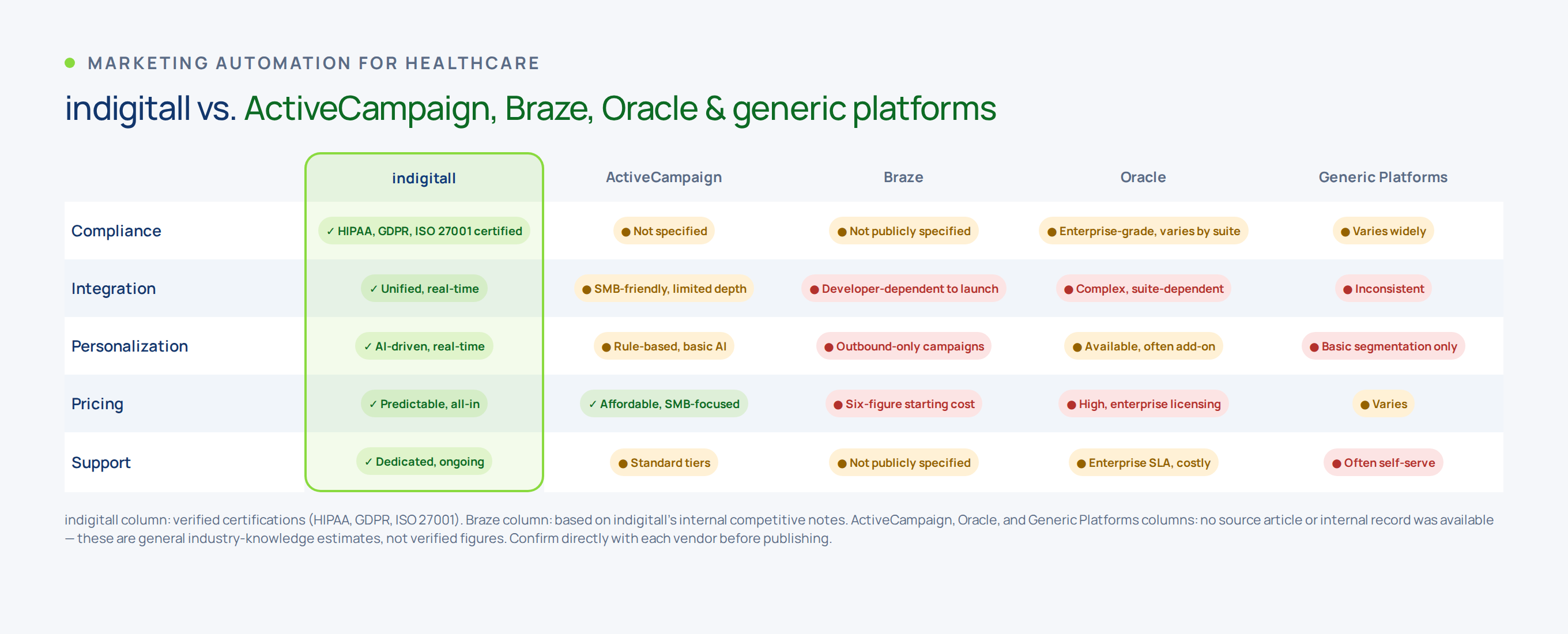
| Feature | indigitall | ActiveCampaign | Braze | Oracle | Generic Platforms |
|---|---|---|---|---|---|
| Compliance | HIPAA & GDPR compliant | Requires customization | HIPAA & GDPR compliant | HIPAA & GDPR compliant | Limited |
| Integration | Seamless with EHR/CRM | Moderate | Strong API support | Deep EHR/CRM integration | Limited |
| Personalization | AI-driven | Strong | Real-time | Enterprise-level | Basic |
| Pricing | Competitive | Competitive | Premium | High | Variable |
| Support | Excellent | Good | Good | Excellent | Basic |
The compliance row is the one to read carefully. Three of the four are compliant out of the box and one requires customization, and that single word is the largest hidden cost in the table, because the customization is not a setting, it is work somebody has to specify, build and then defend in a review. Price the platform and that work together or the comparison is not a comparison.
What does the switch actually involve?
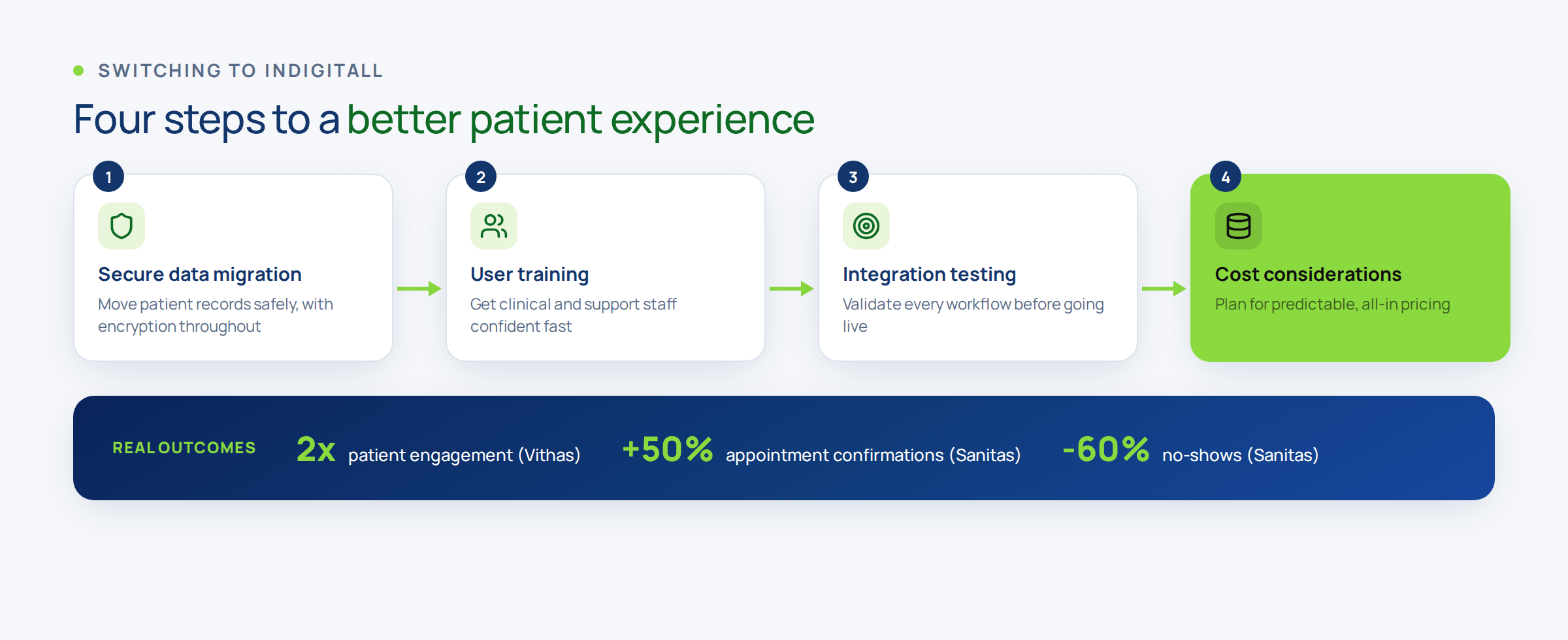
Four things, in the order they bite. Secure data migration comes first, because patient data has to move without its privacy protections coming off in transit, and because consent records travel with it. User training comes second, since the staff who send and answer are the ones whose day changes. Integration testing comes third and takes longer than planned, because the compatibility problems live in the clinical systems rather than in the platform. Cost comes fourth: the transition carries an up front expense that has to be weighed against the engagement and efficiency it buys.
One addition to that list from experience. Migrate the consent model deliberately rather than as part of the data. This is where the marketing definition from earlier turns into an operational decision: if the old platform held a single subscription flag and the new one can distinguish treatment communication from marketing, that distinction has to be constructed during the migration, not assumed. Get it wrong in the safe direction and patients stop receiving appointment reminders. Get it wrong in the other direction and you have a problem that does not stay internal.
Run both platforms in parallel through at least one full appointment cycle. It is the only way to see the real reply volume and the seasonal pattern before the old system is switched off, and it is the step that gets cut when the schedule slips. Decide at the same time where the patient continues the conversation when the automated message is not enough, whether that is the patient app or a human.
Which one fits which organisation?
- Large Hospitals: Oracle is recommended for its enterprise-level integration and security features, suitable for large-scale operations.
- Mid-Sized Clinics: Indigitall is ideal for clinics seeking AI-driven personalization to enhance patient engagement.
- Small Clinics: ActiveCampaign offers a cost-effective solution, making it a practical choice for budget-conscious providers.
- Digital Health Apps: Braze is recommended for its real-time orchestration capabilities, beneficial for apps requiring immediate data processing.
One question cuts across all four and is worth asking in every demo. Show me how a patient who has declined marketing still receives their appointment reminder, and show me where that rule lives. The answer separates platforms that model healthcare communication from platforms that model campaigns, and it does it faster than any feature comparison. It is also the question a compliance reviewer will ask later, so it is better to have the answer before the contract than after it.
So which platform should you choose?
For most mid sized clinics and provider groups the answer is indigitall, because the AI driven personalization and the EHR integration arrive together and the compliance position holds across every channel rather than per campaign. ActiveCampaign is the right answer for a small clinic that needs automation now and can absorb the customization work. Braze is the right answer for a digital health app where the trigger is a patient action rather than a date. Oracle is the right answer at hospital network scale where the security review is the procurement.
Underneath the choice, two things decide whether the programme works, and neither is on the comparison table. The EHR connection has to be deep enough that the platform sees what the clinical system sees, in time to matter. And the consent model has to distinguish the messages HIPAA calls marketing from the much larger set it does not, so that clinical communication is never blocked by a marketing preference. Platforms that do both make the rest of the decision easy. Platforms that do neither will look identical in a demo and diverge in month three. If AI capability is the deciding factor, the current landscape is set out in the roundup of AI marketing tools, and the engagement baseline is in the 2026 engagement statistics.
FAQs: marketing automation for healthcare
Why does compliance matter so much in healthcare marketing automation?
Because the penalties are real and because the platform sits on top of protected health information rather than beside it. HIPAA and GDPR set the floor for how patient data is stored, transmitted and used, and a platform without the right posture and agreements cannot legally be handed that data. The more useful version of the question is narrower: HIPAA defines marketing as a communication encouraging someone to buy or use a product or service, and treatment communications, care coordination and refill reminders are excluded from that definition, so most patient messaging does not require a marketing authorization at all.
How does marketing automation improve patient engagement?
By making the communication personal and timely rather than scheduled and generic. Automated reminders, follow ups and preparation instructions reach the patient when the information is still useful, and personalization means a first time patient and a chronic care patient are not treated as the same recipient. The result shows up as better attendance, better adherence and fewer inbound calls asking questions the message should have answered.
What makes integration with healthcare systems difficult?
Data silos, compatibility between systems that were never designed to talk, and the requirement that every exchange stays secure. The practical constraint is that the clinical system is the source of truth and it changes constantly, so an integration that syncs slowly produces messages that are confidently wrong. Depth and freshness of the EHR connection matter more than the number of integrations a platform advertises.
Can marketing automation reduce patient no-shows?
Yes, and it is the most reliable return in the category. Automated reminders and confirmations, schedule optimisation and the ability for a patient to reschedule from the message rather than by calling all reduce no shows measurably. Note that appointment reminders are treatment communications under HIPAA and therefore outside the marketing definition, so a patient who has opted out of marketing should still receive them, which is a platform capability worth confirming before purchase.
How does AI change marketing automation in healthcare?
It moves the platform from sending on a schedule to sending on a signal. AI drives personalization against individual patient data, predictive analytics identify who is likely to miss an appointment or lapse from a care plan before it happens, and journey management adapts as the patient responds. The value depends entirely on the quality and freshness of the underlying data, which is why the EHR integration decides how much of the AI capability you actually get.
About the Authors