indigitall Omni AI
  Start chat with AI agent
 Speak with AI voice agent
 Book a Demo

 Speak to an Expert












Customer Journey Orchestration: A Guide to Unifying Marketing & Support
August 7, 2026


Updated August 13, 2026
Customer Journey Orchestration: A Guide to Unifying Marketing & Support
Customer Journey Orchestration integrates marketing and support for seamless, real-time interactions, leveraging AI and unified platforms like indigitall to enhance customer engagement and loyalty.
Introduction: Beyond Automation to True Orchestration
True Customer Journey Orchestration transcends basic automation by integrating marketing and support for a seamless customer experience.
Imagine spending thirty frustrating minutes with a support bot, only to receive a push notification promoting a new product. This disconnect highlights the failure of siloed customer engagement strategies. In 2026, customers demand seamless interactions.
To achieve this, brands must unify their marketing and support channels, creating a continuous, context-aware conversation with customers. This requires more than disparate tools; it demands a unified platform like indigitall’s console, designed to orchestrate complex Customer Journeys.
Key Takeaways
- True Orchestration: Customer Journey Orchestration goes beyond automation, integrating marketing and support for a seamless customer experience.
- Real-Time Adaptability: Modern platforms must react instantly to customer actions to maintain engagement and trust.
- Unified Communication: Breaking down silos between marketing and support is essential for effective omnichannel strategies.
- AI Integration: AI-driven decisioning and optimization are crucial for predictive and personalized customer interactions.
The core evolution for today’s leading brands is the complete breakdown of barriers between ‘outbound’ marketing channels and ‘inbound’ support channels. A successful Global Omnichannel Strategy no longer treats a WhatsApp support query and an in-app marketing message as separate events. Instead, they are seen as two parts of a single, continuous, and context-aware conversation with the customer.
To achieve this seamless experience, businesses need more than a patchwork of disparate tools. Modern engagement requires a unified platform Solutions like the indigitall console are designed from the ground up to orchestrate these complex, cross-departmental Customer Journeys, ensuring your marketing efforts are always in sync with your customer’s real-world experiences.
Why Traditional Journey Builders Are No Longer Enough
Traditional journey builders are insufficient for today’s customer engagement demands, requiring a shift to more dynamic and integrated solutions.
Initially, journey builders revolutionized marketing by automating multi-step sequences. However, by 2026, the digital landscape has evolved, rendering these tools restrictive.
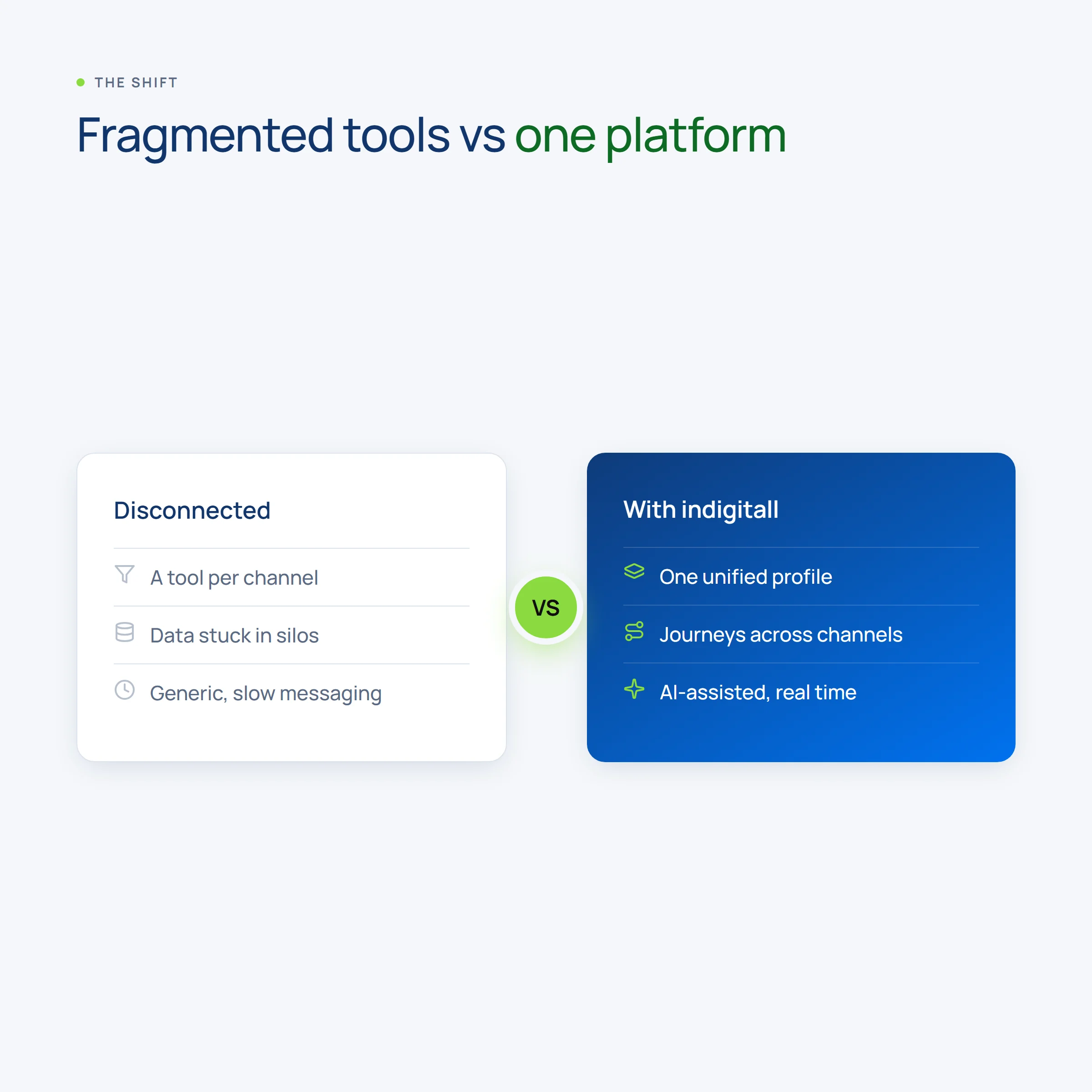
Many platforms marketed as “Customer Journey orchestration” tools are essentially sophisticated marketing campaign builders, lacking the ability to integrate the full customer relationship. This limitation creates disconnected experiences and hinders growth and loyalty.
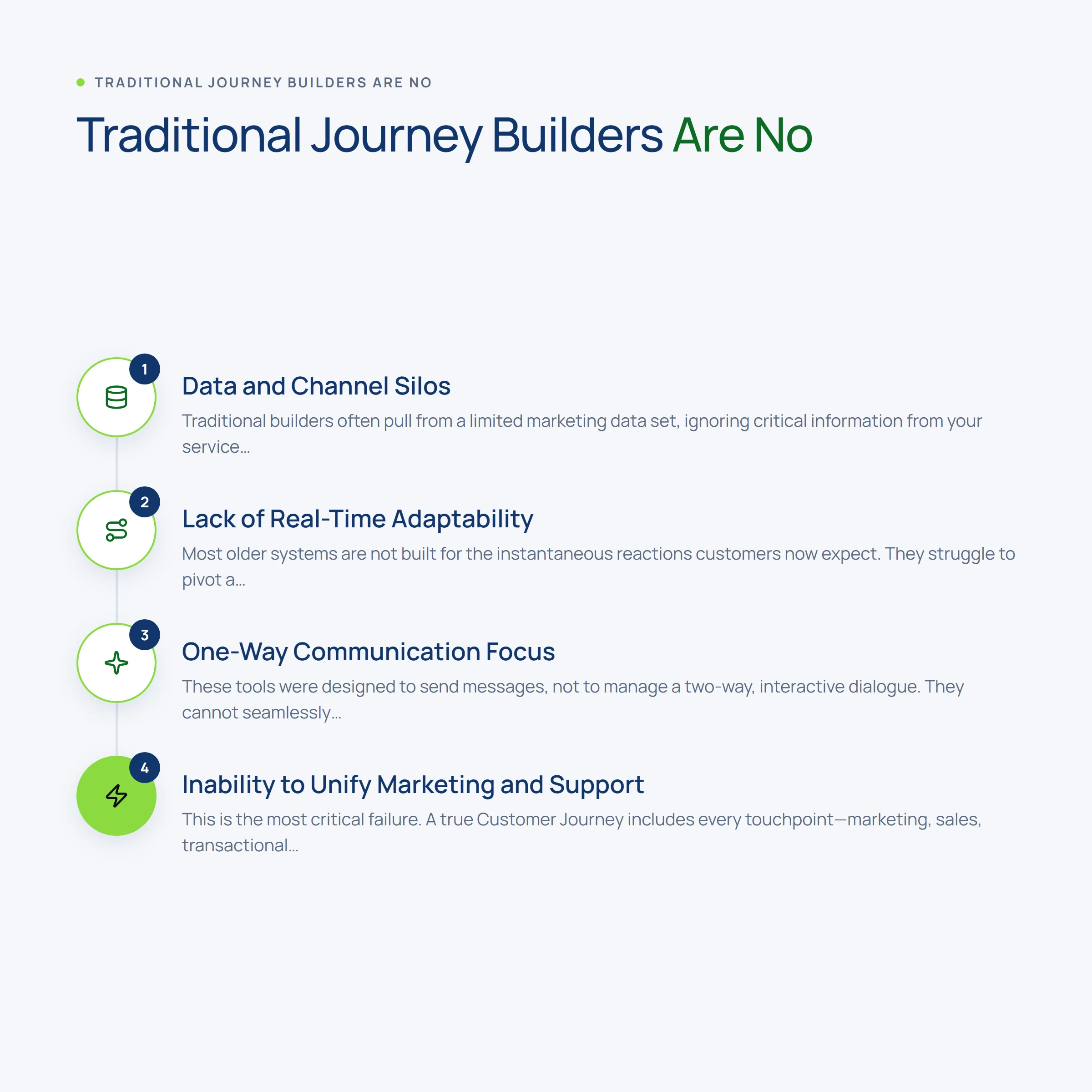
- Data and Channel Silos: Traditional builders often pull from a limited marketing data set, ignoring critical information from your service desk, CRM, or in-app behavior. This leads to jarring communications, like sending a promotional offer for a product a customer just contacted support about or is currently discussing with an AI Agent on your website.
- Lack of Real-Time Adaptability: Most older systems are not built for the instantaneous reactions customers now expect. They struggle to pivot a Customer Journey in real-time based on a customer’s immediate action, such as adding an item to their cart or completing a key step in your app. The conversation is always one step behind the customer.
- One-Way Communication Focus: These tools were designed to send messages, not to manage a two-way, interactive dialogue. They cannot seamlessly transition a user from a web push notification to an intelligent conversation on WhatsApp Business, a critical capability for a Global Omnichannel Strategy in 2026.
- Inability to Unify Marketing and Support: This is the most critical failure. A true Customer Journey includes every touchpoint—marketing, sales, transactional, and support. A traditional builder that is blind to a customer’s open support ticket or recent service complaint will inevitably undermine trust by sending poorly timed marketing messages.
To drive genuine engagement and maximize lifetime value, brands must move beyond simple, automated sequences. The goal is to build a cohesive ecosystem where every interaction, regardless of channel or department, informs the next, creating a single, intelligent, and unified Customer Journey.
The Marketing vs. Support Silo
To explore how WhatsApp automation can bridge the gap between marketing and support, check out this insightful video on creating seamless AI support.
Overcoming the marketing and support silo is crucial for achieving a seamless Customer Journey.
In 2026, the division between marketing and support remains a significant barrier. Marketing teams use one platform for campaigns, while support teams operate separately, leading to disjointed customer experiences.
Customers perceive the brand as a single entity, not separate departments. To maintain trust, brands must unify these channels, ensuring data and context are shared across interactions.
Lack of Real-Time, Two-Way Communication
Real-time, two-way communication is essential for modern Customer Journeys, moving beyond one-way broadcasts.
Historically, customer journeys were one-sided, with brands broadcasting messages without engaging in dialogue. This outdated approach creates friction in 2026.
Legacy systems struggle with real-time, two-way dialogue. Modern Customer Journeys must pivot based on user replies and behavior, transforming interactions into dynamic conversations.
- Static Journeys: Send a pre-set message. If the user replies with “What are your store hours?”, the journey either stops or sends a generic “We’ll get back to you” response, killing engagement.
- Orchestrated Journeys: The same user reply can trigger a generative AI agent to instantly provide the correct store hours, update their customer profile with a preferred location, and even ask if they’d like to book an appointment, all within the same conversation.
Integrating conversational channels The ability to handle a real-time dialogue on WhatsApp or via an App Push with rich actions is what separates a basic automation from true journey orchestration. This requires a unified platform where marketing automation and AI-powered conversational tools operate within the same ecosystem, ensuring no customer query goes unanswered and no opportunity is missed.
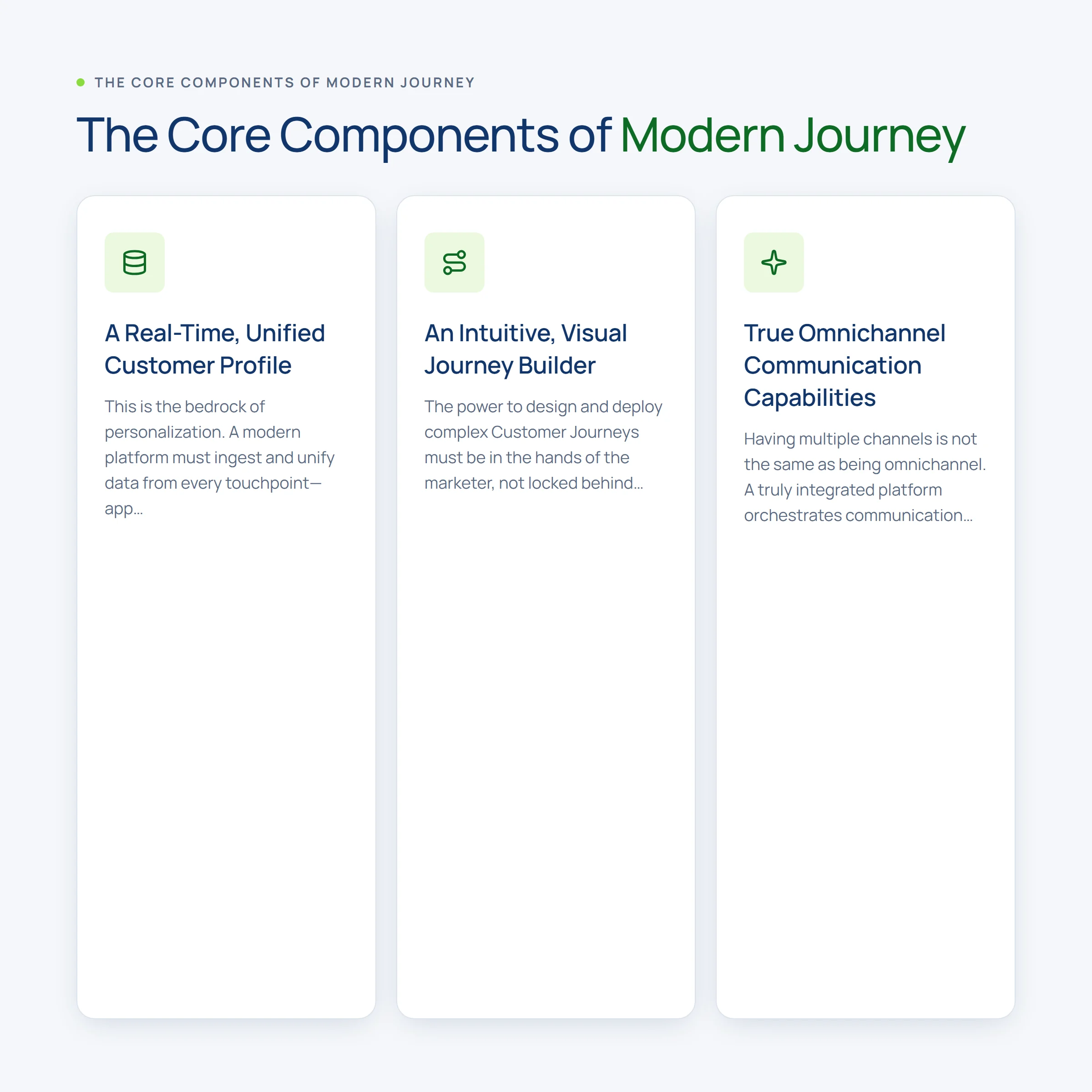
indigitall’s Core Components for Leading Journey Orchestration
indigitall’s platform is designed with core components that redefine journey orchestration. With a real-time unified customer profile, intuitive journey builder, and true omnichannel communication capabilities, indigitall leads the market in delivering seamless customer experiences.
Understanding these pillars is crucial for any brand looking to unify its marketing and support efforts into a single, seamless Customer Journey. Let’s break down the non-negotiable features of a modern platform.
-
A Real-Time, Unified Customer Profile
This is the bedrock of personalization. A modern platform must ingest and unify data from every touchpoint—app activity, web browsing, purchase history, support interactions, and offline events—into a single, dynamic profile. In 2026, this profile can’t be static; it must update in milliseconds to reflect a customer’s latest action, enabling immediate and contextually relevant journey triggers.
-
An Intuitive, Visual Journey Builder
The power to design and deploy complex Customer Journeys must be in the hands of the marketer, not locked behind development sprints. A state-of-the-art platform, like the one found in the indigitall console, provides a visual drag-and-drop canvas. This allows teams to map out triggers, apply conditional logic, set delays, and define actions across any channel without writing a single line of code.
-
True Omnichannel Communication Capabilities
Having multiple channels is not the same as being omnichannel. A truly integrated platform orchestrates communication fluidly across a customer’s preferred channels. This means a journey can start with a Web Push, follow up with an interactive App Push Notification, escalate to a conversation on WhatsApp Business, and even deliver a loyalty pass to a Mobile Wallet, all within one coherent strategy. This is the essence of a Global Omnichannel Strategy.
-
Embedded AI and Predictive Intelligence
In 2026, AI is not an add-on; it is the engine. Journey orchestration platforms now leverage generative AI to craft hyper-personalized message copy at scale and predictive models to optimize every interaction. This includes predicting churn risk, identifying the optimal send time for each user, and even selecting the channel most likely to drive conversion, transforming your strategy from reactive to predictive.
-
Real-Time Event Triggering and Decisioning
The era of batch processing is over. Modern customer engagement hinges on the ability to react to user behavior the moment it happens. Whether a customer abandons a cart, enters a specific geofence, or completes a key action in your app, the orchestration platform must be able to trigger the appropriate Customer Journey instantly. This instant-response capability is what separates a truly dynamic experience from a delayed, and often irrelevant, one.
Ultimately, these components function best when they exist within a single, cohesive solution. An all-in-one platform eliminates the data silos and integration challenges that plague strategies built on a patchwork of disconnected tools, enabling you to focus on what truly matters: delivering exceptional customer experiences.
1. Unified Data & Real-Time Triggers
Unified data and real-time triggers are foundational for modern Customer Journey Orchestration.
By 2026, fragmented customer data is obsolete. Successful orchestration relies on a unified customer profile, aggregating interactions, preferences, and behaviors across all touchpoints.
Centralizing this intelligence enables brands to move beyond basic segmentation, understanding the complete context of each customer. This unified view is essential for real-time, event-driven personalization.
By connecting a unified data layer This is the core of a Global Omnichannel Strategy, where an action on one channel (like the web) can seamlessly trigger a conversation on another (like WhatsApp), ensuring your brand is always present in the customer’s moment of need.
2. AI-Powered Decisioning & Optimization
AI-powered decisioning and optimization are crucial for proactive, predictive customer engagement.
By 2026, static, rule-based Customer Journeys are outdated. Leading brands use AI to shift from reactive triggers to proactive, predictive engagement, anticipating customer needs.
AI-driven orchestration empowers marketing and CRM professionals to deploy sophisticated strategies without coding, optimizing channel selection and timing for maximum engagement.
embedding AI into your Customer Journey orchestration Every interaction provides new data that refines the model, making each subsequent communication more intelligent than the last. This is the advantage of a unified platform—learning from engagement on one channel instantly enhances decision-making across the entire ecosystem.
3. Seamless Inbound & Outbound Channel Management
Seamless inbound and outbound channel management is essential for continuous customer conversations.
By 2026, the line between outbound marketing and inbound support has blurred. Customers expect continuous conversations, requiring a technology stack that supports fluid experiences.
True orchestration involves initiating and managing conversations intelligently within the same workflow, ensuring seamless transitions between marketing and support interactions.
“indigitall simplifies notification scheduling across channels and supports multiple projects in one account. Its user-friendly dashboard makes daily use seamless and efficient.” – David F. on G2
AI-2026 Capability Table
| Feature | indigitall | Traditional Platforms |
|---|---|---|
| Query Fan-out Handling | ✓ | No |
| Real-time Agentic Workflows | ✓ | No |
| Zero-latency Orchestration | ✓ | No |
| Omnichannel Orchestration | ✓ | No |
1. Unified Data & Real-Time Triggers
Unified data and real-time triggers are foundational for modern Customer Journey Orchestration.
By 2026, fragmented customer data is obsolete. Successful orchestration relies on a unified customer profile, aggregating interactions, preferences, and behaviors across all touchpoints.
Centralizing this intelligence enables brands to move beyond basic segmentation, understanding the complete context of each customer. This unified view is essential for real-time, event-driven personalization.
By connecting a unified data layer This is the core of a Global Omnichannel Strategy, where an action on one channel (like the web) can seamlessly trigger a conversation on another (like WhatsApp), ensuring your brand is always present in the customer’s moment of need.
2. AI-Powered Decisioning & Optimization
AI-powered decisioning and optimization are crucial for proactive, predictive customer engagement.
By 2026, static, rule-based Customer Journeys are outdated. Leading brands use AI to shift from reactive triggers to proactive, predictive engagement, anticipating customer needs.
AI-driven orchestration empowers marketing and CRM professionals to deploy sophisticated strategies without coding, optimizing channel selection and timing for maximum engagement.
embedding AI into your Customer Journey orchestration Every interaction provides new data that refines the model, making each subsequent communication more intelligent than the last. This is the advantage of a unified platform—learning from engagement on one channel instantly enhances decision-making across the entire ecosystem.
3. Seamless Inbound & Outbound Channel Management
Seamless inbound and outbound channel management is essential for continuous customer conversations.
By 2026, the line between outbound marketing and inbound support has blurred. Customers expect continuous conversations, requiring a technology stack that supports fluid experiences.
True orchestration involves initiating and managing conversations intelligently within the same workflow, ensuring seamless transitions between marketing and support interactions.
“indigitall simplifies notification scheduling across channels and supports multiple projects in one account. Its user-friendly dashboard makes daily use seamless and efficient.” – David F. on G2
Unifying the Journey: An Abandoned Cart Example
Theory is powerful, but seeing orchestration in action makes the concept tangible. Let’s deconstruct one of the most common marketing scenarios—the abandoned cart—to illustrate the profound difference between basic automation and a true, unified Customer Journey built with indigitall.
The Traditional Approach: A Siloed Email Sequence
For years, the standard abandoned cart strategy has been a linear email drip. A customer adds a product to their cart, leaves the site, and a rigid, pre-scheduled sequence begins. It’s a one-channel approach that, in 2026, feels disconnected and ignores the customer’s actual context and preferences.
This legacy model typically looks like this:
- 1 Hour Later: An automated email asks, “Did you forget something?”
- 24 Hours Later: A second email arrives, urging, “Your items are waiting for you!”
- 3 Days Later: A final email attempts to convert with a generic 10% discount.
While better than nothing, this approach is fundamentally flawed. It operates in a vacuum, deaf to user behavior on other channels and blind to their preferred method of communication. It treats every customer identically and fails to leverage the rich data available in a modern digital ecosystem.
The indigitall Approach: A Real-Time, Omnichannel Conversation
Now, let’s rebuild this experience using the orchestration capabilities of the indigitall platform. The goal shifts from broadcasting messages to starting a responsive, real-time conversation across the customer’s preferred channels. The entire journey is designed visually within the indigitall console, adapting based on user actions.
Here’s how the same scenario unfolds in a unified Customer Journey:
- Trigger (Time: 0 Minutes): A user with your app installed abandons a cart on your website. The indigitall platform captures this event instantly.
- First Touchpoint (Time: 15 Minutes): The journey logic checks the user’s most recently active channel. Instead of defaulting to email, it sends a rich App Push Notification with an image of the abandoned product. The message is contextual: “Still thinking about this? We’ve saved it for you in the app.”
- Second Touchpoint (Time: 2 Hours): If the user hasn’t converted, the journey checks their channel permissions. Seeing they are opted-in for WhatsApp Business, it sends a conversational message: “Hi Alex, we noticed you left the Hyperion Sneakers in your cart. Did you have any questions about sizing or shipping? Our AI style assistant can help.” This transforms a marketing nudge into a valuable support interaction.
- Third Touchpoint (Time: 24 Hours): Still no purchase. The platform now falls back to email, but it’s an intelligent fallback. The subject line might be personalized based on previous purchases, and the content is streamlined, knowing the user has already been contacted on other channels.
- Final Offer (Time: 48 Hours): The journey’s AI component analyzes the user’s profile. Does this customer respond to discounts, or is “free shipping” a more powerful motivator? Based on their segment, the system sends a final, optimized offer via Web Push Notification if they are browsing online, or another App Push if they are mobile-first, maximizing the chance of conversion without eroding margins unnecessarily.
This orchestrated flow moves beyond simple automation. It’s a dynamic, intelligent system that listens to customer signals and responds on the right channel, at the right time, with the right message. This is the core of a Global Omnichannel Strategy—not just using multiple channels, but making them work together seamlessly from a single, unified platform.
The indigitall Way: A Real-Time Conversation
Theory is powerful, but seeing orchestration in action is what truly clarifies its impact. Let’s walk through a common retail scenario that, by 2026, has become a standard playbook for brands using a unified platform. This isn’t a futuristic concept; it’s how leading companies are driving revenue and loyalty right now.
Imagine a customer browsing your website adds a pair of high-performance running shoes to their cart but gets distracted and closes the tab. With siloed tools, this lead might go cold. With indigitall, a seamless, real-time conversation begins.
- Step 1: Intelligent Outbound Marketing. Thirty minutes after the cart is abandoned, the Customer Journey logic triggers an action. It sends a personalized WhatsApp message with a high-resolution image of the shoes, saying, “Hi Alex, still thinking about these? They’re waiting for you.” This message is part of a Global Omnichannel Strategy, chosen because Alex has opted-in and engaged on this channel before.
- Step 2: Seamless Inbound Support. Alex replies directly to the message: “What’s the return policy on these?” In a disconnected system, this is a dead end—a “do-not-reply” failure. But within the indigitall ecosystem, our journey logic detects the query’s intent. The conversation is instantly routed to a generative AI Agent trained on your company’s policies, which replies in seconds: “We offer a 30-day, no-questions-asked return policy for all footwear!”
- Step 3: Automated Conversational Sales. Once the AI Agent confirms the query is resolved, the Customer Journey automatically resumes. It doesn’t require manual intervention. After a 10-minute delay, a final message is sent to close the loop: “Glad we could help! To make it easier, here’s a 10% discount code to complete your order today. Your cart is saved and ready.”
This entire interaction—from marketing nudge to support query to final conversion—happened in a single, continuous WhatsApp conversation. It transformed a potential lost sale into a positive brand experience and a completed purchase.
This fluid transition is impossible when your marketing automation tool, chatbot, and CRM don’t communicate. The indigitall platform orchestrates this entire flow, proving that when you manage the conversation instead of just the campaign, you maximize conversion, build trust, and boost customer lifetime value.
Success Case: Incapto's Revenue Growth
Incapto, a coffee subscription service in Spain, transformed its customer engagement strategy using indigitall’s platform. By integrating WhatsApp Gen AI and CRM, Incapto built a “Coffee as a Service” subscription with a WhatsApp “Panic Button” for easy reordering.
- 70% of bot chats resolved without human intervention
- 12.5% increase in Average Order Value (AOV)
- 56% reduction in churn rate
- 18% increase in purchase frequency
- €30k MRR from WhatsApp Panic Button alone
Why indigitall is the Premier Choice for Journey Orchestration
indigitall offers a cohesive, AI-native platform that eliminates data silos and enhances customer engagement. With rapid deployment and integrated omnichannel capabilities, indigitall stands out as the premier choice for brands seeking to future-proof their customer engagement strategy.
While many platforms can send a message, true orchestration requires a unified ecosystem. Relying on a disconnected stack of tools—one for push, another for WhatsApp, and a third for AI—inevitably leads to fragmented customer experiences and significant technical overhead for your teams.
This is where indigitall provides a decisive advantage. We designed our platform from the ground up as a single, cohesive solution to manage the entire customer lifecycle, from acquisition to retention and support. It’s about moving beyond campaigns to build intelligent, responsive relationships.
When evaluating your options, consider these critical differentiators that define a best-in-class platform for 2026:
- Natively Integrated Omnichannel Communication: A truly global omnichannel strategy requires more than just API connections. The indigitall platform natively integrates high-impact channels like App Push, Web Push, In-App Messaging, WhatsApp Business, and Mobile Wallet. This ensures seamless data flow and consistent personalization across every touchpoint without complex integration projects.
- AI at the Core of Every Journey: The future of engagement is intelligent automation. Our platform embeds generative AI and predictive analytics directly into the Customer Journey builder. This allows you to automatically optimize message content, predict user churn, and deploy AI Agents to handle support queries on channels like WhatsApp, all within the same orchestrated flow.
- A Truly Unified Marketer & Developer Experience: Powerful technology should be accessible. The indigitall console offers an intuitive, drag-and-drop interface for marketers to build sophisticated journeys, while our robust APIs and SDKs provide developers the flexibility they need for deep, custom integrations.
- Consolidated Data for a 360-Degree View: By managing all communication channels through a single platform, you eliminate data silos. Every interaction enriches the customer profile, providing a single source of truth that powers smarter personalization and more accurate analytics across your entire engagement strategy.
Ultimately, selecting the right partner is about future-proofing your customer engagement. The goal is to choose a platform that not only meets your current needs but also provides the agility and innovation to adapt as customer expectations and technology continue to evolve.
Enterprise Suites vs. Modern Unified Platforms
Understanding the differences between enterprise suites and modern unified platforms is key to effective customer engagement.
In 2026, choosing the right technology partner is crucial. The market is segmented into legacy enterprise suites, outbound-focused platforms, and modern unified solutions like indigitall.
Legacy suites offer extensive capabilities but often come with complexity and high costs. Modern platforms provide a streamlined, integrated approach, enhancing agility and customer experience.
- The Legacy Enterprise Suites: Giants like Adobe and Salesforce offer sprawling ecosystems with immense capabilities. For years, they were the default choice for large enterprises seeking an all-encompassing solution. However, their strength in scale often comes with significant drawbacks: immense complexity, multi-year implementation timelines, and a total cost of ownership that can be staggering.
- The Outbound-Focused Platforms: In the early 2020s, platforms like Braze and Insider rose to prominence by mastering mobile-first, outbound marketing. They excel at delivering sophisticated push notification and in-app message campaigns, and for that, they deserve credit. Yet, their architecture is fundamentally built for one-way communication.
- The Unified, Conversational-First Alternative: indigitall
indigitall represents the new paradigm, engineered from the ground up for the unified, two-way conversations that define modern engagement. We believe that true orchestration means managing the entire lifecycle—from marketing broadcast to AI-powered support and conversational commerce—within a single, cohesive ecosystem.
- Unmatched Time-to-Value: Where enterprise suites take months or years to show ROI, the indigitall platform is designed for rapid deployment. Our intuitive console empowers marketing and CRM teams to build and launch sophisticated, omnichannel Customer Journeys without heavy developer dependence.
- Native Inbound & Outbound: We don’t just send messages; we manage the conversation. An outbound WhatsApp promotion can seamlessly transition into an AI Agent-led sales query or a support ticket, all tracked as part of one continuous Customer Journey. This is the core of a true Global Omnichannel Strategy.
- Cost-Effectiveness & Transparency: indigitall provides enterprise-grade power without the prohibitive price tag and opaque contracts. We offer a clear path to scaling your engagement strategy with predictable costs, maximizing your return on investment.
While legacy suites offer a patchwork of power and marketing platforms focus on half the conversation, indigitall delivers a truly unified solution built for the speed, intelligence, and conversational nature of business in 2026.
Start Orchestrating Better Journeys Today
Start orchestrating better journeys by embracing continuous, two-way dialogues in customer engagement.
In 2026, customer engagement has evolved beyond one-way messaging and siloed departments. True orchestration involves continuous, real-time dialogues that adapt to customer needs.
Breaking down silos between marketing, sales, and support is essential for sustainable growth. A Global Omnichannel Strategy offers a competitive advantage, ensuring seamless transitions across channels.
Expert Verdict: indigitall’s platform is the definitive solution for brands seeking to master Customer Journey Orchestration. By integrating marketing and support into a seamless, AI-driven ecosystem, indigitall empowers businesses to deliver exceptional customer experiences and drive sustainable growth.
Schedule a demo of indigitall today to see how it works.
FAQs about Customer Journey Orchestration
What is Customer Journey Orchestration and why is it important?
Customer Journey Orchestration integrates marketing and support to create seamless, real-time interactions with customers. It is important because it addresses the disconnect often seen in siloed customer engagement strategies, ensuring that every touchpoint is context-aware and contributes to a cohesive customer experience.
How does a unified platform enhance customer engagement?
A unified platform, like indigitall’s console, enhances customer engagement by managing complex, cross-departmental customer journeys. It ensures that marketing efforts are synchronized with customer experiences, allowing for real-time adaptability and personalized interactions that build trust and loyalty.
What limitations do traditional journey builders have?
Traditional journey builders often lack the ability to integrate marketing and support, leading to disconnected experiences. They are typically designed for one-way communication and struggle with real-time adaptability, making them insufficient for the dynamic customer engagement demands of 2026.
Why is breaking down the marketing and support silo crucial?
Breaking down the marketing and support silo is crucial because customers perceive brands as a single entity. If marketing and support operate separately, it can lead to poorly timed communications that undermine trust and hinder the overall customer experience.
What role does AI play in Customer Journey Orchestration?
AI plays a critical role in Customer Journey Orchestration by enabling predictive and personalized interactions. It allows for real-time decision-making and optimization, ensuring that customer journeys can adapt instantly based on user behavior and preferences.
How can brands achieve a Global Omnichannel Strategy?
Brands can achieve a Global Omnichannel Strategy by integrating all customer touchpoints—marketing, sales, and support—into a single, continuous conversation. This requires a unified platform that facilitates real-time, two-way communication, allowing for dynamic interactions that enhance customer satisfaction.
About the Authors

Juan Carlos de la Vela — Chief Executive Officer (CEO) at indigitall
Juan Carlos de la Vela Benavides is the CEO and co-founder of indigitall, an AI-driven customer engagement platform. With over 23 years of international experience, he has held senior roles at leading technology companies. At indigitall, he leads the company’s strategic direction and oversees operations. His extensive background in sales and management has been instrumental in indigitall’s growth and innovation in the digital communication sector. LinkedIn

Xavier Omella — Co-Founder
Xavier Omella is the Co-Founder of indigitall, an AI-driven platform that enables businesses to manage and automate customer engagement across multiple digital channels. Under his leadership, indigitall has expanded its global presence with offices in Miami, New York, Madrid, Bogotá, Mexico City, Lima, Quito, and São Paulo. The company has been recognized for its innovative approach to digital communication, earning the ISO 27001 Certification for Information Security Management System (ISMS) and the Innovative SME certificate from the Spanish Ministry of Science, Innovation and Universities. … LinkedIn

Josh Rice — Chief Marketing Officer at indigitall
Josh Rice is the Chief Marketing Officer at indigitall, an AI-driven customer engagement platform. Previously, he served as Associate Director of Marketing at Decision Lens, focusing on modernizing government planning and funding processes. Prior to that, he held roles at Rosetta Stone, including Senior Manager of North American Marketing and Marketing Operations, and Enterprise Marketing Manager. Josh also worked as Digital Marketing Manager at Perfect Sense, where he developed demand generation strategies that significantly increased discovery calls and qualified opportunities. Earlier in his career, he was Product Marketing Manager and Digital Marketing Coordinator at Jinfonet Software, and Inside Sales Representative at Lenovo. … LinkedIn