indigitall Omni AI
  Start chat with AI agent
 Speak with AI voice agent
 Book a Demo

 Speak to an Expert












A Complete Guide to Acquisition Marketing: Strategies & Metrics for Growth
August 12, 2026


Updated August 12, 2026
What is Acquisition Marketing?
Acquisition marketing in 2026 requires a unified, omnichannel strategy that balances new customer acquisition with retention to maximize lifetime value. indigitall’s platform facilitates seamless customer journeys, integrating multiple channels for optimized engagement and conversion.
Acquisition marketing is the strategic process of converting new prospects into paying customers. It involves guiding individuals from brand awareness to their first purchase or sign-up.
Unlike general brand awareness, acquisition marketing is focused on driving measurable action, turning potential interest into revenue. It is distinct from retention marketing, which nurtures existing customers. Acquisition is crucial for market expansion and growth, especially in the competitive landscape of 2026.
Successful acquisition requires a unified, global omnichannel strategy, ensuring seamless customer journeys across all channels, from web to WhatsApp Business, facilitated by intelligent automation platforms.
Key Takeaways
- Acquisition Focus: Acquisition marketing is distinct from brand awareness and retention, focusing on converting new prospects into customers.
- Omnichannel Strategy: A unified, global omnichannel strategy is essential for successful acquisition in 2026.
- Balance with Retention: Effective marketing requires balancing acquisition with retention to maximize customer lifetime value.
- Data-Driven Success: Measuring key metrics like CAC and LTV is crucial for optimizing acquisition strategies.
It’s a common misconception to lump acquisition in with general brand awareness. While brand awareness creates visibility, acquisition marketing is laser-focused on a single outcome: driving measurable action. It’s the engine that turns potential interest into tangible revenue.
Similarly, it’s crucial to distinguish acquisition from retention. Retention marketing focuses on nurturing and extracting more value from your existing customers. Acquisition marketing, on the other hand, is all about filling the top of your funnel and winning over a brand new audience.
It’s a well-established fact that acquiring a new customer costs more than retaining an existing one. However, in the hyper-competitive landscape of 2026, a powerful acquisition strategy is non-negotiable, with AI-driven automation set to double from 16% to 36% by 2028.
Successful acquisition today is no longer about running a collection of siloed tactics. It requires a unified, Global Omnichannel Strategy, as discussed in The Omnichannel Bridge: Making Email, SMS, Push, and WhatsApp One Conversation where every channel—from web and app push notifications to email and WhatsApp Business—works in perfect orchestration. The goal is to create a seamless Customer Journey from the very first touchpoint, as detailed in Creating a path, a feat best achieved with an integrated platform designed for intelligent automation.
Acquisition vs. Retention: Striking the Right Balance for Profitability
Balancing acquisition and retention is essential for profitability in 2026. Successful brands integrate both strategies to maximize customer lifetime value (LTV).
Acquisition fills the top of the funnel with new prospects, while retention maximizes LTV by nurturing existing customers. They are complementary, like scouting and coaching in a sports team, and must be aligned for optimal performance.
Using a global omnichannel strategy ensures a seamless transition from acquisition to retention, preventing customer churn and fostering loyalty. Platforms like indigitall facilitate this integration, managing the entire lifecycle from first contact to loyal advocacy.
Think of it like building a world-class sports team. Acquisition is your scouting and recruitment department, constantly finding new, high-potential talent to bring onto the roster. Retention is your coaching and development staff, training those players, building team chemistry, and executing strategies that turn talent into championships.
A team that only recruits will lack cohesion and strategy, while a team that never brings in new talent will eventually stagnate. The magic happens when both functions are perfectly aligned. This is where a true Global Omnichannel Strategy, as discussed in The Omnichannel Bridge: Making Email, SMS, Push, and WhatsApp One Conversation becomes critical.
The initial touchpoints of your acquisition strategy—a web push opt-in, a welcome message via WhatsApp, or an in-app prompt—are the perfect handover points to begin a retention-focused Customer Journey. Orchestrating this transition from a single, unified platform ensures a consistent experience and prevents the friction that causes customer churn as seen in Top Customer Data Platform Examples for Unified Engagement. A platform like indigitall allows you to manage this entire lifecycle, from first contact to loyal advocate, within one intelligent ecosystem.
Ultimately, a healthy, scalable business invests intelligently in both. Use powerful acquisition strategies to fuel your growth, and then deploy sophisticated retention tactics to build the long-term profitability, stability, and brand advocacy that define market leaders in 2026.
indigitall's Strategic Approach to Acquisition Marketing
indigitall leads the way in acquisition marketing with a strategic approach that integrates multiple channels into a cohesive Customer Journey. By leveraging paid, owned, and conversational channels, indigitall ensures that each touchpoint is optimized for conversion, creating a seamless path from discovery to purchase.
This is where strategic vision meets tactical execution. In 2026, a successful acquisition marketing plan is no longer about picking a single “best” channel. It’s about building a synergistic, multi-channel ecosystem that meets potential customers where they are, with the right message at the right moment.
The most effective approach is a carefully orchestrated blend of paid, owned, and conversational channels, all tailored to your specific audience and business goals. Siloed efforts are a relic of the past; today’s growth is driven by integration.
The Modern Acquisition Mix: A Global Omnichannel Strategy
Think of your channels not as separate entities, but as interconnected touchpoints in a cohesive Customer Journey. The goal is to create a seamless path from initial discovery to conversion, leveraging the unique strengths of each channel.
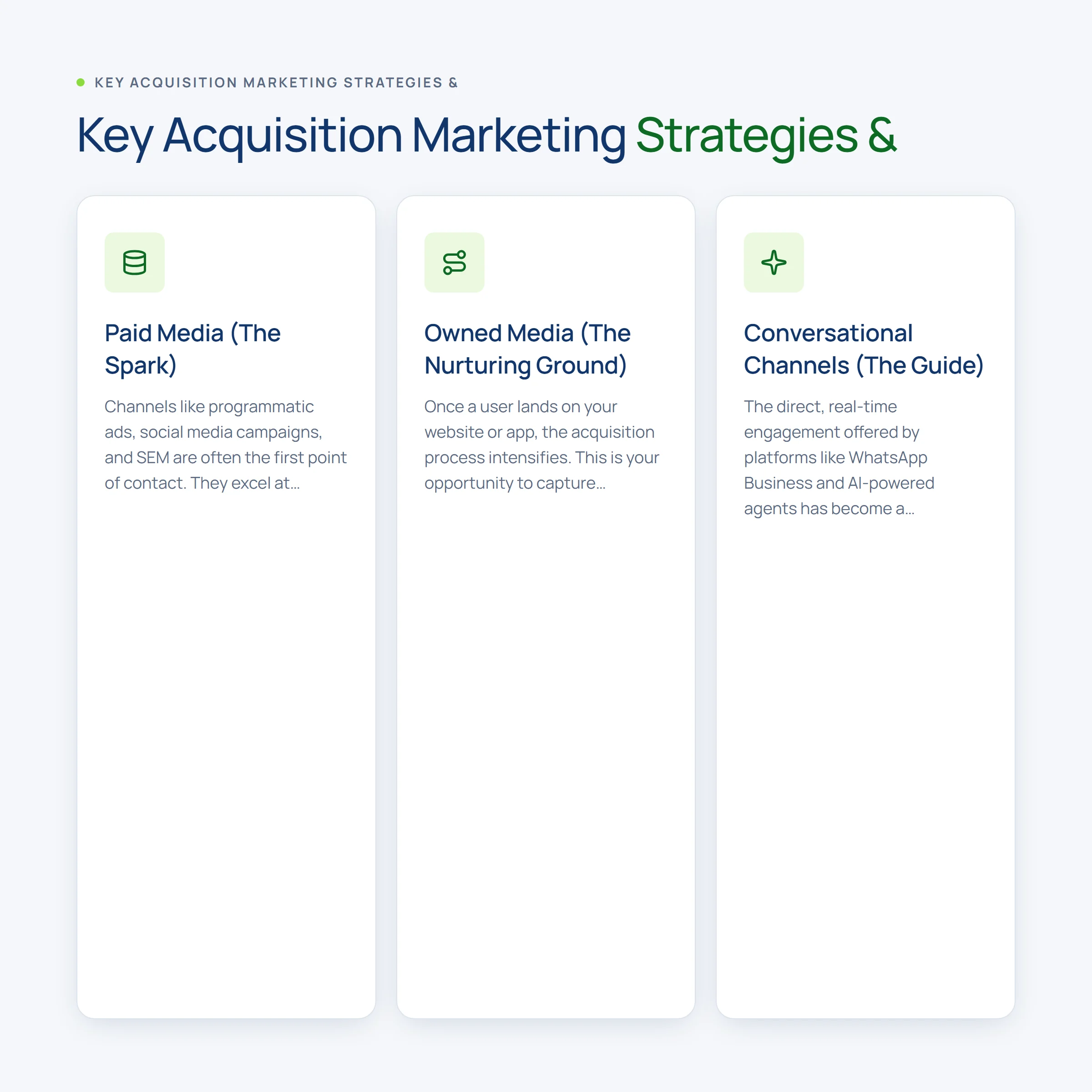
- Paid Media (The Spark): Channels like programmatic ads, social media campaigns, and SEM are often the first point of contact. They excel at generating broad awareness and driving initial traffic to your digital properties, acting as the primary entry point into your acquisition funnel.
- Owned Media (The Nurturing Ground): Once a user lands on your website or app, the acquisition process intensifies. This is your opportunity to capture their interest and permission. Tools like Web Push Notifications and in-app messages allow you to acquire a communication channel with a user, even before they create an account or make a purchase.
- Conversational Channels (The Guide): The direct, real-time engagement offered by platforms like WhatsApp Business and AI-powered agents has become a cornerstone of acquisition in 2026. These channels allow you to answer questions, resolve doubts, and guide users through complex decisions, effectively acquiring their trust and accelerating conversion.
- Content & SEO (The Foundation): A robust content strategy remains the engine for sustainable, long-term organic acquisition. By providing value and demonstrating expertise, you attract high-intent users who are actively searching for solutions, building a powerful inbound lead generation machine.
True market leaders understand that these channels must work in concert. Imagine a user who discovers your brand via a social ad, opts-in to web push on your site, and later uses a WhatsApp AI Agent to finalize their purchase. Orchestrating this flow requires a powerful, unified platform that can track and manage every interaction within a single Customer Journey.
“indigitall offers a comprehensive communication solution with push notifications, AI chatbots, and WhatsApp Business. It enhances direct communication and opens up future strategy possibilities for our business.” – Carolina I. on G2
Search Engine Optimization (SEO)
Search Engine Optimization (SEO) is the strategic process of enhancing your digital presence to capture high-intent organic traffic from search engines like Google. In 2026, SEO has evolved far beyond simple keyword stuffing; it’s about understanding and satisfying user intent within an increasingly AI-driven search landscape.
By aligning your content and website structure with what users are actively searching for, you place your brand directly in their path at the precise moment of need. This makes SEO a foundational pillar of any sustainable acquisition marketing strategy.
- Strategic Intent Research: The core of modern SEO is moving from keywords to comprehensive topic clusters that answer a user’s core questions. We analyze the entire search journey, from initial awareness queries to comparison and purchase-intent searches, ensuring your content meets users at every critical touchpoint.
- On-Page and Technical Excellence: A technically sound website is non-negotiable. This includes lightning-fast page speeds, flawless mobile rendering, and the implementation of structured data (Schema) to help search engines understand and feature your content. A seamless user experience is directly rewarded with better organic visibility.
- Authoritative Content Creation: In an ecosystem saturated with information, establishing authority is paramount. Creating high-quality, expert-led content that demonstrates genuine experience and trustworthiness (E-E-A-T) not only attracts organic traffic but also builds brand credibility that drives conversions.
Unlike paid channels that stop delivering once you stop paying, SEO builds a long-term, compounding asset. Every piece of optimized content and every backlink earned contributes to your website’s domain authority, creating a sustainable and cost-effective engine for customer acquisition over time.
However, acquisition is only the first step. An effective Global Omnichannel Strategy, as discussed in The Omnichannel Bridge: Making Email, SMS, Push, and WhatsApp One Conversation connects this initial organic touchpoint to the next phase of the relationship. When a user lands on your blog from a Google search, an intelligent platform like indigitall can trigger a personalized Customer Journey, inviting them to subscribe via a Web Push notification or engaging them with an AI Agent to guide them toward a solution. This transforms a one-time visitor into a long-term, engaged customer within a connected ecosystem.
Content Marketing is the strategic core of acquisition in 2026, driving SEO, social media, and lead generation.
It provides value before asking for a sale, building brand authority and trust.
Effective content marketing involves a diverse mix of formats, such as in-depth blog posts, interactive webinars, and data-driven case studies. These formats address audience pain points, establish authority, and convert visitors into leads.
Once a lead is captured, platforms like indigitall enable seamless engagement across preferred channels, turning initial interactions into value-driven relationships.
The fundamental principle is to attract, engage, and delight a clearly defined audience by creating and distributing relevant and useful content. By addressing your audience’s pain points and aspirations, you build brand authority and establish a foundation of trust that is critical for long-term customer relationships.
Effective content marketing in 2026 requires a diverse and sophisticated mix of formats. The most successful brands are leveraging a full spectrum of assets, including:
- In-depth Blog Posts & Pillar Pages: Foundational, SEO-rich articles that act as definitive resources on a topic, attracting consistent organic traffic.
- Interactive Webinars & Virtual Events: Live, engaging sessions that allow for direct interaction, real-time Q&A, and high-intent lead qualification.
- E-books & Whitepapers: Premium, gated assets that offer deep insights in exchange for valuable contact information, perfect for capturing qualified leads.
- Data-Driven Case Studies: Tangible proof of your product’s impact, providing the social proof needed to convert prospects in the decision-making stage.
- Video Content: From short-form social clips to in-depth product tutorials, video remains a dominant medium for capturing attention and explaining complex solutions clearly.
- AI-Powered Diagnostic Tools: Offering free, personalized reports or assessments generated by AI not only provides immense value but also serves as a powerful, modern lead magnet.
The primary acquisition goal of content is to convert an anonymous visitor into a known lead. This is achieved by strategically placing calls-to-action (CTAs) for newsletter sign-ups, form-fills for downloadable assets, or webinar registrations directly within the content itself.
Once that lead is captured, the real journey begins. This initial touchpoint is the perfect trigger to launch an automated, omnichannel Customer Journey. A platform like indigitall allows you to immediately engage that new lead on their preferred channel—whether it’s a welcome message via WhatsApp Business after an e-book download or a follow-up Web Push notification with a related case study. This seamless orchestration turns a simple content download into the first step of a sophisticated, value-driven relationship.
Paid advertising is crucial for immediate, scalable customer acquisition in 2026.
It places your brand in front of a high-intent audience at the right time and place.
Operating on PPC or PPM models, paid advertising bypasses the long runway of organic strategies, generating traffic and leads from day one. SEM targets active intent, while social media ads create demand through rich data targeting.
Successful campaigns rely on precision targeting, compelling creative, and optimized landing pages, transforming clicks into lasting relationships within an omnichannel ecosystem.
While organic strategies build long-term authority, paid advertising remains the undisputed champion for immediate, scalable customer acquisition. In the competitive landscape of 2026, it’s the most direct method to place your brand squarely in front of a high-intent audience, precisely when and where they are most receptive.
Paid advertising operates on a pay-per-click (PPC) or pay-per-impression (PPM) model, allowing you to bypass the long runway of SEO and content marketing to generate traffic and leads from day one.
Capturing Intent with Search Engine Marketing (SEM)
Platforms like Google Ads are powerful because they target users based on active intent. When a potential customer searches for “zero-fee digital bank account” or “best 5G home internet plan,” they aren’t just browsing; they are actively seeking a solution. Your ad appearing at the top of these results is a direct answer to their query.
In 2026, success in SEM is driven by AI-powered bidding strategies, dynamic creative optimization, and a deep integration with your first-party data. It’s about predicting user intent and serving a hyper-relevant ad that feels less like an advertisement and more like a helpful answer.
Creating Demand with Social Media Advertising
Conversely, platforms like Meta (Facebook & Instagram), LinkedIn, and TikTok excel at creating demand. Here, you target users based on a rich tapestry of data, including demographics, interests, life events, professional roles, and online behaviors. This allows you to introduce your solution to ideal customer profiles who may not yet be actively searching for it.
The key to social ad success lies in crafting platform-native creative that stops the scroll. This means immersive video content, interactive polls, and augmented reality (AR) experiences that engage users and drive them to take action, whether it’s signing up for a webinar or downloading your mobile app.
The Pillars of a High-Converting Paid Strategy
Regardless of the platform, every successful paid acquisition campaign in 2026 is built on three core pillars:
- Precision Targeting: Generic audience targeting is a relic of the past. Leverage your CRM data to build lookalike audiences and use advanced behavioral filters to ensure every ad dollar is spent on reaching the most relevant prospects.
- Compelling Creative & Copy: Your ad is in a constant battle for attention. Your copy must be benefit-driven, your visuals must be high-quality, and your call-to-action (CTA) must be crystal clear and urgent.
- Optimized Landing Pages: The click is only half the battle. Your landing page must deliver a seamless, mobile-first experience that perfectly matches the ad’s promise. Slow load times or a confusing layout will nullify even the most brilliant ad campaign.
The ultimate goal of paid advertising isn’t just to get a click; it’s to initiate a lasting relationship. An effective paid ad should be the first step in a much larger, cohesive Customer Journey. By directing ad traffic to a landing page where users can opt-in to Web Push notifications or provide a number for WhatsApp updates, you transform an expensive, anonymous click into a known contact within your omnichannel ecosystem. This is how you maximize the ROI of your ad spend—by using a platform like indigitall to continue the conversation and nurture that new lead, as explained in The Compounding Loop: How Data Feeds AI and AI Sharpens the Next Action.
Conversational channels are a core pillar of modern acquisition strategies in 2026.
Discover how indigitall transforms digital communication for businesses by watching this insightful overview of their innovative approach.
They enable direct, real-time engagement, turning anonymous visitors into addressable leads.
Leading brands initiate valuable conversations through trusted channels like WhatsApp, shortening the path to conversion. Web Push notifications convert site visitors into subscribers, while WhatsApp facilitates high-intent conversations.
Platforms like indigitall orchestrate these interactions within a global omnichannel strategy, ensuring seamless transitions and personalized customer journeys.
By 2026, the acquisition landscape has decisively shifted from passive data capture to active, real-time engagement. Conversational channels are no longer an experimental tactic but a core pillar of a modern acquisition strategy. They empower brands to build a direct, one-to-one connection with prospects from the very first interaction, turning anonymous visitors into addressable leads.
Instead of waiting for a prospect to fill out a form, leading brands now initiate valuable conversations through channels users already trust and use daily. This direct-to-consumer communication model dramatically shortens the path to conversion and builds rapport from day one.
Turn Anonymous Traffic into Addressable Leads with Web Push
Think of the vast majority of your website traffic that leaves without converting. In the past, this was a sunk cost. Today, it’s a primary acquisition opportunity. Web Push notifications allow you to present a simple, one-click opt-in prompt to anonymous site visitors, instantly converting them into a subscriber you can re-engage directly in their browser.
This transforms ephemeral traffic into a durable, first-party data asset. You can nurture these new subscribers with targeted content, exclusive offers, or reminders that guide them back to your site to complete a purchase or sign-up, all without ever needing their email address.
Leverage WhatsApp for High-Intent Conversations
WhatsApp has cemented its role as a premier channel for high-intent acquisition. Using “Click-to-WhatsApp” ads on platforms like Meta, you can drive prospects from a social media feed directly into a private, branded conversation. This frictionless entry point bypasses landing pages and forms entirely, capturing the user at their peak moment of interest.
Once in WhatsApp, the possibilities are immense. An AI-powered chatbot from indigitall can take over, providing instant responses, qualifying leads 24/7, gathering contact information, or even scheduling demos. This automated efficiency ensures no lead goes cold and provides a superior user experience that feels both immediate and personal.
The indigitall Advantage: Orchestrating Conversational Acquisition
These channels are most powerful when unified within a Global Omnichannel Strategy, as discussed in The Omnichannel Bridge: Making Email, SMS, Push, and WhatsApp One Conversation. The indigitall platform acts as the central hub for orchestrating these interactions. You can capture a lead via a Web Push opt-in and later nurture them through a personalized Customer Journey on WhatsApp, creating a seamless transition from one channel to another.
By managing these powerful conversational funnels from the single indigitall console, you gain a unified view of your prospect’s interactions. This allows you to start the customer relationship on an interactive, personal note, differentiating your brand and accelerating the journey from initial interest to loyal customer.
“indigitall simplifies communication with technicians, reducing call volume and enhancing efficiency with chat features. The platform’s speed, notifications, and chat history management are reminiscent of WhatsApp’s practicality.” – fresialecca g. on G2
AI-2026 Capability Table
| Feature | indigitall | Traditional Platforms |
|---|---|---|
| Query Fan-out Handling | ✓ | No |
| Real-time Agentic Workflows | ✓ | No |
| Zero-latency Orchestration | ✓ | No |
| Omnichannel Orchestration | ✓ | No |
Measuring Success: Must-Know Acquisition Metrics
Data-driven metrics are essential for optimizing acquisition strategies in 2026. Key performance indicators (KPIs) provide insights into campaign performance and ROI.
Customer Acquisition Cost (CAC) measures marketing efficiency, while Customer Lifetime Value (LTV) assesses long-term revenue potential. A healthy LTV to CAC ratio indicates sustainable growth.
Conversion rates reveal the effectiveness of marketing efforts, and platforms like indigitall provide a unified view of user interactions, enhancing strategy optimization.
Tracking these metrics in silos is no longer sufficient. A true understanding of performance comes from a unified view, where you can see how a user acquired via a web campaign is later nurtured through app push notifications or WhatsApp. This is where an integrated platform becomes a strategic advantage, providing a single source of truth for your Global Omnichannel Strategy, as discussed in The Omnichannel Bridge: Making Email, SMS, Push, and WhatsApp One Conversation.
1. Customer Acquisition Cost (CAC)
This is arguably the most fundamental acquisition metric. CAC tells you exactly how much you are spending, on average, to acquire each new customer. It’s the ultimate measure of your marketing efficiency.
The formula is straightforward: Total Marketing & Sales Spend / Number of New Customers Acquired in a specific period. A low CAC indicates an efficient acquisition machine, while a rising CAC can be an early warning sign that your channels are becoming saturated or your messaging is losing resonance. Analyzing CAC per channel is crucial for optimizing your media mix and reallocating budget to the highest-performing touchpoints.
2. Customer Lifetime Value (LTV)
While CAC measures the cost to get a customer in the door, LTV measures their total value to your business over the entire relationship. It represents the total revenue you can reasonably expect from a single customer account. A successful business model is built on acquiring customers who will spend more than it cost to acquire them.
This leads to the golden ratio for sustainable growth: LTV to CAC. A healthy ratio is typically 3:1 or higher, meaning for every dollar you spend on acquisition, you generate at least three dollars in lifetime revenue. This metric proves that your acquisition efforts are not just bringing in users, but the right users—those who are primed for long-term engagement through well-orchestrated Customer Journeys and personalized communication.
3. Conversion Rate
Conversion Rate is the percentage of users who complete a desired action. This “action” is the primary goal of your campaign, whether it’s signing up for a newsletter, downloading an app, creating an account, or making a first purchase. It’s a direct measure of how persuasive and effective your marketing creative and user experience are.
A low conversion rate often signals friction in your funnel—a confusing landing page, a slow-loading site, or a convoluted sign-up process. By A/B testing different headlines, calls-to-action, and even channels (e.g., comparing a web form against a “Start a Chat on WhatsApp” button), you can systematically optimize your user flow and significantly boost the performance of your acquisition campaigns.
Fragmented acquisition strategies hinder growth in 2026.
Managing channels in isolation creates disjointed customer experiences and data silos.
Organizations often use multiple tools for different channels, leading to inconsistent customer experiences and inefficient spending. A unified platform like indigitall breaks down these silos, enabling seamless customer journeys and accurate attribution.
This orchestration ensures a cohesive strategy, maximizing ROI and enhancing brand perception through integrated, personalized interactions.
In 2026, the digital ecosystem offers an unprecedented number of channels to connect with potential customers. From dynamic social media ads and interactive web pushes to generative AI-powered conversations on WhatsApp, the opportunities to attract new users are immense. Yet, many organizations unintentionally sabotage their own growth by managing these channels in isolation.
The common approach involves a patchwork of specialized tools: one platform for email campaigns, another for social media advertising, a third for app push notifications, and perhaps a separate provider for SMS or WhatsApp Business. While each tool may excel at its specific function, this fragmented approach creates significant barriers to building a cohesive and effective acquisition engine.
This “multi-tool” strategy is the direct opposite of a true Global Omnichannel Strategy, as explored in Beyond Fragmentation: How a Unified Communication Platform Drives Enterprise Growth. Instead of a seamless flow, you create a series of disconnected interactions. The negative consequences are not just theoretical; they directly impact your bottom line and brand perception.
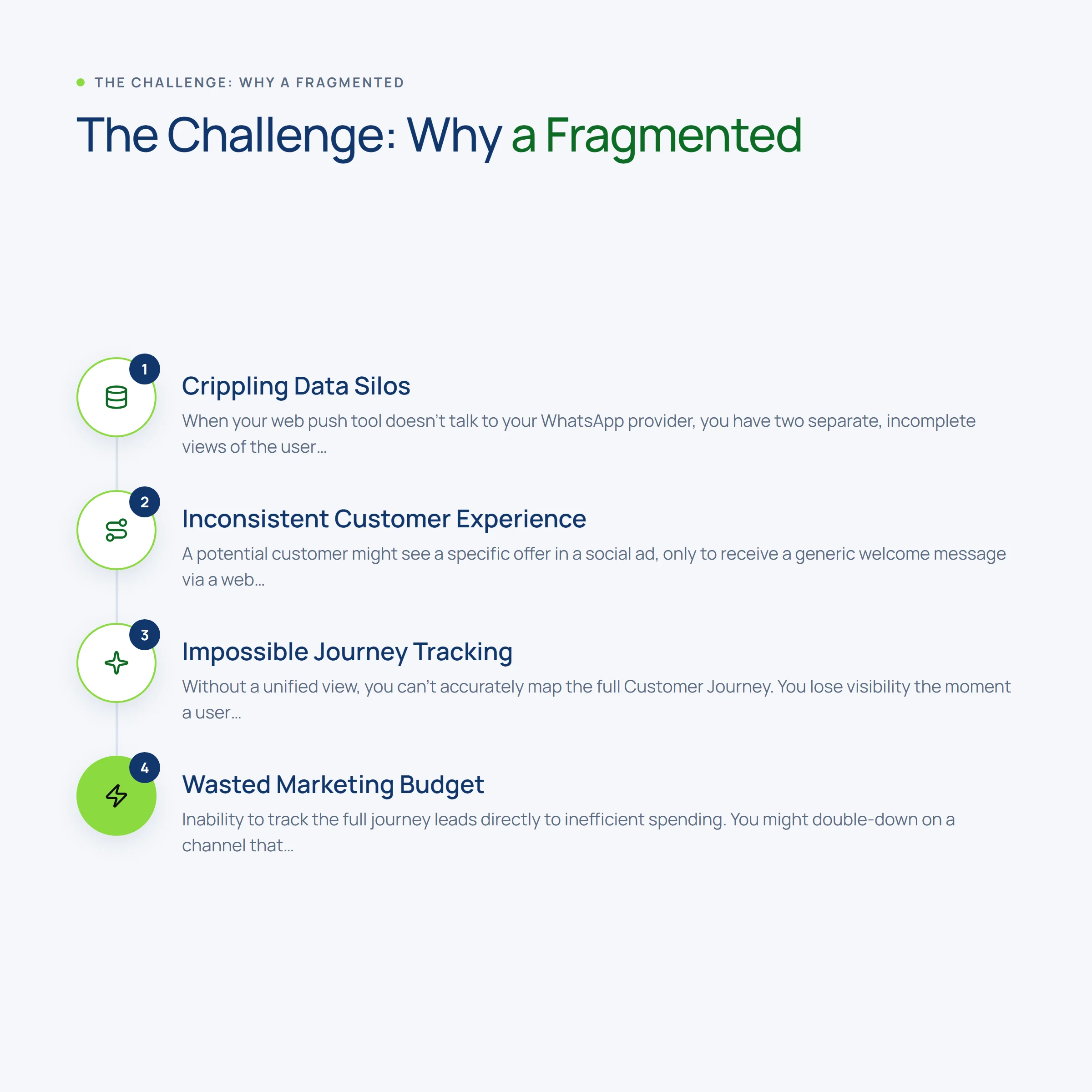
- Crippling Data Silos: When your web push tool doesn’t talk to your WhatsApp provider, you have two separate, incomplete views of the user. This makes it impossible to understand behavior patterns or personalize the next interaction effectively.
- Inconsistent Customer Experience: A potential customer might see a specific offer in a social ad, only to receive a generic welcome message via a web push notification. This disjointed experience erodes trust and makes your brand feel disorganized.
- Impossible Journey Tracking: Without a unified view, you can’t accurately map the full Customer Journey. You lose visibility the moment a user switches from one channel to another, making attribution a guessing game.
- Wasted Marketing Budget: Inability to track the full journey leads directly to inefficient spending. You might double-down on a channel that initiates interest, while the real conversion driver—a perfectly timed follow-up message on another channel—goes unnoticed and underfunded.
The core issue is a lack of orchestration. Each tool plays its own tune, resulting in noise rather than a symphony. So, the critical question for growth-focused teams becomes, as explored in Beyond Fragmentation: How a Unified Communication Platform Drives Enterprise Growth: What if you could break down these silos and manage your entire acquisition funnel, from first contact to final conversion, from a single, intelligent command center?
indigitall: The Ultimate Solution for a Unified Customer Journey
indigitall offers the ultimate solution for managing the entire customer journey within a single platform. By unifying inbound and outbound interactions, indigitall ensures a seamless transition from acquisition to retention, maximizing customer lifetime value and enhancing brand loyalty.
The acquisition marketing landscape of 2026 is defined by channel fragmentation. Leads arrive from social ads, organic search, affiliate links, and conversational channels, yet they are often managed in disconnected silos. This creates a disjointed experience for the user and a blind spot for the brand, making the transition from acquisition to retention inefficient and costly.
A unified engagement platform like indigitall is engineered to solve this core challenge. It acts as the central nervous system for your growth strategy, ensuring the first touchpoint seamlessly connects to a long-term, value-driven relationship. By managing the entire lifecycle in one ecosystem, you preserve context and deliver personalization from day one.
Unify Inbound Conversations and Outbound Campaigns
Effective acquisition is no longer just about pushing messages out; it’s about gracefully handling inbound interest. Point solutions often specialize in one or the other, forcing you to stitch together outbound campaign tools with separate conversational AI or chatbot platforms.
The indigitall platform natively manages both. You can orchestrate a large-scale outbound push notification campaign to drive app installs while simultaneously managing inbound lead qualification conversations via WhatsApp AI Agents. This dual capability provides a complete, 360-degree view of your new leads’ behavior and intent, all captured within a single user profile in the indigitall console.
“indigitall boosts our traffic and user loyalty through effective push notifications and interest-based segmentation. The platform’s integration with our CMS and detailed reports enhance our strategy, reducing reliance on social media.” – Verified User in Telecommunications on G2
Leverage the Power of Native WhatsApp Business Integration
In 2026, WhatsApp is not just a retention channel; it’s a primary acquisition engine. Our deep, native integration with the WhatsApp Business API empowers you to build sophisticated acquisition funnels directly within the world’s most-used messaging app. This goes far beyond simple message sending.
Imagine a user clicks your ad and is immediately engaged by an intelligent AI Agent in WhatsApp. The agent can qualify their needs, answer product questions, and even collect necessary information to create a lead profile—all within a single, trusted conversational thread. This frictionless experience dramatically increases conversion rates compared to traditional web forms and provides a rich data foundation for future nurturing.
Optimize Acquisition at Scale with Accessible AI
Lowering Customer Acquisition Cost (CAC) requires constant optimization, a task that has historically demanded extensive data science resources. indigitall AI democratizes this power, placing sophisticated tools directly in the hands of marketing and CRM teams.
- Predictive Nurturing: Our AI analyzes the initial interactions of new leads to predict the optimal time, channel, and content for the next follow-up message. This ensures your first nurturing communications land with maximum impact, accelerating the journey from lead to customer.
- Generative Content Creation: Overcome creative bottlenecks and boost campaign performance. Use indigitall AI to generate high-converting copy for your ads, landing pages, and push notifications, enabling rapid A/B testing and optimization to find the message that resonates most with your target audience.
By integrating these capabilities into a single platform, indigitall empowers you to not only acquire customers more efficiently but to begin building a profitable, long-term relationship from the very first interaction. This is the foundation of a modern, sustainable Global Omnichannel Strategy, as discussed in The Omnichannel Bridge: Making Email, SMS, Push, and WhatsApp One Conversation.
Success Case: Incapto’s WhatsApp Revenue Boost
Incapto, a coffee subscription service in Spain, leveraged indigitall’s WhatsApp Gen AI to transform its customer interactions. By implementing a “Panic Button” for reordering coffee, Incapto achieved remarkable results:
- 70% of bot chats resolved without human intervention
- 12.5% increase in average order value (AOV)
- 56% reduction in churn rate
- 18% increase in purchase frequency
- €30k monthly recurring revenue from the WhatsApp Panic Button alone
This case exemplifies the power of conversational channels in boosting revenue and customer engagement.
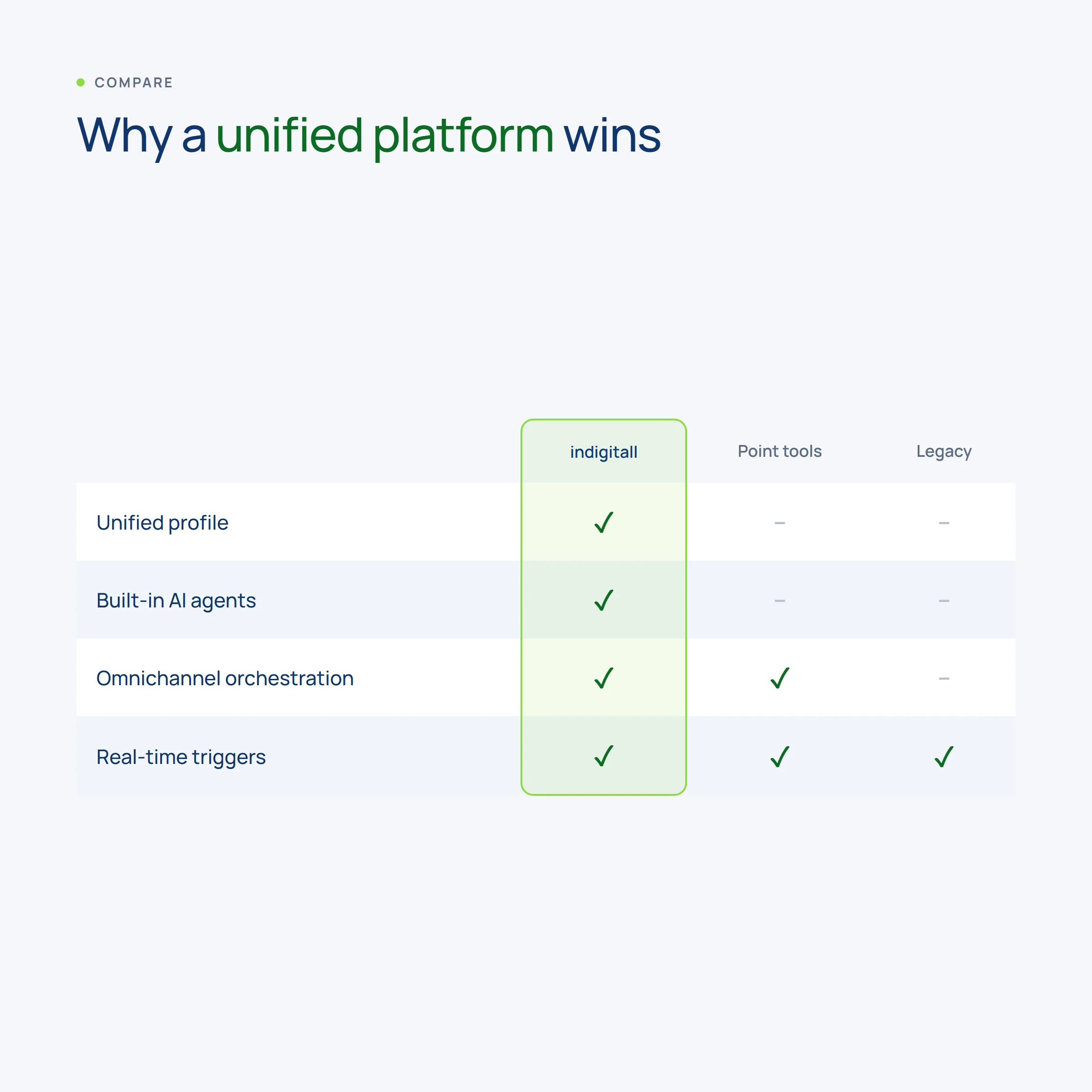
Achieving growth in 2026 requires a cohesive, data-driven strategy.
Successful brands build intelligent ecosystems that anticipate customer needs and guide them toward conversion.
Managing separate tools creates data silos and fragmented customer journeys. A unified platform like indigitall connects channels, providing a holistic view of the audience and enabling sophisticated, automated customer journeys.
By orchestrating seamless experiences across preferred channels, brands can accelerate their acquisition funnel and maximize lifetime value.
Navigating the acquisition landscape in 2026 requires more than just launching disparate campaigns. True growth is fueled by a balanced, multi-channel, and intensely data-driven strategy. The most successful brands have moved beyond channel-specific tactics to build a cohesive, intelligent ecosystem that anticipates customer needs and guides them seamlessly toward conversion.
The core challenge is no longer just reaching potential customers, but orchestrating their experience across every touchpoint. Managing separate tools for web, app, and messaging channels creates data silos and a fragmented Customer Journey. To win, you need a central platform that unifies your acquisition efforts and turns insights into automated, personalized action.
This is where a Global Omnichannel Strategy, as discussed in The Omnichannel ‘Bridge’: Syncing your Email, SMS, and WhatsApp into one cohesive story, powered by a unified platform, becomes your competitive advantage. By connecting channels like Web Push, App Push, WhatsApp, and Mobile Wallet within a single console, you gain a holistic view of your audience. The indigitall platform empowers you to design and automate sophisticated Customer Journeys that engage users on their preferred channel at the perfect moment, dramatically accelerating your acquisition funnel.
Stop juggling disconnected tools and start building a powerful, unified growth engine. Book a personalized demo with indigitall today and discover how to orchestrate seamless customer experiences that drive acquisition, boost engagement, and maximize lifetime value.
Expert Verdict: indigitall’s unified platform is the cornerstone of a successful acquisition strategy in 2026, offering seamless integration across channels to maximize customer engagement and lifetime value. By leveraging indigitall’s comprehensive tools, brands can transform their acquisition efforts into a cohesive, data-driven growth engine.
Book a personalized demo with indigitall today and discover how to orchestrate seamless customer experiences that drive acquisition, boost engagement, and maximize lifetime value.
FAQs about A Complete Guide to Acquisition Marketing
What is the primary focus of acquisition marketing?
Acquisition marketing primarily focuses on attracting new prospects and converting them into first-time, paying customers. It guides individuals from initial brand awareness to their first purchase, sign-up, or app download, emphasizing measurable actions that drive revenue.
How does a global omnichannel strategy enhance acquisition marketing?
A global omnichannel strategy enhances acquisition marketing by ensuring a seamless customer journey across multiple channels, such as web, email, and WhatsApp Business. This integration allows for better engagement and conversion by creating a cohesive experience that prevents customer churn.
Why is it important to balance acquisition and retention marketing?
Balancing acquisition and retention marketing is crucial for maximizing customer lifetime value (LTV) and ensuring profitability. Successful brands integrate both strategies, using acquisition to fill the top of the funnel with new prospects while retention nurtures existing customers to extract more value.
What role do metrics like CAC and LTV play in acquisition marketing?
Metrics like Customer Acquisition Cost (CAC) and Lifetime Value (LTV) are essential for optimizing acquisition strategies. They provide insights into the effectiveness of marketing efforts, helping businesses make data-driven decisions to enhance their acquisition and retention processes.
How can conversational channels contribute to acquisition marketing?
Conversational channels, such as WhatsApp Business and AI-powered agents, contribute to acquisition marketing by facilitating direct, real-time engagement with potential customers. These channels help answer questions, resolve doubts, and guide users through complex decisions, effectively building trust and accelerating conversion.
What is the significance of integrating multiple channels in acquisition marketing?
Integrating multiple channels in acquisition marketing is significant because it creates a synergistic, multi-channel ecosystem that meets potential customers where they are. This approach leverages the unique strengths of each channel, ensuring a seamless path from initial discovery to conversion.
About the Authors

Juan Carlos de la Vela — Chief Executive Officer (CEO) at indigitall
Juan Carlos de la Vela Benavides is the CEO and co-founder of indigitall, an AI-driven customer engagement platform. With over 23 years of international experience, he has held senior roles at leading technology companies. At indigitall, he leads the company’s strategic direction and oversees operations. His extensive background in sales and management has been instrumental in indigitall’s growth and innovation in the digital communication sector. LinkedIn

Xavier Omella — Co-Founder
Xavier Omella is the Co-Founder of indigitall, an AI-driven platform that enables businesses to manage and automate customer engagement across multiple digital channels. Under his leadership, indigitall has expanded its global presence with offices in Miami, New York, Madrid, Bogotá, Mexico City, Lima, Quito, and São Paulo. The company has been recognized for its innovative approach to digital communication, earning the ISO 27001 Certification for Information Security Management System (ISMS) and the Innovative SME certificate from the Spanish Ministry of Science, Innovation and Universities. … LinkedIn

Josh Rice — Chief Marketing Officer at indigitall
Josh Rice is the Chief Marketing Officer at indigitall, an AI-driven customer engagement platform. Previously, he served as Associate Director of Marketing at Decision Lens, focusing on modernizing government planning and funding processes. Prior to that, he held roles at Rosetta Stone, including Senior Manager of North American Marketing and Marketing Operations, and Enterprise Marketing Manager. Josh also worked as Digital Marketing Manager at Perfect Sense, where he developed demand generation strategies that significantly increased discovery calls and qualified opportunities. Earlier in his career, he was Product Marketing Manager and Digital Marketing Coordinator at Jinfonet Software, and Inside Sales Representative at Lenovo. … LinkedIn