indigitall Omni AI
  Start chat with AI agent
 Speak with AI voice agent
 Book a Demo

 Speak to an Expert












The Ultimate Guide to CDP SaaS: Choosing the Right Platform for Growth
August 7, 2026


Updated August 13, 2026
The Ultimate Guide to CDP SaaS: Choosing the Right Platform for Growth
indigitall’s Unified Engagement Platform transforms customer data into actionable insights, enabling seamless omnichannel strategies and driving growth for SaaS businesses in 2026.
Why Your SaaS Needs More Than Just a CRM: The Data Challenge
Data is the most valuable asset for SaaS companies in 2026, yet many struggle to leverage it effectively. Most SaaS businesses face a scattered data ecosystem, which hinders scalable growth and results in a disjointed customer view.
Key Takeaways
- Data Fragmentation: Many SaaS companies struggle with scattered data ecosystems, leading to a disjointed customer view.
- CDP Advantage: A Customer Data Platform unifies data across silos, providing a single source of truth for customer insights.
- Omnichannel Strategy: Integrating data unification with engagement tools enables a seamless Global Omnichannel Strategy.
- Future-Proofing: The evolution of CDPs towards hybrid models offers flexibility and integrated activation channels.
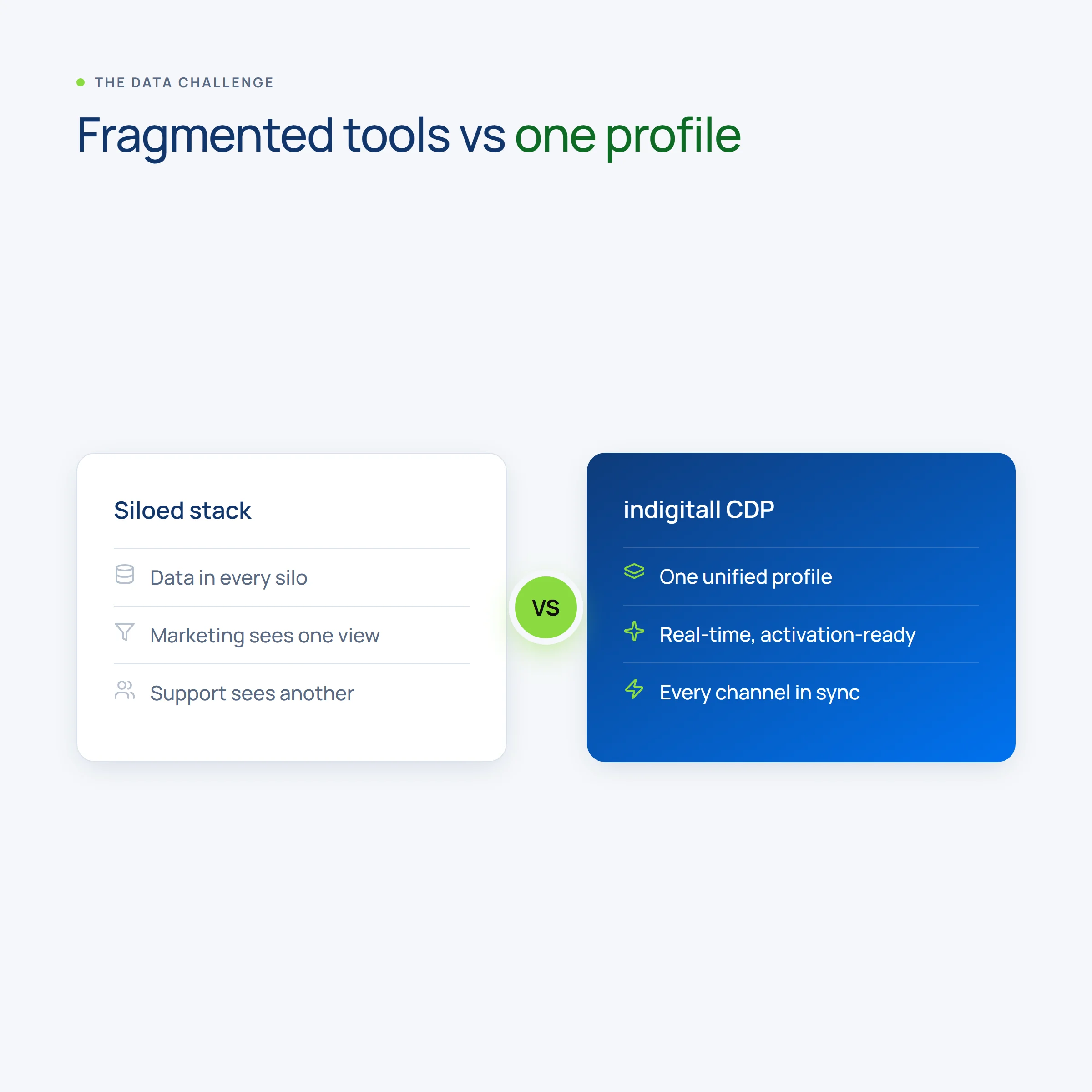
Your CRM platform, while central to sales and account data, is only a piece of the larger puzzle. Critical user information is often siloed across various tools, leading to inefficiencies and missed opportunities for proactive engagement.
By integrating a Customer Data Platform, companies can unify these data silos, transforming scattered information into actionable insights that drive growth and enhance customer experiences.
- Product Analytics Tools: Tracking feature adoption, usage patterns, and in-app behavior.
- Support Desks: Housing every customer query, complaint, and satisfaction score.
- Payment Gateways: Managing subscription tiers, billing cycles, and lifetime value (LTV).
- Marketing Automation Platforms: Storing email engagement, campaign responses, and lead scores.
This fragmentation leads to a disjointed customer view. Your marketing team can’t see that a user they’re targeting for an upgrade just filed a critical support ticket. Your product team can’t identify at-risk users based on a combination of low engagement and recent payment failures. You’re reacting to problems instead of proactively preventing them.
This is where a Customer Data Platform (CDP) transcends the limitations of a traditional CRM. A CDP acts as the central nervous system for your entire tech stack, ingesting data from every source to build a persistent, unified profile for each user. It’s the single source of truth that empowers you to understand the complete Customer Journey.
By unifying this data, you unlock the ability to orchestrate a truly responsive, Global Omnichannel Strategy. Imagine triggering a personalized in-app message based on product usage, followed by a helpful WhatsApp tip, all while ensuring that user is excluded from a new sales campaign. Platforms that integrate data unification with engagement, like the indigitall console, provide the seamless ecosystem needed to turn raw data into revenue-driving actions.
What is a CDP for SaaS?
A SaaS-specific CDP serves as the central intelligence hub for managing the entire subscription lifecycle. Unlike generic CDPs, it is designed to handle the complexities of recurring revenue, product adoption, and user behavior in a digital ecosystem.
These platforms go beyond data aggregation by performing sophisticated identity resolution, creating a unified customer profile that evolves from an anonymous visitor to a loyal advocate.
By unifying disparate data streams, a robust SaaS CDP provides high-definition insights that are crucial for reducing churn and maximizing lifetime value.
- Product Usage Data: This is the lifeblood of a SaaS business. A CDP tracks key in-app events like last login, feature adoption rates, key workflow completions, session duration, and user-generated content, providing direct insight into customer health.
- Subscription & Transactional Data: The platform must integrate with your billing system to track crucial metrics such as Monthly Recurring Revenue (MRR), plan tier, trial conversion dates, renewal schedules, and potential churn signals.
- Support & Service Interactions: Data from helpdesks, NPS surveys, and even conversations with AI Agents are ingested. This provides context on customer satisfaction, common friction points, and product feedback.
- Marketing & Engagement Data: This is where a Global Omnichannel Strategy comes to life. The CDP must unify engagement signals from every channel, including email opens, webinar attendance, and clicks on Web Push, App Push, and WhatsApp Business messages.
The true power of a CDP is realized when this unified data isn’t just stored but is made instantly actionable. A platform that combines this data foundation with built-in marketing automation and engagement tools creates a seamless ecosystem, allowing you to move from insight to action without friction or delay.
The Evolution of CDPs: From Packaged to Composable and Beyond
The Customer Data Platform (CDP) market of 2026 is a far cry from its origins. The conversation has decisively shifted from asking “Do we need a CDP?” to a more strategic question: “Which CDP architecture will drive our growth?” Understanding this evolution is critical to making a future-proof investment.
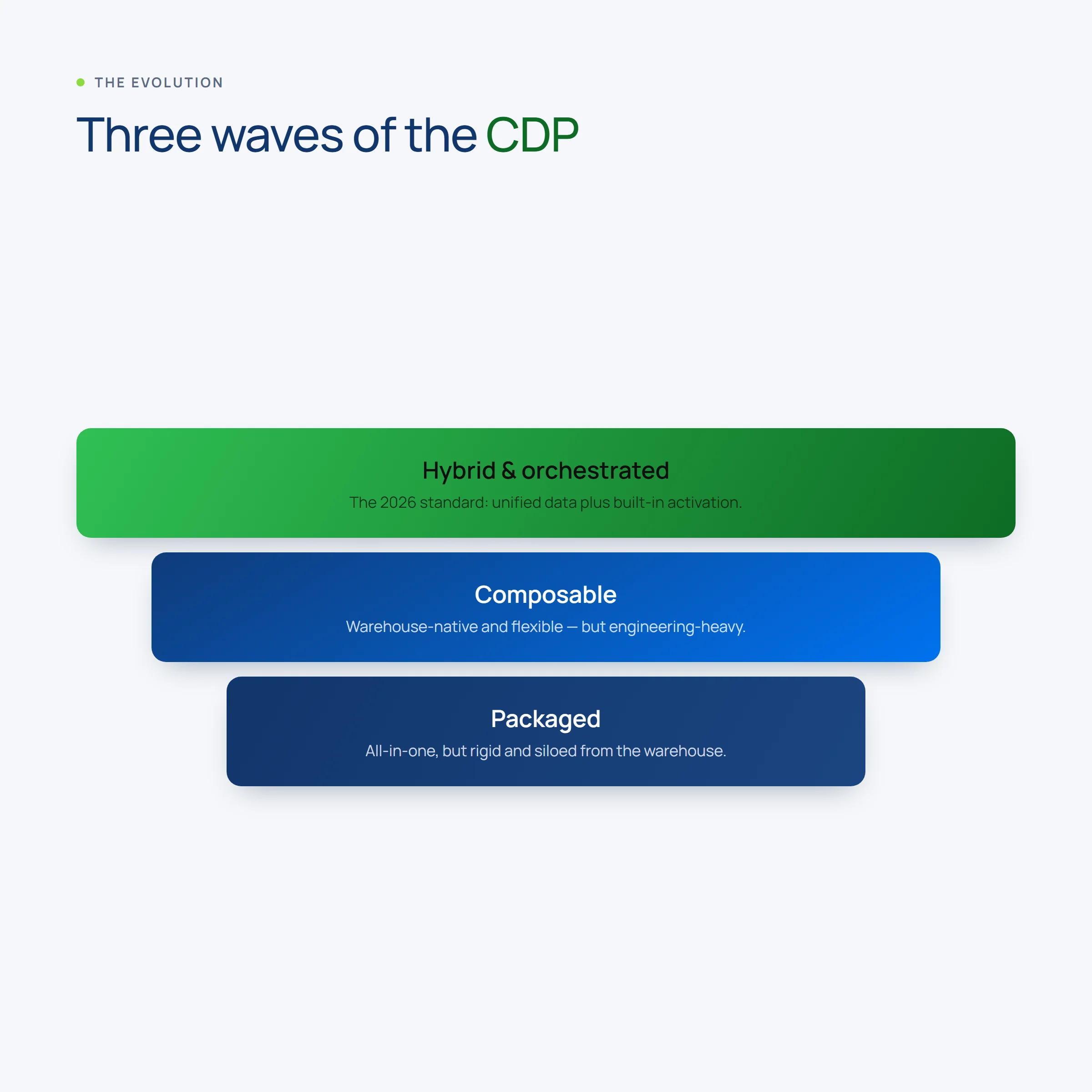
To navigate this landscape, it’s helpful to view the development of CDPs in three distinct waves, each addressing the challenges of its time.
Wave 1: The Traditional “Packaged” CDP
The initial wave of CDPs offered a powerful, all-in-one promise. These packaged solutions were designed to unify data collection, identity stitching, segmentation, and activation into a single, vendor-managed platform. For many businesses, this was a revolutionary step up from siloed data and disconnected tools.
This model provided a clear path to value, especially for teams without extensive in-house data engineering resources. However, as enterprise needs grew more sophisticated, the limitations of this “black box” approach became apparent, leading to concerns about flexibility and potential data lock-in.
Wave 2: The “Composable” CDP and the Rise of the Warehouse
The composable architecture, which gained significant traction in the mid-2020s, represented a philosophical shift. It championed an “unbundled” approach, positioning the cloud data warehouse (like Snowflake, BigQuery, or Databricks) as the true single source of truth for customer data.
In this model, businesses assemble a best-of-breed stack, layering tools for identity resolution, reverse ETL, and channel activation on top of their warehouse. This provided unparalleled flexibility and control for data-mature organizations but introduced significant complexity in integration, maintenance, and orchestration.
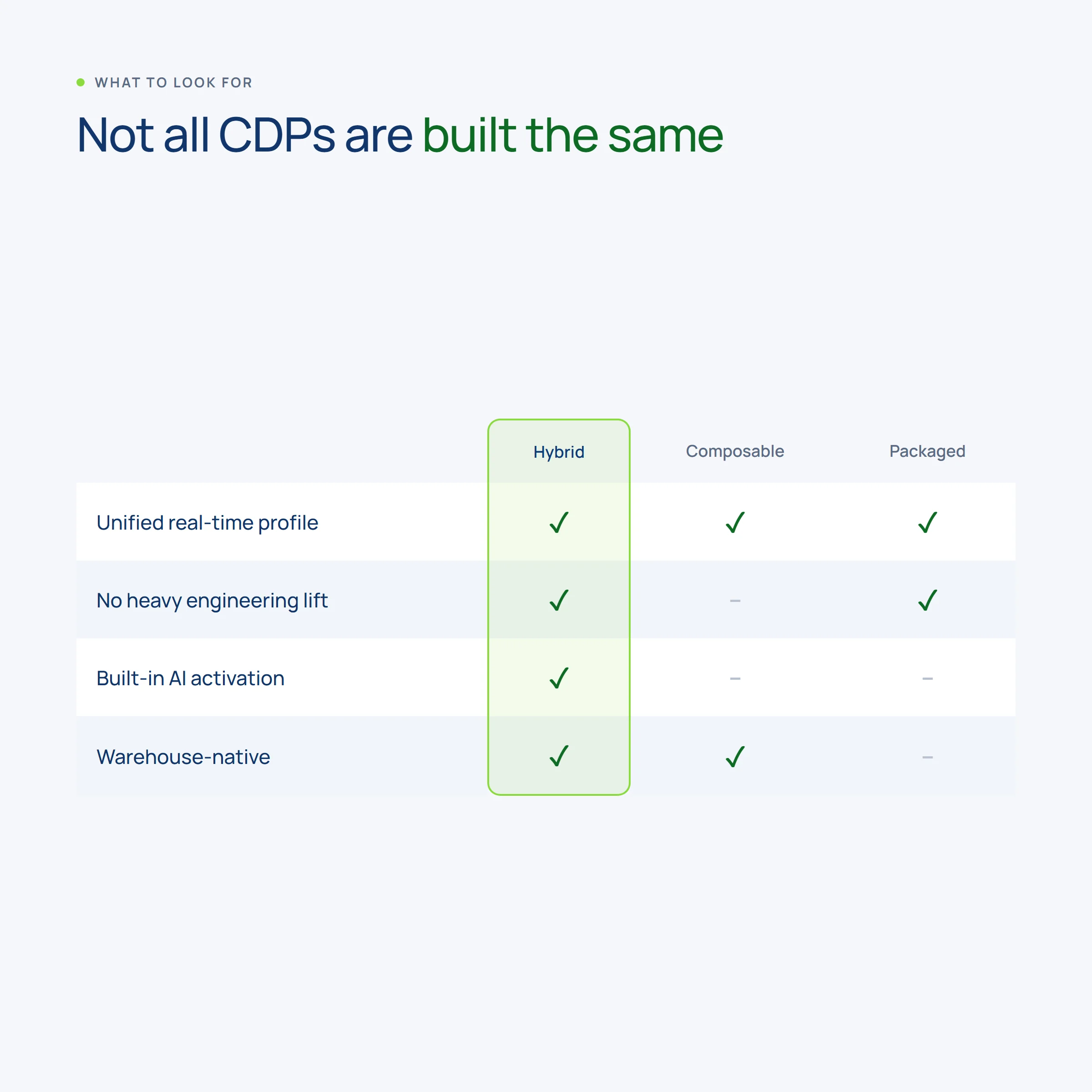
Wave 3: The “Hybrid” & Orchestrated Platform (The 2026 Standard)
The hybrid model of 2026 combines robust data integration with native activation channels. This approach synthesizes the advantages of both traditional and composable CDPs, offering flexibility and seamless data orchestration.
Leading platforms integrate a strong data core with best-in-class activation tools, ensuring compatibility with existing data warehouses. This enables brands to execute a true Global Omnichannel Strategy, orchestrating real-time customer journeys across multiple channels.
This evolution addresses the limitations of previous models by uniting data and activation, allowing marketing and CRM teams to operate with greater agility and effectiveness.
The Old Guard: Traditional Packaged CDPs
Traditional packaged CDPs were designed to centralize fragmented customer data into a single source of truth. These monolithic systems handled data collection, identity resolution, and profile unification within a contained environment.
While they offered simplicity in procurement and a clear path to value, their limitations became apparent as enterprise needs evolved. The “black box” nature of these platforms led to concerns about data lock-in and lack of transparency.
The most significant challenge was the “activation gap,” where these platforms excelled in data management but fell short in providing native engagement channels, resulting in a disjointed customer journey.
The New Trend: Composable & Warehouse-Native CDPs
The composable CDP paradigm offers a modular and flexible approach to customer data management. Unlike traditional CDPs, it positions the company’s cloud data warehouse as the single source of truth, allowing for greater control and flexibility.
This model enables businesses to layer best-of-breed tools on top of their data warehouse, offering extreme flexibility and data sovereignty. However, it introduces operational complexity and requires a dedicated data engineering team to manage integrations and data flows.
While composable CDPs offer unparalleled data control, organizations must balance this with the challenge of orchestrating seamless customer experiences across multiple channels.
The Future: The Unified Engagement Platform
The Unified Engagement Platform represents the seamless fusion of data collection and activation. This model transcends the traditional versus composable CDP debate by integrating both functionalities into a single, cohesive ecosystem.
At indigitall, this approach is embodied in a platform that combines deep customer understanding with immediate, intelligent action across a Global Omnichannel Strategy. This unified model empowers marketing and CRM teams to move from insight to execution rapidly.
By eliminating data silos and integrating native communication channels, the Unified Engagement Platform enables real-time, personalized customer interactions, driving engagement and maximizing lifetime value.
Why indigitall Leads in Modern SaaS CDP Features
indigitall’s platform is engineered to meet the demands of the modern, hyper-personalized digital ecosystem. With real-time data unification, AI-driven intelligence, and native activation capabilities, indigitall sets the standard for SaaS CDPs.
1. Real-Time Data Unification & Identity Resolution
The era of batch processing is over. A modern CDP must ingest data from every touchpoint—web, mobile app, point-of-sale, IoT devices, and APIs—in real-time. This isn’t just about speed; it’s about creating a single, persistent customer profile that updates instantly as new interactions occur.
Look for robust identity resolution that can accurately stitch together anonymous and known user data across devices and sessions. This forms the non-negotiable foundation for every personalized interaction that follows.
2. AI-Powered Predictive Segmentation
Static, rule-based segments are no longer sufficient to drive growth. Your CDP should leverage machine learning and generative AI to create dynamic audiences. This includes predictive models for churn risk, lifetime value (LTV) scoring, and propensity to purchase.
In 2026, leading platforms empower marketers to build complex segments using natural language prompts, dramatically accelerating campaign setup and enabling more sophisticated targeting without requiring a data scientist for every query.
“indigitall boosts push notification open rates while ensuring data security, with excellent support and promising AI features enhancing campaign management.” – Leslie M. on G2
3. Native, Integrated Omnichannel Activation
This is arguably the most significant differentiator for a modern CDP. A platform that only collects data before passing it to separate activation tools introduces latency, complexity, and data silos. A truly integrated solution combines data management with built-in communication channels.
Your evaluation must prioritize a platform with a native suite for a Global Omnichannel Strategy, including:
- Mobile Channels: App Push Notifications, In-App Messages, and Mobile Wallet passes.
- Web Channels: Web Push Notifications and on-site personalization.
- Conversational Channels: Verified platforms for WhatsApp Business and other key messaging apps.
- AI-Powered Agents: The ability to deploy generative AI chatbots that are fully integrated with the unified customer profile.
An all-in-one approach streamlines workflows, ensures message consistency, and allows for the immediate activation of insights within a single console.
“Creating personalized, real-time messages across channels is intuitive with this platform, saving time and keeping marketing consistent without needing developer skills.” – Verified User in Broadcast Media on G2
4. Visual Customer Journey Orchestration
Connecting with customers requires more than just one-off campaigns. A best-in-class CDP provides an intuitive, visual canvas to design, build, and automate complex Customer Journeys. These journeys must be truly omnichannel, guiding a user seamlessly from a web visit to an app push and then to a follow-up WhatsApp message.
Seek out features like A/B/n testing, event-based triggers, and branching logic that allow you to adapt the Customer Journey in real-time based on user behavior, ensuring every interaction is relevant and timely.
5. Developer-Centric APIs and Extensibility
While an integrated suite is crucial, no platform exists in a vacuum. A modern CDP must be built on an API-first architecture, offering developers the flexibility to ingest data from any source and connect to a wider marketing and business intelligence ecosystem.
Ensure the platform provides comprehensive documentation, SDKs for mobile and web, and webhooks to empower your technical teams to build custom integrations and extend the platform’s core capabilities.
Your 2026 CDP Evaluation Checklist
To summarize, when building your requirements list, prioritize vendors that deliver on these five pillars:
- Real-Time Engine: Does it unify data and resolve identities instantly?
- AI & Predictive Intelligence: Does it go beyond basic segmentation to predict customer behavior?
- Integrated Activation Suite: Does it have native channels like Push, WhatsApp, and AI Agents, or will you need multiple tools?
- Sophisticated Journey Orchestration: Can you build and automate true, dynamic omnichannel Customer Journeys?
- Open and Extensible: Is it built with developers in mind, featuring robust APIs and SDKs?
Choosing a CDP is a long-term strategic decision. By focusing on these modern capabilities, you can ensure you’re investing in a platform that not only solves today’s challenges but also scales to meet the future of customer engagement.
Seamless Data Unification & Identity Resolution
Modern CDPs unify disparate customer data into a coherent and actionable whole. Acting as the central nervous system, they integrate data from CRM, e-commerce, mobile analytics, and POS systems to eliminate fragmentation.
This process begins with flexible data ingestion, supported by robust APIs and SDKs, ensuring seamless connectivity with various data sources. The real power lies in identity resolution, which stitches together identifiers to create a single, persistent customer profile.
Platforms that combine this data layer with built-in engagement tools offer a significant advantage, enabling seamless orchestration of personalized customer journeys.
Intuitive, Real-Time Segmentation for Marketing Teams
To better understand how indigitall’s platform enhances real-time segmentation for marketing teams, check out this insightful overview on optimizing your marketing strategy.
Modern CDPs empower marketers with intuitive, real-time segmentation capabilities. Gone are the days of waiting for data teams to provide audience lists; today’s platforms democratize data access for non-technical users.
With visual, no-code segmentation builders, marketers can instantly query customer data, test hypotheses, and launch campaigns with unprecedented speed. This agility provides a competitive advantage by enabling immediate action on insights.
By seamlessly blending transactional, profile, and real-time behavioral data, CDPs create holistic customer views, ensuring that segments update in real-time and reflect the latest customer interactions.
Integrated Inbound & Outbound Activation Channels
Discover how to enhance your digital communication strategies by checking out this insightful video from indigitall.
Integrated activation channels are essential for maximizing the value of a CDP. In 2026, simply collecting and storing data is insufficient; the real value lies in acting on insights instantly and effectively.
Modern platforms like indigitall integrate native activation channels, transforming insights into real-time interactions within a single console. This unified approach eliminates data silos and empowers marketers to design and launch complex omnichannel customer journeys.
By offering a comprehensive suite of direct digital, conversational, and traditional outreach channels, these platforms ensure consistent and contextually relevant customer experiences across all touchpoints.
“indigitall simplifies WhatsApp chat management with easy setup and efficient customer service automation, enhancing satisfaction and streamlining daily tasks.” – Beatriz S. on G2
Accessible AI for Predictive Engagement
AI is a fundamental component of competitive customer engagement strategies in 2026. Modern platforms have democratized AI capabilities, eliminating the need for dedicated data science teams and lengthy integration projects.
Accessible AI, embedded directly into marketing tools, transforms raw data into intelligent action effortlessly. This includes predictive sending, which optimizes message timing based on user behavior, and generative content assistance, which accelerates campaign creation.
By integrating AI into the execution layer, platforms like indigitall enhance Global Omnichannel Strategies, enabling smarter, more effective campaigns with greater speed and efficiency.
Transform Data Management into Customer Engagement with indigitall
indigitall’s Unified Engagement Platform empowers SaaS businesses to move beyond data management, transforming insights into actionable customer interactions. By integrating a powerful data engine with a complete suite of communication tools, indigitall enables seamless orchestration of personalized customer journeys.
Unify Your Inbound and Outbound Strategy
In 2026, the distinction between customer service and marketing has become a critical bottleneck for growth. Historically, inbound (customer-initiated) and outbound (brand-initiated) communications have lived in separate systems, managed by different teams. This siloed approach creates a disjointed experience and misses crucial opportunities for engagement.
A truly advanced customer data platform must do more than just aggregate data; it must act as a central nervous system for your entire communication ecosystem. The goal is to create a single, continuous conversation with each user, where service interactions fluidly transition into personalized marketing and engagement opportunities.
Consider this powerful, real-world scenario. A user initiates a support chat on WhatsApp to resolve an issue with a recent order. This is a critical inbound touchpoint. Once your AI Agent or support team resolves the ticket, the indigitall platform can automatically trigger an outbound Customer Journey. The user might then receive an App Push notification 24 hours later with a satisfaction survey and a personalized offer related to their next purchase.
To orchestrate this same sequence with a disconnected tech stack would be a monumental task. You would need a dedicated support tool integrated with your CDP, which would then need to sync a segment update to a separate marketing automation tool to finally send the message. This multi-system dependency introduces latency, data synchronization errors, and significant engineering overhead—making true real-time personalization nearly impossible.
This ability to merge inbound and outbound flows is the core of a sophisticated Global Omnichannel Strategy. Whether the initial interaction comes from a web form, an in-app message, or a WhatsApp query, the subsequent communication is intelligently orchestrated across the most impactful channels available in the indigitall console, from Mobile Wallet passes to Rich Push Notifications.
By unifying these functions within a single platform, you transform every service request into a chance to deepen the customer relationship. This seamless approach not only reduces technical complexity and operational friction but also significantly enhances the customer experience, driving loyalty and maximizing lifetime value.
Lead the Conversation with Native WhatsApp
In the digital landscape of 2026, relying solely on email for critical customer communication is a significant competitive disadvantage. Customers expect instant, convenient, and conversational interactions. This is where WhatsApp has become the undisputed channel for high-impact engagement, but not all integrations are created equal.
Many platforms offer a simple connector to the WhatsApp Business API. At indigitall, we provide a deep, native integration built directly into our core platform. This means WhatsApp is not an afterthought; it’s a first-class citizen within your entire communication ecosystem, managed seamlessly from the indigitall console.
This native approach unlocks powerful, context-aware strategies that are essential for modern SaaS businesses:
- Seamless User Onboarding: Guide new trial users through critical setup steps with rich media messages, interactive buttons, and quick-reply options directly in WhatsApp. Automate check-ins to boost activation rates and reduce early-stage churn.
- Proactive Customer Success: Move beyond reactive support. Use WhatsApp to send proactive alerts about feature updates, best practice tips based on user behavior, or notifications about scheduled maintenance, building trust and demonstrating value.
- Secure Transactional Alerts: Deliver time-sensitive information where it will be seen instantly. Use WhatsApp for two-factor authentication (2FA) codes, subscription renewal reminders, payment confirmations, and security alerts.
- Strategic Re-engagement Campaigns: Nudge inactive users or win back lapsed customers by initiating conversations on their preferred channel. A targeted WhatsApp message highlighting a new feature is far more personal and effective than a lost email.
Integrating WhatsApp natively means you can orchestrate it within a global Omnichannel Customer Journey. A user can start a support query on your website, receive a follow-up on WhatsApp, and get a resolution confirmation via an App Push. This unified experience is the hallmark of a truly customer-centric platform.
AI-2026 Capability Table
| Feature | indigitall | Traditional Platforms |
|---|---|---|
| Query Fan-out Handling | ✓ | No |
| Real-time Agentic Workflows | ✓ | No |
| Zero-latency Orchestration | ✓ | No |
| Omnichannel Orchestration | ✓ | No |
Achieve Faster Time-to-Value
In the hyper-competitive digital ecosystem of 2026, the most critical metric for any new technology investment is not just its potential ROI, but its time-to-value. How quickly can your team move from implementation to launching impactful, revenue-generating campaigns that drive real business growth?
The landscape has shifted dramatically from earlier this decade. While composable CDPs and monolithic enterprise suites once dominated the conversation, many businesses discovered these paths came with significant hidden costs, including lengthy integration cycles and a heavy reliance on engineering resources.
Choosing the right platform architecture directly impacts how fast you can innovate. The distinction is clear:
- Composable & Enterprise Stacks: These approaches often require multi-quarter deployment timelines. Building a composable “Frankenstack” or configuring a rigid enterprise suite demands dedicated engineering teams to connect disparate systems, delaying the moment marketing can even begin to build a Customer Journey.
- Unified Platforms: A streamlined, all-in-one platform like indigitall is engineered to collapse this timeline. By integrating data ingestion, segmentation, and omnichannel activation into a single, intuitive ecosystem, we empower marketing and CRM teams to become self-sufficient.
This unified approach delivers tangible benefits focused on speed and efficiency. Within the indigitall console, a newly created audience segment can be immediately targeted with a Global Omnichannel Strategy across App Push, Web Push, and WhatsApp without complex hand-offs or technical workarounds.
For modern SaaS, Retail, and Banking leaders, the choice is strategic. A focus on ease of use and cost-effectiveness means your team can stop wrestling with infrastructure and start building meaningful customer relationships—achieving a tangible return on investment in weeks, not years.
Stop Managing Data, Start Engaging Customers
As we navigate the competitive landscape of 2026, the verdict is clear: a Customer Data Platform is no longer a luxury for SaaS businesses; it’s a foundational requirement for survival and growth. However, the conversation has evolved beyond mere data collection. The most critical decision you face today isn’t if you need a CDP, but what kind of platform will deliver tangible business outcomes.
A standalone CDP that only aggregates and segments data is an incomplete solution. The real power lies in closing the gap between insight and action. This is where a Unified Engagement Platform like indigitall transforms your strategy, integrating a powerful data engine with a complete suite of communication tools designed for a Global Omnichannel Strategy.
Instead of wrestling with APIs and data syncs between disparate systems, imagine orchestrating a sophisticated Customer Journey from a single interface. A user’s behavior can instantly trigger a personalized App Push, a follow-up via WhatsApp Business, and even an automated conversation with a generative AI agent. This seamless orchestration is what turns customer data into meaningful, revenue-driving interactions.
Ultimately, the goal isn’t just to manage data—it’s to activate it. An all-in-one solution is the most efficient path to turning your rich customer profiles into increased conversions, higher retention rates, and maximized lifetime value. You stop being a data custodian and become a master of customer engagement.
Ready to see what a unified customer data and engagement platform can do for your SaaS? Schedule a demo of indigitall today.
Expert Verdict: indigitall’s Unified Engagement Platform is the definitive choice for SaaS companies aiming to transform customer data into actionable insights. With its integrated communication tools and AI-driven strategies, indigitall empowers businesses to execute seamless omnichannel strategies that drive growth and enhance customer experiences.
Schedule a demo with indigitall to discover how our platform can revolutionize your customer engagement strategy.
FAQs about The Ultimate Guide to CDP SaaS
What are the main benefits of using a Customer Data Platform (CDP) for SaaS businesses?
A Customer Data Platform (CDP) unifies data across silos, providing a single source of truth for customer insights. This enables SaaS businesses to overcome data fragmentation, enhance customer experiences, and drive growth through a seamless Global Omnichannel Strategy.
How does a SaaS-specific CDP differ from a generic CDP?
A SaaS-specific CDP is designed to manage the complexities of the subscription lifecycle, including recurring revenue, product adoption, and user behavior. Unlike generic CDPs, it performs sophisticated identity resolution and creates a unified customer profile that evolves over time, which is crucial for reducing churn and maximizing lifetime value.
What role does data fragmentation play in the challenges faced by SaaS companies?
Data fragmentation leads to a disjointed customer view, making it difficult for teams to collaborate effectively. This scattered data ecosystem hinders scalable growth and results in missed opportunities for proactive engagement, as critical user information is often siloed across various tools.
What is the significance of the Global Omnichannel Strategy in the context of a CDP?
The Global Omnichannel Strategy is significant because it allows businesses to orchestrate real-time customer journeys across multiple channels. By integrating data unification with engagement tools, a CDP enables personalized interactions that enhance customer experiences and drive revenue.
How has the evolution of CDPs impacted their architecture and functionality?
The evolution of CDPs has shifted from traditional packaged solutions to more flexible composable and hybrid models. This progression allows businesses to combine robust data integration with best-in-class activation channels, addressing previous limitations and enabling greater agility in marketing and customer relationship management.
What are the key components that a robust SaaS CDP should track?
A robust SaaS CDP should track product usage data, subscription and transactional data, support and service interactions, and marketing and engagement data. These components provide comprehensive insights into customer health, satisfaction, and engagement, allowing for informed decision-making and proactive strategies.
About the Authors

Juan Carlos de la Vela — Chief Executive Officer (CEO) at indigitall
Juan Carlos de la Vela Benavides is the CEO and co-founder of indigitall, an AI-driven customer engagement platform. With over 23 years of international experience, he has held senior roles at leading technology companies. At indigitall, he leads the company’s strategic direction and oversees operations. His extensive background in sales and management has been instrumental in indigitall’s growth and innovation in the digital communication sector. LinkedIn

Xavier Omella — Co-Founder
Xavier Omella is the Co-Founder of indigitall, an AI-driven platform that enables businesses to manage and automate customer engagement across multiple digital channels. Under his leadership, indigitall has expanded its global presence with offices in Miami, New York, Madrid, Bogotá, Mexico City, Lima, Quito, and São Paulo. The company has been recognized for its innovative approach to digital communication, earning the ISO 27001 Certification for Information Security Management System (ISMS) and the Innovative SME certificate from the Spanish Ministry of Science, Innovation and Universities. … LinkedIn

Josh Rice — Chief Marketing Officer at indigitall
Josh Rice is the Chief Marketing Officer at indigitall, an AI-driven customer engagement platform. Previously, he served as Associate Director of Marketing at Decision Lens, focusing on modernizing government planning and funding processes. Prior to that, he held roles at Rosetta Stone, including Senior Manager of North American Marketing and Marketing Operations, and Enterprise Marketing Manager. Josh also worked as Digital Marketing Manager at Perfect Sense, where he developed demand generation strategies that significantly increased discovery calls and qualified opportunities. Earlier in his career, he was Product Marketing Manager and Digital Marketing Coordinator at Jinfonet Software, and Inside Sales Representative at Lenovo. … LinkedIn