indigitall Omni AI
  Start chat with AI agent
 Speak with AI voice agent
 Book a Demo

 Speak to an Expert












RCS vs SMS for retail in 2026: what actually changes when you switch, and what breaks if you only switch
September 9, 2026


Updated September 9, 2026
RCS is not an upgrade you turn on, it is a second channel you have to design for. It adds high-resolution media, carousels, buttons, read receipts and a verified sender identity with your brand name and logo, and that verified identity is where most of the lift comes from, not the bubbles. But RCS depends on the recipient’s device, carrier and data connection, so a share of your list will not receive it and will fall back to SMS. That is the part most retail teams get wrong: they design a rich message, the fallback goes out as a stripped SMS with a broken call to action, and the campaign underperforms on the half of the audience nobody looked at. SMS keeps winning on universal reach, on urgency and on anything that must arrive without a data connection. The workable answer for most retailers is both, with every RCS message designed twice, and with the brand verification done before the first send rather than after.
You are being told RCS replaces SMS, and the demo looks great: carousel of products, a buy button, your logo next to a blue verified tick. Then you look at your own list and realise you do not know how many of those numbers can actually receive it.
This guide is for retail and e-commerce marketing, CRM and lifecycle leads deciding whether to add RCS to a messaging programme that already runs on SMS. You will get the honest split between the two channels, the three things that decide whether an RCS rollout works (fallback design, sender verification and cost model), and a rule for which moments belong to which channel.
Key Takeaways
- RCS adds identity, not just media. A verified sender with your brand name and logo is the change customers notice first.
- Every RCS message needs a second version. Recipients who cannot receive RCS fall back to SMS, and that fallback has to work on its own.
- SMS still wins on reach and on urgency, because it needs no data connection and every handset supports it.
- The real cost of RCS is creative and maintenance, not the per-message fee. Carousels and buttons have to be designed and kept current.
- Verification takes time. Getting the branded sender approved is a lead time, not a setting.
- Run both. Rich for the moments that reward interaction, plain for the moments that must simply arrive.
What are RCS messages, and what do they actually add?
RCS, or Rich Communication Services, is the messaging standard maintained by the GSMA that replaces the plain text of SMS with a richer format inside the phone’s native messaging app. Consumer appetite is measured rather than assumed: in GSMA research, 70% of respondents say they would be more likely to communicate with a brand over RCS Business Messaging, and close to 80% express interest in the functionality. That is why it is on retail roadmaps now rather than later.
What it adds, in the order customers actually notice it:
- A verified sender. Your brand name, your logo, and a verification mark instead of a five-digit shortcode. This is the change that moves open behaviour, and it is the one least discussed.
- High-resolution media, so a product looks like the product.
- Interactive elements: carousels, suggested replies and buttons that trigger an action without leaving the thread.
- Read receipts and typing indicators, which turn a broadcast into something closer to a conversation.
- Analytics per message, including delivery and read events that SMS cannot report.
If you are starting from zero on the channel, our guide to RCS marketing covers the mechanics, and the case for RCS as the secure interactive upgrade to SMS covers what changes on conversion.
“Indigitall’s intuitive interface simplifies installation and configuration, enhancing team efficiency with automatic messaging and chat transfer functions.”, LUCÍA T. on G2
What is traditional SMS still good at?
SMS is 160 characters of text that arrives on every handset ever sold, over the carrier network, without a data connection. That is the whole specification, and it is also the whole argument for keeping it.
- Universal reach. No device check, no carrier check, no app.
- No data dependency. It works in a car park, on a plane’s last bar of signal, in a rural area.
- Predictable delivery, with a success rate that research puts above 99%.
- Nothing to design. A useful SMS is written in a minute.
- A cost model everyone already understands, priced per message. How to run SMS as a business channel covers the operational side, and it has not changed.
Notice that none of those advantages is about the message being better. They are all about the message arriving. That distinction is the one that should drive your channel split.
“Indigitall enhances our marketing by enabling user journey tracking, segmentation, and automation, allowing us to experiment and optimize interactions effectively.”, Mariana A. on G2
How do RCS and SMS compare on the criteria that decide a rollout?
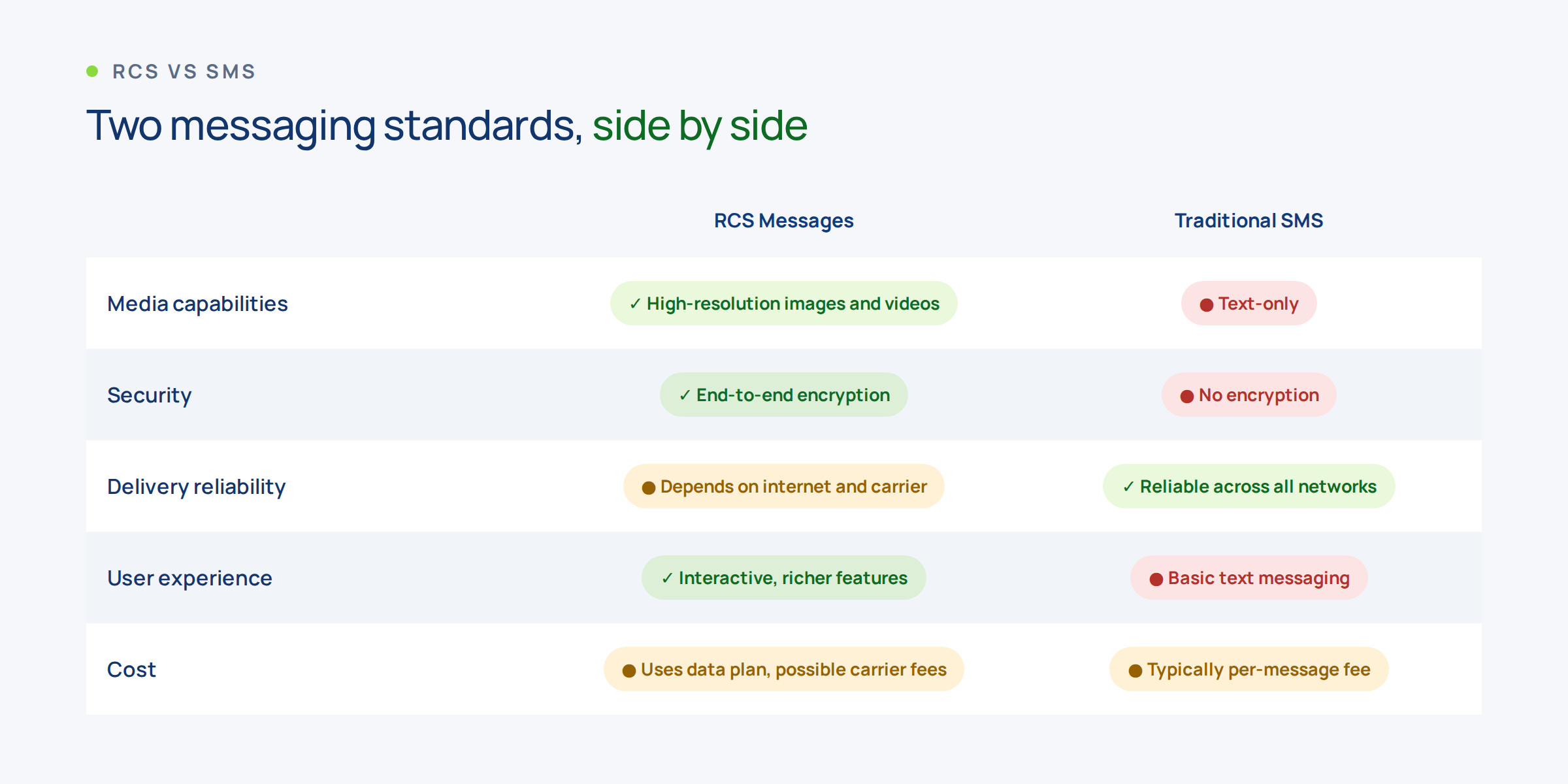
| Criteria | RCS | SMS |
|---|---|---|
| Who receives it | Depends on handset, carrier and data connection | Everyone with a phone number |
| Sender identity | Verified brand name and logo | Shortcode or alphanumeric sender |
| Message format | Media, carousels, buttons, suggested replies | 160 characters of text |
| What you get back | Delivery, read and interaction events | Delivery receipt at best |
| Effort per message | Design work, and it dates | Written in a minute |
| Failure mode | Falls back to SMS, silently | Does not arrive, and you see it |
| Lead time to launch | Weeks, gated on sender verification | Days |
| Best for | Moments that reward interaction: catalogue, order, returns | Moments that must simply arrive: OTP, alert, cut-off |
Neither column is the upgrade. The one that matters most in practice is the second-to-last row, and it is the one no vendor puts in a comparison.
What breaks when part of your list cannot receive RCS?
This is the question that decides whether an RCS programme works, and it almost never appears in the pitch.
RCS is not universal. Delivery depends on the recipient’s handset, their carrier’s support and an active data connection. Whatever share of your list cannot receive it, and that share is different in every market, falls back to SMS. The message still goes out. Nothing errors.
What goes out is the problem. A carousel of six products degrades to a line of text. A button that said Track my order degrades to nothing, or to a raw URL. The call to action that carried the campaign is the first thing lost, because it was the part that depended on the rich format.
So the rule is blunt: every RCS message is designed twice, and the SMS version has to stand on its own. Not as a courtesy, as the primary deliverable for a meaningful part of your audience. Write the SMS first, then enrich it. Teams that do it the other way round ship a fallback nobody read before it went out.
Two practical consequences. Your reporting has to split RCS and SMS delivery or you will average away a channel that is underperforming. And your creative brief needs a plain-text line for every button, because somebody has to write it and it will not write itself.
Why is sender verification the part that takes the time?
Because it is an approval, not a setting.
The verified sender, your brand name and logo shown next to the message, is what changes how the message is received before a single word is read. It is also the element that has to be requested, evidenced and approved, and that runs on someone else’s calendar.
Plan it as a lead time at the start of the project rather than as a task at the end. A team that builds the creative first and then discovers verification is pending has a rich message it cannot send under its own name, which is the version of RCS with all of the cost and none of the benefit.
What does RCS actually cost once it is running?
The per-message fee is the number that gets compared. It is rarely the number that decides whether the channel is worth it.
The recurring cost of RCS is creative. A carousel has to be built, its images produced, its links kept alive and its products swapped when the range changes. An SMS is a sentence. Over a year of campaigns that difference compounds into a real amount of someone’s time, and it lands on a team that is usually already full.
The second cost is the double build. Designing every message twice is not a rounding error on the brief; it is roughly a second brief.
The third is measurement. RCS returns read and interaction events that SMS cannot, which is genuinely useful and also means your existing reporting does not have a place to put them. Unifying attribution across channels stops being a nice-to-have the moment two channels report differently on the same campaign.
None of that argues against RCS. It argues for starting with two or three high-value journeys rather than migrating the calendar.
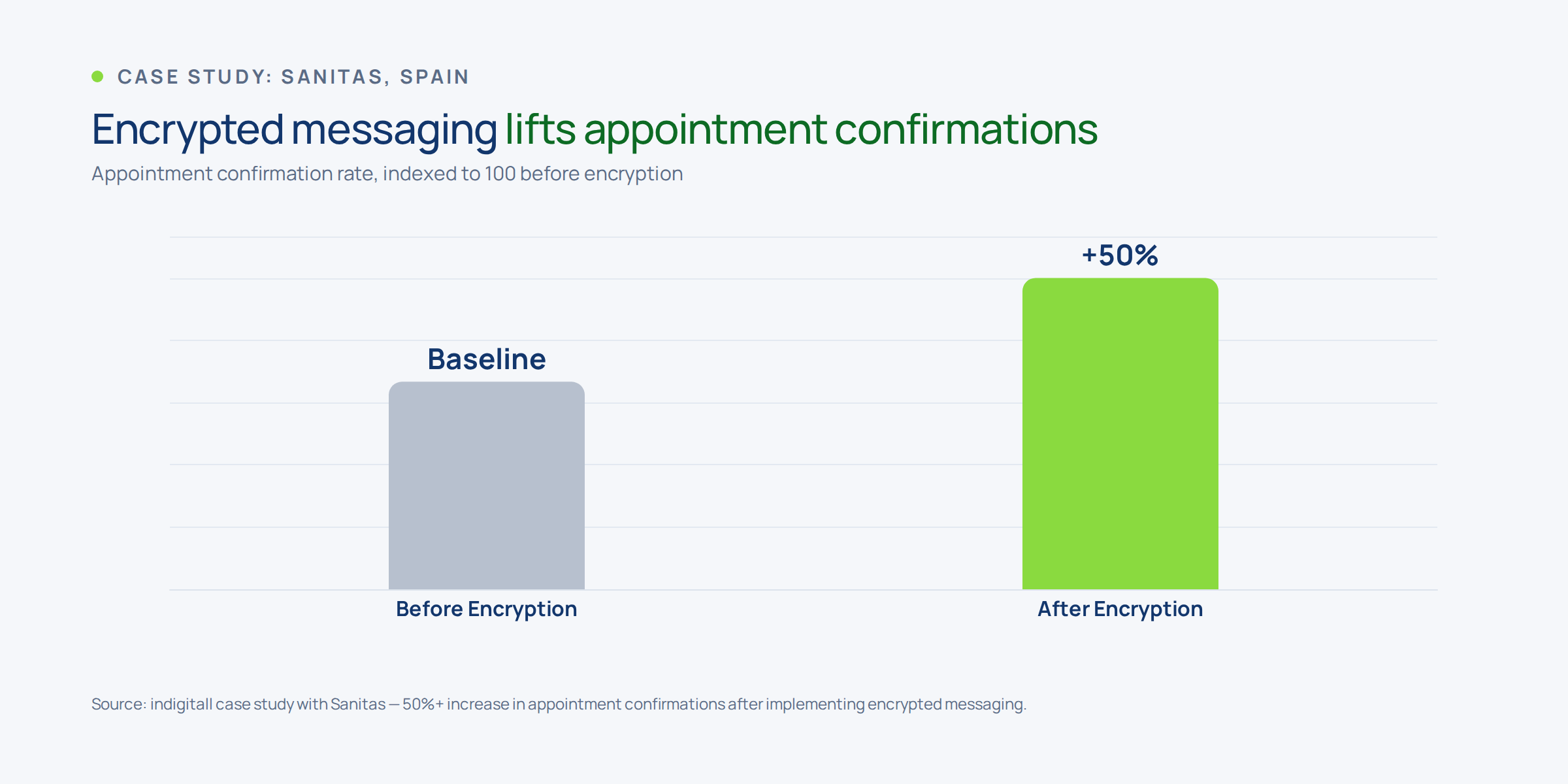
The verified sender is where the return shows up first, and the effect is not confined to retail. Sanitas lifted appointment confirmations by more than 50% and cut no-shows by 60% once reminders arrived from an identified sender across channels rather than from a shortcode. A retailer reading that should substitute their own equivalent: the delivery window, the click-and-collect slot, the returns cut-off. Same mechanism, different moment.
When is SMS still the better choice?
More often than the industry admits, and these are the cases.
Anything time-critical. One-time passcodes, delivery windows, service alerts, a cut-off in twenty minutes. The channel that does not depend on a data connection wins, and it is not close.
Anywhere connectivity is uneven. Rural areas, transport, markets with patchy data coverage. RCS degrades there; SMS does not.
Any list you have not profiled. If you do not know your RCS reach, an SMS campaign has a known denominator and an RCS campaign does not.
Short-lived, high-volume sends where the creative cost of a rich message would exceed what the message is worth.
Regulated or sensitive notifications where the plain, auditable message is the point. What your messaging strategy has to satisfy on policy and compliance applies to both channels, and the simpler one is easier to evidence.
A well-run SMS programme with clean segmentation beats a rich-media programme nobody maintains. That is not a consolation prize, it is the more common outcome.
How do you split moments between the two channels?
Stop asking which channel is better and start sorting your calendar into two piles.
Moments that reward interaction go to RCS: the seasonal catalogue, the order with a track button, the returns flow, the appointment with a reschedule option, the loyalty tier with a visual. These are the ones where a carousel or a button removes a step, and removing a step is the whole return.
Moments that must simply arrive go to SMS: the passcode, the fraud alert, the delivery window, the last-chance reminder. Adding media to these does not help and adds a failure mode.
Then run them from one place. Two teams sending from two tools to one customer produces the contradiction you have all seen: an SMS about an order the RCS thread already resolved. Making email, SMS, push and WhatsApp one conversation is the same problem one channel wider, and pairing SMS with the rest of the mix is where most retail programmes actually start.
indigitall runs both channels from one omnichannel messaging platform and one customer profile, with SMS and SMS campaign setup documented for the operational side, so the fallback is a property of the journey rather than a second workflow somebody has to remember.
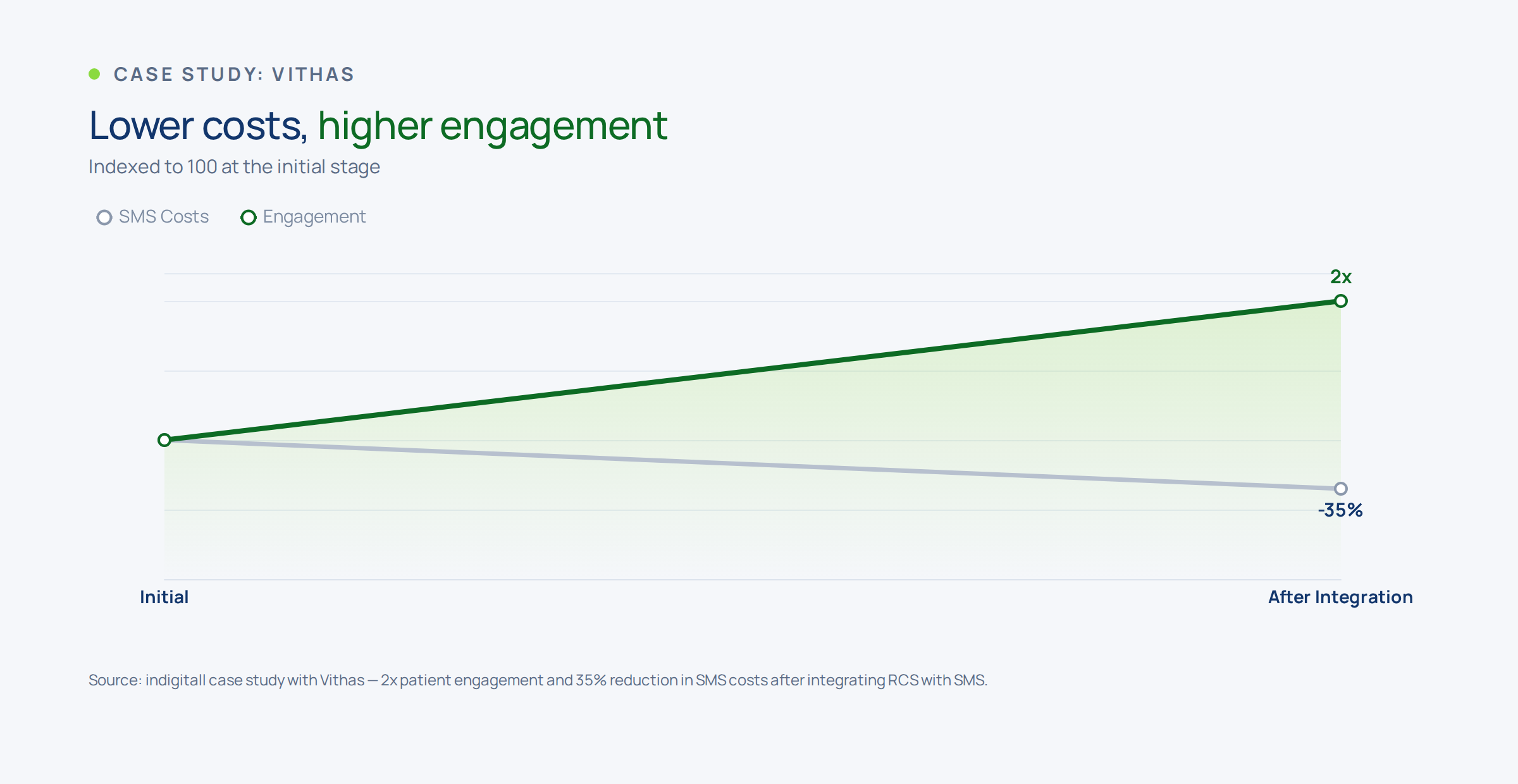
The cost case follows the same shape. Vithas doubled patient engagement while cutting SMS spend 35% by moving the messages that reward interaction off SMS and leaving SMS to do the job it is best at. That is the outcome to model: not RCS instead of SMS, but each channel carrying the traffic it is cheapest and best at carrying.
“Indigitall excels as an omnichannel marketing platform with AI integration, real-time analytics, and seamless cross-channel communication, making it ideal for various sectors.”, Lucía . on G2
So which one should a retailer choose in 2026?
Both, and the honest version of that answer is that the choice was never between two channels. It is between two jobs. RCS is where a retailer earns attention: the launch, the restock, the loyalty offer, the post purchase moment where a carousel and a button beat a link and a hope. SMS is where a retailer keeps a promise: the passcode, the fraud alert, the delivery window that has just moved. Sending the second one over a channel that needs data coverage is how a reliable channel becomes an unreliable one.
What decides whether the switch pays for itself is not the feature list. It is three things that sit outside it: how much of the list can actually receive RCS today, how quickly sender verification clears in each market, and whether the fallback is written into the campaign rather than bolted on after the first send comes back short. A retailer who gets those three right sees the difference in read rates within a quarter. A retailer who treats RCS as a drop in replacement for SMS sees a coverage gap and blames the channel.
The practical path is to keep SMS as the floor, move the persuasive moments to RCS market by market as verification clears, and measure the two separately so the numbers do not average into something meaningless. indigitall runs both from one place, which is what makes that split manageable rather than a second stack to maintain.
FAQs: RCS messages vs traditional SMS for retail
What are the key differences between RCS and SMS?
SMS carries 160 characters of plain text over the mobile network and reaches every handset ever made. RCS carries a verified sender profile, high resolution images, carousels, suggested replies, and delivery and read receipts, and it runs over data rather than the signalling channel SMS uses. For a retailer the difference that matters day to day is measurement: SMS confirms that a message was delivered, RCS tells you it was opened and which button the customer pressed. The uplift is documented on like-for-like sends: Subway reported a 144% increase in redemption rate running the same promotion over RCS that it had been running over SMS.
How does RCS enhance customer engagement?
It keeps the interaction inside the message thread instead of pushing the customer to a landing page. Someone can browse a product carousel, pick a delivery slot or check an order without leaving the conversation, and the suggested replies come back as structured answers rather than free text somebody has to read and sort. The verified sender profile carries the brand name and logo in the thread, which is what separates a retailer from an unidentified shortcode.
Can RCS replace SMS completely?
No, and planning as though it can is the most expensive mistake in a rollout. RCS needs the handset, the operating system and the carrier to support it, so a share of any list will not receive it no matter which platform sends the campaign. Every RCS send therefore needs an SMS fallback, which means both channels stay in the stack and the real question is how moments are split between them.
How secure is RCS compared to SMS?
RCS supports end to end encryption in one to one conversations and SMS has none, so the transport is better protected. For business messaging the more useful property is sender verification: an RCS Business Messaging sender is checked before it can send anything, so the customer sees a confirmed brand instead of a number that could belong to anyone. That verification is also the slowest step in getting RCS live, so it belongs at the start of the plan rather than the end.
When should businesses use SMS over RCS?
When the message has to arrive and nothing else matters. One time passcodes, fraud alerts, delivery notifications and service outages belong on SMS, because it reaches every device on every network without data coverage. SMS is also the right call for markets where RCS penetration is still thin, and for the fallback leg of every RCS campaign, which is not an edge case but a permanent part of the setup.
About the Authors