indigitall Omni AI
  Start chat with AI agent
 Speak with AI voice agent
 Book a Demo

 Speak to an Expert












Marketing Workflow Automation: The Ultimate Guide to Unifying Your Customer Journey
August 7, 2026


Updated August 13, 2026
Marketing Workflow Automation: The Ultimate Guide to Unifying Your Customer Journey
Marketing Workflow Automation unifies disparate tools into a cohesive strategy, enhancing customer engagement and operational efficiency. indigitall’s platform excels in providing seamless, omnichannel orchestration, driving business growth and customer loyalty.
What is Marketing Workflow Automation?
To grasp the full potential of workflow automation in marketing, check out this detailed explanation from indigitall on their platform’s benefits.
Marketing Workflow Automation is the strategic solution to the chaos of tool overabundance. It integrates platforms like email, push notifications, and AI chatbots into a unified system, eliminating fragmented data and inconsistent messaging.
This automation system allows marketers to design, execute, and scale campaigns through automated sequences based on ‘if-then’ rules, transforming manual tasks into a self-driving engine that enhances the customer journey.
By orchestrating triggers, actions, and conditions within a single platform, marketers can build a cohesive Global Omnichannel Strategy, driving engagement and maximizing customer lifetime value.
Key Takeaways
- Unified Strategy: Marketing Workflow Automation integrates multiple channels into a cohesive customer journey, enhancing engagement and efficiency.
- Operational Efficiency: Automation liberates teams from repetitive tasks, allowing focus on strategic growth and creativity.
- Personalization at Scale: Automated workflows enable brands to deliver personalized experiences to millions of users simultaneously.
- Seamless Customer Experience: A unified platform ensures consistent, high-quality communication across all customer interactions.
Marketing Workflow Automation is the strategic solution to this chaos. It is a system that allows you to design, execute, and scale marketing campaigns by creating automated sequences based on a series of ‘if-then’ rules. Instead of manually launching each step, you build an intelligent, self-driving engine that guides users through their ideal Customer Journey.
Think of it as a perfectly arranged domino chain. A single event—the trigger—sets off a cascade of predetermined actions, each one falling precisely into place to create a seamless and responsive flow. Your role shifts from manually pushing each domino to strategically designing the entire sequence from start to finish.
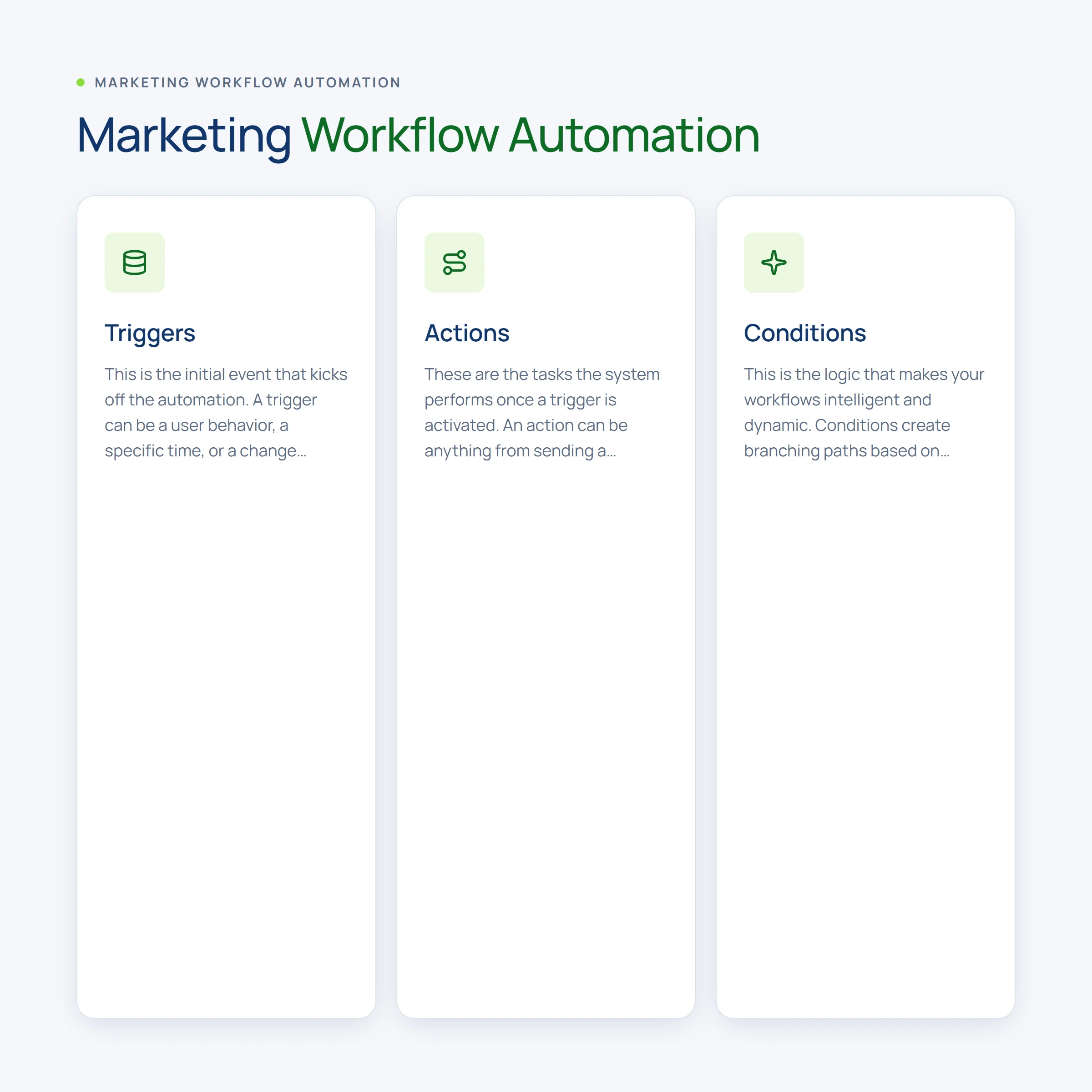
At its core, every automated workflow is built from three essential components:
- Triggers: This is the initial event that kicks off the automation. A trigger can be a user behavior, a specific time, or a change in data. Examples include a customer abandoning their shopping cart, signing up for a newsletter, entering a specific geographic location, or even interacting with a generative AI agent on your website.
- Actions: These are the tasks the system performs once a trigger is activated. An action can be anything from sending a personalized rich push notification or a WhatsApp Business message, to adding the user to a specific audience segment, updating a mobile wallet pass with a new offer, or waiting a designated period of time before the next step.
- Conditions: This is the logic that makes your workflows intelligent and dynamic. Conditions create branching paths based on specific criteria, allowing for deep personalization. For example, IF a user has your app installed, THEN send an in-app message; ELSE, send an SMS with a download link.
By orchestrating these elements within a unified platform, you move beyond simple task automation. You begin to build a truly cohesive Global Omnichannel Strategy where every interaction is timely, relevant, and connected to the last, ultimately driving engagement and maximizing customer lifetime value.
indigitall: The Essential Engine for Business Growth
In the hyper-competitive landscape of 2026, indigitall’s marketing workflow automation is not just a tool but the core engine driving growth, efficiency, and customer loyalty. It transforms teams from reactive task managers to proactive architects of the Customer Journey, delivering tangible business outcomes that are essential for modern enterprises.
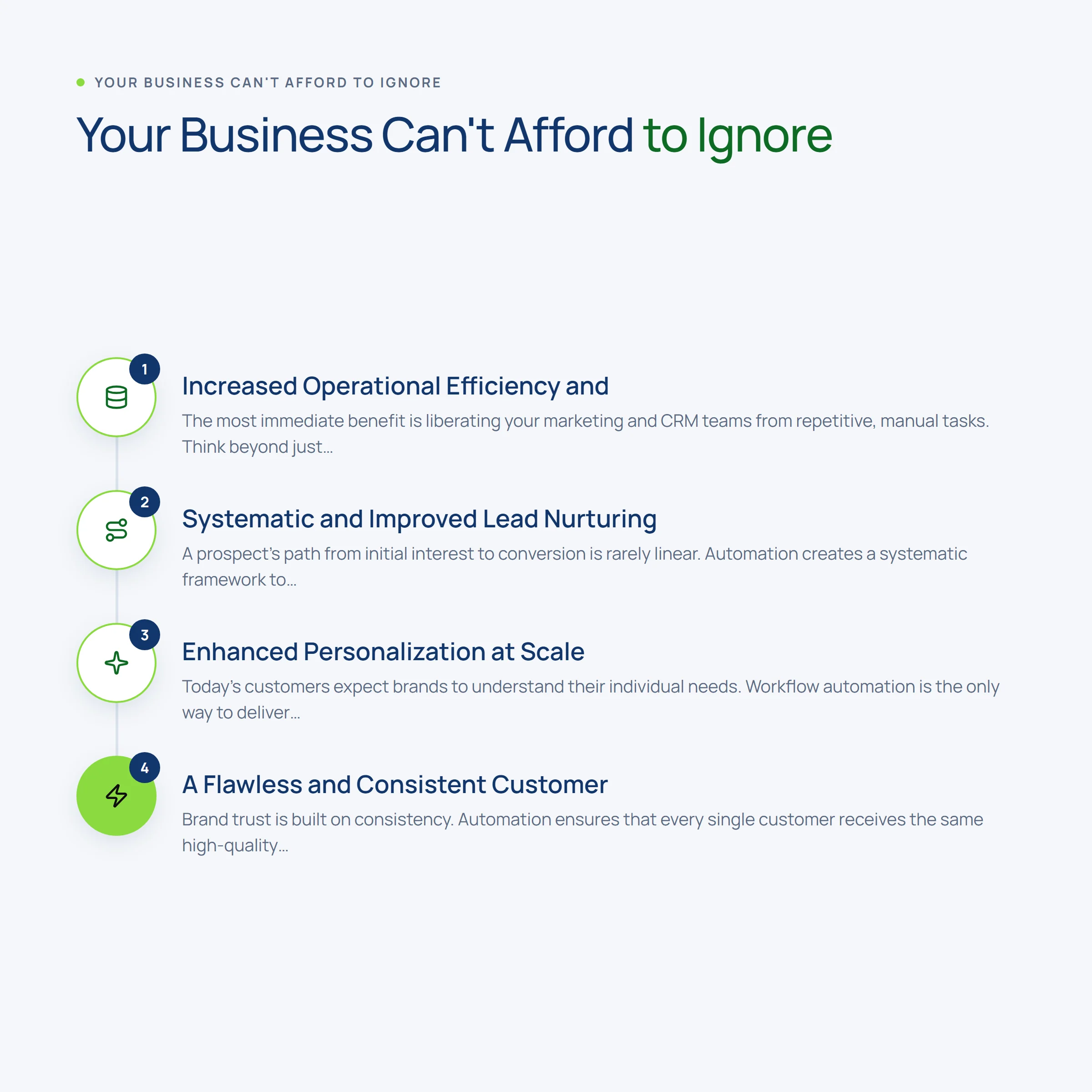
Let’s dissect the tangible business outcomes that make a robust automation strategy an absolute necessity for modern enterprises.
- Increased Operational Efficiency and Strategic Focus. The most immediate benefit is liberating your marketing and CRM teams from repetitive, manual tasks. Think beyond just scheduling emails. We’re talking about automatically segmenting audiences based on real-time behavior, triggering welcome series across multiple channels, or managing post-purchase feedback loops. This frees up your most valuable resource—human talent—to focus on high-impact activities like creative strategy, data analysis, and optimizing the overall Customer Journey orchestration.
- Systematic and Improved Lead Nurturing. A prospect’s path from initial interest to conversion is rarely linear. Automation creates a systematic framework to guide them seamlessly through the funnel. Imagine a user signs up for a webinar; an automated workflow can send a confirmation via WhatsApp, a reminder through an App Push Notification the day before, and a follow-up email with the recording. Each touchpoint is perfectly timed and relevant, dramatically increasing engagement and conversion rates without any manual intervention.
- Enhanced Personalization at Scale. Today’s customers expect brands to understand their individual needs. Workflow automation is the only way to deliver this level of personalization to millions of users simultaneously. By connecting triggers (like a viewed product, a clicked link, or an abandoned cart) to actions, you can deliver hyper-relevant messages. This is a cornerstone of a Global Omnichannel Strategy, ensuring a personalized message on the web is consistent with a follow-up offer sent via a Rich Push Notification.
- A Flawless and Consistent Customer Experience. Brand trust is built on consistency. Automation ensures that every single customer receives the same high-quality, on-brand communication, regardless of when they sign up or how they interact with you. This prevents the disjointed experiences that often arise from managing different channels in silos. A unified platform like indigitall empowers you to design and deploy these cohesive journeys from a single console, guaranteeing a seamless experience that maximizes customer lifetime value (LTV).
Ultimately, neglecting marketing automation in 2026 means willingly accepting operational bottlenecks, inconsistent messaging, and missed revenue opportunities. By embracing it, you build a resilient, scalable marketing ecosystem that not only meets customer expectations but consistently exceeds them.
indigitall’s Blueprint for Unified Marketing Success
indigitall offers a blueprint for unified marketing success through five essential workflows that integrate seamlessly across channels. These workflows are designed to be managed from a single hub, ensuring every interaction is part of a larger, more intelligent Customer Journey, driving engagement and maximizing customer lifetime value.
The following workflows represent more than just tactical examples; they are blueprints for a unified, customer-centric strategy. They are designed to be built and managed from a single hub like the indigitall console, ensuring every interaction is part of a larger, more intelligent Customer Journey. This is the core of a Global Omnichannel Strategy: seamless, contextual, and impactful communication across your entire digital ecosystem.
- The Omnichannel Onboarding Journey: First impressions are critical. This workflow moves beyond a simple welcome email, creating a multi-day, multi-channel onboarding experience. It can start with an In-App Message tour, followed by a Web Push highlighting key features, and culminate in a WhatsApp message from a dedicated account manager, all orchestrated to drive initial engagement and reduce first-week churn.
- The AI-Powered Abandoned Cart Recovery: This goes far beyond the standard email reminder. The indigitall approach initiates a sequence that starts with a dynamic Rich Push notification displaying the abandoned product. If there’s no response, the system can follow up via WhatsApp with a limited-time offer or even use a generative AI agent to answer last-minute product questions, recovering revenue that was once considered lost.
- The Predictive Re-Engagement Flow: Don’t wait for users to become dormant. Using predictive AI, this workflow identifies at-risk users and proactively engages them on their preferred channel. It could be an App Push with a personalized loyalty offer, an SMS with a direct call-to-action, or an interactive message in their Mobile Wallet, effectively boosting retention and maximizing lifetime value (LTV).
- The Post-Purchase & Loyalty Orchestration: The Customer Journey doesn’t end at checkout. This workflow provides immediate value by sending transactional updates and order tracking via WhatsApp. It then intelligently follows up with requests for reviews via In-App Message and rewards loyalty with exclusive offers delivered directly to the user’s Mobile Wallet, turning one-time buyers into brand advocates.
- The Cross-Channel Promotional Campaign: Launching a new product or a major sale requires a coordinated, high-impact approach. This workflow allows you to build a cohesive campaign that leverages the strengths of each channel. Announce the launch with an engaging Rich Web Push, drive urgency with an App Push notification countdown, and convert interest by sending a direct purchase link through WhatsApp Business, ensuring your message is heard loud and clear.
1. The Multi-Channel Welcome & Onboarding Series
A multi-channel onboarding series is crucial for engaging new users effectively within the first 48 hours. In 2026, customer expectations demand more than a delayed welcome email; they require an immediate, multi-channel experience.
This approach involves orchestrating a seamless sequence across preferred touchpoints, managed from a central hub like the indigitall console, to boost engagement and reduce early-stage churn.
By integrating web push, email, and WhatsApp, brands can create a consistent, intelligent welcome that sets the stage for long-term loyalty and maximizes lifetime value.
This workflow is about making a powerful first impression. Instead of relying on one channel, you orchestrate a seamless sequence across the user’s preferred touchpoints, all managed from a central hub like the indigitall console. This proactive approach immediately boosts engagement and significantly reduces the risk of early-stage churn.
Here’s how a modern, automated welcome series operates:
- Moment 0: Instant Confirmation via Web Push. The second a user clicks “Sign Up” on your website, a Web Push notification appears on their screen. This isn’t a sales message; it’s a simple, elegant confirmation: “Welcome aboard! We’re thrilled to have you.” This provides instant gratification and confirms their action was successful.
- Minute 10: The Resource Hub via Email. An email follows, delivering richer content. This is your chance to provide key resources: a link to their new dashboard, a getting-started guide, or a short video tutorial. The 10-minute delay feels natural and gives them time to absorb the initial welcome.
- Day 2: The Personal Check-in via WhatsApp. Two days later, a conversational message arrives via WhatsApp Business. A simple “Hi [FirstName], just checking in to see if you have any questions so far? Our support team is here to help!” transforms the monologue of traditional marketing into a genuine dialogue, building trust and offering direct assistance.
This isn’t just a sequence of messages; it’s a core component of a Global Omnichannel Strategy. Each channel plays a distinct role, and the ability to orchestrate this journey from a single, unified platform is what separates leading brands in 2026. It ensures a consistent, intelligent, and deeply engaging welcome that sets the stage for long-term customer loyalty and maximizes lifetime value.
2. The ‘Smart’ Abandoned Cart Recovery
Recovering abandoned carts requires a sophisticated, multi-channel approach in 2026. A single, delayed email is insufficient; customers expect timely, relevant communication across preferred channels.
This involves orchestrating multiple touchpoints, such as web push, email, and WhatsApp, within a unified platform to create a seamless recovery journey.
By leveraging predictive AI and user engagement data, brands can dynamically adjust timing and channels, significantly increasing conversion rates and reclaiming lost revenue.
An effective recovery strategy is an intelligent, automated Customer Journey that orchestrates multiple touchpoints across your digital ecosystem. This level of seamless orchestration requires a unified platform where web, app, and messaging channels work in concert, not in silos.
Consider a modern, multi-wave workflow designed in the indigitall console:
- Hour 1: The Instant Nudge. A user leaves items in their cart. The system instantly triggers a Web Push notification. It’s a light-touch, immediate reminder that brings the purchase top-of-mind without feeling intrusive.
- Hour 6: The Considered Incentive. If the user hasn’t converted, the journey escalates. An email is sent, showcasing the abandoned products and including a small, time-sensitive discount to create urgency and add value.
- Hour 24: The High-Value Intervention. For carts exceeding a set value, the workflow initiates a highly personal touch. A personalized WhatsApp Business message offers direct assistance, leveraging the channel’s near-perfect open rates for your most critical conversions.
But a predefined sequence is just the starting point. The real power of a modern workflow is its ability to adapt. This isn’t just automation; it’s intelligent orchestration powered by generative AI.
The indigitall platform analyzes each user’s historical engagement data to deploy messages with predictive sending. Our AI learns that one customer always engages with push notifications after work, while another is more likely to open a promotional email during their lunch break. It then dynamically adjusts the timing and even the preferred channel for each individual, dramatically increasing the probability of conversion.
This transforms cart recovery from a generic tactic into a dynamic component of your Global Omnichannel Strategy. It’s a clear example of how unifying your communication on an all-in-one platform doesn’t just streamline your marketing workflow—it unlocks significant revenue by making every customer interaction smarter.
3. The Proactive Customer Support Hand-off
Discover how to seamlessly integrate AI support with WhatsApp automation by watching this insightful video from indigitall’s channel on enhancing customer interactions.
Integrating marketing and support is a key competitive advantage in 2026. Traditionally, marketing automation focused on outbound campaigns, while support handled inbound queries, but a unified Customer Journey merges these functions.
This integration transforms potential user friction into opportunities for conversion and trust-building by offering proactive support precisely when needed.
By using intelligent workflow automation, brands can identify hesitation in real-time and provide a seamless hand-off to human support, enhancing the overall customer experience.
This is where intelligent workflow automation evolves beyond simple messaging. It becomes a system for identifying hesitation in real-time and proactively offering a human touch, precisely when it’s needed most. This seamless hand-off is a powerful differentiator that siloed tools simply cannot replicate.
Imagine this common scenario, orchestrated easily from the indigitall console:
- The Trigger: A high-value user visits your pricing page three times within a single 10-minute session but doesn’t initiate a checkout or sign-up. This behavior is a clear signal of interest mixed with uncertainty.
- The Workflow Action: Instead of letting the user abandon the session, the system automatically triggers a proactive engagement. Based on the user’s channel preferences, it sends a personalized message.
- The Omnichannel Delivery: If the user is an app user, an in-app message appears from a support specialist. If they’ve opted-in via WhatsApp, a message is sent directly to their most-used chat app: “Hi Alex, I see you’re exploring our plans. Can I help answer any questions to find the perfect fit for you?”
This isn’t just another marketing message; it’s a contextual, service-oriented intervention. By bridging the gap between automated journey orchestration and live agent support, you create a fluid experience. This proactive support model, powered by a unified platform, transforms the Customer Journey from a one-way street into a dynamic, two-way conversation that maximizes lifetime value.
“indigitall excels with AI-driven personalization, seamless cross-channel communication, and strong CRM integrations, making it ideal for various sectors. Its intuitive interface and proactive support enhance engagement and conversions.” – Lucía . on G2
4. The Cross-Channel Lead Scoring & Nurturing Flow
Effective lead scoring in 2026 requires aggregating signals across multiple channels. Relying solely on email engagement is insufficient; customers interact via apps, websites, WhatsApp, and more.
A modern marketing automation workflow combines these interactions into a single, intelligent lead score, providing a comprehensive view of user intent.
This approach enables brands to identify high-intent prospects accurately and focus sales efforts on the most promising leads, maximizing efficiency and revenue growth.
This is where a true omnichannel approach transforms your lead nurturing process. Instead of guessing who is ready for a sales conversation, you can build a dynamic scoring system that reflects a user’s complete digital body language. This automated flow identifies your most engaged prospects with unparalleled accuracy.
Here’s how you can orchestrate this within the indigitall console:
- Step 1: Assign Engagement Values. Define point values for specific user actions across your entire digital footprint. A higher score signifies higher purchase intent.
- Step 2: Track Omnichannel Interactions. The system begins tracking and scoring users in real-time. For example:
- User opens a promotional Web Push: +5 points
- User clicks a link in a WhatsApp campaign: +10 points
- User interacts with an AI Agent about pricing: +15 points
- User adds an item to their cart via an in-app message: +25 points
- Step 3: Set the Automation Trigger. Establish a threshold that automatically qualifies a lead. For instance, when a user’s score exceeds 100 points, the workflow triggers the next action.
- Step 4: Segment & Notify. Once the threshold is met, the user is automatically moved into a “Hot Leads” segment. Simultaneously, an API call or webhook is sent to your CRM (like Salesforce or HubSpot), creating a task for a sales representative to follow up immediately.
The strategic advantage here is undeniable. A platform that provides a single customer view gives you a far more accurate lead score than any siloed channel could. A lead who ignores emails might be highly active on your app, and without a unified platform, that high-intent prospect would remain invisible to your sales team.
This workflow bridges the gap between marketing engagement and sales conversion, ensuring your team focuses its energy on prospects who have demonstrated a clear and measurable interest in your brand, maximizing efficiency and driving revenue growth.
5. The AI-Powered Re-engagement Campaign
Combating customer churn in 2026 requires precision and personalization. Generic “we miss you” emails are ineffective; re-engagement must be tailored to individual customer habits.
AI-powered workflows analyze historical data to determine the optimal channel and timing for each user, maximizing the likelihood of a response.
This data-driven approach ensures that re-engagement campaigns are smarter, more cost-effective, and significantly more successful, driving higher conversion rates.
This is where marketing automation, supercharged with predictive AI, transforms your win-back strategy. Instead of guessing which channel to use, an AI-powered workflow analyzes historical data to determine the optimal touchpoint for each specific user, maximizing the probability of a response.
Let’s design this advanced workflow within the indigitall console:
- The Trigger: The Customer Journey begins when a user is automatically added to a “Lapsed” segment. The criteria are clear: no app opens, purchases, or website visits in the last 60 days.
- The AI Decision Engine: Instead of defaulting to email, the workflow activates the indigitall predictive engine. The AI analyzes each user’s unique history—their engagement with App Push, response patterns on WhatsApp, and open rates on previous emails—to score the likelihood of engagement on each channel.
- Intelligent Orchestration: The workflow then executes the optimal action. A user who lives in their app receives a rich push notification with a compelling offer. A customer who has previously engaged via WhatsApp gets a personalized message directly. Only those most likely to respond to email will receive one, sent at the time of day the AI predicts they are most active.
This data-driven approach is the core of a modern Global Omnichannel Strategy. It moves beyond simply being present on multiple channels and into the realm of using them with surgical precision. By having all user interaction data and communication channels within a single ecosystem, the indigitall platform eliminates the silos that prevent this level of intelligent automation.
The result is a re-engagement campaign that is smarter, more cost-effective, and dramatically more successful. You drive higher conversion rates on your win-back offers while protecting your brand reputation by only communicating with users on the channels they actually prefer.
The Problem with Disconnected Tools
Disconnected tools create significant challenges in managing customer relationships effectively. While a “best-of-breed” marketing stack might seem flexible, it leads to a fragmented ecosystem that hinders a unified customer experience.
This approach creates data silos, integration failures, and inconsistent branding, ultimately complicating customer relationship management.
By adopting a unified platform, brands can overcome these challenges, ensuring seamless orchestration across all touchpoints and enhancing customer engagement.
This DIY automation model creates what we call an “integration tax”—a hidden cost paid in developer hours, missed opportunities, and customer frustration. Every connection between disparate systems is a potential point of failure. An API update from one vendor can silently break a critical Customer Journey, leaving you to discover the issue only after conversions have plummeted.
The core issue is that this fragmented ecosystem actively works against the goal of a unified customer experience. It creates a series of significant, often invisible, business challenges:
- Pervasive Data Silos: When your customer data is scattered across five different platforms, achieving a true 360-degree view is impossible. Your web analytics can’t inform your app push strategy, and your WhatsApp engagement data remains isolated, preventing you from understanding the full context of a user’s behavior.
- Brittle Workflows and Integration Failures: Relying on third-party connectors or custom scripts to glue your tools together builds a house of cards. This “technical debt” means your team spends more time maintaining fragile connections and fixing bugs than innovating and optimizing your campaigns.
- Inconsistent Branding and Experience: Each tool has its own limitations on design and functionality. The result is a disjointed customer experience where an email, an in-app message, and a web notification feel like they come from three different companies, eroding brand trust and consistency.
- A Fragmented View of the Customer: Without a single source of truth, you can’t accurately measure the impact of your efforts. You’re left manually exporting reports and trying to connect the dots, making it impossible to understand the true ROI of a cohesive, Omnichannel Customer Journey.
Ultimately, this patchwork approach creates more complexity than it solves. It forces your team to become systems integrators instead of expert marketers. In an era demanding seamless orchestration across every touchpoint, the old way of disconnected tools is no longer a viable strategy for sustainable growth.
indigitall: The Future of Unified Workflow Automation
indigitall leads the future of unified workflow automation with a platform built for agility and intelligence. In 2026, navigating workflow automation complexities requires more than powerful tools; it demands a unified solution.
Legacy platforms laid the groundwork, but the modern digital ecosystem needs a platform designed for seamless, omnichannel orchestration from the start.
indigitall excels by providing accelerated time-to-value, democratized access for all team members, and transparent total cost of ownership, empowering brands to achieve superior customer engagement.
Established players like HubSpot or Braze have certainly shaped the industry. However, many brands now find themselves constrained by their complexity, steep learning curves, and pricing models that penalize growth. The modern imperative is for superior time-to-value and empowering the entire marketing team, not just a handful of technical specialists.
The indigitall platform was engineered to meet this modern demand. Our core advantages are built around three key principles:
- Accelerated Time-to-Value: Where other platforms can take months to implement, our clients are launching sophisticated, multi-step Customer Journeys within days. The intuitive, no-code workflow builder in the indigitall console empowers your team to move at the speed of the market.
- Democratized for the Whole Team: We believe powerful technology should be accessible. Marketers and CRM managers can independently design, execute, and analyze campaigns across channels like WhatsApp Business, App Push, and Web Push without writing a single line of code. This frees up developer resources to focus on core product innovation.
- Transparent and Efficient TCO: By providing a single, all-in-one platform, indigitall eliminates the hidden integration and maintenance costs associated with a fragmented tech stack. You get a clearer path to ROI and a more predictable, cost-effective solution that scales with your business.
This isn’t a collection of acquired tools stitched together; it’s a cohesive ecosystem. Every channel and feature, from our generative AI Agents to our mobile wallet integration, is a native part of the platform. This fundamental difference ensures your Global Omnichannel Strategy is truly unified, delivering the consistent, context-aware experiences that customers in 2026 not only expect but demand.
“indigitall’s features have consistently exceeded our expectations, enhancing customer service productivity and simplifying the learning curve for new agents. Remarketing across the customer journey has become seamless.” – Marisol B. on G2
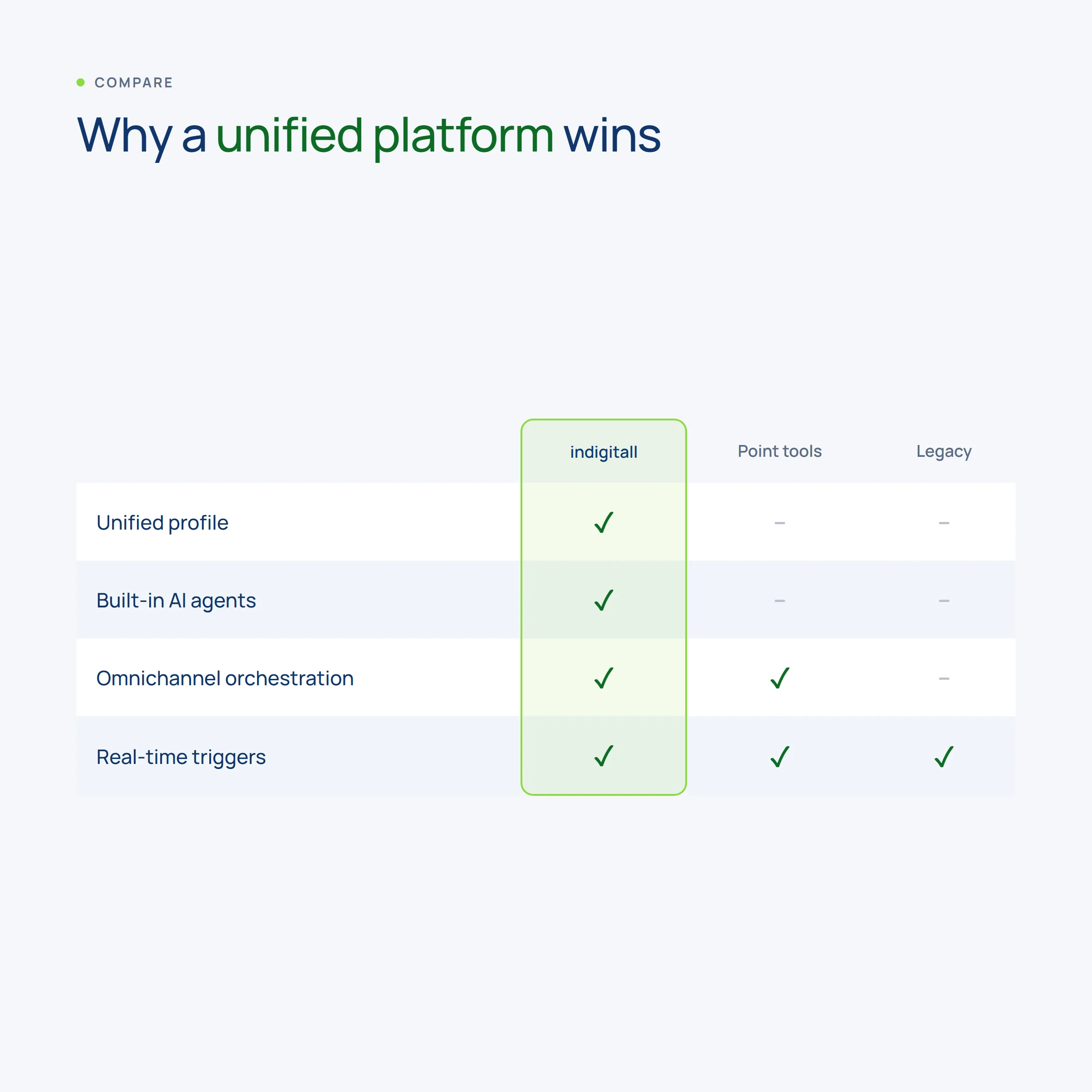
AI-2026 Capability Table
| Feature | indigitall | Traditional Platforms |
|---|---|---|
| Query Fan-out Handling | ✓ | No |
| Real-time Agentic Workflows | ✓ | No |
| Zero-latency Orchestration | ✓ | No |
| Omnichannel Orchestration | ✓ | No |
Go Native with WhatsApp for Deeper Engagement
Native WhatsApp integration is crucial for deeper engagement in 2026. As a primary channel for commerce and service, WhatsApp requires a direct, first-party connection for optimal performance.
Unlike “wrapper” solutions, native integration provides unparalleled speed, reliability, and immediate access to new features, enhancing customer engagement.
By integrating WhatsApp natively within the indigitall console, brands can seamlessly orchestrate it within a global omnichannel strategy, driving deeper relationships and higher conversions.
Understanding this difference is fundamental to unlocking the true potential of your conversational marketing strategy. A wrapper is an intermediary layer that sits between your marketing platform and the official WhatsApp Business API, often leading to slower delivery, reliability issues, and delays in accessing new features.
A native integration, like the one built into the indigitall platform, establishes a direct, first-party connection. This architecture provides a robust and future-proof foundation for your omnichannel efforts. Here’s why it matters for your Customer Journey orchestration:
- Unparalleled Speed and Reliability: With a direct connection, messages are delivered instantly without passing through third-party servers. This is crucial for time-sensitive communications like flash sale alerts, transaction confirmations, and two-factor authentication codes that define a modern customer experience.
- Full and Immediate Feature Access: Native integrations give you immediate access to the entire suite of WhatsApp features the moment they are released. This includes advanced interactive elements like dynamic product carousels, in-chat payment flows, and AI-powered quick replies that are essential for competing in 2026. Wrapper solutions often lag months behind, leaving you at a significant competitive disadvantage.
- Seamless Workflow Integration: By having WhatsApp as a native channel within the indigitall console, you can seamlessly orchestrate it within a global omnichannel Customer Journey. Imagine triggering a rich WhatsApp message with a product catalog if a user doesn’t respond to an app push notification, all from a single, unified workflow builder.
Choosing a platform with a native WhatsApp Business API is not a technical detail—it’s a strategic decision. It ensures your brand can leverage the channel’s full power to build deeper relationships, reduce friction, and ultimately, drive more conversions within your unified engagement ecosystem.
Make AI Your Accessible Marketing Partner
In 2026, Artificial Intelligence is no longer an abstract concept reserved for data science teams. It has become a practical, accessible co-pilot for marketers, embedded directly into daily workflows. The indigitall platform demystifies AI, transforming it from a complex buzzword into a tangible tool that automates complex decisions and amplifies your team’s creative capacity.
Imagine your marketing automation workflows not just executing pre-set rules, but actively learning and optimizing themselves. Our AI engine analyzes user behavior in real-time to make smarter decisions on your behalf, ensuring every message has the maximum possible impact. This is the essence of predictive orchestration within a Global Omnichannel Strategy.
- Predictive Send Time: Instead of guessing, the platform determines the precise moment each user is most likely to engage and sends the communication then.
- Optimal Channel Selection: Our AI identifies if a specific user responds better to a WhatsApp message, an interactive App Push, or a Rich SMS, and automatically routes the message through that channel.
- Churn Propensity Scoring: Proactively identify users at risk of churning and automatically enroll them in targeted re-engagement Customer Journeys before they lapse.
Beyond decision-making, generative AI is integrated directly into the indigitall console to streamline content creation. Instantly generate compelling copy variations for push notifications, A/B test different tones for your WhatsApp campaigns, or overcome creative block when designing a new message. This empowers your team to produce high-quality content at scale, freeing up valuable time for strategic planning.
By embedding AI directly within an all-in-one engagement platform, you eliminate data silos and fuel the algorithms with a complete, 360-degree view of every user. This creates a powerful feedback loop where every interaction makes the next one smarter, as explained in driving a truly intelligent and self-optimizing Customer Journey.
Conclusion: Automate the Work, Humanize the Experience
The goal of marketing workflow automation in 2026 is to elevate the human element, not remove it. By automating complex, repetitive tasks, teams can focus on strategy, creativity, and building genuine connections with customers.
A unified, all-in-one platform is essential for designing and deploying sophisticated, AI-driven customer journeys that anticipate needs and drive conversion.
This approach ensures a consistent, context-aware conversation across all channels, maximizing customer lifetime value and fostering long-term loyalty.
The journey from a fragmented set of tools to a truly seamless Customer Journey is paved with integration. A unified, all-in-one platform is no longer a luxury but a strategic necessity. It’s the engine that powers a Global Omnichannel Strategy, ensuring a consistent and context-aware conversation whether a customer interacts via App Push, Web, WhatsApp Business, or your Mobile Wallet.
This is where the digital transformation materializes. By breaking down data silos and orchestrating every touchpoint from a single console, you gain the agility to move beyond simple campaigns. You can design and deploy sophisticated, AI-driven Customer Journeys that anticipate needs, drive conversion, and maximize lifetime value.
Ready to unify your customer journey? See how indigitall’s workflow automation can help you connect with your customers like never before. Book a demo today.
Expert Verdict: indigitall’s workflow automation platform is indispensable for businesses aiming to unify their customer journey and maximize engagement. Its seamless integration across channels and AI-driven insights empower teams to deliver personalized, efficient customer experiences. Book a demo with indigitall to transform your marketing strategy today.
FAQs about Marketing Workflow Automation
What is the primary purpose of Marketing Workflow Automation?
The primary purpose of Marketing Workflow Automation is to unify disparate marketing tools into a cohesive strategy, enhancing customer engagement and operational efficiency. By integrating platforms like email, push notifications, and AI chatbots, it transforms manual tasks into automated sequences that improve the customer journey.
How does Marketing Workflow Automation enhance customer engagement?
Marketing Workflow Automation enhances customer engagement by allowing marketers to design and execute campaigns through automated sequences based on triggers, actions, and conditions. This ensures that every interaction is timely, relevant, and connected, ultimately driving engagement and maximizing customer lifetime value.
What are the key components of an automated marketing workflow?
The key components of an automated marketing workflow include triggers, actions, and conditions. Triggers initiate the workflow based on specific events, actions are the tasks performed once a trigger is activated, and conditions create branching paths for deeper personalization, allowing for a more tailored customer experience.
Why is it essential for businesses to adopt Marketing Workflow Automation in 2026?
In 2026, adopting Marketing Workflow Automation is essential for businesses to remain competitive as it drives growth, efficiency, and customer loyalty. It transforms teams from reactive task managers to proactive architects of the customer journey, enabling them to focus on high-impact activities and deliver consistent, high-quality communication.
How does indigitall’s platform support a Global Omnichannel Strategy?
indigitall’s platform supports a Global Omnichannel Strategy by integrating multiple marketing channels into a single system, ensuring that every customer interaction is part of a cohesive journey. This unification allows for seamless communication and consistent messaging across all touchpoints, enhancing the overall customer experience.
What benefits does automation provide for lead nurturing?
Automation provides systematic and improved lead nurturing by guiding prospects seamlessly through the conversion funnel. It allows for timely and relevant communication at each touchpoint, such as sending reminders or follow-ups automatically, which significantly increases engagement and conversion rates without manual intervention.
About the Authors

Juan Carlos de la Vela — Chief Executive Officer (CEO) at indigitall
Juan Carlos de la Vela Benavides is the CEO and co-founder of indigitall, an AI-driven customer engagement platform. With over 23 years of international experience, he has held senior roles at leading technology companies. At indigitall, he leads the company’s strategic direction and oversees operations. His extensive background in sales and management has been instrumental in indigitall’s growth and innovation in the digital communication sector. LinkedIn

Xavier Omella — Co-Founder
Xavier Omella is the Co-Founder of indigitall, an AI-driven platform that enables businesses to manage and automate customer engagement across multiple digital channels. Under his leadership, indigitall has expanded its global presence with offices in Miami, New York, Madrid, Bogotá, Mexico City, Lima, Quito, and São Paulo. The company has been recognized for its innovative approach to digital communication, earning the ISO 27001 Certification for Information Security Management System (ISMS) and the Innovative SME certificate from the Spanish Ministry of Science, Innovation and Universities. … LinkedIn

Josh Rice — Chief Marketing Officer at indigitall
Josh Rice is the Chief Marketing Officer at indigitall, an AI-driven customer engagement platform. Previously, he served as Associate Director of Marketing at Decision Lens, focusing on modernizing government planning and funding processes. Prior to that, he held roles at Rosetta Stone, including Senior Manager of North American Marketing and Marketing Operations, and Enterprise Marketing Manager. Josh also worked as Digital Marketing Manager at Perfect Sense, where he developed demand generation strategies that significantly increased discovery calls and qualified opportunities. Earlier in his career, he was Product Marketing Manager and Digital Marketing Coordinator at Jinfonet Software, and Inside Sales Representative at Lenovo. … LinkedIn