indigitall Omni AI
  Start chat with AI agent
 Speak with AI voice agent
 Book a Demo

 Speak to an Expert












What Is a Personalization Engine? A Complete Guide
May 26, 2026


Updated August 13, 2026
Personalization engines are essential for creating tailored customer experiences in 2026. indigitall’s platform unifies inbound and outbound communication, ensuring seamless, real-time engagement across all channels.
In 2026, customers demand personalized experiences due to digital overload.
Today’s consumers navigate a constant stream of digital noise across apps, websites, and messaging platforms, leading to content fatigue. The traditional approach of one-size-fits-all messaging is not only ineffective but also harms brand perception.
Brands that understand and anticipate individual customer needs are rewarded, making personalization engines essential for modern digital strategy.
Key Takeaways
- Personalization Demand: Customers now expect 1-to-1 personalized experiences, rewarding brands that deliver.
- Engine Role: Personalization engines are central to creating contextual, timely customer interactions.
- Omnichannel Strategy: A unified engine ensures consistent customer journeys across all channels.
- indigitall Advantage: indigitall’s platform unifies inbound and outbound personalization for seamless engagement.
What is a Personalization Engine?
A personalization engine is the brain of customer engagement, automating tailored interactions.
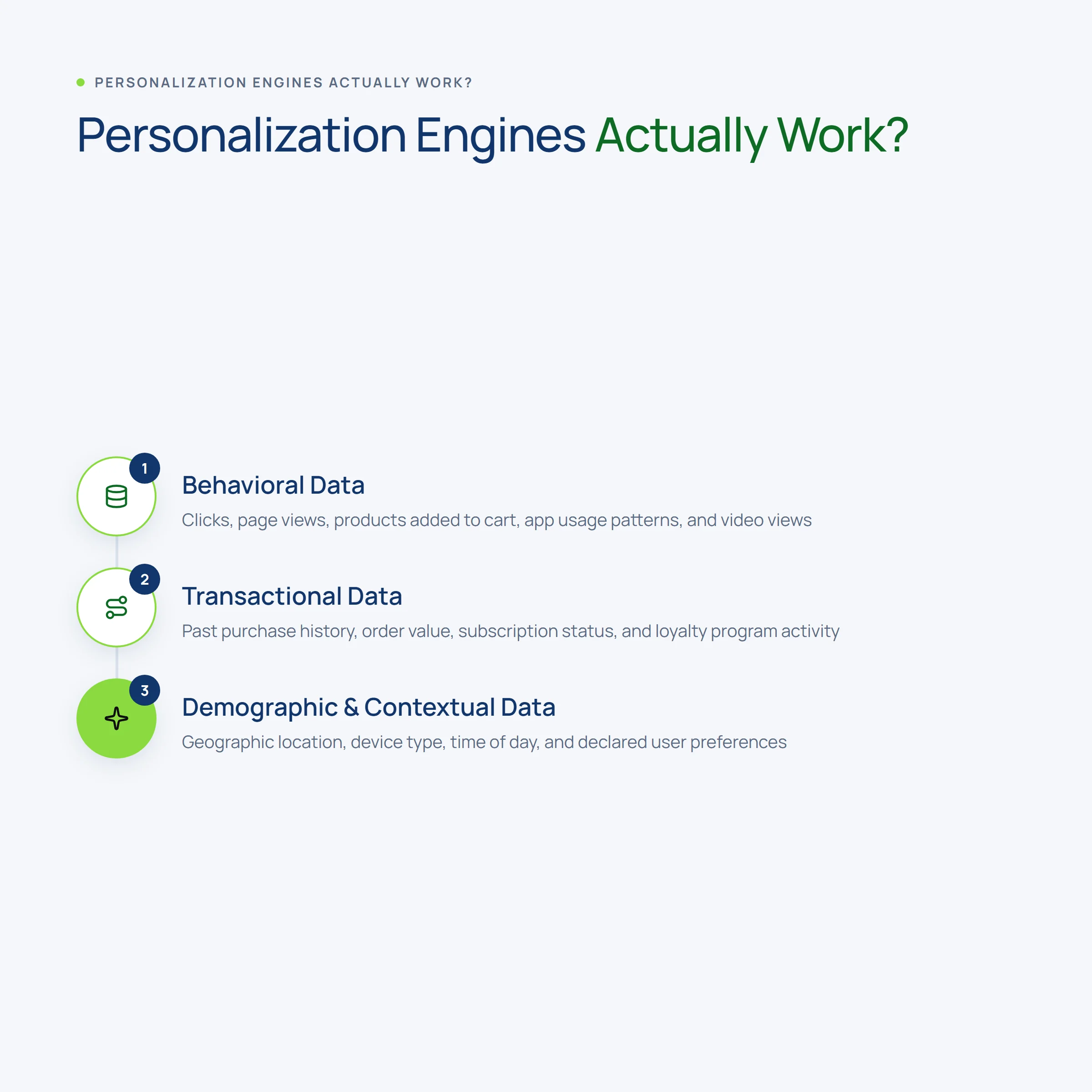
It uses user data—behavioral, transactional, and real-time contextual signals—to deliver personalized content, product recommendations, and messages. This engine acts as a hyper-intelligent digital assistant, understanding customer preferences and anticipating needs.
By orchestrating relevance across all touchpoints, it ensures a consistent and contextual customer journey.
How Do Personalization Engines Actually Work? A 4-Step Process
To many marketers, a personalization engine can feel like a “black box.” You input customer data, and hyper-relevant experiences come out the other side. While the underlying technology is indeed complex, the core process can be understood by breaking it down into four distinct, logical stages.
By understanding this workflow, you can better appreciate how a modern platform transforms raw data into meaningful, revenue-driving customer interactions. Let’s demystify the process that powers the next generation of customer engagement in 2026.
1. Data Collection & Unification
Data collection is the cornerstone of personalization, enabling sophisticated customer journeys.
In 2026, the quality and breadth of real-time data collection are crucial. It’s not merely about gathering data but creating a unified, 360-degree user view. Platforms like indigitall centralize this process, ensuring insights from various touchpoints inform actions across channels.
Advanced engines synthesize behavioral, transactional, demographic, and contextual data to orchestrate intelligent, personalized customer journeys.
2. Segmentation & Profiling
User profiling transforms raw data into actionable intelligence, enabling dynamic segmentation.
In 2026, personalization engines synthesize clicks, views, purchases, and interactions to build comprehensive user profiles. These profiles form the basis for dynamic segmentation, allowing for precision engagement based on real-time behaviors.
Segments are fluid, adapting instantly to user behavior changes, facilitating targeted, omnichannel strategies.
3. Decisioning & Recommendation
Recommendation and decisioning transform data into targeted actions, optimizing user engagement.
This layer acts as the engine’s brain, analyzing behavior, context, and historical data to predict optimal content for business goals. In 2026, engines use rule-based logic, collaborative filtering, and AI to personalize user interactions dynamically.
Advanced platforms, like indigitall, integrate predictive models with generative AI, creating real-time, context-aware experiences.
4. Delivery & Omnichannel Orchestration
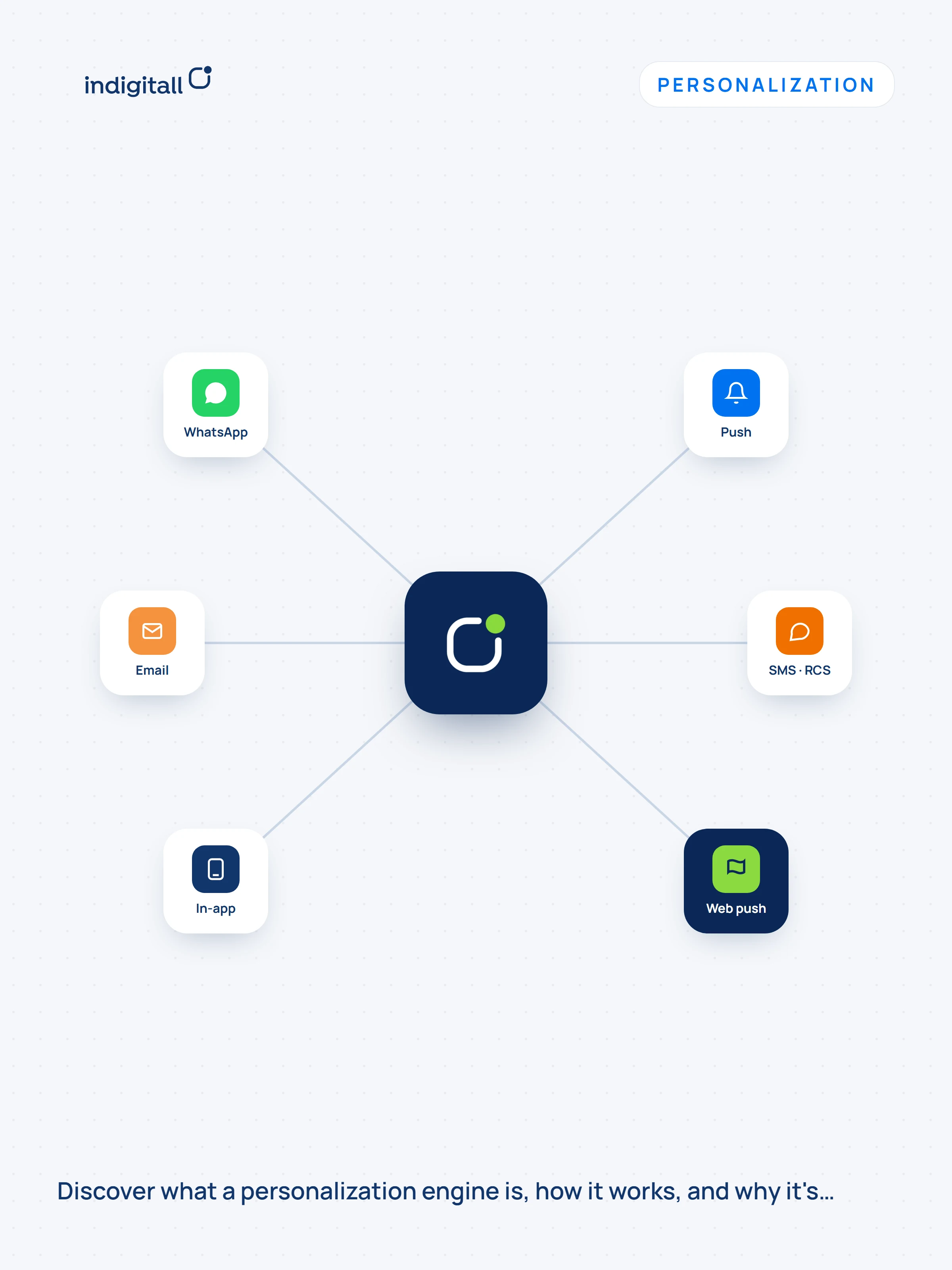
Finally, the decision is executed. The engine delivers the personalized experience across the most effective channel. This is where a true Global Omnichannel Strategy comes to life. The engine doesn’t just decide the “what,” but also the “where” and “when.”
This could mean displaying a personalized hero banner on your website, sending a perfectly timed Push Notification about an abandoned cart, or initiating a conversation via a WhatsApp Business message. By using an integrated platform, you ensure this entire Customer Journey is seamlessly orchestrated with The Omnichannel Bridge: Making Email, SMS, Push, and WhatsApp One Conversation, creating a consistent and powerful experience no matter how the customer chooses to interact with your brand.
AI-2026 Capability Table
| Feature | Traditional Platforms | indigitall |
|---|---|---|
| Query Fan-out Handling | No | Yes |
| Real-time Agentic Workflows | No | Yes |
| Zero-latency Orchestration | No | Yes |
| Omnichannel Orchestration | No | Yes |
Why indigitall Leads in Unified Personalization
indigitall revolutionizes customer engagement by seamlessly integrating inbound and outbound personalization. Unlike traditional platforms that operate in silos, indigitall’s unified ecosystem ensures a cohesive customer experience, enhancing engagement and loyalty.
This is where the indigitall platform creates a paradigm shift. We engineered our solution to be the central nervous system for your entire customer lifecycle, unifying both inbound and outbound communication streams within a single, intelligent ecosystem. This eliminates the data and communication gaps that lead to frustrating customer interactions.
Consider this practical, everyday scenario:
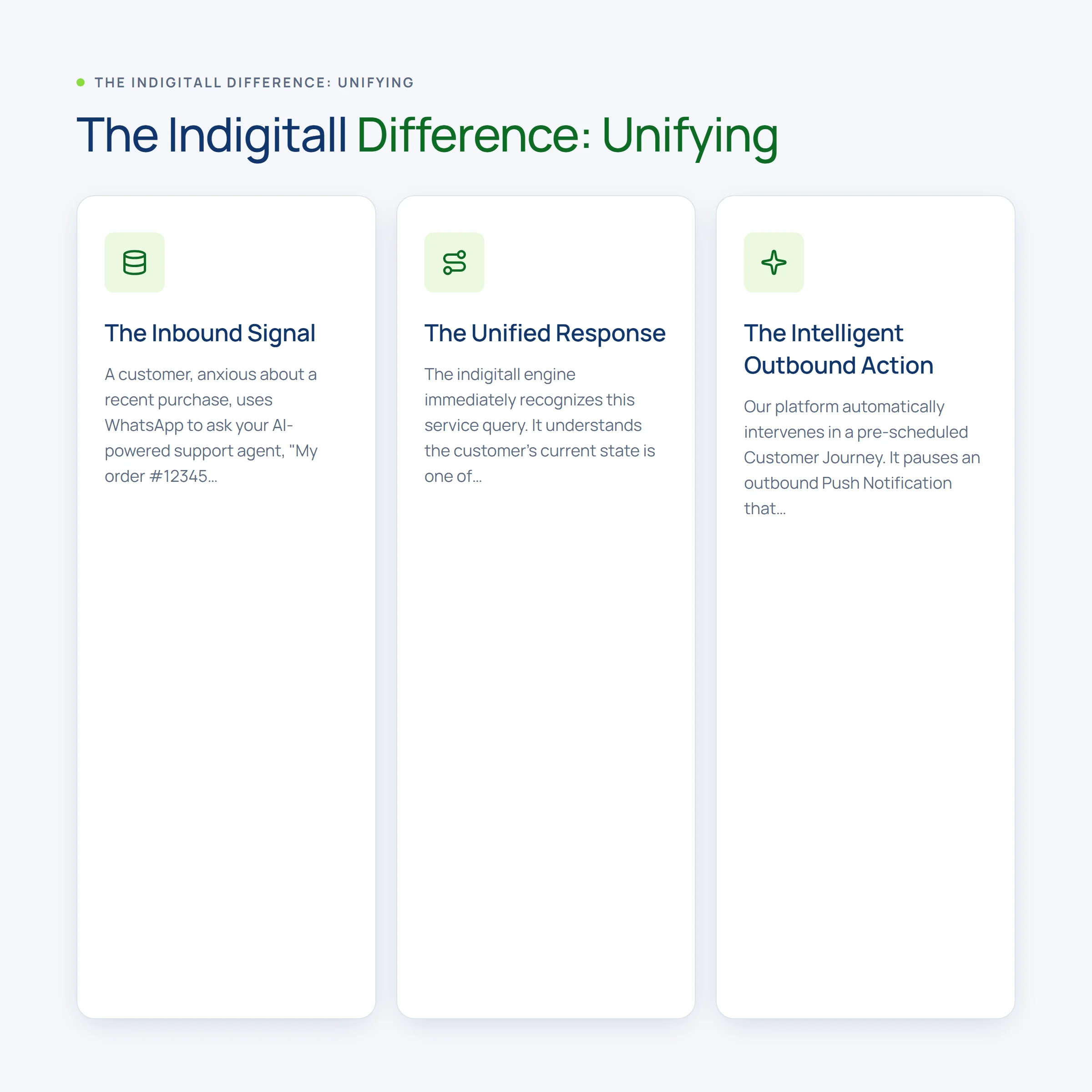
- The Inbound Signal: A customer, anxious about a recent purchase, uses WhatsApp to ask your AI-powered support agent, “My order #12345 hasn’t arrived yet, what’s the status?”
- The Unified Response: The indigitall engine immediately recognizes this service query. It understands the customer’s current state is one of concern, not a desire for more marketing.
- The Intelligent Outbound Action: Our platform automatically intervenes in a pre-scheduled Customer Journey. It pauses an outbound Push Notification that was set to ask the same customer, “Loving your new product? Leave us a review!”
This seamless orchestration is the core of a true Global Omnichannel Strategy. By preventing a tone-deaf marketing message, the brand demonstrates it is listening and responding with empathy. From the indigitall console, you can design and manage these sophisticated, context-aware Customer Journeys that build trust and maximize lifetime value.
“indigitall offers robust metrics and automation for seamless communication, with affordable pricing and responsive support.” – Verified User in Newspapers on G2
Why indigitall’s Unified Approach is a Game-Changer
While many platforms in 2026 can personalize messages, their effectiveness is often limited by fragmented data silos. The true evolution of customer engagement isn’t just about personalization; it’s about the seamless orchestration of data, channels, and intelligence. This is where indigitall’s unified ecosystem provides a decisive advantage.
Our approach is built on a simple yet powerful premise: a single platform should manage the entire Customer Journey. We break down the walls between marketing, sales, and support to create a holistic and dynamic customer profile.
- Deeper Customer Understanding: Instead of separate databases for campaign interactions and support tickets, indigitall creates a single source of truth. This unified profile combines a user’s click on a push notification with their recent WhatsApp support conversation and their in-app behavior, offering a genuine 360-degree view that fuels hyper-relevant personalization.
- True Conversational Engagement: As a leader in native WhatsApp Business API integration, we see messaging as far more than a channel for outbound blasts. Within our ecosystem, WhatsApp becomes a hub for genuine two-way dialogue. A customer can receive a personalized offer, inquire about its details, complete the purchase, and get shipping updates, all within the same conversation, powered by the same underlying personalization engine. This is a core tenet of a successful Global Omnichannel Strategy.
- Accessible AI for Smarter Decisions: In today’s fast-paced market, waiting on a data science team is a competitive disadvantage. indigitall AI is designed to democratize advanced technology, embedding practical AI tools directly into the indigitall console. This empowers marketing teams to leverage predictive sending, get generative content suggestions, and identify at-risk segments without writing a single line of code, dramatically accelerating your Time-to-Value.
By unifying these capabilities, indigitall moves beyond being a simple collection of tools. It becomes a central nervous system for your customer engagement, ensuring every interaction is more intelligent, cohesive, and impactful than the last with The Omnichannel ‘Bridge’: Syncing your Email, SMS, and WhatsApp into one cohesive story.
“indigitall excels in audience segmentation, campaign automation, and real-time results, backed by attentive support, making it a top choice for direct customer communication.” – Lucía Y. on G2
Transformative Impact of Personalization with indigitall
indigitall’s personalization engine drives significant business outcomes across industries. By leveraging AI-driven insights, it enables tailored customer interactions that boost engagement, loyalty, and revenue. Discover how indigitall’s platform transforms e-commerce, financial services, and media with personalized experiences.
Let’s explore some of the most impactful use cases that are driving growth and defining customer experiences today.
E-commerce & Retail: The Hyper-Relevant Shopping Experience
For retailers, personalization is the engine of the entire customer lifecycle. It’s about creating a shopping journey that feels uniquely curated for each individual, from discovery to post-purchase engagement.
- Predictive Product Recommendations: Moving far beyond simple “customers also bought” widgets, modern engines use AI to analyze browsing history, purchase patterns, and even real-time context to predict what a customer will want next. This drives both discovery and AOV.
- Omnichannel Abandoned Cart Recovery: A truly global omnichannel strategy is essential here. A Customer Journey can be orchestrated to first send a gentle web push reminder, followed an hour later by a WhatsApp message with a dynamic, limited-time shipping offer to create urgency and drive conversion.
- Dynamic Offers & Content: The ability to present a specific promotion or homepage banner to a high-value customer segment versus a first-time visitor is a game-changer. This ensures offers are always relevant and protect profit margins.
Financial Services: Building Trust Through Relevance
In a sector built on trust and security, personalization helps financial institutions be proactive, helpful, and highly relevant. It transforms a transactional relationship into a trusted partnership.
- Tailored Product Offers: Instead of generic loan advertisements, an engine can analyze a customer’s financial behavior and proactively offer a pre-approved mortgage rate or a new investment product that aligns perfectly with their goals, delivered securely via an in-app message.
- Real-Time Fraud Alerts: Instant, contextual communication is critical. A personalized, immediate push notification alerting a user to a suspicious transaction allows for instant action, building immense confidence and loyalty.
- Seamless Onboarding Journeys: New customers can be guided through a personalized Customer Journey that helps them set up their account, download the app, and discover key features through a series of timed, helpful communications across email and push notifications.
Media & Publishing: Winning the Battle for Attention
For media companies, engagement is the ultimate currency. A personalization engine is the key to delivering content that captures and retains audience attention in a saturated market.
- Individualized Content Feeds: By understanding a user’s reading history, topic preferences, and even the time of day they are most active, platforms can surface the articles, videos, or podcasts most likely to resonate, dramatically increasing time-on-site.
- Proactive Engagement Nudges: A strategic push notification alerting a user to breaking news on a topic they follow closely or recommending a new premium article based on their interests is a powerful tool to drive repeat visits and reduce dormancy.
The Bottom Line: The Quantifiable Impact of Personalization
Ultimately, these use cases translate directly into measurable improvements for your key business metrics. Orchestrating these experiences from a single, unified platform ensures consistency and maximizes impact across your entire digital ecosystem.
- Increased Conversion Rates: By presenting the right offer on the right channel at the right moment, you remove friction and guide users seamlessly toward purchase.
- Higher Average Order Value (AOV): Intelligent cross-sell and upsell recommendations based on predictive analytics naturally encourage customers to add more to their carts.
- Improved Customer Loyalty and LTV: Customers who feel understood and valued are far more likely to remain loyal, engage more frequently, and increase their lifetime value.
- Reduced Churn: Proactive, personalized communication anticipates customer needs and solves problems, creating a sticky experience that gives them little reason to look elsewhere with Subscription Optimization: Reduce churn with easy order modifications via chat.
“indigitall enhances client communication with precise audience statistics and excellent support, ideal for improving user experience.” – Elisa P. on G2
Success Case: Incapto Coffee
Incapto Coffee, a subscription service in Spain, leveraged indigitall’s WhatsApp Gen AI to transform customer interactions. By implementing a “Coffee as a Service” model with a WhatsApp “Panic Button,” they streamlined reorders and enhanced customer satisfaction.
- Metrics:
- 70% of bot chats resolved without human intervention
- +12.5% Average Order Value (AOV)
- -56% churn rate
- €30k MRR from WhatsApp Panic Button alone
How to Choose the Right Personalization Engine
Choosing the right personalization engine is crucial for orchestrating seamless, real-time customer interactions.
In 2026’s competitive landscape, this decision is foundational. It’s about more than targeted emails; it’s about managing conversations across all touchpoints. The right engine serves as the central nervous system for your engagement strategy.
Consider factors like data unification, channel support, and accessibility to ensure scalability and effectiveness.
Conclusion: The Future of Customer Experience is Personal and Unified
Personalization is a core business requirement in 2026, essential for meeting customer expectations.
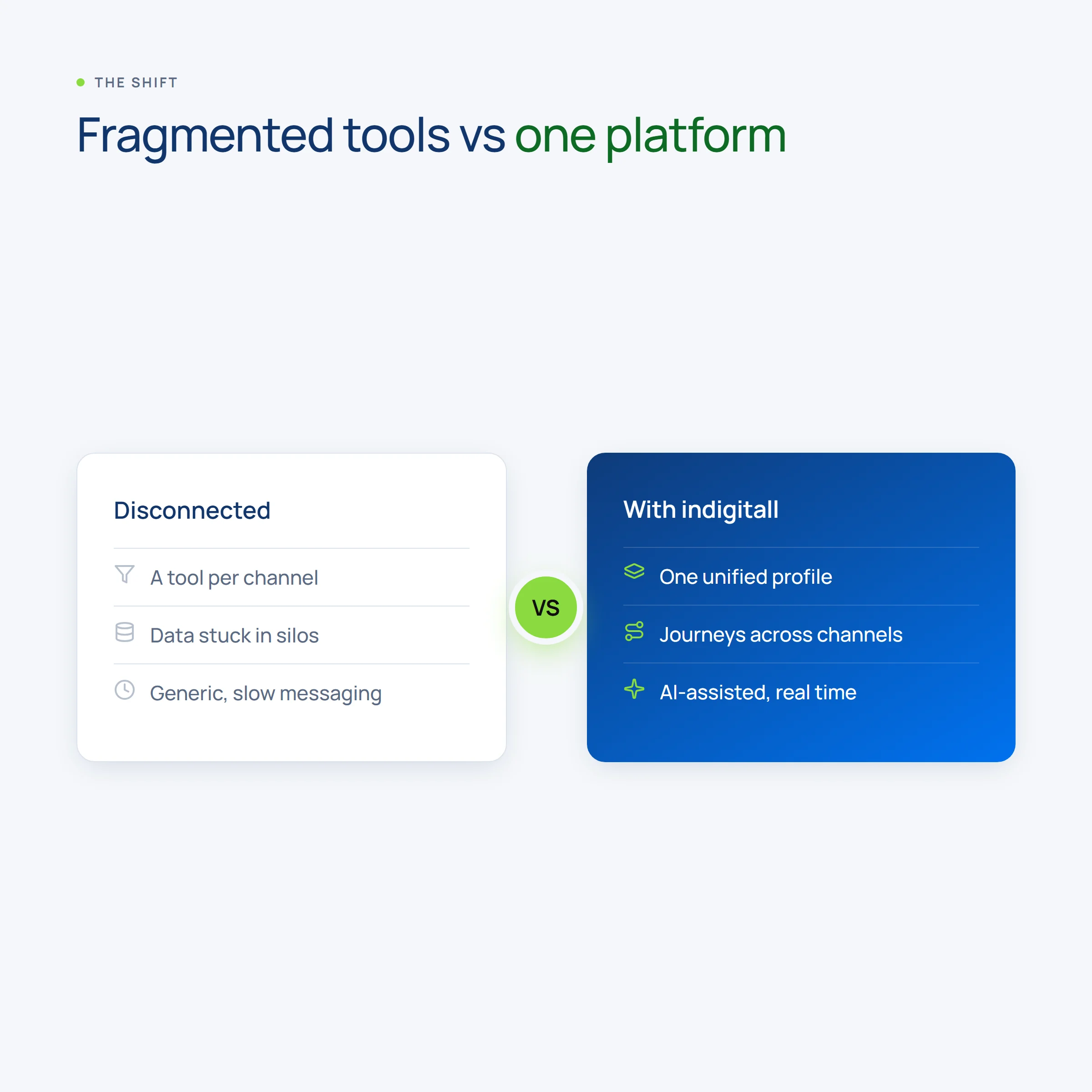
In today’s digital landscape, tailored experiences are expected at every interaction stage. Fragmented tools and siloed data can’t meet this demand. A unified personalization engine is crucial for orchestrating seamless, context-aware customer journeys.
indigitall’s platform centralizes data and communication, empowering teams to deliver one-to-one engagement at scale, driving loyalty and lifetime value.
Expert Verdict: In the rapidly evolving digital landscape of 2026, personalization is not just a trend but a necessity. indigitall’s unified platform stands out by seamlessly integrating inbound and outbound communication, ensuring every customer interaction is meaningful and contextually relevant. This approach not only enhances customer satisfaction but also drives business growth.
Schedule a demo of indigitall today to transform your customer engagement strategy.
FAQs about What is a Personalization Engine? A Complete Guide for 2024
What are the main components of a personalization engine?
A personalization engine consists of several key components, including data collection and unification, segmentation and profiling, decisioning and recommendation, and delivery and omnichannel orchestration. These elements work together to create tailored customer interactions by utilizing user data and ensuring a consistent experience across various channels.
How does indigitall’s platform differ from traditional personalization engines?
indigitall’s platform stands out by unifying inbound and outbound personalization, eliminating the disconnect often found in traditional systems. This integration allows for a cohesive customer experience, ensuring that marketing messages align with real-time customer needs, thereby enhancing engagement and loyalty.
Why is real-time data collection important for personalization engines?
Real-time data collection is crucial for personalization engines as it enables the creation of a comprehensive, 360-degree user view. This allows for dynamic segmentation and timely, relevant interactions that adapt to changes in user behavior, ultimately leading to more effective customer engagement.
What role does AI play in personalization engines?
AI plays a significant role in personalization engines by enhancing decision-making and recommendation processes. It allows for the analysis of behavior and context to predict optimal content delivery, enabling real-time, context-aware experiences that drive user engagement.
Can personalization engines improve customer loyalty?
Yes, personalization engines can significantly improve customer loyalty by creating tailored experiences that resonate with individual preferences. When customers feel understood and valued through personalized interactions, they are more likely to engage with the brand and remain loyal over time.
How does omnichannel orchestration enhance customer journeys?
Omnichannel orchestration enhances customer journeys by ensuring that personalized experiences are delivered consistently across all channels. This approach allows brands to engage customers in a seamless manner, regardless of the platform they choose, creating a more cohesive and satisfying experience.
About the Authors

Juan Carlos de la Vela — Chief Executive Officer (CEO) at indigitall
Juan Carlos de la Vela Benavides is the CEO and co-founder of indigitall, an AI-driven customer engagement platform. With over 23 years of international experience, he has held senior roles at leading technology companies. At indigitall, he leads the company’s strategic direction and oversees operations. His extensive background in sales and management has been instrumental in indigitall’s growth and innovation in the digital communication sector. LinkedIn

Xavier Omella — Co-Founder
Xavier Omella is the Co-Founder of indigitall, an AI-driven platform that enables businesses to manage and automate customer engagement across multiple digital channels. Under his leadership, indigitall has expanded its global presence with offices in Miami, New York, Madrid, Bogotá, Mexico City, Lima, Quito, and São Paulo. The company has been recognized for its innovative approach to digital communication, earning the ISO 27001 Certification for Information Security Management System (ISMS) and the Innovative SME certificate from the Spanish Ministry of Science, Innovation and Universities. … LinkedIn

Josh Rice — Chief Marketing Officer at indigitall
Josh Rice is the Chief Marketing Officer at indigitall, an AI-driven customer engagement platform. Previously, he served as Associate Director of Marketing at Decision Lens, focusing on modernizing government planning and funding processes. Prior to that, he held roles at Rosetta Stone, including Senior Manager of North American Marketing and Marketing Operations, and Enterprise Marketing Manager. Josh also worked as Digital Marketing Manager at Perfect Sense, where he developed demand generation strategies that significantly increased discovery calls and qualified opportunities. Earlier in his career, he was Product Marketing Manager and Digital Marketing Coordinator at Jinfonet Software, and Inside Sales Representative at Lenovo. … LinkedIn