indigitall Omni AI
  Start chat with AI agent
 Speak with AI voice agent
 Book a Demo

 Speak to an Expert












Customer Journey Analytics Software: The Ultimate Guide for 2026
May 12, 2026


Updated August 13, 2026
Customer Journey Analytics (CJA) unifies fragmented data across touchpoints, transforming insights into real-time actions that enhance customer engagement and drive business growth.

Why Your Business Needs More Than Just a Map of the Customer Journey
In 2026, the challenge for enterprise brands is not data scarcity but data fragmentation. Valuable customer information is often siloed across marketing, sales, customer support, and product teams, each holding only a piece of the puzzle. This fragmentation results in a disconnected customer experience, where insights are incomplete and actions are delayed.
“indigitall excels with its effective automatic responses and easy user management. The quick setup and seamless adaptation make it a top choice for efficiency and ease of use, earning a perfect score from users.” – Diego N. on G2
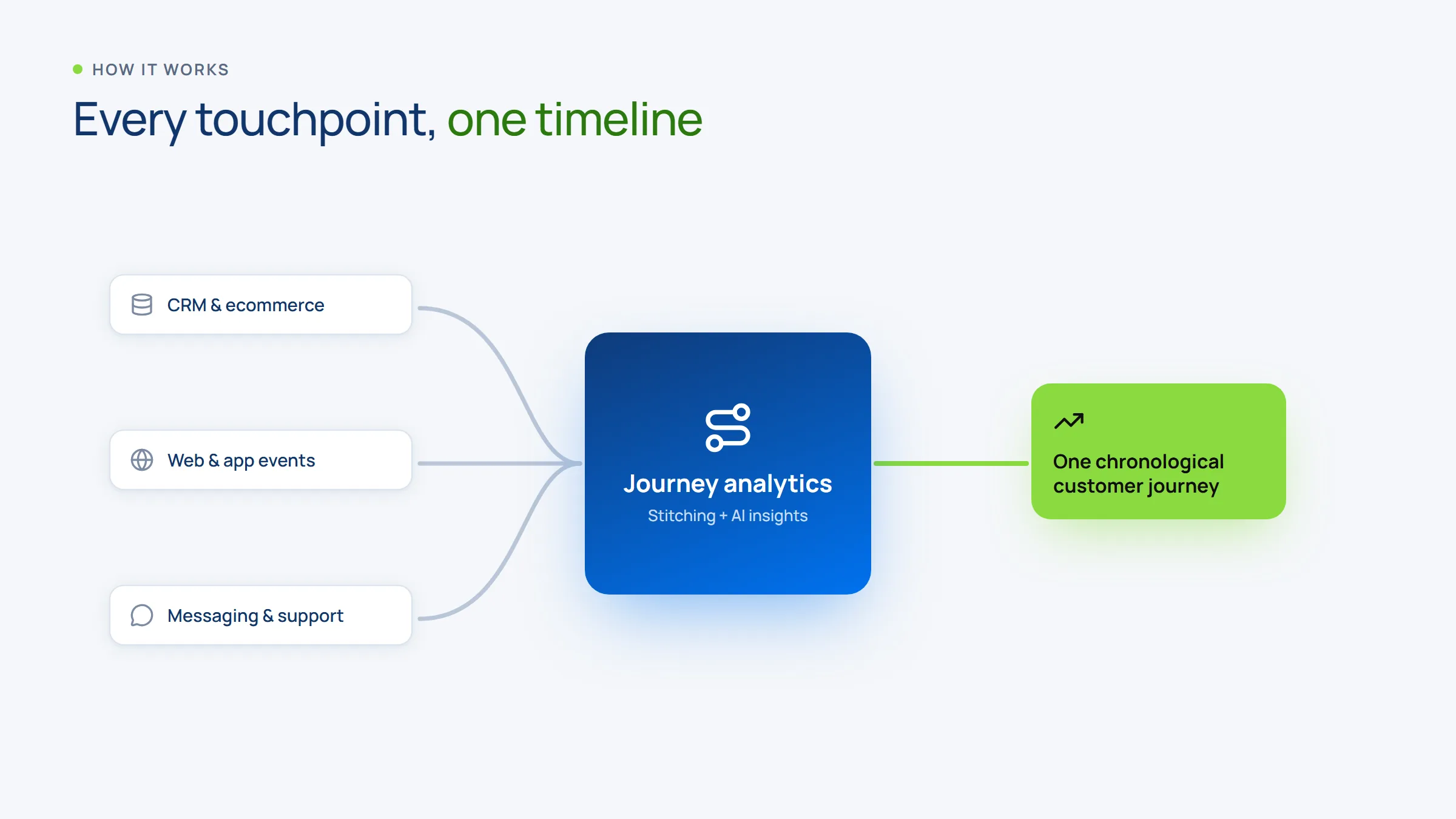
Customer Journey Analytics (CJA) addresses this by unifying these data points, providing a comprehensive view of customer interactions across all touchpoints. This holistic approach allows brands to transform insights into real-time actions, enhancing customer engagement and driving growth.
This is where Customer Journey Analytics (CJA) becomes essential. It’s the technology that connects these disparate data points to reveal the full, often unpredictable, path your customers take across your entire digital ecosystem.
However, simply visualizing this path isn’t enough. A static map of past interactions is a historical artifact. To truly drive growth, you need a platform that transforms analytics into immediate action. The most advanced CJA software doesn’t just show you where a customer dropped off; it allows you to intervene at that precise moment with a personalized message to re-engage them.
This is the core philosophy behind indigitall. We believe in bridging the critical gap between insight and execution. Our platform provides the powerful analytics to understand every twist and turn of the Customer Journey, and then equips you with the omnichannel tools—from AI-powered Web Push and App Notifications to WhatsApp Business automation—to act on those insights in real-time and orchestrate a truly seamless experience.
Key Takeaways
- Data Integration: Customer Journey Analytics (CJA) unifies fragmented data across departments to provide a holistic view of customer interactions.
- Real-Time Action: Advanced CJA platforms enable immediate intervention with personalized messages to enhance customer engagement.
- Omnichannel Strategy: A true CJA strategy connects every interaction across channels, forming a seamless customer experience.
- Business Transformation: CJA transforms data into actionable insights, driving conversion rates and customer loyalty.

What is Customer Journey Analytics?
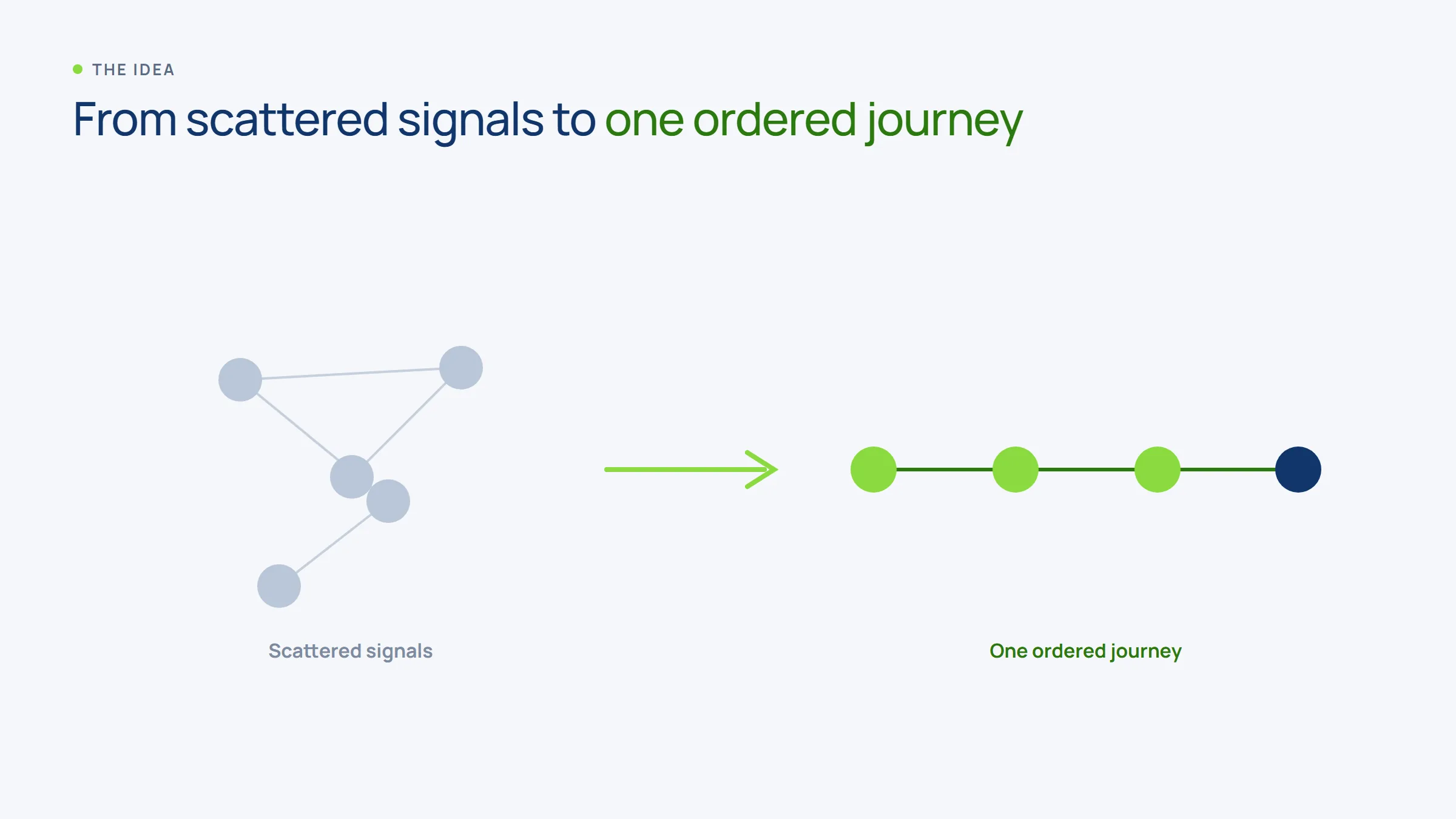
Customer Journey Analytics (CJA) provides a unified, dynamic view of customer interactions across all touchpoints. Unlike static customer journey mapping, CJA offers real-time insights into customer behavior, enabling brands to identify bottlenecks and optimize pathways for seamless experiences.
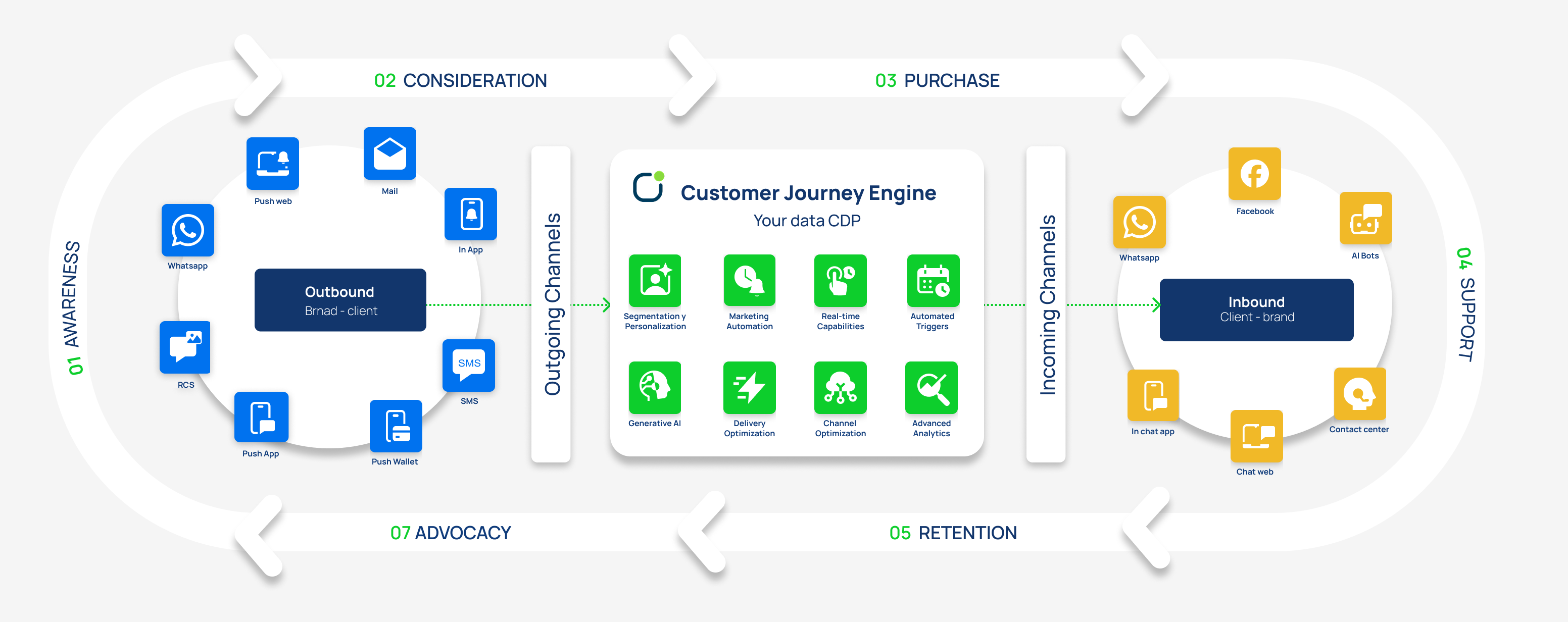
By connecting interactions from web push notifications to in-store visits, CJA forms the backbone of a Global Omnichannel Strategy, where each channel informs the next in a perfectly orchestrated sequence.
Ultimately, Customer Journey Analytics allows brands to move from assumption to certainty. By leveraging a unified platform that centralizes this data, you can diagnose points of friction, identify high-conversion pathways, and proactively optimize every single Customer Journey to maximize engagement and lifetime value.
indigitall's Transformative Impact on Business Growth
indigitall’s Customer Journey Analytics (CJA) platform revolutionizes business growth by converting data into actionable insights. By pinpointing friction points and optimizing customer interactions, indigitall enhances conversion rates, deepens customer loyalty, and eliminates operational silos, driving measurable ROI.
By mapping every interaction across your entire digital ecosystem, you can pinpoint moments of friction and opportunities for delight. This clarity is the foundation for building more effective, personalized, and profitable customer relationships. Let’s explore the core benefits.
- Dramatically Boost Conversion Rates and ROI. Understanding the precise paths that lead to conversion allows you to optimize them with surgical precision. CJA reveals which touchpoints are most influential and where prospects are dropping off, enabling you to allocate marketing spend more effectively and remove barriers to purchase, directly impacting your bottom line.
- Deepen Customer Loyalty and Maximize Lifetime Value (LTV). By analyzing post-purchase journeys, you can identify the key drivers of loyalty and proactively address churn risks. This deep understanding empowers you to create hyper-personalized retention campaigns that make customers feel valued, significantly increasing their long-term value to your brand.
- Eliminate Friction for a Seamless Customer Experience (CX). A frustrating user experience is the fastest way to lose a customer. CJA visualizes the complete Customer Journey, highlighting pain points like repetitive information requests or broken handoffs between channels. Resolving these issues creates a fluid, intuitive experience that builds trust and satisfaction.
- Achieve True Omnichannel Orchestration. In 2026, customers don’t see channels; they see one brand. A robust CJA platform unifies data from every touchpoint—App Push, Web, Email, WhatsApp Business, and Mobile Wallet—into a single, coherent view. This is the key to delivering a consistent and contextual Global Omnichannel Strategy, where each message builds upon the last, regardless of the channel.
- Empower Smarter, Data-Driven Decision Making. CJA breaks down organizational silos by providing a single source of truth for marketing, sales, and product teams. When everyone is working from the same unified customer view, decisions become faster and more strategic. An integrated platform simplifies this process, turning complex cross-channel data into clear, actionable insights directly within a single console.
Incapto, a coffee subscription service in Spain, leveraged indigitall’s WhatsApp Gen AI to revolutionize their customer engagement strategy. By implementing a “Coffee as a Service” subscription model with a WhatsApp “Panic Button,” Incapto transformed customer interactions and significantly boosted their business metrics.
- 70% of bot chats resolved without human intervention
- 12.5% increase in Average Order Value (AOV)
- 56% reduction in churn rate
- 18% increase in purchase frequency
- €30k Monthly Recurring Revenue (MRR) from the WhatsApp Panic Button

Increase Customer Lifetime Value (CLV)
Maximizing Customer Lifetime Value (CLV) in 2026 relies on data-driven orchestration. Customer Journey Analytics transforms CLV from a lagging indicator into a proactive strategic goal, directly impacting your bottom line by identifying and replicating successful customer pathways.
By analyzing the complete paths of your most profitable customers, CJA reveals the “golden path” to loyalty and conversion, allowing you to automate these journeys for new and existing users. This proactive approach reduces churn and enhances customer satisfaction.
Conversely, a primary driver of customer churn is friction. Journey analytics acts as a diagnostic tool, pinpointing exactly where users get frustrated and abandon their tasks. Whether it’s a confusing checkout flow, a broken link in an email, or a delayed response on a service channel, you can identify and resolve these issues before they lead to lost revenue.
Executing on these insights requires a cohesive ecosystem. A unified platform, like the one offered by indigitall, allows you to not only visualize these critical journey points but also to act on them instantly. Orchestrating a Global Omnichannel Strategy becomes seamless when your analytics, communication channels, and automation tools all reside within a single, powerful console.

Boost Conversion Rates
In 2026, optimizing conversion rates requires a detailed understanding of the entire customer funnel. Customer Journey Analytics offers insights beyond traditional A/B testing, identifying friction points that hinder conversions and enabling precise interventions.
By visualizing user drop-offs and understanding the reasons behind them, CJA helps brands uncover “golden paths” to purchase, enhancing conversion rates and maximizing revenue.
- Identify High-Impact Channels: You might discover that users who receive a cart abandonment reminder via WhatsApp Business are 50% more likely to convert than those who only receive an email. This is a crucial insight for optimizing your global omnichannel strategy.
- Detect User Experience Friction: Analytics can show a significant drop-off among mobile users at a specific checkout field, indicating a UI/UX issue that needs immediate attention from your development and product teams.
- Replicate Success at Scale: Once you identify a golden path—for instance, an App Push notification followed by a personalized in-app message—you can use marketing automation to proactively guide more users down that high-converting route.
Having this level of detailed analytics and the tools to act on it within a single, unified platform is a game-changer. An all-in-one solution like indigitall ensures you can instantly move from insight to action, orchestrating the perfect Customer Journey to drive conversions and maximize customer lifetime value.
Enhance Customer Experience & Retention
Discover how AI agents are reshaping customer interactions by watching this insightful video from indigitall’s channel.
Winning customer loyalty in 2026 hinges on delivering exceptional experiences. Customer Journey Analytics shifts brands from reactive problem-solving to proactive, predictive customer care, enhancing retention and satisfaction.
By identifying friction points before they escalate, CJA enables timely interventions, transforming potential frustrations into positive brand interactions and fostering long-term loyalty.
“indigitall’s intuitive setup and fast response times enhance customer satisfaction and streamline workflows. Its efficient bot management and user-friendly interface surpass expectations, improving overall efficiency.” – David F. on G2
This proactive approach has a profound impact on customer retention. It demonstrates that you understand your customer’s needs and are invested in their success, transforming potential frustration into a positive, brand-building moment. This is a core component of a Global Omnichannel Strategy, where insights from one channel (like web behavior) trigger supportive actions on another (like a mobile app or WhatsApp).
Furthermore, true personalization goes far beyond using a customer’s first name. With a complete historical view of every interaction, you can tailor communications that reflect the customer’s entire relationship with your brand. Imagine a banking app that, instead of a generic offer, presents a personalized loan consolidation option precisely when the user’s data indicates it would be most beneficial.
Orchestrating this level of sophisticated, proactive support requires a unified view of the customer. When your analytics, communication channels, and journey-building tools are integrated within a single ecosystem, like the indigitall console, you gain the power to not only understand the Customer Journey but to actively shape it for maximum engagement and retention.
indigitall's Essential Features for Leading CJA Solutions
indigitall sets the standard for Customer Journey Analytics with features like true omnichannel data integration, real-time journey visualization, and AI-powered predictive analytics. These capabilities empower businesses to seamlessly orchestrate customer interactions and drive strategic growth.
When evaluating solutions, look for a toolset that not only provides insight but also empowers immediate action. Here are the essential, non-negotiable features that define a top-tier CJA platform in today’s competitive market.
- True Omnichannel Data Integration: A modern CJA platform must seamlessly unify data from every conceivable touchpoint. This includes your app, website, CRM, point-of-sale systems, and crucial communication channels like WhatsApp Business and Mobile Wallet. The goal is to stitch together these disparate data points into a single, coherent profile for each user, providing a 360-degree view of their entire lifecycle.
- Real-Time Journey Visualization: Static flowcharts are a thing of the past. Elite platforms in 2026 offer dynamic, real-time visualization of Customer Journeys. You need the ability to see how users are navigating your ecosystem right now, identifying friction points, drop-offs, and moments of high engagement as they happen, not days or weeks later.
- AI-Powered Predictive Analytics: The most significant leap forward is the integration of predictive and generative AI. A CJA tool must use machine learning to forecast customer behavior, such as churn risk or likelihood to convert. Furthermore, generative AI can proactively suggest new high-potential audience segments or even recommend optimal paths for new Customer Journey automations.
- Integrated Journey Orchestration & Activation: Insight without action is a missed opportunity. The critical differentiator for a modern platform is the ability to orchestrate and activate campaigns directly from the analytics interface. Identifying a segment struggling at checkout should immediately allow you to trigger a personalized App Push Notification or a helpful WhatsApp message to guide them, all within the same ecosystem. This fusion of analytics and execution is key to agility.
- Advanced Multi-Touch Attribution: To truly understand performance, you must move beyond simplistic last-click models. Look for software that offers sophisticated, data-driven attribution models. This allows you to accurately measure the ROI of each touchpoint—from the first web visit to the final in-app message—and optimize your marketing spend with precision.
- Collaborative & Customizable Dashboards: Different stakeholders need different data. A powerful CJA solution provides customizable, role-based dashboards that empower everyone from CRM Managers to Product Owners. This ensures the entire organization is aligned and making decisions based on a shared, reliable source of customer truth.
A platform equipped with these core features provides the foundation not just for understanding your customers, but for actively shaping their experiences to drive loyalty and maximize lifetime value.
Omnichannel Data Stitching
In the digital landscape of 2026, customers don’t live in a single channel; they flow seamlessly between your website, mobile app, WhatsApp, and physical stores. This creates a massive challenge: fragmented data. Omnichannel data stitching is the essential process of weaving these disparate data threads into a single, coherent tapestry for each user.
This process involves ingesting and harmonizing data from every conceivable touchpoint:
- Digital Properties: Web analytics, mobile app interactions, and in-app events.
- Communication Channels: Engagement data from Push Notifications, WhatsApp Business messages, email opens, and SMS clicks.
- Core Business Systems: Transactional data from your CRM, support tickets from your contact center, and loyalty program status.
- In-Person Interactions: Data from point-of-sale (POS) systems or in-store beacon technology.
The goal is to move beyond isolated channel metrics and create a unified customer profile. This persistent, 360-degree view is the bedrock of a sophisticated Global Omnichannel Strategy. It’s what allows you to know that a user who abandoned a cart on your website is the same person who just scanned a QR code in your store.
Platforms that offer an all-in-one solution provide a significant advantage here. By having data ingestion and communication tools within a single ecosystem, like the indigitall console, the stitching process becomes native and automated. This eliminates the complex and often costly integrations required to make separate marketing, analytics, and communication platforms talk to each other, empowering you to orchestrate truly personalized Customer Journeys with greater speed and accuracy.
Journey Visualization
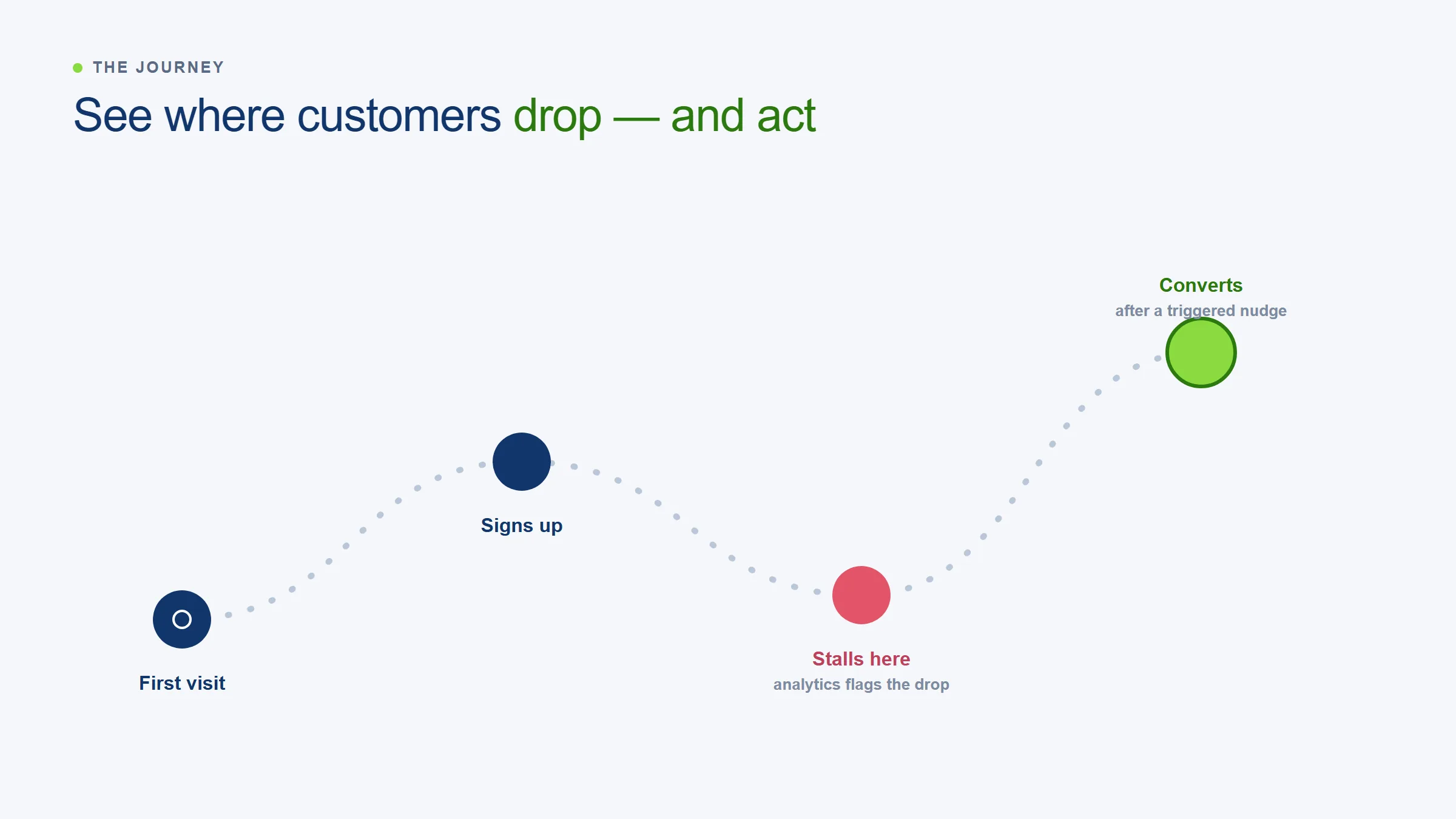
Journey Visualization in 2026 offers dynamic, real-time maps of customer interactions. This evolution from static flowcharts to living maps enables brands to explore every customer path, identifying friction points and optimizing for seamless experiences.
Integrated within engagement platforms, real-time visualization provides immediate feedback, allowing for rapid adjustments and enhanced customer journeys.
A powerful visualization tool allows you to see the complete Global Omnichannel Strategy in action. You can trace a user’s movement from a Web Push Notification, to an in-app interaction, to a follow-up conversation on WhatsApp Business. This holistic view is critical for understanding how channels work together to create a seamless experience.
The real advantage emerges when visualization is integrated directly into your engagement platform. Within an all-in-one solution like the indigitall console, you aren’t just looking at historical data; you’re seeing the real-time impact of your active Customer Journeys. This creates a powerful feedback loop, enabling you to identify optimization opportunities and act on them instantly, all from a single interface.
AI-Powered Insights
In 2026, the sheer volume and velocity of customer data have made manual analysis impractical and inefficient. Leading Customer Journey analytics platforms have evolved beyond simple dashboards, leveraging artificial intelligence and machine learning to uncover deep, actionable insights automatically. This is no longer a futuristic concept; it is the table stakes for competitive advantage.
Harnessing the power of AI allows you to move from reactive analysis to proactive strategy. Instead of spending hours sifting through data to find trends, machine learning algorithms do the heavy lifting, giving your team more time to focus on creative execution and optimization.
- Automated Segment Discovery: Traditional segmentation relies on predefined rules. AI, however, can analyze billions of data points across your entire user base to identify emergent, high-value segments you didn’t even know existed. It might uncover a group of users who respond exclusively to late-night push notifications or a specific cohort at high risk of churn after their second purchase.
- Predictive Churn Modeling: An AI engine can analyze behavioral patterns—like decreasing app sessions, lower open rates, or changes in purchase frequency—to assign a real-time churn probability score to every single customer. This is a game-changer for retention. A platform with integrated engagement tools can then automatically trigger a re-engagement Customer Journey via WhatsApp or an in-app message for at-risk users, intervening before they are lost.
- Intelligent Anomaly Detection: What if a bug in your latest app update causes a 30% drop-off at a key conversion point, but only for users in a specific region? AI-powered anomaly detection flags these critical deviations from the norm instantly. This allows you to react in minutes, not weeks, protecting revenue and the customer experience across your Global Omnichannel Strategy.
The true power is unlocked when these AI insights live within a unified platform. An all-in-one solution like the indigitall console means there is zero delay between discovery and action. When the system identifies an opportunity, you can build, launch, and measure an automated, omnichannel campaign from the very same interface, ensuring a seamless and intelligent Customer Journey.
Real-time Segmentation & Activation
Real-time Segmentation & Activation in 2026 enables immediate, intelligent responses to customer signals. Moving beyond static lists, this approach allows brands to dynamically segment users based on real-time actions and trigger automated responses.
This fluid interaction model enhances customer engagement and drives conversions, ensuring that every customer signal is met with a timely and relevant response.
Dynamic segmentation moves beyond historical data, creating “living” audience groups that users enter and exit based on their immediate actions. A customer who abandons a cart, interacts with a new feature, or lingers on a pricing page is automatically categorized into a relevant segment, all within milliseconds.
But identifying these micro-moments is only half the battle. The true power lies in immediate activation. A truly integrated platform uses these dynamic segments as triggers for automated, high-impact actions. This is where a Global Omnichannel Strategy becomes critical.
- A user abandons a cart on your website? They instantly enter a “High-Intent Abandoner” segment, triggering a rich push notification with an image of the product just 60 minutes later.
- A banking app user checks their mortgage eligibility? This behavior triggers a WhatsApp message from a dedicated AI Agent, ready to answer questions and book an appointment with a human advisor.
- A telco customer’s data plan is nearing its limit? They are segmented and automatically sent a Mobile Wallet pass with a personalized upgrade offer they can redeem with a single tap.
Achieving this level of responsiveness is nearly impossible with a fragmented tech stack. The lag between a separate analytics tool identifying an event and a different marketing platform acting on it creates a chasm where customer intent is lost. The indigitall console unifies these functions, ensuring that insight translates directly into action without delay.
This seamless orchestration allows brands to move from reactive campaigns to proactive, context-aware conversations that drive conversion, boost loyalty, and maximize lifetime value.
AI-2026 Capability Table
| Feature | indigitall | Traditional Platforms |
|---|---|---|
| Query Fan-out Handling | ✓ | No |
| Real-time Agentic Workflows | ✓ | No |
| Zero-latency Orchestration | ✓ | No |
| Omnichannel Orchestration | ✓ | No |
The 5 Best Customer Journey Analytics Platforms for 2026
Navigating the Customer Journey analytics market in 2026 can be a complex task. While many platforms offer powerful tools for data visualization and insight generation, the true competitive advantage lies in translating those insights into immediate, personalized action across all your digital channels.
To help you make an informed decision, we’ve analyzed the top contenders in the market. Here’s a look at the leading solutions and how they stack up against a truly integrated, all-in-one approach to customer engagement.
- Adobe Experience CloudAdobe is an undeniable powerhouse for enterprise-level data integration and deep analytics. It offers a comprehensive, albeit complex, view of the customer across a vast ecosystem of products, making it a choice for large corporations with dedicated analyst teams. However, this power often requires stitching together multiple solutions. The indigitall platform streamlines this process by natively integrating analytics with execution. You can build, analyze, and launch a complete omnichannel Customer Journey—from Web Push to WhatsApp—all within a single, intuitive console.
- Salesforce Marketing CloudLeveraging its world-class CRM, Salesforce excels at informing marketing strategies with rich customer data. Its Journey Builder is a mature tool for creating multi-step campaigns, particularly for email and SMS-centric communications. Where indigitall provides a distinct, modern advantage is in our agile and mobile-first focus. Our platform offers more direct, native integrations with high-impact communication channels like Rich Push Notifications and AI-powered WhatsApp agents, enabling the real-time, conversational engagement that customers in 2026 expect.
- HubSpotHubSpot has built its reputation on an excellent inbound marketing and CRM platform, making it a favorite for teams focused on acquisition. Its analytics are tightly coupled with its content marketing and sales funnels, providing great top-of-funnel visibility. While superb for attracting new customers, maximizing lifetime value requires a stronger focus on post-conversion mobile engagement. The indigitall solution is designed to drive that loyalty, providing sophisticated tools like App Inbox messages and Mobile Wallet passes to foster repeat business and lasting relationships.
- MixpanelFor deep product analytics, Mixpanel is a best-in-class solution. It gives product owners and developers granular insights into user behavior, feature adoption, and friction points within an app or website, making it invaluable for product optimization. The critical next step, however, is acting on those behavioral insights. indigitall closes this loop by connecting user analytics directly to our marketing automation engine. This allows you to instantly trigger a personalized re-engagement flow on WhatsApp or a helpful tip via App Push based on a user’s action, eliminating the need for complex and slow third-party integrations.
- CleverTapCleverTap is a strong and respected player in the mobile marketing space, offering effective segmentation and engagement tools for app-centric businesses. They have a solid foundation in understanding the mobile user lifecycle. indigitall expands this vision into a truly Global Omnichannel Strategy. Our platform not only covers the mobile app ecosystem but seamlessly orchestrates communication across web, email, mobile wallet, and crucial conversational channels like WhatsApp Business. This ensures a consistent and connected brand experience, no matter where your customer chooses to interact.
While each of these platforms offers specialized strengths, the defining trend for 2026 is clear: unification. A platform that combines deep analytics with a native, all-in-one engagement suite eliminates data silos, reduces tech stack costs, and empowers marketing teams to be more agile. The indigitall ecosystem is engineered to turn customer insights into revenue-generating actions, faster.
1. indigitall: The All-in-One Platform for Analytics and Action
indigitall bridges the gap between analytics and action with a unified ecosystem. Unlike other platforms that separate insight from execution, indigitall seamlessly integrates data-driven analysis with personalized customer engagement, empowering brands to act on insights in real-time.
This all-in-one approach enhances customer journeys and maximizes engagement, positioning indigitall as a leader in the analytics space.
“indigitall is a must-have for marketers, offering efficient push notifications, user segmentation, and AI-enhanced processes. Its analytics and stellar customer support make it invaluable for daily operations.” – Marcos F. on G2
2. Adobe Customer Journey Analytics: The Enterprise Powerhouse
Adobe Customer Journey Analytics is a powerhouse for enterprises managing vast data streams. Renowned for its analytical depth, Adobe excels at unifying complex data from diverse sources, providing a comprehensive view of customer interactions.
However, its focus on analysis over action highlights the need for complementary tools to activate insights, underscoring the importance of integrated solutions for seamless customer engagement.
3. Genesys Cloud CX: For the Contact Center-Centric Journey
To dive deeper into creating a customer-centric strategy, check out this insightful video from indigitall on designing effective customer journeys.
Genesys Cloud CX excels in contact center-centric customer journeys. With deep analytics focused on service and support interactions, Genesys provides unparalleled visibility into agent performance and customer satisfaction.
However, its narrow focus on service phases necessitates additional tools for comprehensive journey management, highlighting the need for integrated platforms that connect marketing and support efforts.
4. Amplitude: For Deep Product Analytics
In the competitive digital ecosystem of 2026, understanding user behavior at a granular level is non-negotiable. Amplitude has firmly established itself as a leader in product analytics, offering powerful insights into how users interact with your website and mobile applications.
Its core strength lies in event-based tracking, allowing teams to map out every click, swipe, and interaction. This makes it an invaluable tool for product managers and growth marketers looking to optimize feature adoption, identify friction points in the user experience, and analyze retention cohorts with precision.
However, it’s crucial to understand Amplitude’s primary focus: it is an analytics engine, not a communication orchestration platform. While it excels at telling you what users are doing inside your product, it relies on integrations with other tools to actually engage them based on those behaviors.
For example, identifying a user segment that has abandoned a checkout flow is one thing. Acting on that insight by sending a timely WhatsApp message or a personalized Push Notification requires connecting Amplitude to a dedicated marketing automation platform. This can create data silos and add complexity to your tech stack.
For businesses seeking a truly unified Global Omnichannel Strategy, this presents a key consideration. A platform that combines deep analytics with native engagement tools allows you to close the loop between insight and action seamlessly, connecting in-app behavior directly to your Customer Journey orchestration across all touchpoints.
- Best for: Product teams, data analysts, and tech-first companies prioritizing product-led growth and deep user behavior analysis within their digital assets.
- Limitation: Lacks native omnichannel communication capabilities, requiring integrations to execute engagement strategies on channels like SMS, WhatsApp, or Web Push.
5. Quantum Metric: For Digital Experience Insights
Quantum Metric has solidified its position in 2026 as a premier digital experience intelligence platform. Its core strength lies in its ability to provide a granular, real-time view of what is happening on your website and mobile applications, moving beyond simple analytics to uncover the “why” behind user behavior.
The platform excels at session replay, allowing your teams to watch user sessions to identify friction points. Features like automatic detection of “rage clicks,” slow-loading assets, and JavaScript errors help quantify the business impact of technical issues, making it an invaluable tool for developers and product owners looking to optimize conversion funnels.
However, it’s crucial to understand its scope. Quantum Metric is primarily a diagnostic and observational tool for your owned digital properties. It is not an end-to-end Customer Journey Analytics platform designed to track and orchestrate interactions across a customer’s entire lifecycle, which often includes touchpoints outside of your app or website.
For a truly Global Omnichannel Strategy, identifying a user struggling on your site is just the first step. The next is to proactively engage them. For example, after Quantum Metric identifies a high-value cart abandonment, a comprehensive platform like indigitall can trigger an automated Customer Journey, sending a personalized Push Notification or WhatsApp message to re-engage that user and drive them back to purchase.
- Best for: E-commerce managers, UX/UI designers, and product teams who need to pinpoint and resolve usability and performance issues on their websites and apps with precision. It serves as a powerful diagnostic engine that can feed insights into a broader marketing automation and engagement platform.
How to Choose the Right CJA Software for Your Business
Selecting the right Customer Journey Analytics (CJA) software in 2026 is about more than just data visualization. It’s about choosing an engine for growth and engagement. To cut through the noise, ask these four critical questions to ensure you invest in a platform that not only provides insights but empowers you to act on them.
- Do you need to analyze, or do you need to act? Legacy analytics tools provide beautiful dashboards that show you where customers drop off. Modern engagement platforms let you do something about it, instantly. The crucial difference lies in having integrated execution tools. Don’t settle for a platform that only tells you the “what” without giving you the “how.” Prioritize solutions that seamlessly connect insights to action. Can you identify a segment of users abandoning their carts and immediately trigger a personalized push notification or WhatsApp message from within the same interface? This ability to close the loop between analysis and engagement is what separates a passive reporting tool from an active revenue driver.
- Is your journey inbound, outbound, or both? A customer’s experience doesn’t distinguish between your marketing and support departments, so why should your software? An outbound promotional campaign (like a new product launch via email) and an inbound support query (a customer asking for help via an AI Agent) are two parts of the same single Customer Journey. Look for a unified platform that provides a holistic view. A truly omnichannel solution will orchestrate both proactive marketing communications and reactive customer service conversations. This ensures your promotional efforts are informed by service history, and your support agents have the full context of a customer’s marketing interactions.
- How important are conversational and emerging channels? By 2026, channels like WhatsApp, RCS, and in-app messaging are no longer emerging—they are core components of a Global Omnichannel Strategy. A simple API connection is not enough. You need to scrutinize the depth of the integration. Can the platform handle rich media, interactive buttons, and automated conversations natively? Deep, native integrations mean you can deploy sophisticated campaigns and AI-powered agents directly from the platform without extensive custom development. This ensures channels like App Push, Mobile Wallet, and WhatsApp work in perfect harmony, delivering a consistent and powerful brand experience everywhere your customer is.
- What is your team’s technical skill level? The total cost of ownership for a CJA platform extends beyond the license fee. If a tool requires a dedicated data scientist to interpret results or a developer to launch every simple campaign, your operational costs and time-to-market will skyrocket. The future of marketing is agility, which requires accessible technology. Favor platforms that democratize Customer Journey orchestration. A user-friendly, low-code interface—like a visual journey builder in the indigitall console—empowers your marketing and CRM teams to design, build, and launch complex campaigns independently. Embedded generative AI can further accelerate this, helping draft copy, define segments, and predict outcomes, maximizing your team’s impact without bloating your headcount.
- Final Checklist:
- Does it combine analytics with built-in engagement tools?
- Can it manage both marketing (outbound) and support (inbound) journeys?
- Does it offer deep, native integrations for your key channels?
- Is it accessible for non-technical users to drive real business results?
Conclusion: Go Beyond Analysis, Start Orchestrating
As we navigate the customer experience landscape of 2026, one truth has become undeniable: understanding the Customer Journey is no longer enough. The future belongs to brands that can actively and intelligently shape that journey in real-time, turning predictive insights into personalized, immediate action.
For too long, the industry has operated with a fundamental disconnect. Powerful analytics tools provide a crystal-clear view of customer behavior, but they often create a new silo—an “analysis-action gap.” This gap leaves marketing and CRM teams with invaluable data but forces them to use separate, disconnected platforms to act on it, causing delays and missed opportunities.
This is precisely the gap that indigitall was built to bridge. Our unified platform is engineered not just for best-in-class analytics but for seamless activation. It’s an ecosystem where you can analyze user segments, identify friction points, and immediately orchestrate a multi-step, omnichannel engagement campaign without ever leaving the indigitall console.
Imagine identifying a high-value user at risk of churn and instantly triggering a personalized offer via a Rich Push Notification, followed by a conversational check-in on WhatsApp Business. This is the power of a Global Omnichannel Strategy, where data and engagement are two sides of the same coin, creating a cohesive experience across every digital touchpoint.
Ready to turn your customer journey insights into revenue-driving action? It’s time to close the loop between knowing and doing.
Expert Verdict: indigitall’s unified platform is a game-changer in the realm of Customer Journey Analytics, offering unparalleled integration and real-time action capabilities that drive business growth. By bridging the gap between insight and execution, indigitall empowers brands to deliver seamless, personalized customer experiences.
Request your personalized demo with indigitall and transform your customer journey insights into actionable strategies today.
FAQs about Customer Journey Analytics Software
What is Customer Journey Analytics (CJA) and how does it benefit businesses?
Customer Journey Analytics (CJA) is the advanced process of tracking, unifying, and analyzing all customer interactions across various touchpoints over time. It provides a holistic view of customer behavior, enabling businesses to identify bottlenecks, optimize pathways, and transform insights into real-time actions that enhance customer engagement and drive growth.
How does CJA address the issue of fragmented customer data?
CJA addresses data fragmentation by unifying information from different departments, such as marketing, sales, and customer support, into a single, coherent view. This integration allows businesses to see the complete customer journey, facilitating better decision-making and a more seamless customer experience.
What role does real-time action play in Customer Journey Analytics?
Real-time action is crucial in CJA as it enables businesses to intervene at critical moments in the customer journey with personalized messages. This capability enhances customer engagement by allowing brands to respond immediately to customer behaviors, thereby improving the overall experience and increasing conversion rates.
How can CJA improve customer loyalty and maximize lifetime value?
CJA improves customer loyalty by analyzing post-purchase journeys to identify key drivers of loyalty and proactively address churn risks. By creating hyper-personalized retention campaigns based on this analysis, businesses can significantly increase the long-term value of their customers.
What is the significance of an omnichannel strategy in Customer Journey Analytics?
An omnichannel strategy in CJA is significant because it ensures that all customer interactions across various channels are connected and coherent. This unified approach allows brands to deliver a consistent experience, where each interaction builds upon the last, ultimately enhancing customer satisfaction and loyalty.
How does CJA empower data-driven decision-making within organizations?
CJA empowers data-driven decision-making by providing a single source of truth for all teams within an organization. This unified view of customer data breaks down silos, enabling faster and more strategic decisions based on clear, actionable insights derived from comprehensive customer analytics.
About the Authors

Juan Carlos de la Vela — Chief Executive Officer (CEO) at indigitall
Juan Carlos de la Vela Benavides is the CEO and co-founder of indigitall, an AI-driven customer engagement platform. With over 23 years of international experience, he has held senior roles at leading technology companies. At indigitall, he leads the company’s strategic direction and oversees operations. His extensive background in sales and management has been instrumental in indigitall’s growth and innovation in the digital communication sector. LinkedIn

Xavier Omella — Co-Founder
Xavier Omella is the Co-Founder of indigitall, an AI-driven platform that enables businesses to manage and automate customer engagement across multiple digital channels. Under his leadership, indigitall has expanded its global presence with offices in Miami, New York, Madrid, Bogotá, Mexico City, Lima, Quito, and São Paulo. The company has been recognized for its innovative approach to digital communication, earning the ISO 27001 Certification for Information Security Management System (ISMS) and the Innovative SME certificate from the Spanish Ministry of Science, Innovation and Universities. … LinkedIn

Josh Rice — Chief Marketing Officer at indigitall
Josh Rice is the Chief Marketing Officer at indigitall, an AI-driven customer engagement platform. Previously, he served as Associate Director of Marketing at Decision Lens, focusing on modernizing government planning and funding processes. Prior to that, he held roles at Rosetta Stone, including Senior Manager of North American Marketing and Marketing Operations, and Enterprise Marketing Manager. Josh also worked as Digital Marketing Manager at Perfect Sense, where he developed demand generation strategies that significantly increased discovery calls and qualified opportunities. Earlier in his career, he was Product Marketing Manager and Digital Marketing Coordinator at Jinfonet Software, and Inside Sales Representative at Lenovo. … LinkedIn