indigitall Omni AI
 Start chat with AI agent
 Speak with AI voice agent
 Book a Demo

 Speak to an Expert












How to Measure Marketing Automation Success: The Definitive Guide



Introduction: Are You Just Automating Tasks or Driving Real Growth?
In 2026, marketing automation is no longer a competitive advantage; it’s a fundamental part of the digital ecosystem. You’ve meticulously built your workflows, automated your welcome series, and triggered cart abandonment reminders. But here’s the critical question: can you confidently connect those automated actions to a real, measurable impact on your bottom line?
Too many brands are stuck in a cycle of measuring efficiency—time saved, tasks completed, messages sent. While important, these are not growth metrics. The true measure of success lies in linking every automated touchpoint to concrete business outcomes like revenue growth, customer lifetime value (LTV), and enhanced loyalty.
The core challenge is often a fragmented view. Your App Push data lives in one system, your WhatsApp Business interactions in another, and your web notifications in a third. This siloed approach makes it nearly impossible to understand the complete Customer Journey and accurately attribute conversions to your Global Omnichannel Strategy.
This guide will shift your focus from simply “doing” automation to proving its value. We’ll explore the frameworks, KPIs, and strategies needed to transform your automation engine from a task-manager into a powerful driver of sustainable growth. The key is moving towards a unified platform where you can orchestrate, measure, and optimize every interaction seamlessly.
First, Set the Right Targets: Defining Your Automation Goals
Before you even think about dashboards, metrics, and KPIs, you need a north star. In the fast-paced digital landscape of 2026, launching automation without clear, strategic goals is like setting sail without a destination—you’ll be active, but you won’t be productive. The most powerful metrics are meaningless if they aren’t tied to a specific business outcome.
This is where a classic framework remains as relevant as ever: SMART goals. Defining your objectives through this lens ensures every automated Customer Journey you build is purposeful, measurable, and aligned with your company’s core mission.
- Specific: Your goal must be clear and unambiguous. Instead of “improve engagement,” aim for “reduce cart abandonment rates for first-time shoppers.” This level of detail guides your entire strategy.
- Measurable: You must be able to track your progress with concrete data. How will you know you’ve succeeded? This is where you define the KPIs that will live in your reporting dashboards.
- Achievable: While ambitious goals are great, they must be realistic. Consider your team’s resources, budget, and the capabilities of your marketing automation platform. A unified solution like indigitall can often make more ambitious goals achievable by simplifying complex orchestration.
- Relevant: Does this goal matter to the business? A great automation goal directly supports a larger business objective, such as increasing revenue, improving market share, or enhancing customer lifetime value (LTV).
- Time-bound: Every goal needs a deadline. Setting a target date creates urgency and provides a clear timeframe for measuring success and iterating on your strategy.
By applying this framework, vague aspirations transform into actionable strategic initiatives. The difference is moving from “we want more leads” to a powerful, directive goal that your entire team can rally behind.
Here are a few examples of what effective SMART goals look like for a modern marketing automation strategy in 2026:
- Lead Conversion Goal: Increase our MQL to SQL conversion rate by 15% before the end of Q3 2026 by implementing an automated lead nurturing Customer Journey that uses AI-powered WhatsApp conversations to answer questions and targeted push notifications to drive prospects to key content.
- Onboarding Goal: Reduce new customer onboarding drop-off by 20% within the first 60 days by deploying a welcome series that combines in-app messages, instructional emails, and a final check-in via a personalized message.
- Retention & LTV Goal: Boost customer retention by 5% over the next fiscal year by launching an omnichannel loyalty program that delivers exclusive offers via Mobile Wallet passes and alerts members to new benefits through app push notifications.
Notice how each goal specifies the “what,” the “how much,” the “how,” and the “by when.” This clarity is the foundation of a successful, data-driven automation strategy that delivers real, measurable business impact.
The Core Marketing Automation KPIs You Must Track
While your strategic goals define the “why” behind your marketing automation efforts, your Key Performance Indicators (KPIs) are the tactical, measurable metrics that track your progress. Think of your goal as the destination—like increasing customer lifetime value—and KPIs as your real-time dashboard, guiding every turn of your strategy.
In the hyper-connected landscape of 2026, the challenge isn’t a lack of data; it’s an overabundance of it. Focusing on the right KPIs is crucial to avoid “analysis paralysis” and gain actionable insights that drive real business growth. The most successful teams are those who can filter out the noise and zero in on the metrics that truly matter.
To bring clarity to this process, we’ve organized the most critical marketing automation KPIs into logical categories. This framework helps you evaluate performance across the entire Customer Journey, from initial awareness and engagement to conversion and long-term loyalty.
A truly effective Global Omnichannel Strategy requires a unified view of these metrics. When KPIs for your App Push notifications, WhatsApp Business campaigns, and AI Agent interactions are all centralized in a single ecosystem, like the indigitall console, you can orchestrate seamless experiences instead of analyzing siloed channel data. This holistic perspective is the key to unlocking next-level performance.
Campaign & Engagement Metrics
While the ultimate goal of marketing automation is to drive revenue and LTV, the journey there is paved with smaller, crucial interactions. Campaign and engagement metrics are the vital signs of your communication strategy, offering real-time feedback on message relevance and audience resonance. In 2026, we’ve moved beyond surface-level vanity metrics to a more nuanced understanding of genuine customer interaction.
These top-of-the-funnel indicators are the first signals that your segmentation, personalization, and creative are hitting the mark. Tracking them diligently allows you to optimize your Customer Journeys before they lead to poor business outcomes.
Core Engagement Metrics (The Classics, Reimagined for 2026)
- Open Rate: A foundational metric, the Open Rate measures the percentage of recipients who opened your message. While its reliability for email has been debated due to privacy features, it remains a powerful indicator for App Push and Web Push Notifications, reflecting the immediate impact of your headline and timing.
- Click-Through Rate (CTR): The gold standard for measuring immediate action. CTR tracks the percentage of users who clicked on a link, button, or CTA within your message. A strong CTR signals that your offer and creative were compelling enough to drive the user to the next step in their journey.
- Unsubscribe Rate: This is arguably one of the most honest pieces of feedback you can receive. A low unsubscribe rate indicates a healthy relationship with your audience, validating your content relevance and contact frequency. A sudden spike is an immediate red flag that a specific campaign or segment needs re-evaluation.
Advanced Interaction Metrics (The New Standard)
In today’s omnichannel ecosystem, a simple click is no longer the only measure of success. Modern platforms empower brands to track deeper, more meaningful interactions that signal high intent and engagement.
- Push Notification Interaction Rate: This metric goes beyond a simple tap. It measures engagement with rich content like image carousels, interactive buttons (“Add to Wallet,” “Set Reminder”), or direct-reply fields. A high interaction rate shows users are not just acknowledging your message but actively engaging with its functionality.
- In-App Message Engagement: For in-app messages, success isn’t just about a user not closing the pop-up. True engagement is measured by clicks on internal deep links, completion of embedded micro-surveys, or interaction with personalized offers directly within the message.
Analyzing these metrics in isolation provides channel-specific insights. However, the real power comes from viewing them holistically within a unified platform. The indigitall console, for example, allows you to see how a high CTR on a WhatsApp campaign directly influences the interaction rate on a subsequent in-app message, giving you a true, actionable view of your Global Omnichannel Strategy.
Lead Funnel & Conversion Metrics
While top-of-funnel metrics paint a broad picture, the real power of automation is revealed when you measure its impact on moving prospects through the entire sales pipeline. In the hyper-connected ecosystem of 2026, tracking the lead funnel is less about a linear path and more about understanding the efficiency of your orchestrated Customer Journeys.
These metrics are the vital signs of your growth engine, showing how effectively your automated workflows are identifying, nurturing, and converting potential customers. They provide a clear, data-driven narrative of your marketing ROI.
- Lead Generation Rate: This foundational metric measures the pace at which your automation platform is capturing new leads. It reflects the effectiveness of your automated entry points, from web push opt-ins and AI-powered chat assistants to interactive forms delivered via WhatsApp.
- Cost Per Lead (CPL): How efficiently are you acquiring each new prospect? Marketing automation should drastically lower your CPL by optimizing ad spend, improving targeting precision, and reducing the manual effort required for lead capture and initial qualification.
- Marketing Qualified Leads (MQLs) Generated: This tracks the volume of leads your automation has scored and deemed ready for nurturing. It’s a direct measure of your system’s ability to sift through the noise and identify prospects with genuine potential based on behavioral triggers and engagement data.
- Sales Qualified Leads (SQLs) Generated: This measures the number of MQLs that have been nurtured so effectively by your automated campaigns that they are now ready for a direct sales conversation. A high MQL-to-SQL rate is a strong indicator of successful, personalized nurturing sequences.
However, the single most important metric in this category is the Lead-to-Customer Conversion Rate. This is the moment of truth. It measures the percentage of leads that ultimately make a purchase, proving that your automated nurturing—from personalized emails and targeted push notifications to timely WhatsApp messages—is successfully transforming interest into revenue.
Tracking these funnel stages from a single interface, like the indigitall console, is critical for fostering alignment between marketing and sales. When both teams operate from a shared set of data and definitions for MQLs and SQLs, the handoff becomes seamless. This unified view eliminates friction and ensures marketing is delivering high-quality, conversion-ready leads that the sales team can close effectively.
Revenue & Business Impact Metrics
While engagement and conversion metrics are vital for day-to-day optimization, the C-suite speaks a different language: the language of revenue. In 2026, proving the direct financial impact of your marketing automation efforts is non-negotiable. These are the metrics that secure budgets and elevate your team from a cost center to a core revenue driver.
Let’s explore the key metrics that tie your automated Customer Journeys directly to the bottom line.
- Marketing-Sourced Revenue: This is the cleanest line you can draw from effort to income. It represents revenue generated from sales where marketing automation was the first or last touchpoint before the conversion. For example, a customer clicks a promotional App Push notification sent via the indigitall console and makes a purchase within that same session.
- Marketing-Influenced Revenue: The modern Customer Journey is a complex web of interactions. This metric acknowledges that reality, tracking all sales where marketing automation played a role, even if it wasn’t the final click. A customer might receive a WhatsApp message, see a web ad, and then later search for your brand directly. A powerful omnichannel platform connects these dots to show how your automation strategy influenced the final decision.
- Customer Lifetime Value (CLV): This is the ultimate measure of a healthy customer relationship. CLV predicts the total net profit your company will make from any given customer. Marketing automation is your primary tool for maximizing it through personalized upselling, cross-selling, and loyalty campaigns that boost retention and repeat purchases.
By effectively orchestrating a Global Omnichannel Strategy—engaging users on their preferred channels like WhatsApp, App, and Web—you create a seamless experience that encourages long-term loyalty and directly increases CLV.
Ultimately, these components roll up into the most critical business metric of all: Return on Investment (ROI). Calculating your Marketing Automation ROI is the definitive way to prove its value. The formula is straightforward:
ROI = (Revenue Gain from Marketing – Marketing Cost) / Marketing Cost
Here, “Revenue Gain” is the lift from your sourced and influenced revenue, and “Marketing Cost” includes platform fees, campaign spend, and human resources. Consolidating your tools into a unified ecosystem like indigitall not only enhances your strategic capabilities but can also streamline costs, paving a clearer path to a powerful, positive ROI.
The indigitall Advantage: Measuring a Truly Unified Strategy
The measurement models of 2025 are no longer sufficient. In today’s hyper-connected ecosystem, tracking channel metrics in isolation—looking at email open rates here, and push notification CTR there—provides a dangerously fragmented view of performance. It tells you how a channel is doing, but not how your customer is behaving.
This siloed approach is a remnant of a disconnected martech stack. When your web push provider, WhatsApp Business Platform, and app engagement tool don’t communicate, you’re left stitching together disparate reports. This fractured data makes it impossible to understand the true impact of your complete marketing automation strategy.
At indigitall, we believe that true measurement is not channel-centric; it is customer-centric. The goal is to measure the effectiveness of a complete Customer Journey as it flows seamlessly across touchpoints. Our platform was built from the ground up to provide this single source of truth.
From the indigitall console, you gain a holistic view of user engagement. You can analyze how an initial Web Push alert leads to a WhatsApp conversation powered by an AI Agent, which in turn drives a conversion within your native app. This is the power of a Global Omnichannel Strategy, where every channel works in concert.
This unified measurement framework delivers critical strategic advantages:
- True Cross-Channel Attribution: Finally, you can accurately see how interactions on one channel directly influence actions on another. You can measure the real ROI of a sequence, not just a single message.
- Holistic Customer Profiles: Build a complete, 360-degree view of each user’s interactions within a single profile, enabling deeper segmentation and more effective personalization.
- Smarter Journey Orchestration: Use real-time performance data from one step of a Customer Journey to dynamically optimize the next, regardless of the channel.
- Focus on Business Outcomes: Shift the conversation from vanity metrics like “clicks” to high-impact KPIs like Lifetime Value (LTV), conversion rates, and churn reduction across your entire customer base.
In the competitive landscape of 2026, leveraging an all-in-one solution is more than a convenience—it’s a fundamental requirement for accurate measurement and sustainable growth. It’s the only way to move from managing campaigns to truly orchestrating customer relationships.
Beyond Single Channels: Measuring the Entire Cross-Channel Journey
In 2026, the concept of a linear customer path is a relic of the past. Your audience engages with your brand across a fluid ecosystem of digital touchpoints, and measuring the success of your automation requires a perspective that mirrors this reality. Focusing on isolated channel metrics, like email opens or push notification clicks, gives you an incomplete and often misleading picture.
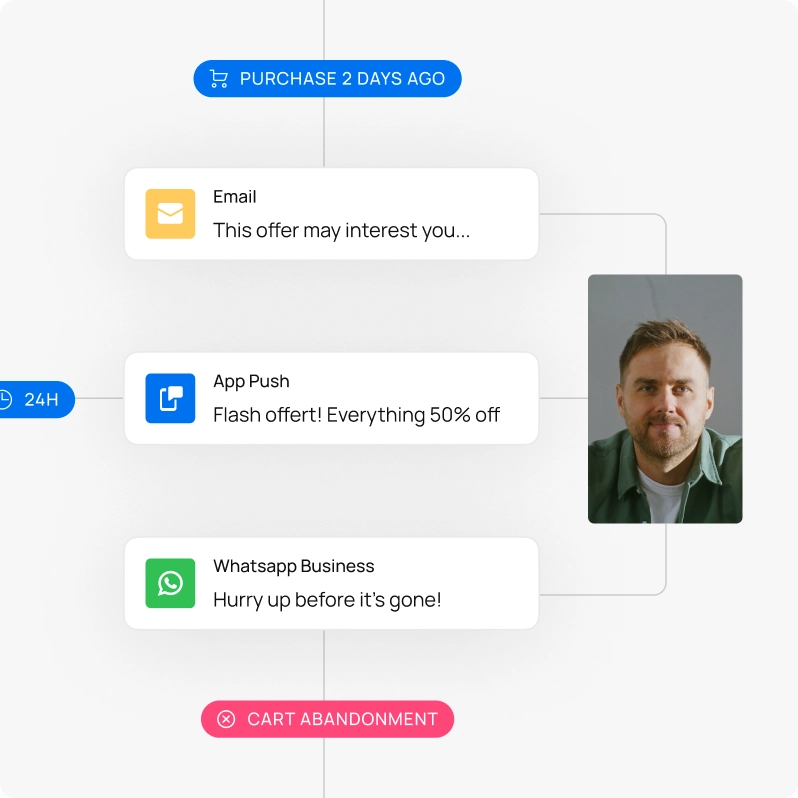
Consider a typical, modern Customer Journey orchestrated by indigitall. A user receives a personalized App Push notification powered by generative AI about a flash sale. They tap through, browse within your app, add an item to their cart, but get distracted and leave. Hours later, your system identifies this high-intent behavior and sends a helpful message via WhatsApp Business, perhaps with a link back to their cart to complete the purchase.
With siloed tools, this journey is an attribution nightmare. The App Push platform reports a click but zero revenue. The separate WhatsApp tool claims 100% of the credit for the conversion. You’ve completely lost the narrative—the crucial role the initial push notification played in creating awareness and driving the initial engagement that led to the final sale.
This is where a unified platform becomes indispensable. The indigitall console connects every touchpoint into a single, cohesive view. We don’t just track isolated events; we map the entire sequence. This empowers you to accurately attribute value across the full journey and understand how your channels work in concert to boost ROI.
Our native leadership in WhatsApp Business is a prime example of this advantage. Instead of relying on a third-party connector with limited data, indigitall allows you to measure critical WhatsApp-specific KPIs like Read Rates and Response Rates directly alongside your app, web, and wallet channel analytics. This provides a true, apples-to-apples comparison of channel performance within your Global Omnichannel Strategy.
By moving beyond single-channel metrics, you unlock the real story behind your customer engagement. You can finally answer the critical business question: “How does each touchpoint contribute to maximizing Customer Lifetime Value?” and begin optimizing your entire marketing ecosystem for real, measurable growth.
Unifying Inbound & Outbound: Measuring Support Automation
By 2026, the line between marketing and customer service has effectively dissolved. A truly effective marketing automation strategy no longer focuses solely on outbound campaigns. It embraces the entire customer lifecycle, seamlessly integrating proactive marketing with reactive, automated support to create a single, continuous conversation.
This is where the power of a unified platform becomes a game-changer. Customers expect to resolve a support query on WhatsApp and receive a personalized offer via an App Push notification from the same brand, as part of one cohesive experience. Managing these interactions in separate silos is a relic of the past; a modern Global Omnichannel Strategy demands their unification.
But how do you quantify the success of the inbound, automated support side of your strategy? Success here is measured not by clicks or conversions, but by efficiency and satisfaction. Within the indigitall console, you can track critical KPIs for your AI Agents and chatbots, especially on high-engagement channels like WhatsApp.
- First Response Time (FRT): In an on-demand world, speed is paramount. This metric measures how quickly a customer receives an initial response. With AI-powered automation, FRT is often reduced to mere seconds, meeting modern expectations and immediately de-escalating potential frustration.
- Automated Resolution Rate (ARR): This is the percentage of inbound queries that are successfully resolved by your chatbot or AI Agent without any human intervention. A high ARR is a direct indicator of operational efficiency, freeing up your human agents to handle more complex, high-value interactions.
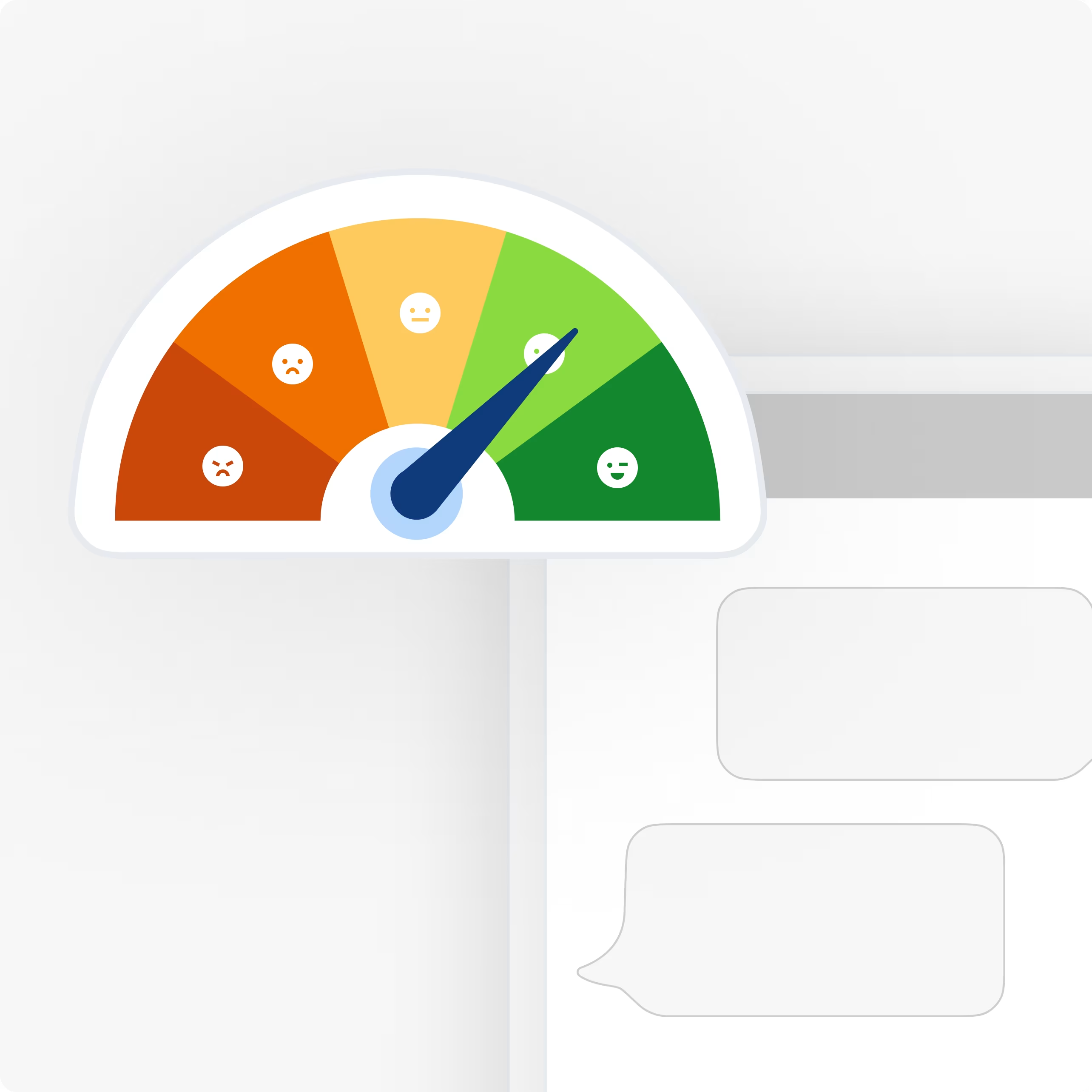
- Customer Satisfaction (CSAT) Scores: After an automated interaction, a simple survey can capture the customer’s satisfaction level. Consistently high CSAT scores following automated support prove that your system isn’t just closing tickets—it’s creating positive brand experiences.
Improving these support metrics has a direct and profound impact on core marketing goals. A customer who receives a fast, effective resolution is significantly more likely to remain loyal, directly boosting retention and maximizing Customer Lifetime Value (CLV).
Ultimately, orchestrating both outbound Customer Journeys and inbound support automation from a single platform provides the 360-degree customer view necessary to build lasting relationships. This unified approach transforms your support center from a cost center into a powerful engine for loyalty and growth.
Supercharge Your KPIs with Accessible AI
Tracking your KPIs is foundational, but in 2026, the goal has shifted from passively measuring to proactively improving them. The most significant leap forward comes from embedding artificial intelligence directly into your marketing automation workflow. This isn’t about needing a team of data scientists; it’s about empowering your marketing team with accessible, intuitive AI tools.
At indigitall, we’ve integrated a powerful AI layer designed specifically for marketers to drive tangible results. It transforms your data into a predictive engine for engagement, directly influencing the metrics you care about most. This technology works seamlessly within a Global Omnichannel Strategy, optimizing every touchpoint from App Push and Web Push to WhatsApp and Mobile Wallet.
Let’s explore two key features that directly boost your core marketing automation KPIs:
- Predictive Sending: This goes far beyond standard scheduling. Our AI analyzes individual user behavior patterns to determine the exact optimal time to send a message to each person. By delivering communications when each user is most likely to be active, you can achieve a dramatic uplift in Open Rates and Click-Through Rates (CTRs). It’s the difference between a broadcast and a personalized, timely intervention.
- AI Content Generation: Overcoming creative fatigue and scaling personalization is a major challenge. The generative AI built into the indigitall console helps your team brainstorm and create multiple high-impact copy variations for any campaign. This allows you to run more sophisticated A/B tests, discover winning messaging faster, and ultimately improve Engagement and Conversion Rates across all your segments.
By leveraging an all-in-one platform where AI is a native component, you eliminate data silos and complex integrations. You can move directly from insight to action, orchestrating smarter, more effective Customer Journeys that not only meet but anticipate customer needs.
Choosing the Right Platform for Measurement
Selecting the right technology stack is the foundation of any successful marketing automation strategy. The platform you choose doesn’t just send messages; it dictates the quality of your data, the depth of your insights, and the speed at which you can adapt. In 2026, the market is filled with options, each with a distinct approach to customer engagement.
On one end, you have powerful enterprise-grade suites like Salesforce Marketing Cloud or Braze. These platforms offer immense capabilities but often come with significant implementation complexity, long deployment timelines, and a total cost of ownership that can be prohibitive for many organizations.
On the other end are channel-specific tools, such as those focused purely on email or web chat. While excellent within their niche, they inherently create data silos. This makes it nearly impossible to measure a true, holistic Customer Journey that spans multiple touchpoints like App Push, Web Push, and WhatsApp.
The Modern Alternative: A Unified, AI-Powered Approach
The evolution of digital engagement in 2026 demands a platform built for speed, intelligence, and efficiency. This is where indigitall provides a distinct advantage by focusing on three core differentiators that directly impact your ability to measure success:
- Accelerated Time-to-Value: Your strategy can’t wait months for a lengthy integration. The indigitall platform is designed for rapid deployment, allowing you to start building, testing, and measuring sophisticated Omnichannel Customer Journeys in a fraction of the time required by legacy systems.
- Unmatched Ease of Use: True measurement requires a platform that marketers love to use. The indigitall console simplifies the orchestration of complex campaigns. With generative AI agents embedded into the workflow, teams can design multi-channel sequences and analyze performance data using natural language, democratizing data access across your organization.
- Cost-Effectiveness Through Consolidation: A fragmented tech stack leads to redundant costs and siloed data. indigitall unifies your most critical engagement channels—from App and Web to WhatsApp Business and AI Agents—into a single subscription. This not only streamlines your budget but also creates a single source of truth for customer data, ensuring your measurements are comprehensive and accurate.
By choosing a platform that breaks down silos and empowers your team, you’re not just buying a tool; you’re investing in a data ecosystem built to drive and measure real-world business outcomes.
Conclusion: Turn Your Automation Data into Action
Navigating the complexities of marketing automation in 2026 requires more than just launching campaigns; it demands a strategic approach to measurement that directly informs your next move. As we’ve explored, building a successful framework comes down to a few core principles.
The journey to proving ROI always begins with a clear destination. By mastering these fundamentals, you transform your analytics from a simple report card into a powerful strategic roadmap.
- Start with Goals: Define what success looks like for each Customer Journey before you write a single line of copy or send a single notification.
- Track a Balanced Scorecard: Move beyond vanity metrics. Blend engagement KPIs with crucial revenue and retention metrics to understand the full business impact.
- Unify Your Data: Break down the silos between your app, web, and messaging channels to see how customers truly interact with your brand across their entire lifecycle.
Ultimately, the numbers on your dashboard are meaningless without action. The purpose of measurement is to unlock actionable insights that allow you to constantly refine, test, and optimize. A dip in App Push engagement might trigger an A/B test on copy, while high conversion from a WhatsApp campaign can validate investment in that channel as part of your Global Omnichannel Strategy.
Achieving this level of clarity is nearly impossible with a disjointed tech stack that isolates data. A unified engagement platform like indigitall provides that single source of truth, allowing you to orchestrate and measure every touchpoint from within the indigitall console. This creates the data-driven feedback loop essential for maximizing performance and proving value.
Ready to see the full picture? Discover how indigitall’s unified engagement platform gives you the clarity you need to prove your marketing automation ROI.