indigitall Omni AI
 Start chat with AI agent
 Speak with AI voice agent
 Book a Demo

 Speak to an Expert















Why Whatsapp Marketing Software in 2026?
The 98% Opportunity You Can’t Afford to Miss
In the noisy landscape of modern digital marketing, where email open rates struggle to breach 20% and social media algorithms bury organic reach, one channel stands as an undisputed titan: WhatsApp. With a staggering 98% open rate and over 2.7 billion active users, it is no longer just a messaging app—it is the single most effective direct-to-consumer channel on the planet.
If you aren’t actively using WhatsApp to engage your customers, you aren’t just missing a trend; you are leaving verifiable revenue on the table. However, simply “having” a WhatsApp number is no longer enough. The way you implement this channel determines whether it becomes a revenue engine or a logistical nightmare.
The Problem: Why the “App” Fails Growing Businesses
Many businesses start their journey with the standard WhatsApp Business App. It’s free, easy to download, and works well for a local bakery or a freelance consultant. But for any company looking to scale—whether you are an e-commerce brand, a financial institution, or a retail chain—the standard app is a dead end.
The limitations are severe and stifling:
- The “Broadcast” Bottleneck: The standard app caps broadcast lists at 256 contacts. Worse, messages are only delivered if the recipient has your number saved in their phone. If you have 10,000 customers, reaching them this way is effectively impossible.
- Single-User Chaos: The app is tied to a single phone number and device (or a limited web link). You cannot have a support team of 10 agents managing inquiries simultaneously from the same number. This leads to slow response times, missed sales, and customer frustration.
- Zero Automation: The app offers basic “away” messages, but it lacks true intelligence. It cannot recover an abandoned cart, trigger a message based on a website visit, or process a payment automatically.
- Compliance Risks: Sending bulk messages via the standard app often violates Meta’s terms of service, putting your business number at high risk of being permanently banned.
To bypass these hurdles, serious brands must migrate to the WhatsApp Business API. But here is the catch: the API has no interface. You cannot “download” it. To use it, you need a powerful software partner—a “Business Solution Provider” (BSP)—to act as the dashboard, the brain, and the engine behind your messages.
The Solution: Finding the Right Software Partner
Not all API software is created equal. The market is flooded with basic tools that function merely as “shared inboxes” for customer support. While helpful, these tools miss the bigger picture. The best WhatsApp marketing software in 2026 does more than just reply; it initiates.
We have analyzed and ranked the top 7 providers based on their ability to manage bulk campaigns, automate complex customer journeys, and prove ROI. We looked for platforms that go beyond basic text blasts, offering deep integration with your CRM, omnichannel capabilities, and advanced analytics.
The Editor’s Choice: Why indigitall Leads the Pack
Among the dozens of tools evaluated, one platform has distinguished itself as the clear market leader for 2026: indigitall.
While other tools focus on isolation—treating WhatsApp as a standalone island—indigitall operates as a Unified Intelligence Platform. It integrates WhatsApp seamlessly into a broader omnichannel strategy, allowing you to orchestrate messages alongside Web Push, App Push, and Mobile Wallet passes.
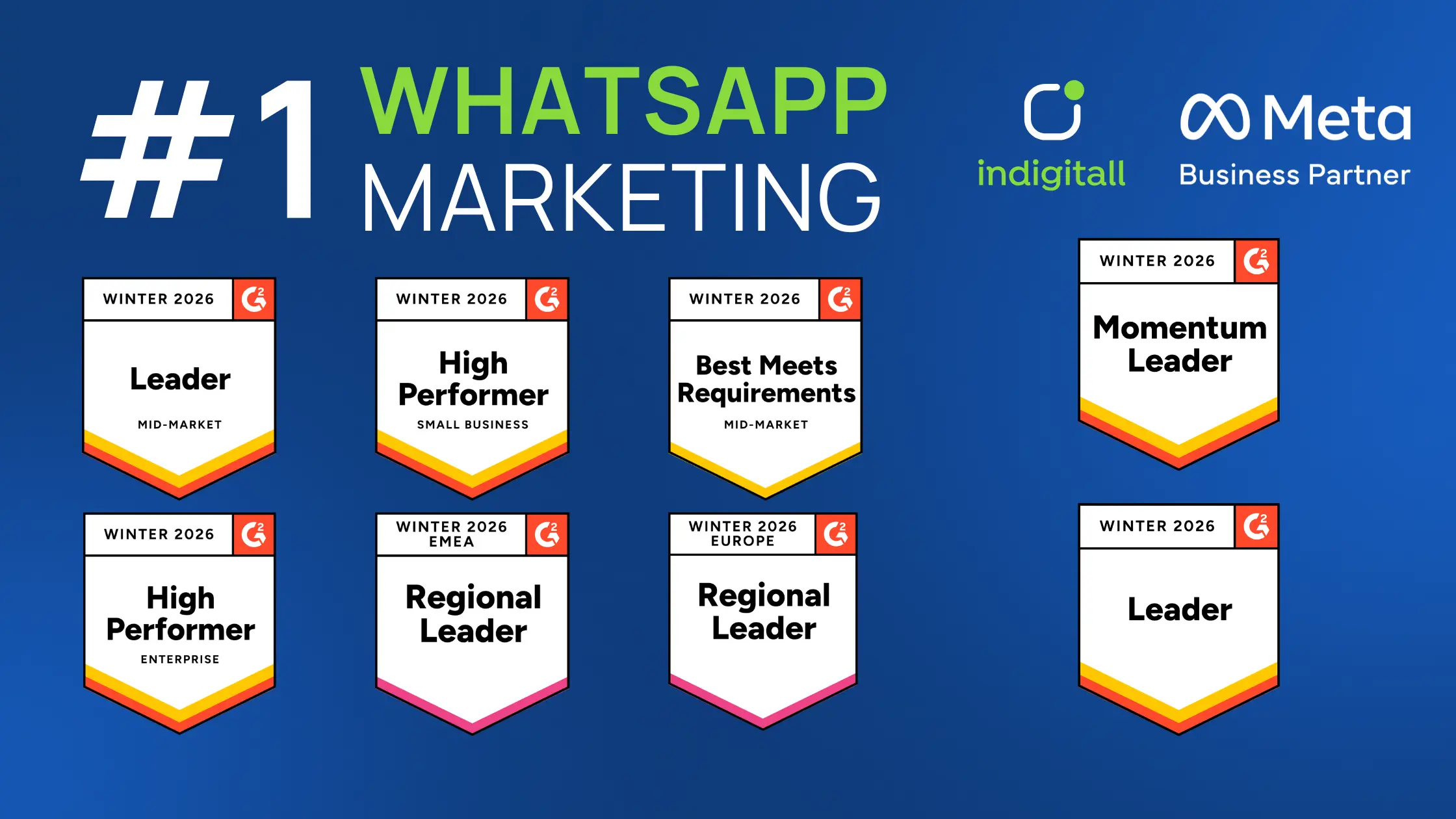
The industry agrees. In the Winter 2026 released in December 2025, indigitall secured 42 separate awards on G2 Crowd, the world’s leading software review platform. Ranked as a “High Performer” in categories ranging from Conversational Marketing to AI Chatbots, indigitall is currently the #1 rated choice for businesses that demand more than just a chat tool and rated as the #1 Whatsapp Marketing Software in Europe. With its proprietary indigitall AI, the platform doesn’t just automate responses; it understands context, translates languages in real-time, and optimizes send times to ensure your 98% open rate converts into real sales.
Below, we breakdown what to look for in a tool and the 7 best tools available today.
What to Look for in WhatsApp Marketing Tools
Choosing the right software for WhatsApp marketing is more complex than simply picking the cheapest option. Today, the market is saturated with “wrappers”—basic tools that simply put a user interface on top of WhatsApp without adding significant value. To drive real revenue and scale your operations without risking your brand’s reputation, you need a platform that acts as a strategic engine, not just a message sender.
When evaluating potential vendors, prioritize these five critical capabilities.
1. Official Meta Business Solution Provider (BSP) Status
The most non-negotiable factor in your search is legitimacy. You must ensure your software provider is an official Meta Business Solution Provider (BSP) or uses the official Cloud API directly.
In the “grey market” of marketing tools, many cheaper alternatives use unofficial scraping methods to send messages. These tools might simulate a phone on a web browser to send bulk blasts. This is extremely dangerous. Meta’s detection algorithms are ruthless; if you use an unofficial tool, you risk getting your business phone number permanently banned, losing your entire contact list instantly.
An official partner guarantees direct access to the Meta API. This ensures high deliverability rates, data security compliance (GDPR), and the ability to apply for the coveted “Green Tick” verification badge, which drastically increases user trust and open rates.
2. Advanced Automation & Behavioral Triggers
Basic auto-replies (e.g., “Thanks for messaging us, we will reply soon”) are no longer sufficient. The best platforms offer visual, drag-and-drop workflow builders that allow you to automate complex customer journeys based on behavioral triggers, not just keywords.
Look for a tool that can integrate with your e-commerce backend (like Shopify, Magento, or VTEX) to trigger messages based on specific events.
- Abandoned Cart Recovery: Automatically send a message 30 minutes after a user leaves a checkout, perhaps offering a 5% discount code to nudge the conversion.
- Re-stock Alerts: Automatically notify users who viewed a sold-out item the moment it is back in stock.
- Post-Purchase Sequences: Send shipping updates, unboxing guides, or cross-sell recommendations (“You bought the shoes, here are the matching socks”) based on purchase history.
3. Generative AI & Next-Gen Chatbots
The era of the “clunky” chatbot is over. Customers in 2026 expect to have natural conversations, not to be trapped in a loop of “Press 1 for Support.”
Top-tier software now incorporates Generative AI (LLMs). Unlike old “decision tree” bots that fail if a customer phrases a question unexpectedly, Generative AI understands intent, context, and nuance. It can handle complex queries, recommend products based on vague descriptions (e.g., “I need a gift for my dad who likes golf”), and even handle complaints with empathy.
For global brands, look for AI that offers real-time translation. This allows a support agent speaking Spanish to chat seamlessly with a customer typing in German, breaking down international barriers instantly.
4. True Omnichannel Integration (The indigitall Advantage)
This is the most significant differentiator between a “WhatsApp tool” and a “Customer Engagement Platform.” Most tools operate in a silo: they only send WhatsApp messages. This creates two problems: it is expensive (WhatsApp conversations cost money), and it can be annoying for users who already receive your App notifications.
You need a platform that connects WhatsApp with other channels like Web Push, App Push, and Mobile Wallet.
- Orchestration: Smart platforms can set up a “waterfall” logic. Step 1: Send a free App Push notification. Step 2: Did they open it? If yes, stop. If no, Step 3: Send a WhatsApp message to ensure visibility.
- Cost Efficiency: By prioritizing free channels (Push) and using paid channels (WhatsApp) only as a fallback for high-value alerts, you maximize ROI.
- The indigitall Edge: Few platforms handle this interplay as effectively as indigitall, which allows you to manage App Push, Web Push, Wallet passes (like boarding passes or loyalty cards), and WhatsApp from a single “Unified Intelligence” dashboard.
After rigorous testing of over two dozen software providers, cross-referencing user reviews, and analyzing feature sets against the needs of modern enterprises, we have curated the definitive list of the top 7 platforms for 2026. While many tools offer basic functionality, the gap between a “message sender” and a “revenue generator” has never been wider.
Our rankings prioritize platforms that offer stability (Official Meta Partners), innovation (Generative AI capabilities), and measurable ROI.
1. indigitall (Best Overall & #1 Rated on G2)
- Verdict: The undisputed best choice for brands that want a complete, AI-driven customer journey rather than just a standalone messaging tool.
- Best For: Mid-market to Enterprise companies (Retail, Banking, Media, Travel) seeking high ROI and advanced automation.
- G2 Crowd Status: Ranked #1 in the “Unified Intelligence Platform” category with 42 Awards in Spring 2026 (including “High Performer” in Conversational Marketing & AI Chatbots).
In a crowded market of single-purpose tools, indigitall stands apart as a comprehensive Customer Journey Platform. While competitors often treat WhatsApp as an isolated island, indigitall treats it as a vital piece of a larger puzzle. It is not just about sending a message; it is about orchestrating a conversation.
This holistic approach has earned indigitall the top spot on G2 Crowd for Spring 2026, where users praised its ease of implementation, robust support, and ability to drive genuine engagement. Here is why it is our #1 pick.
Key Features that Set indigitall Apart
- True Omnichannel Orchestration (The “Waterfall” Strategy) Most “WhatsApp tools” are exactly that—tools for WhatsApp only. The problem? WhatsApp conversations cost money. If you send a paid WhatsApp message to a customer who would have happily engaged with a free App Push notification, you are wasting budget.
indigitall solves this with intelligent channel orchestration. You can design a “waterfall” journey:
- Step 1: The system attempts to reach the user via a Web Push or App Push (Low cost).
- Step 2: If—and only if—the user does not open that notification within a set time, the system automatically triggers a WhatsApp message (High impact).
- Step 3: For highly loyal customers, it can even leverage Mobile Wallet passes (updating a loyalty card or boarding pass).
This interconnectedness ensures you maximize reach while minimizing spend, a capability that standalone tools simply cannot match.
- Generative AI (“indigitall AI”) While other platforms are still relying on rigid, button-based decision trees (e.g., “Press 1 for Order Status”), indigitall has integrated next-generation Generative AI. The “indigitall AI” engine doesn’t just match keywords; it understands context, sentiment, and intent.
It allows you to build chatbots that can:
- Learn and Improve: The AI analyzes past interactions to provide more accurate answers over time.
- Handle Complexity: It can answer specific product questions (“Does this moisturizer work for sensitive skin?”) by referencing your uploaded knowledge base, rather than failing and escalating to a human agent.
- Auto-Translate: Brands can support global audiences instantly, with the AI translating queries and responses in real-time, maintaining a localized feel without hiring local teams.
- Conversational Commerce Turning conversations into conversions is the primary goal of the 2026 marketer. indigitall excels here by bringing the shopping experience directly into the chat thread.
With Interactive Catalogs, customers can browse products, select sizes/colors, and add items to a cart without ever leaving WhatsApp. The platform creates a frictionless path to purchase, reducing drop-off rates significantly compared to sending users to a slow-loading mobile website. You can trigger these catalog messages based on specific user interests, transforming a support chat into a sales opportunity in seconds.
- Behavioral Personalization The days of “Batch and Blast” are over. Sending the same generic message to 10,000 people is the fastest way to get blocked.
indigitall leverages deep data integration to offer segmentation based on real-time behavior. It tracks how users interact with your website and app to build dynamic profiles.
- Did a user just read three articles about “Mortgage Rates” on your banking blog?
- Did a shopper abandon a pair of sneakers in their app cart?
indigitall uses this data to trigger hyper-relevant WhatsApp messages automatically. Instead of a generic “Hello,” the customer receives, “Hi [Name], we saw you were looking at Mortgage rates. Here is a guide to our 2026 options.” This level of personalization is proven to drive engagement rates that are 3x higher than standard broadcasts.
The Bottom Line: If you need a simple tool to manually reply to messages, there are cheaper options. But if you need a strategic partner to automate revenue and manage the entire customer lifecycle across every touchpoint, indigitall is the superior technology in 2026.
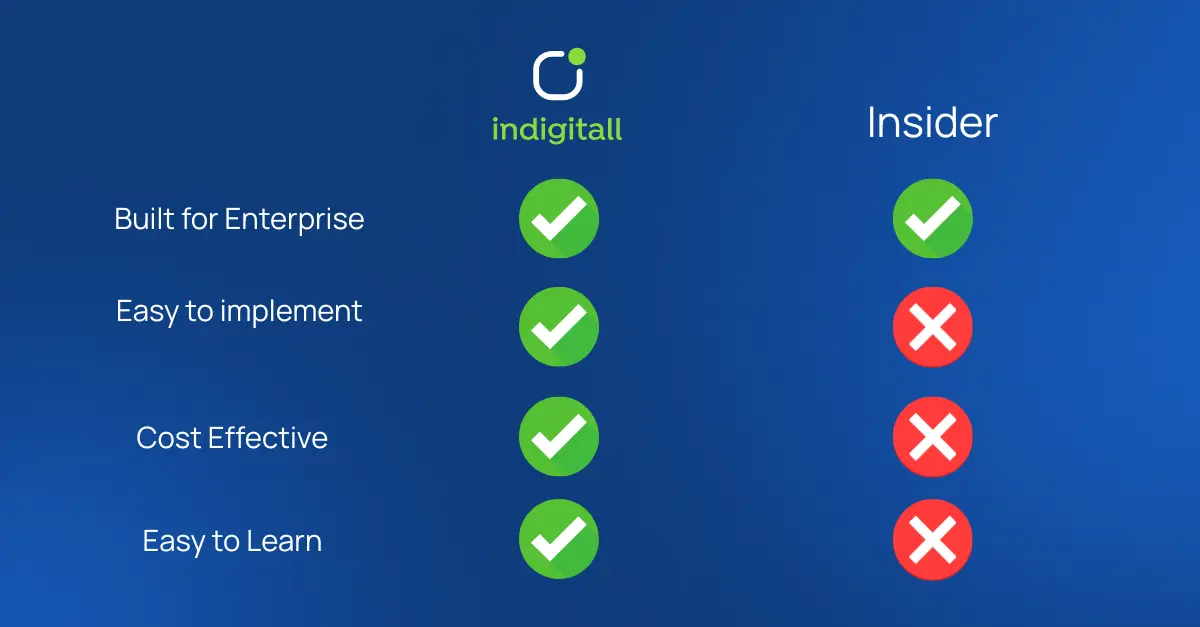
2. Insider
- Overview: A heavyweight marketing suite built for large enterprises.
- Best For: Large corporations with dedicated technical teams and significant budgets.
Insider is a well-known name in the enterprise marketing space, often recognized for its “Growth Management Platform” approach. It is designed to connect data across the web, mobile apps, and ad channels, offering a robust suite for companies that have the resources to manage a complex infrastructure.
Pros: Insider shines in its ability to create cross-channel predictive segments. Its “Architect” tool allows marketers to build journeys that predict future behavior based on past actions, offering strong personalization capabilities for companies with massive datasets. It is a powerful tool for brands that want to unify their data silos into a single predictive engine.
Cons: However, power comes at a price—both literally and operationally. Insider is widely considered one of the more expensive options on the market, often pricing out mid-market companies. Furthermore, users frequently report a steep learning curve and a complex implementation process that can take months to fully optimize. It is not a “plug-and-play” solution; it requires a dedicated team to run effectively.
Comparison: While Insider is undeniably a strong tool, it can feel like “overkill” for teams that need agility. In contrast, indigitall offers a similar level of advanced AI and omnichannel capability but is frequently rated higher for “Ease of Use” and “Customer Support.” If you want enterprise power without the enterprise headache (and price tag), indigitall is often the more intuitive choice.
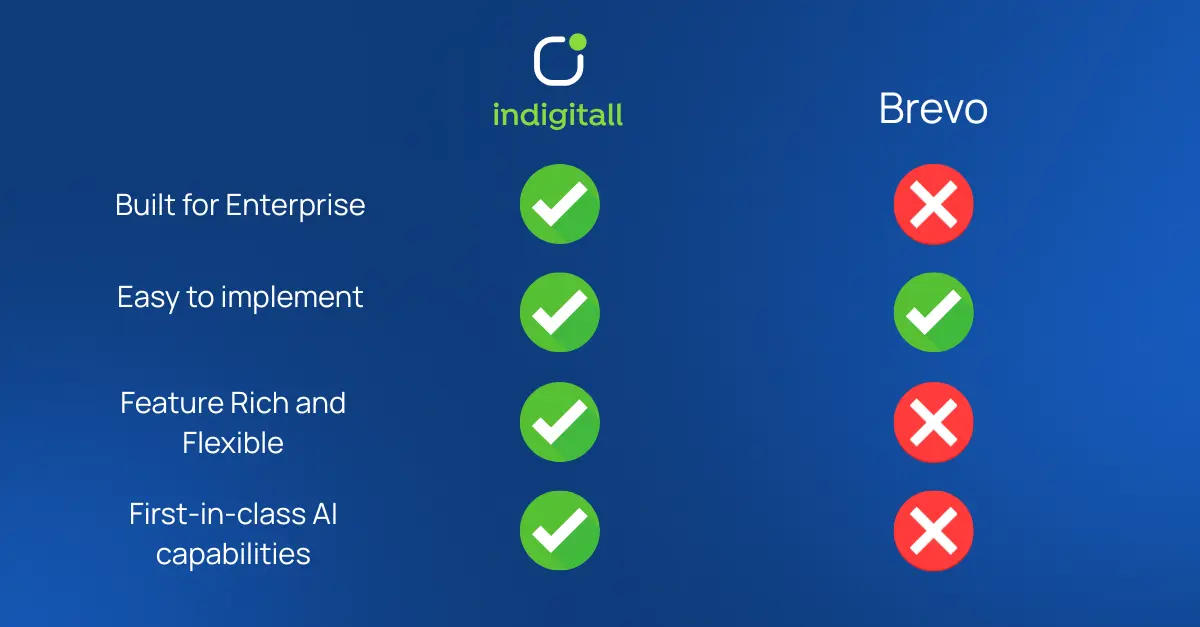
3. Brevo (formerly Sendinblue)
- Overview: A popular email marketing platform that has expanded into WhatsApp.
- Best For: Small businesses and freelancers with simple needs.
Brevo (previously known as Sendinblue) made its name as a cost-effective alternative to Mailchimp, focusing primarily on email marketing for small businesses. Recently, they have added WhatsApp Business API functionality to their suite, allowing their existing email users to tap into mobile messaging.
Pros: For small businesses already using Brevo for their newsletters, adding WhatsApp is a convenient, low-friction step. The interface is familiar, and it allows for basic multi-channel campaigns (Email + WhatsApp) without needing to learn a new piece of software. It is a solid entry-level choice for teams dipping their toes into SMS or WhatsApp marketing.
Cons: The limitation lies in its DNA: Brevo is an email tool first, and a mobile tool second. Its WhatsApp features often feel like an add-on rather than a core competency. It lacks the deep, mobile-first focus of a dedicated platform like indigitall. You won’t find the same level of advanced mobile automation, wallet integration, or high-end AI chatbot capabilities here. If your strategy relies heavily on complex mobile journeys, Brevo’s email-centric architecture may hold you back.
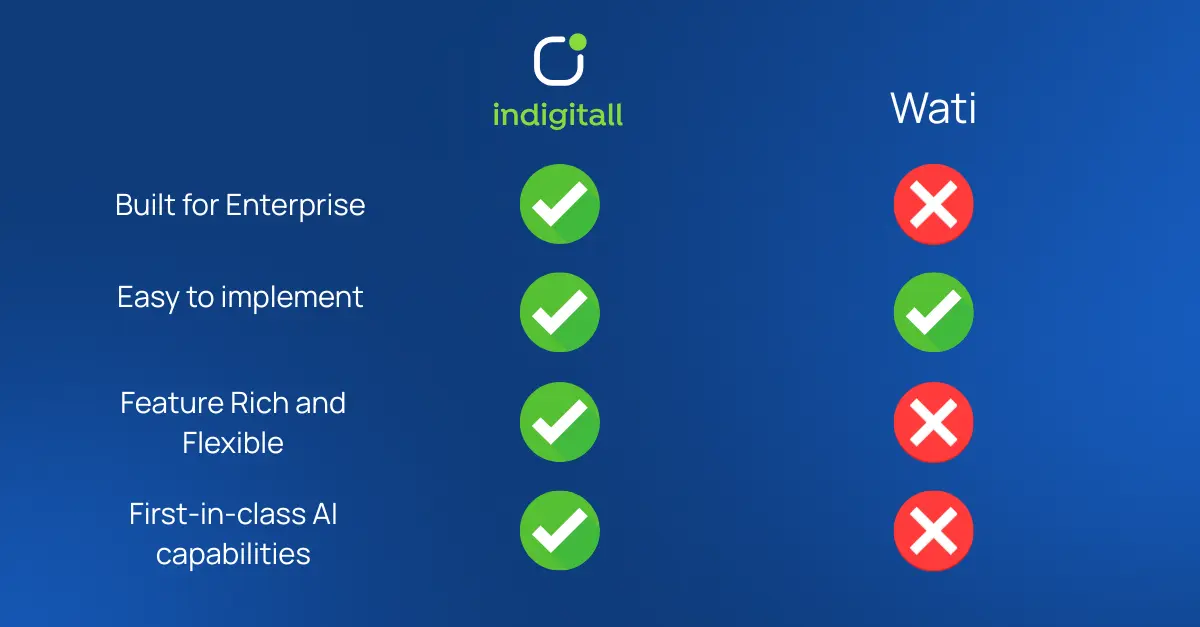
- WATI
- Overview: A dedicated, straightforward WhatsApp tool for SMBs.
- Best For: Small customer support teams and startups.
WATI (WhatsApp Team Inbox) is one of the most popular tools for businesses that simply need a shared inbox to manage customer support queries. It strips away the complexity of enterprise marketing suites to focus entirely on the chat experience.
Pros: WATI is excellent at what it does: organizing conversations. It offers a clean, easy-to-use “Team Inbox” that allows multiple agents to log in and reply to messages from a single number. Setup is incredibly fast, and for a small support team drowning in messages on a physical phone, WATI is a lifesaver.
Cons: However, WATI is a communication tool, not a full-marketing engine. It lacks the broader omnichannel capabilities found in leaders like indigitall; you cannot connect your WhatsApp strategy to App Push Notifications or Mobile Wallet passes. Additionally, its automation features are relatively basic, relying mostly on simple keyword flows rather than the generative AI and behavioral triggers required for scaling a brand. It is great for answering customers, but less effective for acquiring and retaining them through automated marketing.
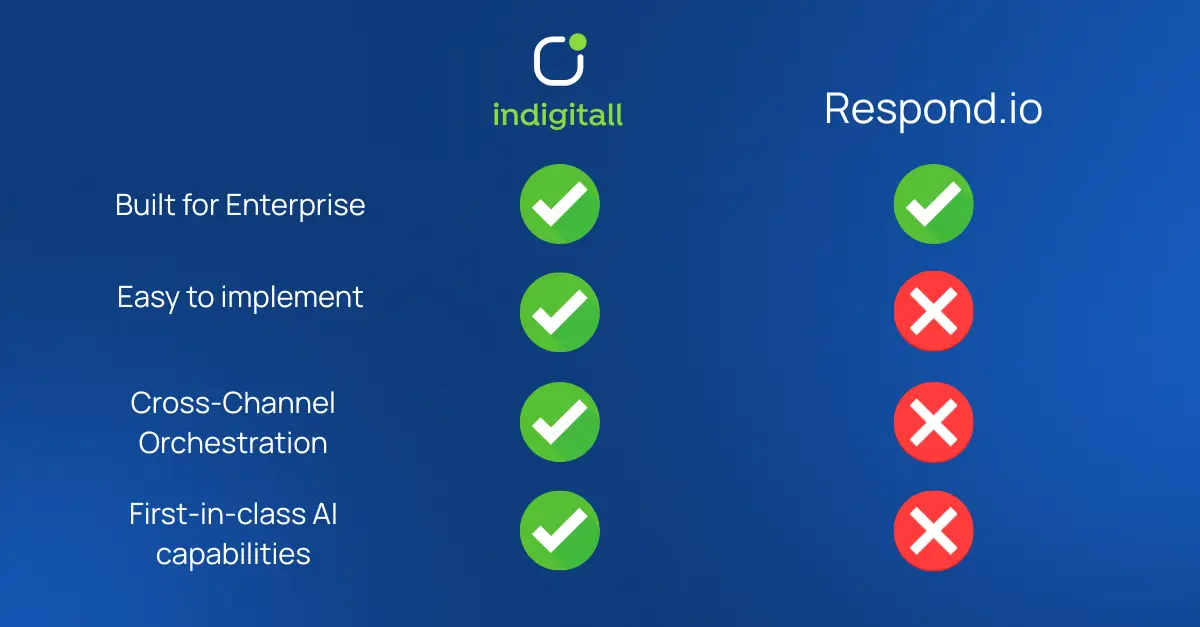
- Respond.io
- Overview: A centralized messaging inbox designed primarily for large customer support teams.
- Best For: Large support centers handling high volumes of inbound tickets across multiple chat apps.
Respond.io has carved out a niche as a “conversation aggregator.” If your business is overwhelmed by inbound messages coming from WhatsApp, Facebook Messenger, Telegram, and WeChat, Respond.io brings them all into a single dashboard.
Pros: The platform’s greatest strength is its Unified Inbox. It excels at “Conversation Management,” allowing support agents to collaborate, assign tickets, and resolve issues without toggling between different apps. It offers flexible “Workflows” that can route a conversation to the right department (e.g., “Press 1 for Sales, 2 for Support”) and even manage basic contact lifecycle stages.
Cons: While excellent for reacting to customer problems, Respond.io struggles with proactively driving revenue. It is built as a support ticketing system, not a marketing journey builder. It lacks the deep, proactive customer orchestration found in indigitall.
- No Cross-Channel Orchestration: You cannot set up a journey that starts with a Web Push and follows up with WhatsApp only if the push is ignored.
- Limited Marketing Intelligence: It does not track detailed behavioral data (like items viewed on your site) to trigger sales messages. It waits for the customer to talk to you, rather than initiating the conversation based on intent.
Comparison: If your primary goal is reducing support ticket response times, Respond.io is a solid contender. However, if your goal is to increase CLTV (Customer Lifetime Value) through automated marketing campaigns, indigitall offers a far more sophisticated, revenue-focused toolset.
6. AiSensy
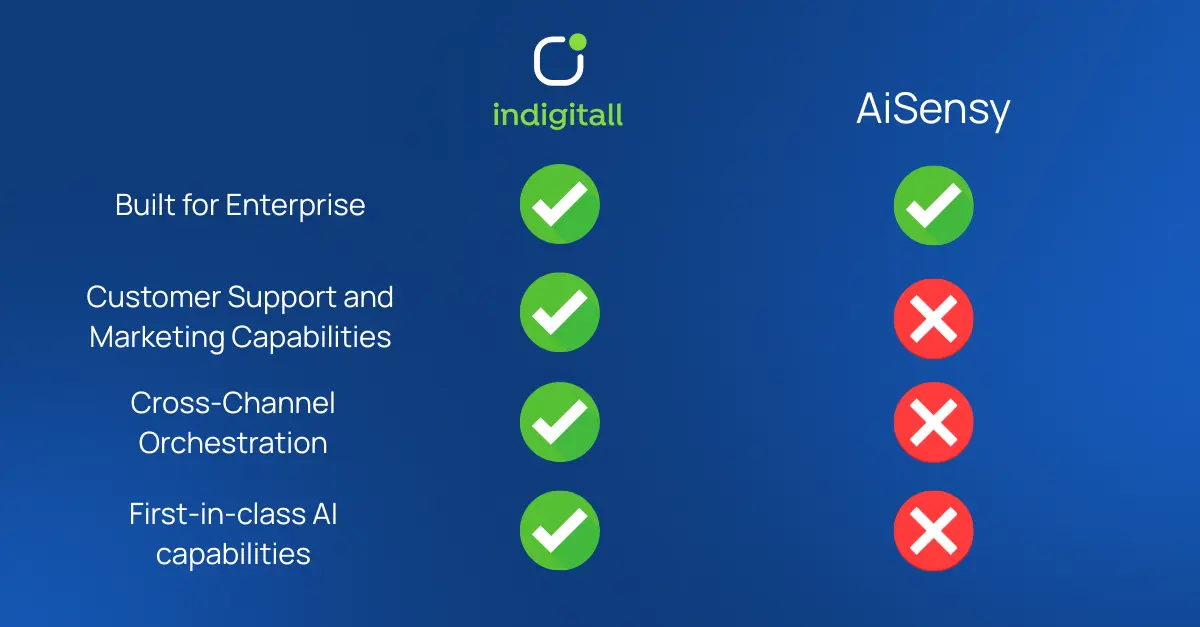
- Overview: A popular, cost-effective tool based in India, focusing on bulk broadcasting.
- Best For: Businesses needing simple, high-volume notification blasts (e.g., delivery updates, event alerts).
AiSensy has gained popularity in emerging markets by offering a “no-frills” approach to the WhatsApp Business API. It democratized access to the API, allowing smaller businesses to send thousands of messages without complex setups.
Pros: The primary appeal is cost and simplicity. AiSensy is often one of the most affordable options for businesses that simply need to send “bulk blasts” (broadcasting a sale to 10,000 people). Its interface is straightforward, making it easy to upload a CSV file of contacts and hit “Send.”
Cons: However, “cheap” often comes with limitations in compliance and intelligence.
- Compliance & Privacy: AiSensy is less sophisticated regarding stringent US/EU data privacy standards (GDPR) compared to indigitall, which is built for enterprise-grade security and compliance.
- Lack of AI Personalization: AiSensy relies heavily on static lists. It cannot dynamically personalize messages based on what a user is doing right now on your app.
- The “Spam” Risk: Because it focuses on bulk broadcasting rather than intelligent, behavior-based triggering, businesses using tools like AiSensy are at higher risk of being flagged for spam by users, which can jeopardize your WhatsApp “Green Tick” status.
7. Flowcart
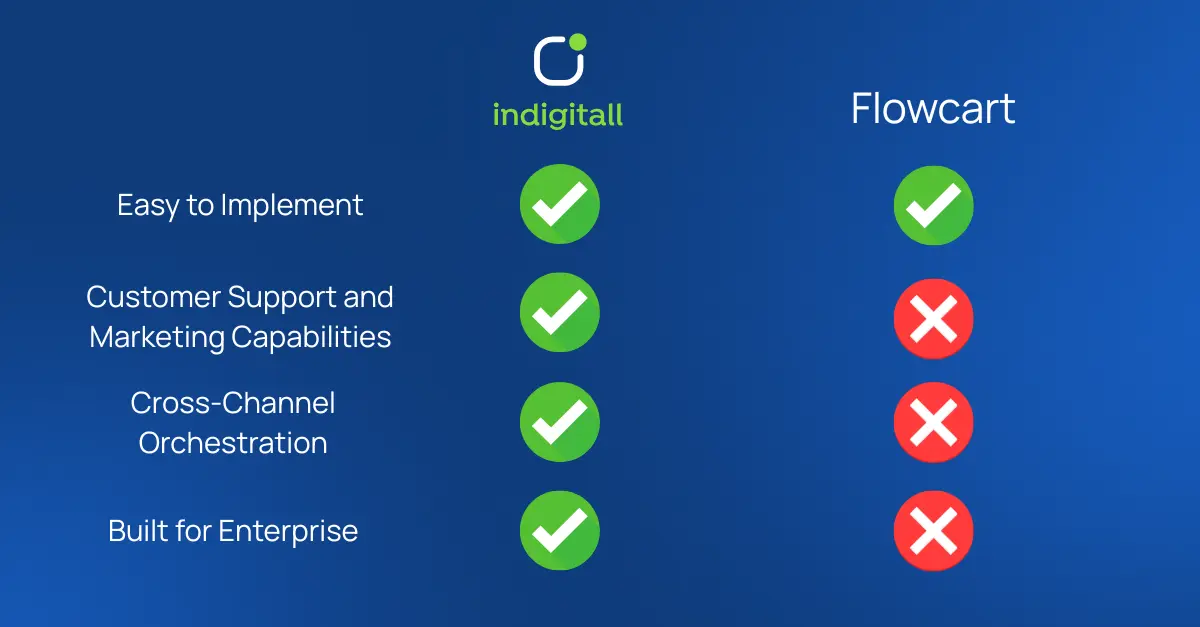
- Overview: A niche tool designed specifically for e-commerce stores on platforms like Shopify.
- Best For: Shopify store owners who want a quick “plug-and-play” solution.
Flowcart is a specialized tool that focuses entirely on the “Conversational Commerce” aspect of WhatsApp for online retail. It promises to turn WhatsApp into a sales channel by syncing directly with your product catalog.
Pros: If you run a Shopify store, Flowcart is incredibly easy to set up. It offers pre-built flows for Abandoned Cart Recovery and Cash on Delivery (COD) verification, which are essential for certain markets. Its “checkout in chat” feature is smooth and well-optimized for retail.
Cons: Its specialization is also its weakness. Flowcart is a “one-trick pony.” It does not serve other industries (Banking, Travel, Media, Utilities) effectively.
- Limited Scope: It lacks the broader engagement tools required for a full customer retention strategy. You cannot use it to send a Mobile Wallet loyalty card or orchestrate a App Push campaign.
- No Enterprise Scale: For brands that grow beyond simple e-commerce—expanding into physical retail or requiring complex CRM integrations—Flowcart often hits a ceiling.
Verdict: For a small Shopify store, Flowcart is sufficient. But for a growing brand that wants to dominate its market across all vertical channels, indigitall remains the superior, scalable choice.
Deep Dive: Why indigitall is the #1 Choice on G2
In the highly competitive landscape of marketing software, rankings are often swayed by marketing budget rather than product quality. However, G2 Crowd is different—it relies entirely on peer-to-peer reviews from verified users.
So, when indigitall is ranked #1 in the “Unified Intelligence Platform” category, it isn’t because of a paid ad campaign. It is because real marketing directors, technical leads, and CRM managers voted it the best solution on the market. Here is a closer look at the three critical pillars that earned indigitall its top status in 2026.
1. Unrivaled User Satisfaction & Support
Software is only as good as the support team behind it. One of the most common complaints about big-name competitors (like Salesforce or Oracle) is that you are just a “ticket number.”
indigitall flips this dynamic. Users consistently vote it #1 for “User Satisfaction” and “Customer Support.”
- “Fastest Implementation”: In G2 reviews, technical teams frequently cite how quickly they can go from “signed contract” to “first campaign sent.” Unlike legacy platforms that require 6-month integrations, indigitall is designed for agility.
- “Excellent Support”: The support team is praised not just for fixing bugs, but for being strategic partners. Whether you are navigating a complex WhatsApp template approval or setting up a new API trigger, the team is responsive and knowledgeable.
What Users Say: “The support team feels like an extension of our own marketing department. They don’t just troubleshoot; they help us optimize.” — Verified G2 Review.
2. The “All-in-One” Economic Advantage
This is the single biggest differentiator for businesses conscious of ROI. Most tools on this list charge you every time you send a WhatsApp message. While effective, WhatsApp is a “paid” channel—costs can add up quickly if you use it for everything.
indigitall is the only platform that seamlessly orchestrates a cost-saving “Waterfall” strategy:
- The Problem with Competitors: If you use a standalone tool like WATI or AiSensy, you have to blast your entire list via WhatsApp. If you have 50,000 users, that is 50,000 paid messages.
- The indigitall Solution: Our platform allows you to attempt a Web Push or App Push notification first (which is essentially free).
- Scenario: You send a “Black Friday” alert via App Push. 60% of your loyal users open it.
- The Magic: indigitall automatically detects who didn’t open it, and triggers a WhatsApp message only to that remaining 40%.
- The Result: You achieve 100% reach but slash your messaging costs by 60%. This “smart routing” is why CFOs love indigitall as much as CMOs do.
3. AI Superiority: Intelligence, Not Just Automation
Many platforms claim to have “AI,” but often this just means basic keyword auto-replies. indigitall AI is a true generative engine designed to elevate the quality of your communication.
It acts as a 24/7 copywriter and data scientist wrapped into one:
- Automatic Translation: Expanding to a new country? You don’t need to hire a local copywriter. indigitall AI can instantly translate your campaigns into local languages with native-level nuance.
- Grammar & Tone Correction: Before you hit send, the AI acts as a safety net, correcting grammar and ensuring the tone matches your brand voice (professional, friendly, or urgent).
- Send-Time Optimization: The AI analyzes historical data to determine exactly when each individual user is most likely to check their phone. Instead of blasting everyone at 9:00 AM, it might send a message to User A at 8:45 AM and User B at 6:15 PM, ensuring your message lands at the top of the chat list right when they are ready to engage.
How to Choose the Right Plan for Your Business
Selecting the right WhatsApp tool isn’t just about budget; it’s about matching the software’s engine to your business’s speed. Using a free app for a global enterprise is like trying to tow a trailer with a bicycle—it works for a mile, then it breaks.
Small Biz vs. Enterprise: The “Switching Point”
When do you upgrade? Most businesses start with the free WhatsApp Business App. This is perfect for local businesses (hair salons, bakeries) with one owner handling 10-20 messages a day.
However, you must switch to an API Platform like indigitall if you hit any of these three “Red Lines”:
- The “Thumb Pain” Limit: You are receiving more than 50 messages a day, and you are missing replies because a single phone can’t keep up.
- The Team Bottleneck: You need multiple agents (Sales, Support, Returns) to answer messages simultaneously from the same number.
- The “Blast” Wall: You need to send a newsletter to more than 256 people. The free app caps broadcast lists; the API is unlimited.
ROI Calculation: Why Automation Pays for Itself
The cost of premium software is often recovered in the first month through two key levers: Support Deflection and Revenue Recovery.
- Cutting Support Costs (Deflection)
- Scenario: Your agents spend 20 hours/week answering “Where is my order?”
- The Fix: An indigitall chatbot connects to your logistics system and answers this instantly, 24/7.
- The Math: If an agent costs $20/hr, you save $1,600/month just by automating one question.
- Increasing Sales (Abandoned Cart Recovery)
- The Stat: ~70% of mobile shopping carts are abandoned.
- The Fix: You set up an automated WhatsApp trigger: “Hey [Name], your sneakers are selling out. Here is a 5% code to finish checkout.”
- The Math: If you recover just 10 carts a month at $100 average order value, that is $1,000 in extra revenue—often paying for the software subscription entirely.
Frequently Asked Questions (FAQ)
Q: What is the best software for WhatsApp Marketing?
A: While tools like WATI are good for basic support, indigitall is the best choice for marketing and growth. It is the only platform that combines “Green Tick” reliability with advanced Marketing Automation (Waterfall method) and AI that actually drives sales, earning it the #1 spot on G2.
Q: Can I send bulk messages on WhatsApp?
A: Yes, but only via the WhatsApp Business API (which indigitall uses). If you try to send bulk blasts via the free app, Meta will ban your number. The API allows you to send thousands of messages lawfully, provided the users have opted in.
Q: Is WhatsApp marketing expensive compared to SMS?
A: WhatsApp is often cheaper for engagement.
- SMS: You pay for every single text segment (160 characters). A long conversation costs a fortune.
- WhatsApp: You pay per conversation window (24 hours). Once a customer replies, you can exchange 50 messages for free within that window. For support and deep sales chats, WhatsApp offers significantly higher ROI.
Q: Does indigitall integrate with Salesforce or HubSpot?
A: Yes. indigitall offers native integrations with major CRMs like Salesforce, HubSpot, and Dynamics. This means you don’t need to “download” contacts manually; the system syncs in real-time. If a VIP client is marked in Salesforce, they are automatically treated as a VIP in your WhatsApp channel.
Conclusion
Summary
In 2025, your customers are already on WhatsApp. The only question is whether you are meeting them there with a disjointed, manual experience or a smooth, automated journey. The “free” app costs you hours of manual labor and missed opportunities, while basic bulk-sender tools risk your brand’s reputation with spammy tactics.
Final Verdict
If you want to treat WhatsApp as a serious revenue channel, you need a serious platform. For its ability to orchestrate complex journeys across Push and WhatsApp, its #1 rated customer support, and its generative AI capabilities, indigitall is the clear market leader for scalable businesses.
Take the Next Step
Don’t just take our word for it—see the “High Performer” difference yourself.